1 free read left. Create a free account for unlimited reading + AI research.
Create free account
Superstar Session: Wordscapes: How the World’s Most Popular Word Game Boosted LTV by 40%
Key insights
7 takeaways- 01PeopleFun increased the lifetime value (LTV) of Wordscapes by 40% by shifting to vanity-driven live operations and seasonal content.
- 02The studio successfully reduced coin payouts by 50% without negatively impacting KPIs by introducing exclusive crown rewards within a 13-week tournament structure.
- 03A 100-player bracket size was identified as the optimal threshold for competitive engagement, as larger groups discouraged lower-performing users.
- 04Chronological enrollment proved more effective than skill-based matchmaking, as it prevented top-tier players from feeling penalized by the system.
- 05Sticker collections increased both in-app purchase and ad-based ARPDAU by over 20% while doubling level completion rates among top players.
- 06Live operations features are gated between levels 50 and 80 to ensure players are sufficiently invested before engagement.
- 07Developers use high-performing creative advertisements as a proxy for feature demand to validate market viability before committing to full-scale development.
Ask AI about this video
Transcript
I'm going to welcome to the stage our next speaker. We have a superstar session coming up for you. Now I confess I actually am a Wordscapes player. I love that game. It's I love finding those words. That's so I'm interested to hear about how Wordscapes, the world's most popular word game, boosted lifetime value by 40%. So Carol, I welcome you're muted at the moment Carol, but if you unmute can you can you hear me okay? Yes, I can hear you just fine Dave. Thanks for having me. Yeah, well thank you for being here. Really appreciate it. So everyone this is Carol from People Fun. I'm going to hand over to you. If folks have questions for you, drop them in the box at the bottom of the Zoom window and I'll come back in at the end of your talk and help you curate those, but for now I'm going to hand over to you. Thank you very much
for being with us. Carol, take it away. Thanks Dave. And away we go. So I am so happy to be here with everyone today. We are going to talk about Wordscapes' journey through and improving our LTV by 40%. I'm going to talk with you today about our tournaments and our stickers feature. Let me make sure that I am uh able to let's see. I'm sorry. Give me one moment. I am having a slight bug with my screen share and I will get that fixed. That's okay. It's one of the uh the problems with doing things over Zoom, right? It's it's unusual for a a bit of an unusual experience of doing things live. But are you are you doing okay there with your with your screen share? Do you think it's a
Give me one moment. It worked just fine in the green room as it always does when Absolutely. Well, so I've been a a games journalist Well, I'm not a games journalist anymore, but I but I've been involved in games media for about 25 years. I can tell you now one of the one of the things I always realize is as soon as I look at a product, I break it. That's one of my That's my special power. So, there we go. Okay, are you You seem to be a displaying to us here your slide show. Ah, now there you go. You seem to be live with your presentation. Yes, we can blame Chrome for that one. Anyway, away you go. Okay, yes. Away I go. So, we are going to talk about how Wordscapes, which is now a nearly 3 and 1/2 year old game, boosted its LTV by 40% through live ops. So, I'd like to walk you through the way that our tournament was designed and iterated on. This was an interesting design problem for us because we run an extremely broad market casual game. So, as such, the thinking behind our design had to
consider how do we get the most players to join? How do we make sure that the UX is really easy to understand, that we don't have any issues with opt-in rates because in such a casual game, perhaps only 5% of your users might opt into a tournament. First, let me go through what our tournament used to look like when we first launched it, and then I will cover what our tournament looks like now. So, on this slide you see our original star tournament that was very basic. Users play regular levels in the game. So, there's no separate mechanic. It's very easy to understand. You just play our normal game on weekends, rank on a leaderboard, and if you take one of the top places, then you got coins. And and just a coin reward, no vanity component.
We updated that and we AB tested it to have a crown vanity reward with a seasonal component. So now our tournaments operate on a 13-week season and when you place high on the leaderboard, you get crown points that at the end of the season convert to a beautiful crown that you can show on your profile page as shown as uh in the screenshot on the far right. Uh in doing so, it's important to note that we wanted to couple this with an economy retuning. Uh bearing in mind that we have a very casual game with no fail state. So when we give users coins and they can finish levels quickly, uh they are hinted as to what the next word should be. Uh 2,000 coins is quite generous. That is 20 hints.
Uh and so we wanted to rein that back a little bit without any detrimental effects on our KPIs, of course. Uh so what we did was we coupled testing the crown prize with reducing the coin prize by 50%. So once again, some specifics on the design. Uh 13-week season for the tournaments. They run Friday to Sunday. Core gameplay super easy to understand. There is nothing new for users uh to need to learn for how to play the game. What they need to learn, which we've tried to make as simple as possible, is how the tournament itself works in terms of the ranking and the pricing and the claiming of the prize, right? So we've done automatic enrollment. And this was an interesting decision because typically with tournaments, um, you don't necessarily want unengaged players on the leaderboards. Uh, but in our particular case with such a simple game, if we did opt-ins, we
would have, uh, you know, a minority of our players opting into the tournament and missing out on this wonderful experience. So, we wanted to make sure that the feature surfaces and they're able to have this experience. Right now, we have 100 players per bracket, and this was tested, which I will talk about in a moment. The top 10, uh, players, so 10%, get the coin prizes, and the top 66, so 2/3, get crown points towards a seasonal crown. So, even if you're not one of the top players in your bracket, you still feel like you are making progress towards that seasonal vanity reward, and we found that that increases engagement by quite a bit. Um, another thing that we tested was giving crown, uh, more generous crown points throughout the season. So, if you wanted the top crown, you wouldn't have to place first every single tournament out of 13. You could be, um,
uh, you can sit out a couple tournaments and still get that top crown, and we found that that somewhat counterintuitively allowed a lot of our players to feel like the top prizes were within reach, and we got quite a big engagement lift just from being a little bit less stingy on our top prizes. So, once again, the rank one prize is currently 1,000 coins and 50 crown points, and just for a frame of reference, 1,000 coins can buy 10 hints, and 50 crown points is 14% of the progress towards the top crown. So, you can clearly see that the user does not need to participate in, uh, all 13, uh tournaments as long as they uh place well uh in the other 11 or 12. Uh going a little bit more into our vanity prizes, uh we realized that showing the same prizes, giving users the same prizes every season was going
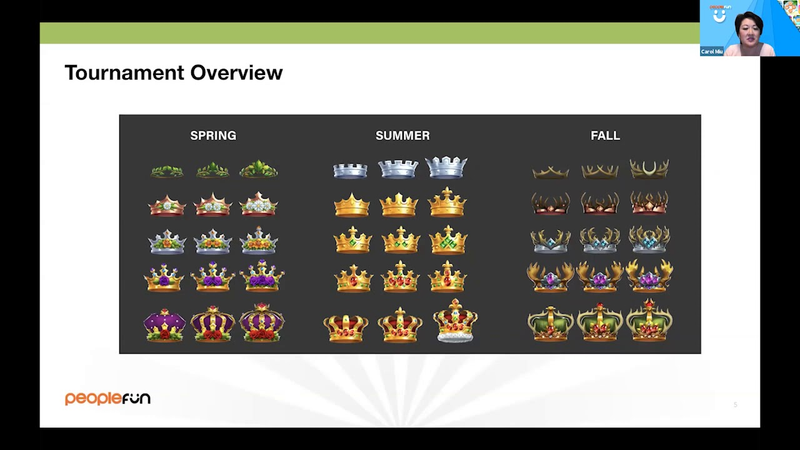
to have high decay. Who wants to collect the same crown more than once, right? And so, what we did on this front is we made we really leaned into the season. And we made our prizes very season-specific. You can see the spring with the vines, the leaves, the flowers. Uh summer, the really rich jewel tones. Uh and then of course fall with the antlers. So, the beautiful art was a huge draw for our players. And the results that we found were very, very interesting um and uh pleased us quite a bit. So, uh for major tournament learnings, uh I haven't included specific numbers on this slide, but I can tell you that the introduction of a tournament itself on the weekends boosted our LTV by about 20% on its own. Subsequent testing and tuning for uh bracket size uh boosted us uh another 8% or so.
Uh so, uh 50 players to 100 players, increasing the bracket size, uh made that 8% difference. When we looked at 100 players versus 250 players per leaderboard bracket, that did not make a difference. So, what that means is 100 or 250 uh performed similarly to each other and both were significantly above 50. We decided to keep it at 100 because we realized that with 250, although the LTV lift was the same as 100, some players towards the bottom of the leaderboard felt like they couldn't fight their way up. So, there was less uniform engagement with 250 players. Uh uh especially less engagement from uh you know, the bottom half of the bracket. So, we decided that 100 players would be our winner.
Uh for bracket criteria, some of the most interesting learnings are here uh with a broad market casual game uh with automatic enrollment, uh we need to be careful as to what are the other enrollment criteria. So, chronological by time of first tournament level was what we decided to do. Uh and the players need to be online. We actually had an exploit early on in this feature where uh players realized that if they played a whole bunch of levels uh with Wi-Fi off and then they joined the tournament later, they would get put in a bracket uh where they already had, let's say, 10,000 points and the other players who didn't know of the exploit were just getting started. So, we removed that exploit by setting the additional criterion of the players must be online. Uh and very interestingly, and I attribute this to being uh broad market casual and also because our tournament
that I am talking about right now, the seasonal crown tournament, is not uh a team tournament. It is a individual tournament where you are competing against individual players. Brad getting by previous performance, spend, and hint usage made absolutely no difference. And that is a very counterintuitive finding. Uh and what we discovered with that is that players really enjoyed that uh broad competition. Uh Uh top players need other players to beat. So, when we uh decided to do matchmaking, maybe we did it a little too well where players who uh beforehand would have made it to the tops of their brackets every week were bracketed with each other um and starting to knock each other out. So, imagine for many weeks you're used to being first or second, and then we tried
to bracket by previous performance, and all of a sudden you're 40th because you're in a bracket with everyone else who performs like you, right? So, we have to be very careful there. Uh we have since uh launched a team tournament feature, which is a separate feature that's not covered today. And that uh is one in which users can join teams of 50 players, and those teams play against each other. And for that tournament uh by popular demand, players are asking for better team matchmaking uh because there with the team component, it is a lot more exciting uh when you're uh matched with teams that are more engaged. So, uh we will be heeding that call very shortly. The other thing I wanted to point out with tournaments is we can't run tournaments all the time, especially not in our uh games. Uh I used to work in uh more mid-core and core games, and there there were more
tournaments more frequently. Uh in Wordscapes, when we tested uh tournaments during the weekday, at first, we got a very large KPI lift from that. Uh but our users got fatigued over a couple of months, uh and then the KPI impact reduced quite significantly uh almost to nil uh because of the cannibalization of the weekend tournament. And that was just fatigue with the same type of event running all the time. So, that clued us into the fact that we need different types of events, not just tournaments. And so, that is how we decided to make a vanity collectible event, which is our stickers. And what we've done there is it's actually a funny story. Our design director Lee Eisenhooth and I were drinking coffee at a Starbucks in holiday 2018 season and we saw there a holiday game, which is you collect
three stickers in a row and then you get the prize that's for that row. So, Starbucks for life, 150 stars and we said, we really like the UX of this. Let's drink more coffee and figure out how they're doing the drop weights and the pricing. And so, that gave us the inspiration for our sticker event, which runs on weekdays, so it runs when our seasonal crown tournaments are not running. And users play normal levels once again. And what we see here is that for every five levels a user plays, they collect a prize box. And within that prize box, there are these stickers. And when you collect three of the sticker, you can use it as your profile. You can use it as your profile image, your avatar. What will you? That is an example here and then it shows up on the leaderboard. It represents you.
So, we have these beautiful stickers that have different themes, very exotic, travel and um You can see here some more of those themes, forgotten palace, hidden shrine, jungle, really cute, really unique look. And the way that we have done the uh UI here is really interesting. It is modeled very closely after our inspiration, which doesn't even come from gaming. And the way that we have done it makes the user feel as though they are missing something when they don't have each and every sticker. So, in this particular screenshot, you see that I have every stick single sticker available for use as a portrait. Before I have collected the sticker, all you see is a silhouette. So, it's very obvious that there is something missing
and I want to complete it. I want to find out what is the image that gives me that silhouette. Uh and so, um a few tips here. Uh we're running this on weekdays. Right now, we're running it uh 2 days a week, Wednesdays and Thursdays, and looking to expand to Tuesdays as well, but right now our Tuesday spot is reserved for other live ops testing where we have quite a few tricks up our sleeves. Um in launching this event, we have found that it has improved our IAP ARPDAU on the day of the event by 20% and likewise our ad ARPDAU on the day of the event uh by over 20%. And that is a really interesting finding. I heard in the previous session uh that one of the attendees asked Chong whether uh
even in an ad monetized game, having live ops uh boost KPIs and it's worth to do. And the answer is unequivocally yes. Uh it this was a very important result for us. Some of our top players did double the number of levels that they typically do uh during the stickers event. So, it's a very very strong result for us. Uh and that is uh most of my presentation. I believe I've left some time for uh Q&A, hopefully quite a bit of time for Q&A. Uh when I present, I love to show you what's going on and I'm happy to go back to certain slides to answer questions. Uh mainly I'm seeking to be helpful to the audience. That's wonderful. Thank you very much, Carol. What a great presentation. Um really really nice presentation and uh and really informative about the steps you've taken in the in the game. We've got some questions, yes. So, um
I'll I'll leap in and and ask these. If anyone else watching has some questions, please do pop them in the window um or into the chat window. I can look at both and uh I'll make sure that that Carol gets to see these. So, Carol, yeah, we have some questions here from the audience. Um uh an anonymous attendee asks, "Do you put bots in the leaderboard to make players want to reach the top ranks?" Uh I'm guessing there if they're asking about the you know, do you artificially load the the leaderboard? The answer is no. Okay, so they're all real players in the leaderboard. They are absolutely all real players. At PeopleFun, we really care about that honesty and that transparency with our players. And so, everything that we present to our players as an event and especially as competition, where they care very much about getting to the top, is absolutely authentic. That's great. Thank you. So, um uh the next question from
an anonymous attendee is uh what tools do you use for leaderboards and for testing the um uh the leaderboards. Uh the question about tools, you saw Chong's presentation. He was talking about how maybe uh, smaller developers can bring in um, kind of off-the-shelf tools. But, but at PeopleFun, what tools do you use for your leaderboards? Okay. So, first of all, the leaderboard itself, uh, is a feature that we developed. So, um, it is not a tool provided, uh, by others, but it's a fairly simple feature to implement, and so we've done so ourselves. Uh, I realize that there are a lot of turnkey solutions out there right now for getting a leaderboard into, uh, your games. And in fact, uh, I have, you know, consulted with some services that basically do like an HTML5 overlay, uh, very native-looking over your game that has a leaderboard. Ours is custom-developed, uh, and it was not a huge effort. When it comes to the
tools that we use for AB testing, um, we have been using DeltaDNA for quite some time now, many, many years. And for our use, it's very intuitive for us to set up AB tests, uh, they consider us power users because we do so much testing. We're nearly always, pretty much always, uh, running AB tests in our games. So, uh, absolutely, it's, uh, easy to, uh, put in the hooks and code to, uh, make sure that you can test your new features, uh, and easy in the console as well to set up the new tests and make sure that you have all the variants that you want, and that the test is running on the audience that you want, on the build that you want, when you want it to start. That's great. Thank you. Um, the next question is, uh, there's a couple of questions here I might group together, actually. Um, so, uh, at what at what level do you allow users to
enter into the tournament? Is the first question. Uh, is it is it a is it a level-based you would do you reach a a level where you're you can enter into the live ops that you've been speaking about. Yes. Um and that is a fantastic question. Uh we don't want to bombard a new user with too many features at one time. We want to make sure that they are comfortable with our core gameplay and develop a routine. So for a lot of the live ops features that we have launched and are testing, they generally come between levels 50 and 80. Uh and the reason for this is we are uh once again a very uh broad market game and we do see that our average player plays on a normal day without live ops uh about four or five levels a day. It's very relaxed. Uh but when we do have uh so we obviously do have our top power
players uh even in casual uh as mid-core and core are very well aware of uh our engagement whales. Um and and they do 10x what our average player does, right? Um and when we run these uh live ops events, they will do, you know, uh 2x or 3x what they even normally do. Uh and so that's a a phenomenal result for us. Uh in terms of, you know, just getting back to the root of the question, you need to do some testing to make sure that whenever you are unlocking uh these additional features, your players are comfortable with the game and that your LTV uh lift is actually there because especially when you are running an ad monetized game, uh if you launch um these features and unlock them uh too early, uh number one, it is very hard to um
uh put the genie back in the bottle, right? And and make it later. Uh, and then the the other thing to bear in mind is you could be greatly increasing your churn by confusing absolutely brand new players, new installs. Uh, and of course that decreases LTV. No, that's very useful. And in fact, another question here, um, from the audience I think is been answered in one respect. Someone says that they are uh, level nine, um, and they're playing in India and that you mentioned that about the the the levels that you you have to be at. However, they make an interesting point here. Um, are you also uh, testing by geographic region as well? Is there uh, is there a a limit to the presentation of say tournaments and stickers in certain parts of the world? No, there's not. That's interesting, great. So, the um, uh, there's another question here uh, here as well. Uh, we've got a question from Tanveer, uh, who's in the audience who says, "Do you tie user acquisition with live ops? Um, how much
uh, do you think uh, live ops impact on user acquisition?" Uh, absolutely we do. Uh, and that is such an interesting question, very pertinent question. When we do know that we are about to launch a feature that gives us such a big LTV lift, we absolutely uh, do let our UA partners know that the feature is coming and that we need to ramp up uh, UA for it. Uh, the other reason that we uh, scale up UA potentially on a temporary basis is to make sure we quickly fill our AB test buckets. But certainly, when you do find a feature that is a big hit, uh, such as the live ops features that I've presented here, um, that does give you an indicator since your LTV is higher now that you can afford to scale up your UA some. Um, let me see what other specifics I can give here. Uh I we have to pay attention to some lag,
right? So, since these features don't unlock right away, um I don't necessarily uh plan for the LTV lift to happen before the users have unlocked the feature. Uh so, in concert with UA, uh I would uh think to myself, "Well, our top players will be hitting this feature uh in just a couple of days, uh and then the bulk of our players will be hitting this feature uh you know, uh after their first week. And so, just for my own planning on uh when I expect to see the the LTV lifts uh actually come out in my data. Um uh I think the the other point here is featuring opportunities. So, of course, have to plan at least 4 to 6 weeks ahead for featuring opportunities. And the way that we typically do it, we'll run a small-scale uh
AB test, but of course, there's more than just a control and treatment variant. We may have uh somewhere between 10 and 20 variants depending on what the test is uh at maximum. And we will test those against each other potentially on a small percentage of our user base. We can afford to do so uh with you know, 5 million DAU, we can afford to do so. So, then with that type of testing, we want to make sure that we are getting that KPI lift that we plan to get, that we are hitting all of our targets. And then we do 4 to 6 weeks in advance uh apply to our platform partners for featuring. So, there's a lot of planning uh that comes before even the full launch of a new live ops feature. That's really interesting, really interesting. Um we've got a little bit more time and some more questions, so let me take a question from Dominique here in the audience. Um, uh, the question is, "With your live ops tools, do you use
any machine learning to provide real-time player personal personalization? For instance, um, difficulty or ad pressure or anything like that?" Not difficulty and ad pressure, but segmented offers, yes. So, targeted uh, IAP bundles. Right, that's interesting. Um, so yeah, we've got some some more questions here. Um, uh, let me work my way down. So, we have an anonymous attendee asks, "What do you think is the future of word games?" Big question. Um, the uh, is it about meta games? Is it about word games in local languages? Uh, where else can word games go? Uh, it's interesting that you ask that because we are exploring uh, those two options uh, at the current moment. So, we don't want to give away too much secret sauce. Uh, but absolutely we are uh, exploring those uh, and in fact,
uh, if you go into Wordscapes right now and you go into the settings, you may see some new and exciting options in there after our most recent uh, 111 release uh, to the effect of localization. Uh, and then uh, when it comes to meta games, absolutely we explore different meta games. I think that with respect to how much investment it takes to really and truly develop a meta game, the safest way to test some of these ideas is through creative testing. So, what we have done is we have meta game ideas, we will then uh, put them into video creatives and run those creatives, take a look at what our watch rates are, what our click-through rates are, um what our install rates are running off of those types of creatives. Uh and I think we've seen from a lot of
our I'd call them competitors, but they're really friends in the industry uh that they have adopted that strategy of let's run a creative of either a meta or a new feature that doesn't exist in our game just yet. And if it seems popular, and if it seems like a creative uh that does amazingly on install conversions, let's actually build that into our game. So, we have some of that in testing now. That's wonderful. Thank you. Well, it unfortunately, we're at the end of our time here. What I've done, Carol, is I've There were some other questions in the uh in the Q&A box. Uh I'm sorry, Emil, Stefan, we haven't got your questions. What I've done, Carol, is I've copied those questions out of the box, and I'll email them to you, and then if they're of interest or you know, maybe we can do something with them else outside of this this chat, something like that. But I'm And other people, if you are uh hoping to catch up with with Carol, um maybe look for her in the um
meet-to-match platform or on Discord or or or or around the uh the conference in another way. Um I'm going to give you a round of applause. You have to imagine it coming from the uh the other attendees here. And unfortunately, the the situation means it has to be virtual. Great presentation, really practical, uh some really great insight there into into a very successful game. So, thank you very much. Thanks so much for having me, Dave. Lovely speaking with everyone today. Enjoy the rest of the conference. Thank you.
Summary
PeopleFun achieved a 40% increase in the lifetime value of the mobile title Wordscapes by shifting toward vanity-driven live operations and seasonal content. By implementing a 13-week tournament structure featuring exclusive crown rewards, the studio successfully incentivized engagement while simultaneously reducing coin payouts by 50% without harming key performance indicators. This strategy highlights the effectiveness of leveraging cosmetic progression to drive retention and monetization in the casual word game segment.
Operational success relied on precise matchmaking and event cadence adjustments. A 100-player bracket size emerged as the optimal threshold for competitive engagement, as larger groups tended to discourage lower-performing users. Furthermore, the studio discovered that chronological enrollment, rather than skill-based matchmaking, better served the player base by preventing top-tier players from feeling penalized. To combat the fatigue and cannibalization caused by back-to-back tournaments, the team introduced diverse, non-competitive features such as sticker collections. These collections proved highly effective, increasing both in-app purchase and ad-based average revenue per daily active user by over 20% while doubling level completion rates among top players.
Strategic implementation of these features is gated between levels 50 and 80 to ensure players are sufficiently invested before encountering live ops. Rigorous A/B testing via data analytics platforms remains central to this process, allowing the studio to validate performance before scaling. This data-centric approach extends to the pre-development phase, where developers utilize high-performing creative advertisements to gauge user interest. By treating ad conversion data as a proxy for feature demand, studios can prioritize the development of concepts that have already demonstrated market viability, thereby minimizing risk and maximizing the impact of new content updates.