Updated Jun 1, 2026 by AppLovin
Financial
Published by AppLovin
AppLovin reported a robust third‑quarter 2024 performance, with revenue rising to $1.20 billion—up 39% YoY—and net income reaching $434 million, a 300% increase and a 36% margin. Adjusted EBITDA climbed to $722 million, a 72% jump and a 60% margin. Operating cash flow surged to $551 million, while free cash flow hit $545 million, both up more than 170% YoY. Cash and equivalents stood at $568 million with 335 million shares outstanding. The Software Platform segment dominated growth, generating $835 million in revenue (+66%) and $653 million in Adjusted EBITDA (+79%), achieving a 78% margin. The Apps segment remained stable, with revenue at $363 million (+1%) and Adjusted EBITDA of $68 million (19% margin). Share repurchases totaled 5.0 million shares at a cost of $437 million, and the board increased repurchase authorization by $2.0 billion, aiming to fund future buybacks from free cash flow. Guidance for Q4 2024 projects total revenue of $1.24–$1.26 billion and Adjusted EBITDA of $740–$760 million, maintaining a 60% margin. The company emphasizes continued investment in talent and technology to drive organic growth, disciplined capital allocation through share buybacks and equity grants, and maintaining a net debt leverage ratio below 2.0×. Financials are presented in US GAAP terms, with non‑GAAP Adjusted EBITDA and Free Cash Flow defined for investor clarity. The letter notes forward‑looking statements, risks, and the intent to rename the Software Platform segment to “Advertising” in future filings.
To Our AppLovin Shareholders: We had another fantastic quarter in Q3. Our AXON models continue to improve through learning and, more importantly this quarter, from technology enhancements by our engineering team. As we continue to improve our models our advertising partners are able to successfully spend at a greater scale. We're proud to be a catalyst to reinvigorating growth in our industry. In the third quarter, we generated revenue of $1.20 billion (+39% year-over-year), net income of $434 million (+300% year-over-year) at a net margin of 36%, and Adjusted EBITDA of $722 million (+72% year-over-year) at an Adjusted EBITDA margin of 60%. We generated net cash from operating activities of 551 million (+177% year-over-year) and Free Cash Flow of 545 million (+182% year-over-year). At the end of 3Q24, we had $568 million in cash and cash equivalents and 335 million shares of our Class A and Class B common stock outstanding. Our Software Platform revenue grew in the third quarter to $835 million (+66% year-over-year) and Software Platform Adjusted EBITDA expanded to $653 million (+79% year-over-year) at an Adjusted EBITDA margin of 78%. During the third quarter, we retired and withheld a total of 5.0 million shares of our Class A common stock for a total cost of $437 million¹. Given our confidence in AppLovin's future, our board of directors has increased our share repurchase authorization by an incremental 2.0 billion, increasing our total aggregate remaining authorization to 2.3 billion, with future repurchases to be funded from Free Cash Flow.
cost of $437 million¹. Given our confidence in AppLovin's future, our board of directors has increased our share repurchase authorization by an incremental 2.0 billion, increasing our total aggregate remaining authorization to 2.3 billion, with future repurchases to be funded from Free Cash Flow. We believe a strong capital structure and effective capital allocation plan are crucial to the creation of long-term shareholder value. To achieve this goal, we are focused on: • Investing in top talent and technology to drive organic growth; • Managing share capital through ongoing share repurchases funded from Free Cash Flow and prudent equity grants to employees; and • Building a strong capital foundation with sufficient liquidity to support financial flexibility and a net debt leverage ratio below 2.0x. Looking ahead to the fourth quarter of 2024, our outlook is as follows: Financial Guidance Summary² 4Q24 Total Revenue 1,240 to 1,260 million Adjusted EBITDA 740 to 760 million Adjusted EBITDA Margin 60% 1Includes repurchased shares as well as withholdings upon net share settlement of vested equity awards. Total cost includes repurchase costs, including commissions and fees, as well as cash paid in connection with tax withholding and remittance obligations upon net share settlement. 2We have not provided the forward-looking GAAP equivalents for forward-looking non-GAAP metrics, specifically Adjusted EBITDA and Adjusted EBITDA margin, or a GAAP reconciliation as a result of the uncertainty regarding, and the potential variability of, reconciling items such as stock-based compensation expense.
ovided the forward-looking GAAP equivalents for forward-looking non-GAAP metrics, specifically Adjusted EBITDA and Adjusted EBITDA margin, or a GAAP reconciliation as a result of the uncertainty regarding, and the potential variability of, reconciling items such as stock-based compensation expense. Accordingly, a reconciliation of these non-GAAP guidance metrics to their corresponding GAAP equivalents is not available without unreasonable effort. However, it is important to note that material changes to reconciling items could have a significant effect on future GAAP results. We have provided historical reconciliations of GAAP to non-GAAP metrics in tables at the end of this letter.
3Q24 Financial Overview ALL COMPARISONS ARE TO 3Q23 UNLESS OTHERWISE NOTED. Revenue was 1.20 billion, an increase of 39%. Net Income was 434 million, a net margin of 36% compared to a net income of $109 million and a net margin of 13%. Software Platform revenue grew 66% to 835 million. Adjusted EBITDA increased 72% to 722 million, an Segment Adjusted EBITDA increased 79% to Adjusted EBITDA margin of 60%. $653 million, a 78% Adjusted EBITDA margin. Apps revenue grew 1% to 363 million. Segment Cash Flow: We generated 551 million of net cash from Adjusted EBITDA increased 24% to 68 million, a 19% operating activities and 545 million of Free Cash Flow. margin. Revenue Net Income Net Income Revenue Net Income Adjusted EBITDA $1,198 Net Income ( millions) 1,058 1,080 1,198 Adjusted EBITDA Adjusted EBITDA 953 1,058 1,080 ( millions) $722 864 953 549 601 $722 864 476 549 601 $434 419 476 $434 109 172 236 310 Q323 Q423 Q124 Q224 Q324 Q323 Q423 Q124 Q224 Q324 (As % Revenue) 50% 52% 56% 60% 49% Software Platform Revenue 13% 18% 22% 29% 36% ( millions) 835 678 711 576 678 504 576 Q323 Q423 Q124 Q224 Q324 Q323 Q423 Q124 Q224 Q324 Q323 Q423 Software Platform Adjusted EBITDA ($ millions, as a % of revenue) ($ millions, as a % of revenue) Q124 Q224 Q324 Cash Flow and Shares Cash Flow from Operations Q124 Q224 Q324 Outstanding Free Cash Flow Shares Outstanding 653 ( and shares in millions) Free Cash Flow 653 ( and shares in millions) Shares Outstanding 492 520 340 364 420 492 520 336 340 455 446 551 545 420 78% 336 393 388 334 334 551 335 364 73% 73% 73% 78% 344 340 393 329 455 446 72% 199 194 344 340 $388 334
standing Free Cash Flow Shares Outstanding 653 ( and shares in millions) Free Cash Flow 653 ( and shares in millions) Shares Outstanding 492 520 340 364 420 492 520 336 340 455 446 551 545 420 78% 336 393 388 334 334 551 335 364 73% 73% 73% 78% 344 340 393 329 455 446 72% 199 194 344 340 $388 334 72% 73% 73% 73% 199 194 329 Q323 Q423 Q124 Q224 Q324 Q323 Q423 Q124 Q224 Q324 Q323 Q423 Q124 Q224 Q324 Q323 Q423 Q124 Q224 Q324 Note: Totals may not sum due to rounding
Software Platform Update Our Software Platform segment continued to grow in the third quarter, with Software Platform revenue of $835 million, up 66% year-over-year, driven by continued development of our AXON engine through ongoing self-learning and directed model enhancements. These technology enhancements allowed our advertising partners to further increase the scale of their spend on our platform while consistently achieving their return on ad spend ("ROAS") goals. Software Platform Adjusted EBITDA grew 79% year-over-year to $653 million at an Adjusted EBITDA margin of 78% reflecting continued management of operating leverage as we scale. As we have noted in the past, our margins for this business will fluctuate on a quarterly basis, primarily driven by our investment in infrastructure as we continue to scale and secure data center capacity to support future growth. Our core advertising business now represents substantially all of our Software Platform revenue and future focus for the company. Starting with our next shareholder letter and Annual Report on SEC Form 10-K, we will rename our “Software” Platform and associated revenue to “Advertising” to better align with the nature of this business. Software Platform Revenue Software Platform Adjusted EBITDA ( millions) ( millions, as % revenue) 835 653 504 576 678 711 364 420 492 520 78% 72% 73% 73% 73% 3Q23 4Q23 1Q24 2Q24 3Q24 3Q23 4Q23 1Q24 2Q24 3Q24 Apps Update
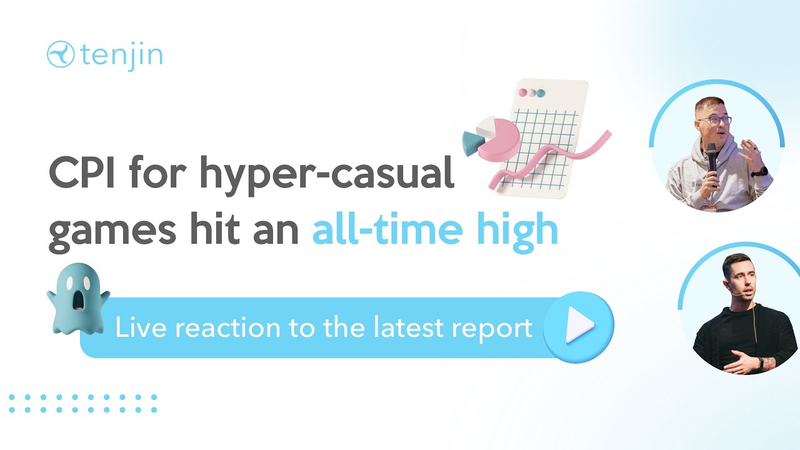
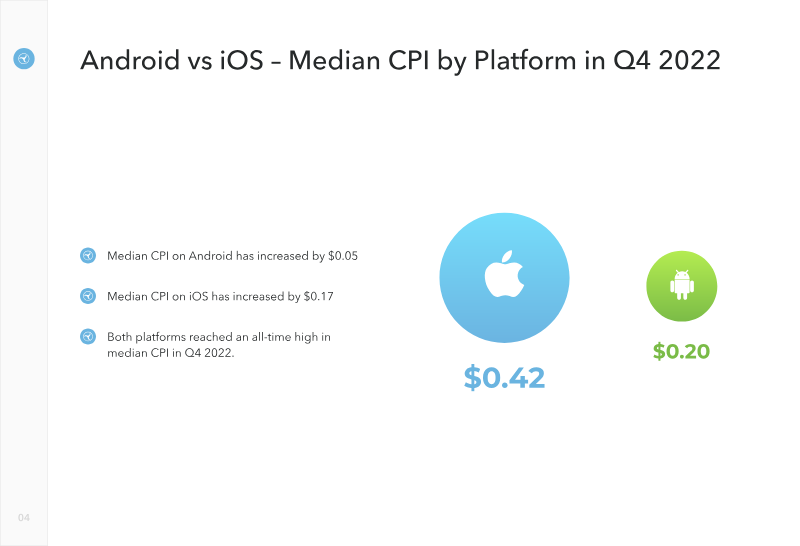
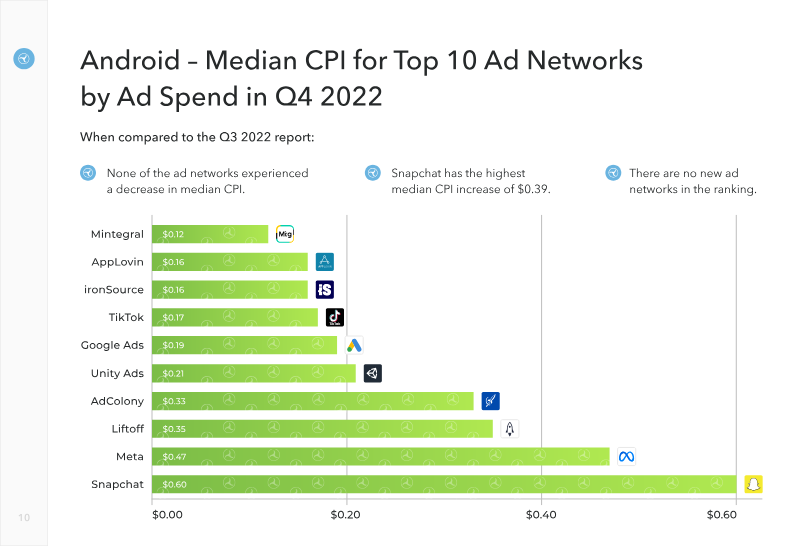
The hyper-casual mobile gaming sector experienced a notable escalation in acquisition costs during the latter half of 2022, characterized by rising median cost-per-install (CPI) rates across both Android and iOS platforms. By the fourth quarter of 2022, median CPI reached all-time highs of $0.20 on Android and $0.42 on iOS. This upward trend in acquisition spending was global, as no major market tracked by ad spend experienced a decrease in median CPI on Android, while iOS markets saw varied fluctuations, including a significant decrease in the United States and notable increases in France and Germany. Retention metrics reveal a consistent performance advantage for iOS over Android across all tiers of game quality. For the top 2% of hyper-casual titles, iOS achieved a 45% Day 1 retention rate compared to 38% on Android, with Day 7 retention figures similarly favoring iOS at 19% versus 14%. This performance gap persists among the top 25% of games and the median cohort, where iOS maintains a higher percentage of returning players. These findings underscore a widening disparity between high-performing titles and average games, emphasizing the critical importance of engagement optimization in a landscape of increasing user acquisition costs. The analysis draws upon data from over 100,000 games and one-third of the global mobile player base to establish these benchmarks. By segmenting performance by platform and geographic region, the data highlights the shifting economic landscape for developers and publishers. The findings suggest that while market saturation and rising costs present significant challenges, the ability to maintain player retention remains the primary differentiator between top-tier hyper-casual games and the broader market.
The interim filing presents the fourth‑quarter 2025 financial results for a midcore‑casual gaming group, emphasizing a record‑setting revenue run and the successful execution of a transformation agenda that includes the integration of the Plarium acquisition and the rollout of a new district structure in early 2026. Revenue reached SEK 3,123 million, reflecting 108 % organic growth year‑on‑year and a 25 % increase on a constant‑currency basis, while adjusted EBITDA rose to SEK 717 million, delivering a 23 % margin that matches the full‑year figure. Unlevered free cash flow amounted to SEK 878 million, with a cash‑conversion rate of 66 % and a leverage ratio of five times EBITDA, underscoring robust liquidity and disciplined capital management. User‑acquisition spending accelerated, representing 38 % of quarterly revenue—up from 37 % in the prior quarter—and grew 76 % on a reported basis, driven by heightened investment in original studios, new casual titles, and the racing franchise. The direct‑to‑consumer channel expanded by 600 basis points to 32 % of total revenue, reflecting a strategic shift toward higher‑margin in‑app purchases. Across the fiscal year, the company posted a 9 % organic revenue increase, with word‑games, racing, and RAID franchises delivering the strongest quarter‑end performance. Operating cash flow for the quarter stood at SEK 840 million, while adjusted net income was SEK 1,390 million, translating to an adjusted EPS of SEK 11.33. The financial outcomes exceed guidance and position the firm to meet its medium‑term outlook, with a pre‑IPO study for PlaySimple concluded and the midcore transformation progressing as planned.
Mobile gaming drives the global industry’s growth through 2025, accounting for more than half of worldwide revenue and over eighty percent of players. Global gaming income is projected to reach $197 billion in 2025, a 7.5 % year‑over‑year rise largely powered by mobile and PC segments, while console expansion remains modest. The sector’s resilience is most pronounced in emerging markets where Android and iOS user volumes surge, yet revenue concentration persists in Western regions—particularly the United States and the United Kingdom—where iOS dominates acquisition spend. Competitive dynamics sharpen as the top ten to fifty titles on Google Play and Apple’s App Store capture an increasing share of revenue, creating a winner‑take‑all environment. Hyper‑casual and match‑3 games concentrate U.S. spend, whereas Android strategy titles spread more evenly across Japan, Korea, and Taiwan. Sub‑genres such as chess, ludo, hidden object RPGs, and slots thrive in China, India, Brazil, and Southeast Asia, collectively commanding 15–20 % of global spend. Across most categories, day‑one retention has slipped from roughly 80 % to about 60 %, underscoring a broader challenge of sustaining early engagement. Download patterns reveal Android’s volume advantage—about 70 % of global downloads—with the United States, India, Brazil, and Indonesia leading. iOS, though smaller in volume (30 %), delivers higher per‑download revenue, especially in China and the U.S. iOS penetration is rising in emerging markets such as Brazil and Vietnam, while Android’s share in India climbs from 18.8 % to 21.3 %. Genre‑level analysis shows modest growth (10–30 %) across most mobile categories, with occasional outliers and declines in specific niches. Overall, the landscape is characterized by rapid mobile expansion, concentrated monetization power, and shifting geographic priorities that shape strategic opportunities for developers and marketers.
The mobile gaming industry is entering a period of strategic recalibration, projected to reach $126.1 billion in revenue by 2025. This growth is underpinned by a transition toward hybrid monetization models and the integration of AI-powered personalization to combat persistent retention challenges. While global install volume grew by 4% in 2024, the market exhibits a distinct geographic divide; North American and European markets face stagnation, whereas Latin America and the Middle East and North Africa regions demonstrate robust expansion. Success in this evolving landscape requires developers to move beyond traditional acquisition, favoring diversified channels such as Connected TV and localized, player-centric engagement strategies. Data from early 2025 indicates that user tracking remains a pivotal operational hurdle, with global App Tracking Transparency opt-in rates hovering at 37.9%. Although arcade games have seen notable improvements in opt-in performance, the United States remains relatively static at 32%, underscoring the necessity for refined messaging strategies to maintain visibility. Concurrently, the industry is grappling with a complex financial environment characterized by rising costs per install and declining average revenue metrics. These headwinds are forcing a shift in marketing tactics, as developers increasingly rely on a broader array of acquisition partners and data-informed creative experimentation to sustain growth. Ultimately, the path to profitability in 2025 lies in prioritizing long-term player value over short-term acquisition metrics. By leveraging AI-driven optimization and fostering community-building initiatives, developers can mitigate the impact of declining revenue per user. The industry is clearly moving toward a more sophisticated, data-reliant ecosystem where the ability to measure performance across fragmented channels—including mobile and Connected TV—is essential for maintaining a competitive advantage in a maturing global market.