VideoThe Game Business
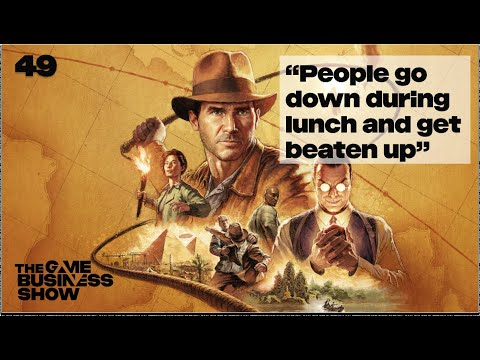
The Indiana Jones game developer has a fight club in its basement
2 Sept 202525 min video
Transcript
There's a fight club going on in the basement. We have a lot of Hang on.
We're not stupid. We knew it would be a a controversial decision to
Yeah.
to make such an iconic character and make a first person game. Hello and welcome to the game business show with me Christopher Ding. We're here in Brighton to attend the developer conference and actually the developer awards as well where machine games is not only doing a talk but is up for a number of awards. Now, Machine Games is a really interesting studio. Not only have they made this hit game, Indiana Jones of the Great Circle, which is a brilliant, brilliant game. They're also known for making the Wolfenstein titles, but also creating map packs and extra levels for titles such as Doom and Quake, the original Doom and Quake. Really interesting studio, and I wanted to get to understand them a little bit better. So, we decided to catch up with design director Jen Anderson and audio director Pete Ward. Check this out. Hello and welcome to the Game Business Show. Uh, Pete, you're the audio director?
Yeah, I'm Pete. I'm audio director at Machine Games. I was audio director on
Indiana Jones and the Great Circle. I've been there for about four and a half years. So,
and you've come from is it is it I think it's EA and I was looking up your history.
Yes, I worked at EA for six or so years before that. Uh and then before that I worked at Code Masters in the UK and some of the smaller studios as well in the UK.
Brilliant. And Yen, you are the
design director.
Design director. It's a great title to have on an Indiana Jones game, isn't it? You're relatively new to machine games in compared to the leng the size of the studio, but you go back cuz you were at the Starburst.
Yeah, it's it's a weird relationship almost. No, I worked with these guys for 20 plus years, some of them now and founded Starburst together with some of these guys and have been helping out on on some of the Wolfenstein titles. But with Indiana Jones and the Grid Circle, you know, I couldn't pass up the offer to to take a full-time job as design director for for this project that I knew was going to be amazing.
Now, I'm interested in in your perception of this because Machine Games works on has worked on Wolfenstein. It's
done some stuff with Doom and Quake and it's it's on Indiana Jones, not owned IP, third party, other IP. But what do you think of the characteristics of make of what a machine games is rather than an Indiana Jones game or rather than a Wolves game, but a machine games game?
The DNA of it.
Yeah.
Yeah. No, that's that is a good question and and it's it's something we had to think about a little bit as well because as you say in the great circle was the first project for machine games that wasn't Wolfenstein. So, so what did we want to bring over? what did we need to change and stuff like that and it was also a big part of my job to try to communicate to the team what we were trying to do. So, so after struggling struggling with that for a while, uh we coined the term a machine games adventure and that that for us answers that question very precisely because the machine games part of that a machine games adventure is just that what is what is a machine games and in that we
included like an immersive firstp person game uh strong characters centered around a story with variation in environments in in in gameplay mechanics. next. And then the adventure part, that was the new part. All the stuff we hadn't really done at Machine Games before, like the the exploration, the puzzles, and and the new character that iconifies adventure Indiana Jones.
Mhm. Is there a sound to machine or when you come into this, how much ability do you have to play around and put your own stamp on something that has its own music basically?
Yes, that's a really good question. Um, it's something we've talked about in the audio team and the wider team as well. What is the DNA of the sound is true for the the wider studio and creative as well. It's about the attention to detail that we get. And there's a lot of focus on um like really really important details and really strong narrative um really strong storytelling throughout, not just in the narrative script, but also in the environment and the the kind
of ambient storytelling that goes on.
And we always try and support that with sound as well. And that was something that was quite different for me coming from my previous games experience because I used to work on a lot of racing games. Um where the overall narrative is a bit less important than the second stuff. But in Indiana Jones in the great circle in particular, the overarching narrative was incredibly important. But the second stuff was really important as well. Like how how ridiculous a guitar sounds when you hit someone in the head with it. And like those kind of little bits of storytelling um were really important. So we were trying to lean into that a lot when we were developing the game. How did you create that sound of what a guitar sounds like? Did you
We So we did actually pick up we bought a bunch of props, guitars and frying pans and interesting sounding stuff and broke them in the studio a lot.
Oh, okay.
And then layered them with kind of more comical elements as well because part of the part of the DNA of Indiana Jones to us was that kind of comic aspect as well, the kind of cartoonish violence that comes in. Um, so where we could accentuate the the guitar hit and the strings twanging and and that kind of
stuff, just making it sound funnier was um was really important.
Oh, yeah. You've talked about the first person games, like they're first person games, but they're often different first person games. If you're into first person shooters, you you know, recalibrate just a little bit when you when you come to experience a machine games title. Where does that come from? Is it is it Starburst?
Yes. Um, that's that's the easy answer, I think. and and you know a lot of people on the team have been working together for a very long time and and that also of course is part of the of the DNA and there are stuff that we collectively like like the player agency the the immersion um and first person as as a perspective is something that we feel very strongly about and have iterated on all the way back since since Chronicles Ritic
um you know Chronicles Ritic was one of the first games that where you had your full body in the game and and you know with the lighting that cames with it, you could see your shadow, you could
hide in the shadows. That stuff becomes really important for us and we want to follow that
thread throughout interact with environment in a first person way. And in these games, we've also taken the opportunity to break out of that. uh like it's not only a first person game, it's it's a first person/ third person game many times where we take the opportunities to break out, show the character, and really use the perspective where it's most effective.
I was going to ask about that cuz I I'm a big fan of Golden Eye from the '90s.
Mhm.
And I speak to the team a lot and they said one of the challenges they had is that Bond is such an iconic character. Yeah.
Then you don't see him on the screen cuz it's the first person. that had that idea at the beginning where the camera swoops around Bond so you you know you're getting into the head of Bonds and I wanted to wonder with your third person elements if part of that was so you know here's Indie
of of course and and you know we're not stupid we knew it would be a controversial decision to
to make such an iconic character in make a first person game
about that so so partly was also um you know a guarantee that okay trust us you're going to see the character on enough for it to make sense. Uh, but we also knew from from previous games how to execute on that and we just refine that a little bit further, played with it a little bit more and I think it's it's a very nice mix of perspectives that you come out and you can like the whole concept of of the game is you are Indiana Jones.
You can't really like first person is perfect for that, right? uh because you're seeing the world through his eyes and and that's what we want to build on.
You talked about what a machine games game is, but Machine Games has always worked on IP that didn't originate a machine games. Is there a reason for that? Is that just
I'm not sure how I can answer that really. the games you get to work on. There are so many reasons why why those are the projects like I I can speak about the projects we have back at Starbase. That was very much by what is
available to us.
Yeah.
We want to work in video games. Give us something to work on and and here's this IP that someone is prepared to fund.
Yeah. I think with machine games uh you know starting off as part of of of Bethesda picking an IP that's uh within the organization that was that was a very smart decision by the studio because it allow them to create their own thing while also having an established IP to to build on top of.
Yeah.
But it's not a that is not part necessarily of of what machine games DNA is. Now, the game, I don't know if you think about this. I'm really interested in this because when you're making a game on when you're part of Bethesda, part of Xbox, you naturally, you know, your game is going to go into Game Pass. So, you're going to get an awful lot of players and way they play games because they can jump from game to game quite easily. They might dip in a little bit or give it a go. They're more likely to give it a go than than if it wasn't in the service, obviously. But does that change? Did you think, "Oh, I might need
to think about that when it came to designing this, you know, make sure that we grip them really quickly." Is that does that change anything? Yeah, you have to, right? It's a very difficult proposition. Uh because uh for for this game in particular, we we don't only have to struggle with that. We also have to struggle with the the players who have know who Indiana Jones is and the players who don't because there's a lot of kids out there who haven't seen the movies and this is going to be their first introduction to the IP. So, what's important here is, you know, we're trying we try to make this the most accessible machine games that that we made so far. Um, and part of that is also because of of the target audience.
It's on Game Pass. There's going to be a lot of people that is going to try this genre for the first time, maybe the first first person game they've ever played. So it was very very important to to make sort of the onboarding uh stronger and better than other titles. That was a big focus. Um as for
having a game on on on Game Pass, yes, we know the behavior of of players. They jump in for 5 minutes and they they drop out. You can take certain amount of decisions based on that, but at the same time, you don't want to make too many concessions. It needs to be
a great game for the player who play all the way through. I think that's the most important part for us, you know, being such a storycentric studio as we are.
I spoke to Rebellion recently about Atom for which launched in in in Game Pass and they said I asked the same question and they said, "Well, obviously you want to make sure you're gripping people at the start and make it exciting." But you don't want it to be all at the start.
It's got you've got to you got to give them some big moments at other points. Yeah, it's it's a hard balance and and you always know that you should worry about that more, but at the same time, you know, you you care about the grand scheme of things most.
This question for both of you because actually there used to be a time where you make a game based on a license. A,
it has a certain perception, but also they're going to do all right. You're going to make, you know, they're going to perform quite well. And now we're seeing it's actually no guarantee of anything, right? You know, we've seen you big games on based on big IP come out and just not do very well. I'm not going to name them. So what's important I guess in delivering a successful game based on a movie or a TV series and let's both you can answer that.
So yeah I can start with that one because um with Indiana Jones the sound is incredibly important for the franchise. You have the Raiders march theme which everyone knows in the music and you have the kind of iconic voice that Harrison Ford had in Raiders and those those earlier films and you have the classic whip sound effects and the revolver and the punching sounds and everyone's really familiar with those. Um, so when we were starting to approach this project, we had those as the main sort of pillars that we needed to meet to meet players expectations and Luke's film games expectations as well. Um, and that was critically important for us to get right. We knew that once we got those right or we were confident that once we got those right, everything else would fall into place around that. Um,
but those were the most critical things. Uh, does that answer the question? Sorry.
Well, it was important for you. So, it's about making sure they get the sound right and I guess and and and
because it is part of that, you know, that getting that
authenticity, I guess. Is that the same when it came to the
Yeah. Yeah, of course. Um, I think, you know, there are a couple of things. The easiest answer to the question is really you need to make a great game.
You know, it doesn't matter how well you represent the the IP or characters if if the game isn't there to support that. But, you know, assuming you you made a great game, you need to respect the IP, but make it your own. Um, and we've seen in in our development history, you've seen various versions of that. I think with Indiana Jones, we might be the most true to the franchise as we've ever been on any of the projects we've done before. Like, if you compare to Wolfenstein, for example,
that's a very different Wolfenstein than than the previous ones.
Yeah. Machine Games really made Wolfenstein their own kind of
Wolfenstein with Indiana. Sure, we make it our own kind of game, but it's very much like the the Raiders of the Lost Arc.
Yeah.
Kind of Indiana Jones character feeling sounds.
It's interesting because I guess I know Indiana Jones has a rapid fan base.
Yeah.
And I know they'll they will be on you if you get something wrong. enthusiastic,
enthusiastic,
but but at the same time the franchise isn't as a film franchise isn't in the best spot um compared to it its origin creates. So I do wonder if I wasn't planning to ask this if it gave you a bit more freedom or if there's an element of you know ultimately if we make a really good Indiana Jones experience then you know I I don't know what the question is. So, you know, it's a very interesting IP because of that because because it's, you know, you have the movies and they've evolved over time, but in the game space, it hasn't really been well defined.
No. No.
Like it was a very long time ago since
we saw the last Indiana Jones games. And if you ask people about Indiana Jones games, they most people come up with like Fate of Atlantis, which I love, uh, as as the reference. And obviously, we couldn't do that. So we had a you know blank slate in terms of what would the game be.
Yeah.
As for the IP that comes with obviously much more expectations.
It's amazing what Indiana Jones's IP as a concept has such influence in video games. You can see it in Tomb Raider and you can see it in Uncharted. You can see it in these big mega franchise. But as the IP itself doesn't seem to have well maybe it does now but it didn't really have that same sort of video game cache. Um my Indiana Jones game is the N64 one which was never released in Europe. Which one is that?
With the one that Factor 5 made. I'm trying to remember the name. It's like it's a really generic name. Here's an interesting thing about the games that Machine Games have made, which includes Indiana Jones, is they are IP that resonate with an older audience, right? Wolfenstein's from the '90s. Indiana Jones is is obviously I know it's
there's been more modern Indiana Jones, but really it's it's a legacy uh franchise. Do you find therefore that actually your players are older than perhaps you might find other other studios might have?
I actually don't know if they're older or not, but what I will say is that I I have uh twin boys and they're 13 and they are desperate to play the game. Um so I know that the there are much younger fans who are very interested and they keep telling me that all their school friends are playing it. So that's I can comment on that aspect of it. Like there is a younger generation that's really interested in this. So
yeah, it's a great way of reaching them, but I just wonder if if Yeah. did I you know there's no intentionality in in who we make games for. You know we're kind of making the games that we
would like to see we would like to play and we are we're all getting pretty old at this point.
You know obviously we want to make games that gets played by as as many people as possible.
Yeah. And as I talked about accessibility and inclusivity like there, you know, we we want people to
play our games and and the format is constantly evolving. The platform is constantly evolving and we want to evolve with that, but we still are going to make the games that we would like to play.
And this is what I'm talking about cuz I am slightly older. Indiana Jones I'm very very excited by. I'm very excited when you announced new Wolfenstein. I'm very excited. The Indiana Jones DLC I'm very excited by. Um, but I also I'm those people that gets those Night Dive, Quake, Doom remasters, which Machine Games have produced stuff for. So, you're a studio that speaks to me directly and I have to wonder if if I guess not not purposefully by the sounds of it that that's an intention, just happens to be the nature of who you are and what you're interested in. It's interesting about that. How is actually, this might be a little bit of insight into the studio. How is the studio structured? Because you do do these little cool little projects with like dooms and I know that you don't maybe maybe you do. I don't know. uh with with with Doom and Quake and stuff. How does how's it all set up?
There's a ton of really passionate game developers at Machine Games, as I would
assume with any other, you know, uh big studio. I think the Quake stuff is um I don't partake myself, but there's a there's a a proud tradition like uh we have Yak Gustafson, our game director and studio CEO. You know, that's where he came from. He he he got into the industry by building quick levels and and that's when I started working with him as well. That was his, you know, he was a level designer. He built quick levels. And throughout the years, enough people like that have joined machine games. And these guys are crazy because at the you know they work like hell on on the games as we all do but then they go and and you know do Quake maps because that's something they I don't know they feel they can control a little bit better. It's it's a pure
uh game development thing and and of course within the Bethesa family with the you know close collaboration with uh
ID software and all that kind of stuff these kind of opportunities arise.
Yeah.
With the top leadership of the studio being there on the ground floor building of course it cheers the rest of the the studio on to to do this kind of stuff and it's it's very fun I think.
Is it like a little hobby then that's in the studio of people just doing this?
Yeah. Yeah. Yeah, I I definitely considered this a hobby. Like it sometimes go off the race a little bit. Like these kind of campaigns they did for Quake 1 and Quake 2. That's that was a lot of work that people put into it and and start to compete with, you know, their day job.
Yeah.
Because you need to ship and and that's, you know, that's always the hard part. Um but they want to consider it a hobby. And you know, there are other hobbies at Machine Games that are that trended. There there's a fight club going on in the basement.
We have a lot of
Hang on.
Yeah. Our our animation director is uh jiu-jitsu like really high level and
he's been holding this thing where people can get down during lunch and get beaten up. There's a lot of people who are into sports shooting.
Okay. As you can tell from Wolfenstein, a lot of
interest in weapons generally uh both inside the games and outside the games. So it's it's it's a very nerdy culture, but outside of games as well.
I love that.
Lego building Thursdays.
Do you get beaten up in the basement?
I haven't been down to the basement to get beaten up. Yeah. No,
we've been very busy on the on the game.
Yeah. For the last couple of years.
There's a bunch of those kind of different sports events. the Swedish language learning as well, which I also need to do more of having lived in Sweden for 10 years now. I need to be better at it.
But moving back to indie, you you're moving on to this DLC. It's interesting. I've got what why do it as an expansion or a DLC rather and rather than a standalone game?
Well, it's a scope thing, right? If you do something standalone, it needs to be bigger.
Yeah. DLC's generally feel a very good
function within a studio because because of es and flows of of of the development teams. You have a lot of artists rolling off a project with the next project not really being ready to to have a full team on.
I see. Okay. Interesting.
So you need to go into you know proper pre-production on the next project. So DLC's are a great tool to sort of spread out the development resources across projects.
That's really interesting because sometimes dealing with a story game.
Mhm.
I remember that again of an of an age. I remember when you didn't get DLC, you just got another game the following year, which was mostly like the last game that you got, but with a different story and maybe some tweaks and iterations on it.
DLCs are fun in that sense as well because you finally know what the game is about. Like so much of the development is figuring out like what what game are we really making and it comes together in it's like ah of course this is how we should this is the parts of the game that's really fun. We should do more of that.
That's what I mean. So when I I always think that in the old days used to be
the second game was obviously the best game. The first game you sort of worked it out just about and the second game you all the ideas you have time to put into the first game and you've iterate on the things that you know you you can tweak upon. when I play a big DLC, like I suspect I suspect it'll be my experience with the Indiana Jones DLC. It'll be like that. It'll be almost like the purest form of that experience and and and that's why I sort of asked the question. Um, but I'm mindful of the time. Um, and you've you've I'm suspect you've got lots of places to be and lots of people to say, but is it 15 years of machine games think this year? The fact that you're looking at me like that suggests that I'm the question I'm about to ask is going to Yes,
absolutely.
Not in the corner of the room. Well, I was going to ask if you got plans to celebrate them, but seeing as you do, you know,
there will be stuff.
Oh, well, what are you looking forward to from um what what you're working on? I know you can't tell us everything that you're working on. You might working on announce things, but what is it that you're hoping to to do next at Machine Games sort of high level?
So, I'm looking forward to having because we've built a huge amount of extra technology and improved technology. Um we've built up the audio team. We've got lots of experience
within the team generally and I'm looking forward to taking that experience that we've built up in uh people and in how to work together as human beings and how to work with the technology and taking that and making the next game even better than this one was.
Yeah.
Um because we're starting from a much different position now. So
what about what about yourself?
No, no, I just thought that was the perfect answer. Like uh there's so many things we did for the first time uh on the great circle like rebuilt the engine from the ground up tampered with lots of like expanded our vocabulary of of features like you know exploration you know open world semi-open world areas a lot of new tech and that we had to learn for the first time and and as Pete says we are just in a much much better position to to build more with more intentionality.
It's a defining game, right, in the early days. I know that Wolf Time has been a real big hit and it and it was it was great and amazing, but this has really defined machine games and I actually feel a bit annoyed it came out
in December because if it came out, you know, 6 weeks earlier, it would have been in the BAFTAs. Definitely would have been the game awards, right? Cuz it was one of the very best games. it would have been Indiana Jones versus Astrobot which are very different games but it it would have been and in in those awards and I know you've picked up other awards since it is it was one of by far the best games released last year and I think that's um and if anything and hopefully when the awards season comes around again it will still be considered that it's now out on PlayStation and I know that um it's got an audience there. So I I hope that um um that sort of recognition continues to come.
It was very interesting releasing in December. Uh, but you know there are also there were great stuff coming out of that. So many people went home for Christmas break and played the game. That was that was lovely.
Get an Xbox Christmas with Game Pass.
What's right up there right at the top? It's Indiana Jones. Well, um, good luck with the DLC. Thank you for your time. Um, and uh, yeah, thank you for joining us.
Thank you very much.
I really enjoyed talking to Yens and Pete there. a bit terrified of their
studios basement, but this way that they work on smaller projects like Quake and Doom Matacks for fun mostly, but also it builds that camaraderie potentially brings in a little bit of money for them as well in order to keep things ticking over. Really great studio, really fascinating. Should also play Indiana Jones if you haven't done so already. It's a wonderful game. That's it for today's episode of the Game Business Show. We'll be back, of course, with more news, analysis, and interviews. Head to the gamebus.com, stick in your email, and you won't miss a thing.
Auto-generated captions from YouTube — names and numbers may be misheard.





















Comments