VideoThe Game Business
Rainbow Six: Siege boss: We'll treat our players like kings and queens when GTA 6 comes out
22 Sept 202637 min video
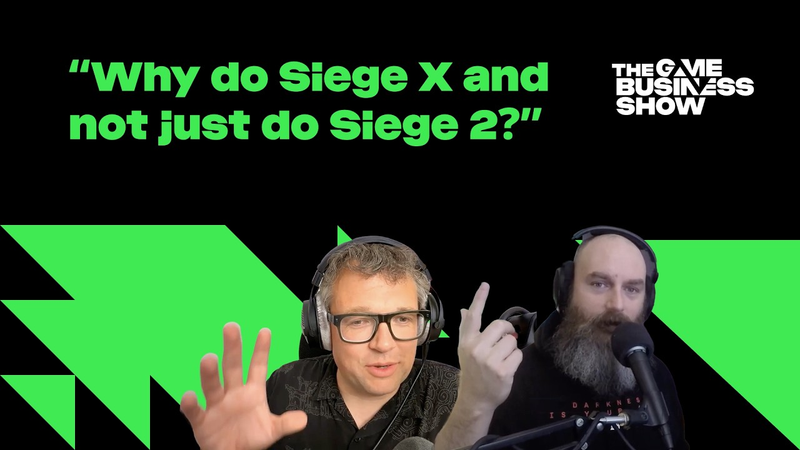
Right as soon as we launched, we needed to rest. We had to give the team some time to kind of recover from this. And then that caused a a bit of a content lenal cadence and that really hurt. We know something's coming along the lines. Like we've got a big one coming this year with GTA. Obviously, it doesn't matter what genre you're in, you're going to get hit.
Yeah.
You have to think ahead and be like, okay, bring your expectations in line of what's going to go on there. People are going to go play and they'll come back and stuff like this. And heck, all of us are going to play. The question was like, why do you see Jackson not do Siege 2? One of the big things is fundamentally rebuilding our entire system. It's a mountain of work to do and to nail it and to get it right and to be able to scale in the way we're doing. If we were to want to do something like this, Siege would have to essentially go on ice in order to do. [music] Hello and welcome to the game business show. This week's show is sponsored by Keyword Studios. Now, Keywords is a real global company with 13,000 people across 26 countries. And what they do is they
provide talent and expertise to studios to help them make their games, release their games, and make sure that they're supported long beyond that. They say they're supercharged by technology and shaped by long-term partnerships. And when it comes to that global impact, they help studios prepare games for more markets, languages, platforms, and launch windows, while crucially keeping quality, context, and control where they matter. From localization, planning and QA to localization, QA, and launch support, Keywords helps ensure meaning, tone, and release quality are protected at a global scale. You can find out more on the Keyword Studios website or click the links in the newsletter connected with this show. And now, let's get back to that show. This week's edition is once again about a major shooter series. Particular, it's about Rainbow Six Siege. Now, it launched nearly 11 years ago, and last year it celebrated its 10th anniversary with the major update X, which introduced a new game mode,
modernized maps, various gameplay upgrades, audio and UI overhaul, and loads of other things as well. It also introduced the ability for players to access the base game for free. But it proved a challenging project. It led to a tired development team and a large number of people left the project. That included creative director Alexander Capassis, who handed the reigns over to Joshua Mills, who was previously the game director. Now, I had a chance to chat with me about Rainbow Six Siege, how it's doing today, how his team plans to react to the launch of Grand Theft Auto 6, the impact of Siege's major 2025 security breach, and whether there will ever be a need for a Rainbow 6 Siege 2. Check it out. Hello, Josh. Welcome to the show.
Hey, man. It's an honor to be here. It's cool to be talking to you, so appreciate it.
Oh, well, I love doing these interviews where I discover I mean, I do know about Rainbow Six Siege. I was there 11 years ago when it launched. I did Warframe recently and um old school Runescape and I just thought so fascinating because they're like different industries in
their own little right. Anyway, I find it really exciting doing these sort of pies.
It's funny cuz the team sent me uh whenever they sent this over to me, they sent me the Warframe one you had done and I was like that's awesome cuz like I'm originally from Ontario so like Digital Extremes was like the thing uh back then. So it was really really cool to see and like I mean I still follow them to this day because like it's incredible what they've done.
Yeah. Well, just just plugging at it and keep going. That's that's kind of the way. Well, you've taken the creative director role on Reb Six Siege. Yes.
Was it April you took you joined? Was it Oh, not joined, but when you took that role
publicly, we announced it at SI or a little before SI uh just this year. But the reality was I actually took the role in the shadows or at least Ubisoft structure uh around September of last year.
All right. You've been doing it for a year.
Yeah. So, it's Oh, man. I didn't even realize it's been a year now. [laughter]
Yeah. So beyond that, we mentioned in like a blog post we did where Kurpasses, like Alex Kapassis and I got to kind of uh talk about the handover. The reality was I was shadowing Alex for some time. Uh and this was something that was kind of on the books for a while.
So when you got like full control, did you ring in the changes? Have you uh ripped up all the rule books? And [laughter]
I Okay. So uh I've [snorts] not just me there's been a lot of uh we have like a generational team. So this team on Siege has changed a lot over time. uh which has definitely brought new perspectives and different challenges. Uh one of the things was when I joined the team like what was it 5 years ago or about that now everything that could have been challenged to say that well this is how it's done it was like well let's talk about it because it's been 10 years like does it make sense at this point with like how the industry shifted how our players have shifted so I don't want to say ripping up the rule book but definitely challenging decisions that may have been uh kind of stuck for a little bit that hasn't changed and then post Siege X's launch there were a bunch of challenges that we were being faced with and we had to adapt at that Well, I'll ask about both of those things. So, it's interesting when I interviewed Runescape recently, they've gone through the same thing. They've been going 20 odd years and they've gone through the whole thing where they've gone, right, those decisions that we made in 2009 where we decided that that
doesn't work. Actually, is it we in a different world now where that might work? Should we put a game on a console? Should we do that? you know, all they challenge all of the decisions that they made before, not because they were wrong in the first place, because when you're talking about a game that's been around for, in your case, nearly 11 years, things change, players change, behaviors change.
Yeah, 100%. It's exactly that. Just challenge it. Open up the hood of the car, take a look at the engine, see if everything makes sense, and if it does, cool, keep it going forward, but then build it as part of your pillar going forward. And that was kind of the way we looked at it.
I was going to ask about the X launch later on in the interview, but you brought it up already.
Oh, sorry.
No, no, no. It's great. Yes. How these things flow. So you talk about some challenges coming out of that. What what what ones are you talking about?
I mean there's multiple because if we talk about just the the sheer amount of work that we did as a team, basically we're running a live game at the same time as producing what was essentially a huge feature list uh in the background and then dropping it all at the same time. There's a ridiculous amount of technical risk doing something like that because you're going to go live. It can trip up stuff that is live because once you're live, that's when the truth
starts coming out. And that kind of standup was we were essentially building a game while still shipping the live game at the same time for a good while there. So there was a lot of uh fatigue that was building on the team. The goal was to kind of kick off for a big 10-year anniversary of Siege. Like I mean it's a huge accomplishment. Like I mean we're in company with some of the like the great out there and it's really awesome to be able to be here for 10 years. So we wanted to do something special. This meant some fundamental rebuilds of different modules within our engine, pushing our lighting system and our audio system further and stuff like this. It was a a huge undertaking. And then when we came out there, really what it came down to was the idea that right as soon as we launched, we needed to rest. We had to give the team some time to kind of recover from this. And then that caused a bit of a content lull that happened in the the seasonal cadence. And that really hurt where people were like super excited about the stuff coming, excited about the future of what Siege was going to be. And then we went a little bit quiet as we came out. And I think fundamentally that was where we
kind of misaligned with the expectations of our our community and we had uh we had some trust and rebuild after that.
I guess it was a bit of a bad time to do that because it also happened to be a moment when I know they're different types of games, but suddenly Battlefield does its thing and Art Raiders does it thing and you've got these competitors. I understand that a lot of the time you're snatching players away from each other and then they come back and all that kind of stuff, but if [laughter] you're if you've slowed down your output at a time when these sort of things happening, I guess that that that poses business challenges as well.
That's definitely the thing like we're always like the eb and flow of players like moving between different games and different experiences. I think the the one thing that we we know we know that DNA of Siege is super unique and super special and we know there's nothing quite like it. Um which is why many of us work on it in the first place. Uh so really what that meant was okay listen like let's get a rest for a second rally and then start working towards it and that's where we rebuilt our new content cadence a bunch of different things like this to kind of make those measurable steps uh moving forward. Have you had to make any changes to the team after all that and and
Oh well I mean the reality is we did have uh so when Alex say stepped out and then I took uh the creative director role the majority of the core team has actually been updated uh because a lot of them had been on the project for 7 years or a long time and a lot felt that Cjax was a good opportunity like this is a big moment we'll do this anniversary together and then we'll go on to our next chapter and so there was a big shift of a lot of personnel going through. So, we have a new game director. We have uh new folks in different positions and stuff like this. This is all adjusting and obviously there's
I would say growing pains that come with that where everyone's kind of adjusting into their new roles.
Uh but all in all, this is that generational team I'm talking about where there's kind of a a constant evolution that happens where people bring their best for a bunch of years and they'll they'll put what they want like what they want and what they can into the game and then they'll be like, "All right, I think my chapter is done. I'm going to move on to something else." So, I'm not caught up with the Rainbow Six Siege uh in a long time. I'm interested. Is it all set up? Are you all in Montreal? Is that where most of
this takes place?
We're pretty global, so we do have a lot of codevs. Uh so, we have codevs in Barcelona. We have co-devs in other parts of Quebec as well. Um and over in Shanghai. So, we do have people around the world, but the majority of the team or like your core kind of hive mind is in Montreal.
Mhm. Okay. Obviously the big change from a corporate level I don't know if it affects you has been has been Vantage Studios and and 10 cents sort of being more involved and or at least co-owning it. Has that actually changed anything for you? Do you suddenly have access to 10 cents array of hit live service game makers you can tap into and and get on the phone with?
So I mean things have definitely changed. I think one of the the coolest things about it is we have like a much more direct line with HQ. I may be jumping on a topic that you might bring up later, but uh there was a a hack that happened at Christmas a little while back and when that occurred like I was in a chat like Charlie was in the chat with us and we were all sitting up like a couple days after Christmas in conversations figuring out what was going on ramping the team back online and kind of calling people in to get things moving. The point being like we were all in it together and it it kind
of felt like we were thick of thieves which was really really cool in that regard because there's a real rally point around the game to try to protect it and kind of get things moving. So between that and the fact that we have open communication, if there's conversations we need, resources we need, or anything like that, we can just talk and that's that's really great. So there's a lot less um I don't want to say layers of stuff we have to go through in order to have like a transparent conversation. We can have those relatively easily, which is I think a really really good improvement. Outside of that, when we're talking about Tencent, uh like we're definitely working with our partners there. We've announced like Siege China is something that's happening. who are working with them and that's been a great collaboration because yes there's a lot of insight on the region that we just don't have. So being able to work with them has been incredible.
China's tricky because there's a there's an element of cultural changes and things you have to sort of make to adapt to that. But um obviously it's tricky but a huge opportunity if if you can get if you get it right. But there's one company that can help you do that is Tencent, isn't it? [laughter]
It sounds to me like you've had quite a
baptism to be honest. You've you've you've you've come in off a off a really challenging and you said fatigue team and with X. You've then seen a lot of people leave and you've had to rebuild that way. You've had this horrible hack happened in December and you've had to look at everything again. Are you okay? [laughter]
Uh let's just say I didn't have the hair before. So it's not like I lost it during this. No. Uh, honestly like kind of the thing that I'll say is like the new core team and I can say this very honestly like I think we're we've all become very like good friends and we've kind of been bapt like you said baptized in the fire of of everything going on. [clears throat]
But that's been awesome. And the reason I say it's awesome is because it really felt like uh like we can handle anything together and this team can handle anything together. So, as things are coming up, we're less like, "All right, this is like we take our hit and we find out what we do next and we kind of keep moving." And that could be like maybe a new cheat provider comes out and now they're attacking our game. It's like, "Okay, cool. That's a new conversation we're going to have and we're going to get on that. We're going to ramp up in
different ways and then counter it." But yeah, it's been tough in a lot of different ways, but I don't know when when you talk about this idea of like, oh, it's it's quite the way of jumping into it. I look at my career and most of my career was always that where it was like okay here's the deep end go and figure it out from there. So uh I think surrounding yourself with good people makes a huge difference on being able to to weather the storm there.
I wasn't ask too much about the hack but I will ask how has that impacted things?
I think one of the big things is uh like well we did a roll back whenever it happened. So basically we shut everything down rolled back the data and and did this. So we've just uh kind of updated a bunch of internal processes and stuff like that to go faster if something like this were to ever happen or occur again. So you have your best laid plan for the what if then it happens you're like okay well we could be better. So ultimately it was that um outside of this we know we tend to get attacks launched at us right around Christmas because they know we're off.
I see.
So like this is kind of the thing. So we've built up extra layers around that too. Well, I mentioned it earlier, the shooter genre. It's always been a I know I know your game is very different. It's very unique and that's why it's managed to hold succeed over 11 years, but um it's obviously very competitive scene and last year we had obviously Battlefield Arc Raiders suddenly enter the fight and and track loads of numbers. I'm interested in this when big launches like that happen or even when it's like another a game that's been around for ages does a big update like you did I guess with X and it disrupts things even if it's a short-term disruption. How do you have to react to that or do you just not?
I think uh one of the things we like I mean from a business point of view we we prepare accordingly like we know something's coming along the lines like I mean we've got a big one coming this year with GTA obviously it doesn't matter what genre you're in you're going to get hit when that drops.
So it's like you have to think ahead and be like okay
bring your expectations in line of what's going to go on there. People are going to go play and they'll come back and stuff like this. And heck all of us are going to play like that's what happens like like even like Battlefield played Battlefield through all through
it. Yeah, it comes out. Of course, we're playing. Um, so as far as that goes, it's it's being smart about your expectations during that window. Uh, so that you can keep all those expectations in in run with HQ with the team as well because the the team is affected by the same thing. So if they see that we don't like our players are going down or whatnot, they can get uh almost like an anxiety about it as well, but it's it's all temporary generally speaking because we know the core is there. And the one rule we have is to act as if uh for those who are staying in connected the whole time, serve them like kings and queens. Like make sure that they constantly have what it is that we offer and make sure we serve them to the best of our ability. We don't go on vacation because there's a competitor that's kind of, you know, swelling the market for a second. No, we do our double down and serve as best as we can during that time and give even more during that time just to make sure that anyone who is spending that most valuable resource time is rewarded for
spending it with us.
You're probably not doing a major update during those periods, are you? [laughter]
Well, we that's the funny thing cuz we will have our season 4 drop right around that that time.
Oh, right.
But that's okay because like uh this shifts up the game in a bunch of different ways. We do have some surprises that we actually haven't talked about. So like we are we are holding a few things just uh
to make a bit of a splash.
Well, okay. Well, that's interesting. I like asking this question. I if you've heard the Warframe, I might have asked it to them as well cuz it's been 11 years since, you know, nearly 11 years since Siege launched. 18 year olds that bought that game in December 2015. They're now knocking on 30. And as you know, that becomes a tricky age. Um folks have careers, maybe families when they start getting to that point. Have you had to adapt much to an aging audience or do you find that new people come in? It's such a good question because like I can tell you this like our audience has definitely aged lower now uh with uh like just more players coming in who are are younger than what we've seen in the past which is cool. It's awesome to see people like looking for that challenge and jumping into the
game but their expectations are different as well because you take that someone who played 10 years ago which myself like and what I am now I am very much I'm not going to be the most mechanically driven player anymore. I have to rely on all the strategy and all the gadgets and everything like this. Uh whereas like a lot of the younger players are they'll they'll click heads like they are absolutely insane with their their sticks or the mouse and keyboard. So they'll they'll run and gun it a little bit more. So they change the pace of the game, the meta of the game because of the way they like to play. One thing that we've talked about a lot and like you can see this like even with that market shifting younger, you go well they want faster, they want this. It's like yeah but that's not what Siege is. Like Siege is a tactical like methodical game. We need to be true to it. And anytime we've uh veered away from it or whatnot, you get that immediate flashback from the core because the core knows what the game is, which is it's a thinking man shooter. That's kind of the way it's chess when it comes down to it. And we've done different things like in the past, we've
slowed down ADS times and different things like this because again, they were so mechanically good that they were on the verge of just breaking the actual net code of what they could do because of how fast they were moving around the game and like jiggle peeking and all these things. [clears throat] when you do that, you break the entire immersion of the game. You break this idea that you are this tactical elite unit and you just look like Rambo. Um, so there was a real consensus to be like, we need to know who we are and we need to focus on that. I did a talk inside Ubisoft. This is the most ridiculous thing I'm probably going to say this entire conversation. Um, we do this thing called UDC, which is like a Ubisoft developer conference kind of thing. And the clip I used was a clip from Moana because you can tell I have kids. So, uh, and it's the part where she's like, uh, uh, I am Moana. She's on the the board at the end when all her ancestors come up.
Yeah.
Because the reality is Siege is a product of its past and the entire franchise that came before. So anytime we want to push the game or we are
challenging what the game is meant to be or what that core identity is, we got to not necessarily look in everybody else's backyards, but look back to where we came from and readjust to that point. So between that and then rallying the community around that that concept and that idea has been our main focus, just to let people know this is a methodical tactical shooter. If you want to run and do all that stuff, Siege isn't going to be the place for you. You mean the moment after Maui has left and run away and she's alone on the boat, right? Yeah. My man. Yeah, [laughter] that's exactly it. You guys in the heart of Teiti, you went down to the ocean. Yes, that is
that that moment. Yeah. Yeah. Yeah. I've also got kids. Um perfect. [laughter]
Um the uh uh before we DJ off cuz they're going to ask me for the film the new one. Um but you were right. So I spoke to Arrowhead around Hell Divers 2 launch and they got caught up in this because they launched Hell Divers 2 which they viewed as like an escape from Tarov sort of thing and then they had millions of Call of Duty players play it. Like millions of Call of Duty players jumped in and they're like, "Oh well, what do we do for these players?"
And then they sort of went away from what the game was supposed to be to try and satisfy those Call of Duty players. And they do they they soon realized their mistake and they course corrected. But it's that's exactly what we're talking about which is you might want to chase that lovely audience you suddenly manage to bring in but
longterm it's probably not the best
oh yeah
not the best you lose you lose your call.
Exactly.
Well it's interesting because obviously you've done a bit of freeto play and all this sort of stuff. Are you finding you're bringing in lots of new users there? I mean based on what you just said the answer is yes. What keeps Rainbow 6 going basically? Is it this engaged audience that you have or is it these new players that come in and cycle in? Or is it a bit of both?
It is. It is a bit of both. Like I think ultimately is uh once Rainbow gets like its uh its hooks in you, you're done. There's literally nothing else that feels like it and then that's really what makes it stand out. So like if you've crossed that echelon into getting to the point where something clicks where you could be like, "Oh wait, I didn't just immediately get shot off the spawn or whatever, then you're kind of starting to see the magic of it." And
then you start doing the what if scenario game where it's like, "Well, what if I did this? What if I did this? What if I did this?" And you can do that a billion times in the same map that's been out for 10 years. Sure, it's been remastered or updated and stuff like this, but essentially it's the same essence. And that's where the the magic goes. And then every update we do, we shake the board a little bit. And then you like, okay, well now what if? What if? What if? We do see a lot more players checking out the game because we have free access so they can jump into the game and give it a go. And we we see a lot of players bounce, which we knew was going to happen where they come in, they're like, "Okay, whoa, no, these people are crazy." And then they leave. um which is why we we've put such a focus on our onboarding and this is one of the things that we're constantly working on. To give full context, it was year seven when we got a tutorial. So like this is not something that we've been uh like stellar about doing to introduce people into the game. something we're we're kind of building towards. We have our our new uh machine learned AI essentially like where we use player data to actually drive our AI because siege is so complicated just
straight up programming an AI to do what an operator can do in all the scenarios. It's not enough. So we actually feed it player data to be able to to figure out where it goes, the best placement of the gadgets and everything like this, all the interactions. So those sort of systems are helping a lot for players to get into the game and uh we're making it so that we're kind of building those that staircase on the side of the mountain which is the mastery of siege. So it's helping a lot and people are sticking but again the second the hook gets in you like okay you're done. like it is
this such a special thing.
But yeah, it is definitely a different beast to say you're not going to be good for a while and if you're willing to put in the time, you're going to find that that like that special um I don't know the magic that everybody else sees.
My one sgestion I've had on the show that I quite liked around AI was the fact that because I'm an older player, sometimes I have I disappear from a game for a while and I'll come back and I'll have to be reminded where it is. I'd love for some tool or whatever to be
able to come in and just say, "All right, okay. Just remind you. This is what you're up to. This is the new stuff we've introduced." Just like a like it knows it knows where why I might be a bit lost.
100%. [laughter]
Yeah. I think that'd be useful. Um, you've had like is the number 100 million players in the game over time.
Oh, yeah. Yeah. Like we're we're well past that now, but Yeah. Do do [clears throat] you spend much time like obviously but you talk about people cycling out but do you spend much time thinking about how to win them back or is that not really part of it?
I mean that's definitely a part of it because like the reality is if we have players that have fallen off the game for one reason or another. It could be just personal reasons like you said like that life happens and like you've got more responsibilities
but at the end of the day we want it to be a place that if this is the kind of game that you want to play that this is the the experience for you. Um, and any of the rough edges that are in the game that are causing uh you to bounce off of it, we're investigating those to see like what's what's the problem here. Is this necessary for the game to be the game itself. Some of those rough edges 100% are like one shot headshot and
siege is a very integral part to what that game feel like how the game feels. But other things that are in the game right now, for example, we are actually in this season we're introducing the mini map into quick match. So we didn't have a mini map up until this time. But map knowledge is fundamentally one of the hardest things for people to learn. And new maps, our players stay away from them because they don't want to risk their ELO and everything like this. So, we're trying to find new ways to get people more comfortable and get that level of competency quickly.
And if you walked away from the game, let's say in year 7, we've released a ridiculous amount of operators since then and guns and everything else. That can be incredibly overwhelming. You're going to need an AI like lecture thing like you were talking to catch up. Um, so we are looking at different ways to kind of reactivate players in that regard and serve them where they are because some folks have a very clear idea of what Rainbow 6 is meant to be and we're trying to drive towards that.
That's got to be really when you get to the age you are, you've got people wanting one thing. You've talked about young people coming in expecting
different stuff and I often find that's the where people fall down. One of my favorite games live games is Sea of Thieves. And there's players that just want to shoot. They want to shoot everything. And there's players that don't. Why do you have to have it where you shoot people and you can attack people. You've got completely different audiences. And I have to imagine as a developer, you're sort of looking at these two groups of people wanting the opposite thing to be really hard. And it's not a question. I just it sort of simplifies.
It is. It is really tough because like if we look at the Sieure actually just the market in general, the way people kind of uh engage with like free access games and stuff like this, whether it be through cosmetics, some people like really over the top stuff. Siege is a tactical shooter based on military operations where some some folks just want like the most tactical thing and that's it. Like they don't want anything. They don't want to see any of the collabs and stuff like this and that's a real like clash between the player engagement and like how people engage with their games because that's a totally different way of looking at it and how you play. What we try to do is make clear lines in the where it's like this is what siege is and if we do an event like assault on Herford, this is
canon. So there will be nothing like this is true to what actual Rainbow 6 franchise is. If you're in a PvP match, player expression is king at that point. They can do whatever they want and stuff like that. But if we're driving the narrative or we're showing an asset, it's going to be canon.
I'll change the subject a little bit. How does the esports side of things influence you? Does it have much impact on on what you're doing? Uh it's pretty big actually because like everything we do like a new operator or whatnot uh we do all the testing with our pros first because they're going to be the ones who are going to break it like 100% then they're going to break it very fast if we get it to them and they're like oh well if you do this and this then the game is unplayable for these reasons because nobody can open a wall or nobody can do this. So we work really closely with our pro teams to have uh really early testing. uh at this point I think they're usually I don't know two three ops ahead of where we actually are in the the release uh count like cadence of the the calendar. Uh this includes balancing changes and different conversations like that. We'll go to a a major which is one of our esports events throughout the year. And what we've started to do is
we'll actually do a meeting with the pros early when the the competition's first starting and then just sit down and show them everything for the reveal coming up and then things coming down the line to get their feedback on where things are going and if it aligns to what they expect at their level. Now, not every change is for esports. In fact, the majority of the stuff we do, we focus on our core community. But if something happens on one of our stages, like say the SI stage, somebody pulls off a crazy player, crazy interaction, 6 months later that's in everybody's rank game. So like it's it's kind of a signal for us.
I see. I see. And you've got so many different areas to this and so many different challenges. Well, opportunities as well. And I'm not always mean that in a negative sense.
How big is your [laughter] is the Rainbow Six team. Can you say
uh we're I think worldwide now we're over 600. Wow.
Uh so like cuz we have co-devs around the world and stuff like this. Uh so yeah, we're a pretty big team. We were bigger during X uh for the natural thing that we were building a game at the same time as producing the live content. So, you kind of ramp up like a normal production would do. Yeah.
But yeah, we're still pretty big, but there's a lot going on because there's the entire esports side of things. Obviously, there's the store stuff, there's the gameplay and all the different uh playlists that we run because we have a lot of content that's dropping throughout the season as well. So,
how's the freetoplay stuff? I know it's not all free to play, but the ability to come in for free, has that had a much of an impact? It sounds like it might have done in terms of types of players you had coming in. uh 100% as far as types of players because you get a lot of uh like uh well I don't like the term but it's like it's I've heard it called tourists someone who's just checking it out because they're like oh it's free I can just download it and they'll take a look at it. So folks will come in and see the game. There are a decent amount of people who will just stay in the the free access ecosystem because basically for us uh paid access unlocks ranked. We did it for security concerns as well just to keep it that one layer away from just easy testing against like with cheats and stuff like this. But generally speaking, you do see people come in, check out stuff, see if they like it, and then bounce back out. Um, engagement is there. Actually, it's raised over time. Like the amount of people that are coming in and kind of finding the spark, they're sticking
around longer. So, that's really cool. But there's a large amount of traffic, I'll say that, uh, of people coming in and checking out the game now, compared to when you had to put down your $5 originally.
Mhm. a fascinating world and it seems to be one that's uh constantly changing and and and I I learned a lot from this, but what's your goal? I guess when you took charge and I know you've been working on the game for a while, but when you took to charge, I guess you might have had a vision for where you'd like to take the game. I know the players end up leading that in a lot of the ways, but where would you like to see Siege, I don't know, 5 years?
Well, I I mean, like you said, the players do lead a lot of it because that's the one key thing is we listen really closely to what the players are are experiencing and living in the moment to moment matches because that's what really matters. Um, but I think when we talk about where we want to take siege and like we're driving towards, I look back to a few years ago, we had a real tone shift in the game. So, it was uh the last SI we did in in Montreal where uh essentially Harry, which was the six at the time, uh he was killed by Damos. Like, this is old lore stuff in a
PvP game. I know that doesn't necessarily uh shake everyone, but the reality was when it happened, it was a real signal to everyone that the stakes are back and Rainbow is back in a very big way is in the sense that we're going to be that counterterrorist unit. We're going to be uh this uh much more gritty and grounded kind of approach to the game. Uh because it was a little bit combat sportsesque before that. It was kind of a turn that it went to. We're kind of put like doubling down on this and kind of focusing on that back to roots. This is why many of the different things that we've introduced into the game have been callbacks from the original franchise. So Damos's Gerald Moors uh coming back from the game. Scopos is carries like there's a bunch bunch of different references coming out of the original uh franchise. We even released uh casino which was from Vegas 2 like the the Vegas games all of for the idea of just again reminding where we're from so that we stay the course and we focus on our core identity and
solidify it and then armor it. And what I mean by armor it is because
all the mechanics in Siege are very unique and they're they add to this ridiculously cool system of interactions and creativity and we want to reinforce that. We wanted to show that if I'm being as competitive as most Siege players are, I want us to be the best at it where it's like this is impenetrable. You can't even come close to what Siege can pull off as far as the level of 10 years of investment into these interactions and into this kind of chess like FPS. Um, continuing to go that way, bring really exciting technological advancements as we're going forward as well. uh because as of right now like we are still we run on PS4 all the way up. So that's a pretty widespread of like tech to be working on right now. Um but there's a lot of opportunity on the horizon and uh I'm trying to be as cryptic as possible because I don't want to leak anything but uh the reality is when we look at Siege and people ask like oh like is it hard to come up with
operators and stuff like that? It's like no because it's always a question of what if. So what if this happened? And I'll give you the example of we added these things called destructible ingredients. It's a simple thing of a gas pipe. You shoot it and it does this. So we have team A, team B, and team C being the map. Now, and I think that's where things get really exciting is when we add these extra levels of interaction and extra levels of what if into the game.
This might sound like a stupid question, but do you ever need to do a Siege 2? Is that something that Yeah,
it's it's a funny one because it's come up a lot and it came up a lot during X. Uh and really
the re Yeah, because the question was like why do Siege X and not do uh just Siege 2. Um one of the big things is the fundamentally rebuilding our entire system.
It's a mountain of work to do and to nail it and to get it right and to be able to scale in the way we're doing. If we were to want to do something like this, Siege would have to essentially go on ice in order to do because I don't think we could ever do something of that scale
like we did with C like CX is not even close to the level of scale we're talking about if we were to go and rebuild the entire game and kind of make a Siege 2. I think uh end of the day the way we've architectured our technology it's very modular. So when we did X we rebuilt the audio and the lighting system and both of those are maturing right now. So the foundations were rebuilt and now we're actually taking them to new levels as we p push forward. This is all kind of behind the scenes stuff, but we can do that with all the different parts of our game. And we've been doing it with different parts of our game for the last 10 years. So the need for doing it is not necessarily completely there with the cost of what would happen when you have to shut the lights off and then do that because you can't possibly run both at the same time with the the fact that you would need the expertise of the team that's running the game to rebuild the game. Yeah. Kind of thing. So it'd be really really difficult to do and again our tech teams are able to run ahead and rebuild the modules anyways. So it makes it pretty easy for us to to take those steps incrementally.
I think I also not entirely convinced based on these other games. I don't know about your audience but certainly the
other games I people really want oh it needs to look flashy. It looks fancy. I find it hilarious. I mean I know it's completely different but I find it hilarious that old school Runescape is bigger than Runescape. I don't think some of the stuff some of that stuff necessarily matters as much as we did once upon a time.
Yeah, for our core it really doesn't. And I I mean I was at the EWC just the other day uh like in Paris and we had the demo booth set up with the new season and every time I walked by all the screens were set by 4x3 and stretched resolution everything on low looking like completely like flat lighting and stuff like this because everyone's going for all those FPSs and then they're they're running they just run at the lowest settings anyway because it's what we're used to and that is very much the core ident like the core audience of Siege runs like this. So we have a lot of conversations internally when we were rebuilding the lighting system and modernizing the maps. It was the question was should we really do this? Does anybody care? And the reality on that is it's more about this idea where people talk about um
especially Siege prior to the modernization of the maps. Uh folks were saying that the maps were a bit more flat in the lighting and stuff like this because they were hyper competitive and that's what we went for and it made total sense. But the richness is what everybody has in their head as to what Siege is and what Rainbow 6 is. So they think of the original E3 trailer. They think of Vegas and all these moments where it's uh flashlights and gritty and dark and like uh you know it's uh people repelling down the the building and then breaking in and all everything busting up and stuff like this. Whereas in the game because we were so so focused on competitive, we had cleaned all that out and made everything super super easy and readable. So, we had new outline systems and stuff like that to allow us to get a little bit more to the rich lighting. But it it is funny. We get this feedback that it doesn't matter like all the lighting and all these things. But then we'll get the exact same feedback from pros and this was the funniest thing I had heard during all this was we had the gas pipes. We showed them for the first time and one of the pro teams said,
"Well, you can't put those on bank. Bank is one of our maps." And we're like, "Oh, why?" They're like, "Well, gas pipes wouldn't be in a bank. Like, that doesn't make it." Oh, they're like, "Well, maybe in the basement." So, they cared more about the realization of it being in the basement. And I'm like, "But you're the same players who will turn off everything and stretch a resolution, but they cared that the gas pipe made sense in the world." So,
it's not how it looks, it's what it does. Yeah, I get it. I think it makes sense. I think it's fascinating. Um Josh, it's lovely chatting to you. I love the fact the game's still going. remember it to launch and to see it go from strength to strength and be one of the key tactical shooters in the world and doing this well is is phenomenal one. It's great to see it going and good luck with all the challenges and opportunities you got ahead.
Hey, appreciate it. Like I mean I stand on the shoulder of giants that came before like honestly this team. We just carry forward the legacy of the game and it's an honor to be able to do it. So
going to watch more now, right? [laughter]
I'll see you then.
There you go. Take care. Bye-bye. So that's it for today's episode of the Game Business Show. You can join us for more news, analysis, insight, and
interviews in the days and weeks ahead. To make sure you don't miss an episode, just need to go to the gamebus.com, pop in your email, and you'll get an email every time we put out a new edition. But that's it from us today. Until next time, thank you for tuning in.
Auto-generated captions from YouTube — names and numbers may be misheard.
Rainbow Six: Siege maintains its long-term viability by prioritizing a service-oriented model that emphasizes technical stability and tactical depth over the development of a sequel. By leveraging a modular architecture, the development team avoids the need for a full rebuild, allowing for continuous, high-scale updates that modernize lighting and environmental interactions while preserving the franchise’s gritty, methodical identity. This strategy ensures the game remains competitive within the tactical shooter genre, even as the studio manages a workforce exceeding 600 people to support ongoing operations.
The studio’s primary objective is to sustain player engagement through a period of intense industry competition, specifically anticipating the market disruption expected from the release of GTA 6. To mitigate the risk of player attrition, the team is doubling down on service quality and refining internal processes, including enhanced security protocols following past cyberattacks. Strategic integration with Tencent has further bolstered these efforts, facilitating improved communication and regional expansion. By focusing on player retention, the studio aims to treat its existing community as a priority, ensuring the game remains a primary destination for its active user base.
To balance the needs of a veteran audience with a younger, more mechanically skilled demographic, the development team utilizes data-driven insights and professional esports feedback to guide design decisions. While the game faces challenges regarding an aging player base and the influx of transient users during free-access periods, the focus remains on "back-to-roots" design. By improving onboarding through AI-driven tutorials and prioritizing strategic complexity over superficial changes, the team successfully maintains the high-stakes, immersive gameplay that defines the franchise’s core appeal.

The Game Business · 2026

The Game Business · 2026

The Game Business · 2026

The Game Business · 2026

The Game Business · 2026

The Game Business · 2026

The Game Business · 2026

The Game Business · 2026

The Game Business · 2026

The Game Business · 2026

The Game Business · 2026

The Game Business · 2026
Deconstructor of Fun · 2024

The Game Business · 2026

Deconstructor of Fun · 2026

The Game Business · 2026

The Game Business · 2026

Deconstructor of Fun · 2026

Deconstructor of Fun · 2026
The Game Business · 2026
Deconstructor of Fun · 2025

Deconstructor of Fun · 2026

Deconstructor of Fun · 2026

The Game Business · 2026
Comments