1 free read left. Create a free account for unlimited reading + AI research.
Create free accountWhitepaper DiGRA
1 free read left. Create a free account for unlimited reading + AI research.
Create free accountWhitepaperDiGRA
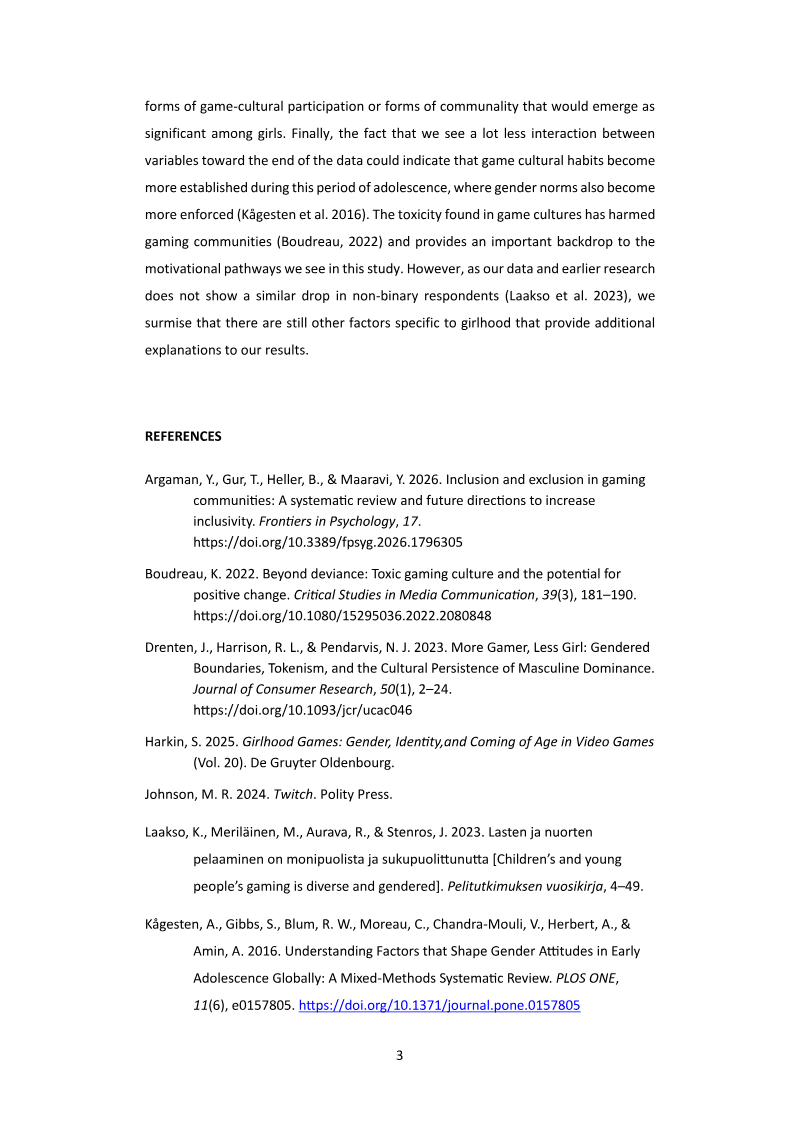
This study examines the barriers that non-male players face in Magic: The Gathering communities and the strategies they use to participate despite them. Drawing on a mixed-methods design combining a survey of 324 respondents with 14 follow-up interviews, the research identifies economic, cultural, and social obstacles, along with knowledge gaps, as principal constraints on participation. Its central thesis is that these barriers are rooted in exclusionary cultural norms, male-dominated discourse, and localized "idiocultures" that restrict access to mentorship and community belonging.
A notable methodological finding concerns the gap between survey and interview data. Survey respondents were reluctant to openly report discomfort, and sentiment analysis showed only small differences across gender groups that did not reach conventional statistical significance. Interviews, conducted in more supportive settings, surfaced detailed accounts of stereotyping, being overlooked in tournaments, and substantial emotional labour, suggesting that standard self-report instruments may understate the lived experience of exclusion.
In response to these barriers, participants have built alternative community structures, including women-only events, queer-friendly groups, supportive playgroups, and inclusive Commander leagues. The authors interpret these practices as forms of resistance and agency, and draw on participants' prior experiences as minorities to explain their resilience.
The authors conclude that Wizards of the Coast's emphasis on game competency does little to address these social barriers. They recommend that organizers, local game stores, and allies actively cultivate welcoming environments and inclusive practices to reduce the burden placed on marginalized players.
Each row is a game or company this document names, each column a document, oldest first. A mark means that document names it. Select a row to see those documents.

DiGRA · 2026

DiGRA · 2026



DiGRA · 2026



DiGRA · 2026



DiGRA · 2026



DiGRA · 2026



DiGRA · 2026



DiGRA · 2026

DiGRA · 2026



DiGRA · 2026



DiGRA · 2026

DiGRA · 2026
DiGRA · 2020