VideoTwo & a Half Gamers
🎯 The 2026 D2C Survey: Why 41% of studios still DON'T have a web store (and why they're wrong)
19 Aug 202646 min video
91 of studios have over $10 million a year in revenue. So again, big studios, big game publishers here that were trying to get in the door. Um, pretty evenly split across US and Europe. It was 48% US, 52% Europe. So really focusing on the Western market. And last thing is it's pretty well split across genres as well. So it's 58% casual, 42% core. Rolling the dice but day [music] drops knowledge made of golden ice. Felix with ads making those coins rise. Jack up designs worlds chasing the sky. We're the two and a half gamers. [music] The midnight crew talking UA adverts and game design too. M feeling shak bringing the insight. We're rocking [music] those vibes till the early day master eyes on the prize. Tracking data through the cyber [music] space. Feeling stacks like a wizard in disguise. Jacks to the high. Two and a half gamers talking [music] smack. Slow hockey stick got your back. Ads are beautiful, they light the way. Click it fast, don't
delay. Uh-huh. Uh-huh. Uh-huh. [music] [music] Countdown. Hello everybody. Welcome to D2C trends. That that's that's how we started calling this episode because it's very important for for everybody and we talk D2C. Today we're going to talk about some numbers survey and many more things. My name is Matthew.
I'm Selich Broberg
and I'm Kubra and I'm Chip Thirstston.
Exactly. And we are your hosts. Welcome Chip again. We love you here and this is always a pleasure. Yeah, I love being here. I was I was looking back at my calendar. This is number six. Can't believe it.
And these episodes are really like
they're very popular. Let's let's call it that way. Very popular because we're talking about interesting stuff and interesting numbers, which brings me to your survey because you did it last year and we kind of touched it last year. Let's touch it a little bit more this time. How about How about that?
So, we repeated the survey this year. I And I do want to I think set the table a little bit with context on the survey itself because I was listening back to last year's podcast after the survey and we just kind of jumped into the data and
some of the commentary I saw from that was people asking, okay, how did they arrive at this data? Like what questions were they asking? And so I wanted to share a little bit about who we surveyed
to get at some of these responses and also as we go through I'll try to articulate the actual question that we asked because I think certain prompts can elicit certain responses and so I know the the minutia of a survey is not the most exciting part but I think that
will help reinforce some of the conclusions that we're drawing.
Context is very important always so it's okay.
Yeah absolutely. So this survey also I'll say the survey is getting published on fastpring.gg. This will get published August 24th. Uh so very shortly after we go live here and little bit about this survey itself.
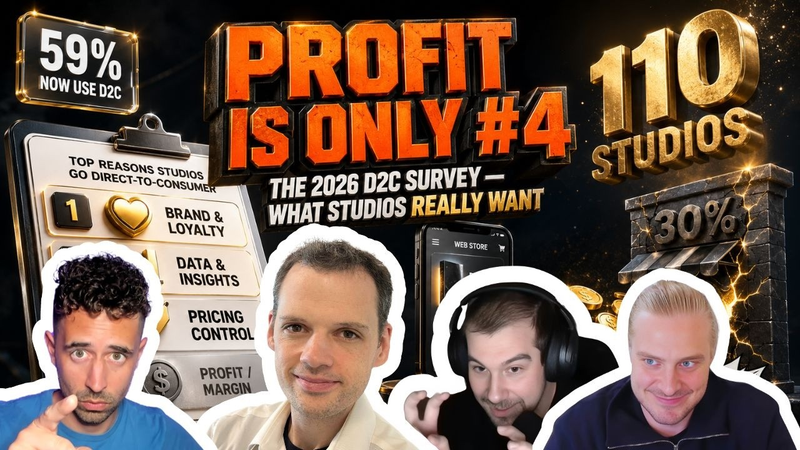
So this ran in Q2 this year. It ran from April to June 2026. We got 110 respondents and that was because we were very qualified in who we wanted to get responding to this survey. And this is something I think in retrospect I didn't emphasize clearly enough last year. This is a very strategic view of DTOC. not meant to be the tactical boots on the ground. What's uh going on with DOC, it's meant to be the senior level view. So, every person that responded to this survey was a senior manager or higher. So, senior manager, director, executive, even seuite. A quarter of the respondents were from the seuite of studios. All of them were developers across iOS and Android. So, it's a very
mobile ccentric survey because that's where we're seeing the most DTOC adoption. 92 of respondents were from companies over 100 people. So, we cut out a lot of the small indie studios. These are sizable studios. 91 of studios have over $10 million a year in revenue. So, again, big studios, big game publishers here that we're trying to get in the door. Um, pretty evenly split across US and Europe. It was 48% US, 52% Europe. So, really f focusing on the Western market. And last thing is it's pretty well split across genres as well. So it's 58% casual, 42% core. So and that includes like midcore hardcore or casual hybrid casual. I'm kind of bucketing things up into just a very binary split there. So I threw out a lot of numbers, but I wanted to at least give that context because that's what gives me confidence in these results as a snapshot of DTOC right now.
Yeah, it's it's a very good mix of of people because we always talk about different genres and also different sizes of the companies. Even I asked last time like what's the minimum size of the the revenue when I should be actually thinking about introducing a web store? So this is nice.
Yeah. So was there a specific question you wanted to start with or do you want me to to jump into some of the insights that we got here? I think we can jump into the insights first.
Question after
question after insights first questions after.
Okay. Okay. And before before the big reveal. I'll I'll also clarify this is this is a world premiere. This is like a two and a half gamers debut. This these I have not talked about these elsewhere.
I'll be talking about them at Gamescom, but you know haven't talked about these elsewhere yet. We haven't published content on these yet. So this is we're we're breaking the seal here.
Yay.
Yes. Well, our listeners know that this is where you go to stay two and a half
two and a half steps ahead of the curve, right? So, this is Yeah, this is a Tuesday for us. [laughter]
That's it. Oh, come to come to two and a half gamers for all your breaking news.
There we go. So I think the headline coming out is when we structure this survey, we ask a number of qualifying questions and then we ask about do you currently make use of DTOC and then we split the survey based on if they say yes or no. If they say yes, I make use of DTOC, we ask them questions. If they say no, we ask them questions. Well, we did the same thing last year and one thing I love now is we have this time series of data. It's not just a snapshot of today, but we have results from this year and we can compare that against the results from last year. So I'll do that throughout. So we asked them the exact question was do you make use of a direct to consumer web store currently? Yes or no? That was the question. The results said 59% yes, 41% no as of this year. Last year that
was 57% yes.
43% no. So, very slight increase from 57% yes to 59% yes, but still not not as significant a change as I was expecting year-over-year.
What would you what what were you expecting? Did you think like it's going to be like 70%.
Yeah. Yeah. Somewhere in that range. Because last year for those that did not have a web store, we asked them, are you planning to have a web store? And we we specifically asked, are you planning to make use of a web store in the next 12 months? [laughter] 60 60% said they were
so I think
people talk don't forget people talk plans always there always plans
always pl exactly that that's the the conclusion for me you want to kind of mash all this together is we game development is hard right it's hard to prioritize it's hard to get things delivered to fruition on a roadmap and things come up and so in a vacuum like
yes maybe I'm asked about DOC and I do plan to launch DTOC if I don't have that today and I plan to launch it in the next 12 months but then a bug happens or a new feature idea comes up or some organizational change happens and it delays my road map and things get delayed and so what's reassuring to me is when we asked again in the current moment do you plan to make use of a web store 91% said yes so we're still planning it we're still saying yes we plan to do it and actually 67% now say yes within the next 12 months So we are seeing greater adoption. We're seeing more people continue to plan for it. So basically the plans are continuing even if the delivery may not be quite in line with what people were expecting a year ago.
Well, let's see if the adoption rate will increase next year. [snorts] I'm looking forward.
Yeah. So
so the next stop was okay if they don't have a web store. I want to understand
that more. So what's what's causing that delay in adoption or that hesitation? Um so we asked the the exact question was what are the main reasons for not adopting a DTOC web store? 56% the top reason said DTOC is too technically complex to implement.
So this is where I'll get into what I think of as some of the misconceptions about DTOC right now. I think there are these perceptions holding publishers back from adoption of DTOC solutions and I think technical complexity is one because in a sense that's largely the function of a merchant of record. I think there's some conflation of a merchant of record versus a payment service provider and
people still don't understand about these things
two terms.
Yes.
Let me let me try to unpack that then. So, a payment service provider, the first name that comes to mind might be Stripe. Stripe is
great as a payment service provider to process payments. And so, if you make a
web store, you can use Stripe and they can process payments for you, but they don't handle everything beyond that. Meaning, they won't handle the tax remitt. They won't have that global reach of compliance across different countries and the taxes. They're not the actual merchant. You are the merchant of record in this scenario, meaning you're selling the product and you're accountable for the taxes and the global scale of compliance. And so if there's an audit in Germany, for example, that would come to you and they would say, "Hey, we need these records. We need to just the financial due diligence of all these things." That's if you use a payment service provider. And that's where I could see okay yeah the technical complexity is pretty significant because you need a team internally yeah financial a finance team to handle all these things.
If you use a merchant of record like fastring we handle all that because we're the ones actually selling the product. We're the actual merchant of record in this scenario. Meaning we sell on a global scale and insulate you from all that financial complexity. So we
handle the taxes. You don't worry about taxes globally. We handle anything when it comes to life. There's an audit. They come to us. they don't come to you. We're on the hook for that. We have the records and the compliance for that. So, we are a turnkey solution to enable global sales. And so, when looking at the solution, the the backend provider that you're using for a DTOC solution, it's very important to understand the merchant of record versus the payment service provider because there is an extremely different level of complexity that comes along with that.
But I need both. Yeah. as a company
I I will say no because the merchant of record insulates you from that again so a merchant of record might use different payment service providers or they might have direct relationships with payment methods but the point is if you use a merchant of record you don't worry about that if you use Fastpring you don't worry about are they using Stripe do they have a direct relationship with Visa and Mastercard or whatever you just say Fastpring is processing my payments and they're handling all of that and I
just need to worry about getting my players into my web store as best I can and merchandising and keeping them in the game and all the game metrics that we want to care about. You don't worry about the complexity of the the payment service provider situation.
Okay. So if I'm using a payment provider, I need to be the merchant of record and either find someone else or be myself responsible for the whole legal mambo jumbo or I use the merchant of record which will also handle the transaction pro provider stuff which means I don't need to do anything basically as a developer whereas I just work with the merchant of record company.
Exactly.
Okay, now we're moving somewhere.
Now we're moving somewhere. But that's why I think when we ask this question right going back to the survey what are the main reasons for not adopting a web store and the top response I see is it's too technically complex to implement
well I think that's rooted in this misunderstanding about these two terms as a payment service provider
now what about the sorry if interject here like what about the complexity I've
heard about how to bundle what you're actually going to have in your web store and how to decide how to yeah what discounts and stuff like that cuz that's also one of the things I've heard that's supposedly complicated. Is there any best practices there or is that just also
isn't this like basic monetization economy stuff like you know you have in the game?
Yeah.
Yeah. Yeah. I think I think that's the right way to put it is it's really boiling down to economy management, right? It's saying I have another vector for players to source any currency whether it's soft currency, hard currency, whatever it is, and I need to be able to effectively manage that. And the tricky part about that that I think you're alluding to here is typically that source is a bit more a bit more generous than what's inside the game. Meaning I might offer 10% more for purchases on my web store, 20% more. I have to determine what that right number is and that can disrupt my economy. And so yeah, that is something that a game
needs to be able to accommodate to do this optimally. But that's also part of just managing the economy of the game. And I think part of the the scale of what is coming with direct to consumer now
like let me just chip in here also that you don't want to underell your economy because it's going to web store the first thing you also need to care about your margin that's the other thing and then of course the last thing which is like the resources and all these things are coming because even offers themselves or whatever there's in the game these are limited doesn't mean that like again but this again this is basic monetization economy knowledge whatever if this doesn't work in your game it won't work in your web store it's There's another vector where it will be broken most probably. If it's good is in your game, it will be most probably also good in your web store. That's it.
Yeah. Yeah. I at the most basic level, I think of it as source versus sync. When I go back to my economy 101, right? And with the web store, you're increasing your sourcing. So, your economy needs to have a way to increase the sync from your players. If you can do that
successfully, great. Bring in the web store. If you can't well you don't have a very flexible economy and malleable economy to accommodate this thing. So I think the other piece that could be part of the technical complexity is there is some onboarding when it comes to a merchant of record. I don't want to glaze over that. there is the need to tether together the backends, the product catalog, have the fulfillment speak to one another and those kind of things, but at the end of the day, that's a pretty lightweight integration for what becomes a recurring revenue stream and a recurring data stream. And we could talk about the reasons to go direct to consumer, but I think that might be getting overindexed as well in some of this data to say, "Oh, that's that's a lot of work." When realistically, we've had customers go live within the same week. It really depends on the publisher how much how quickly they want to move, but it's not it's not a huge organizational burden to say, I'm going to bolt on this web store to my store.
Easier said than done.
I think like this boils down again to
like agility of any company that's doing or dealing with these kind of let's say background services, technical engineering stuff. It's just like if you're slow, you will be slow. That's it.
Yeah. Yeah. Exactly. And I think we see that borne out in the data when we see the adoption has increased from 57% to 59% this year even though people said they intended much higher than that.
The second reason
we know we know why everybody's scared not to implement the web store.
Yeah.
Who is going to say
fear?
Yes.
Fear
the I am s. So the second reason when we asked what are the main reasons for not adopting web store top reason was technical complexity. The second reason was they don't want to damage relationships with Apple and Google and other platform holders.
Oh that's such a political way of sending fear.
So so that came in at 51% of respondents for people who don't have a store. My take on this is that's a perspective
anchored in the past because there were real repercussions for pursuing DTOC. I saw some of those firsthand, but that was back in 2023. That was three years ago. It was a lifetime ago in game development.
Yeah, I love that.
In 2026, Apple and Google have defined policies for DTOC compliance. And I have seen this anecdotally, I have seen zero consequence for publishers who are abiding by these policies. And I have been looking and asking and I have not heard about something. But more importantly, Apple and Google are saying if you abide by these policies, we allow you to steer direct to consumer. It's not it's no longer this clo and dagger strategy of, oh, I hope I can do this without them finding out. It's saying, I'm going to do this. I'm going to submit it to Apple and Google and they will approve it and I can move forward with this. And so I do think there's this like historical anchoring of expectations saying that a few years ago this was the case and there would be these repercussions and therefore I am more hesitant to act today and I think
people are missing out on the DTOC opportunity as a result. There's still what if and the big question mark and also if the D2C revenue is not potentially higher than the organic revenue they're the companies are getting from the actual store featuring and the relationship then
which I think which I think in 90% of cases they don't.
Yeah. Yeah.
Let's be honest.
Let's be honest. Yes.
But there's al there's also that thing that organic users let's just say it out loud. They suck. like they're not good anymore. Like [laughter] it's not good for ads, not good for IEPs.
I I do think there's a misunderstood tradeoff between those two, though. It's it's there's this inherent assumption there that the greater success I see with my web store, the lower success I'll see with organics. And I haven't seen that be the case either. If you go look at the top featured games on the store, they have web stores and they have successful web stores. like you,
they are top games that have very successful web stores. If you see maybe you're even on Reddit and you see ads from Apple promoting the app store with certain games called out, those games have web stores. These games aren't getting blacklisted because they have a web store. They're not even getting like they're still getting paid promotion from the platforms despite these stores. And so I think there's this real normalization that's happening now with web stores in a way that we didn't see a few years ago. And so that's again why I think this this fear of consequence and repercussion is a bit overblown.
I think when we were in China, we were talking to our friend and he was like, "Oh my god, everybody's talking to me." Like, "Oh, what's happening with your game? The revenue on center is declining." And they're like, "And
yep,
it was the best quarter ever." I mean, we are up by 50%. Like, what are you talking about? Like, hello, web stores. [laughter] It was a very Yeah, it was a really good conversation.
Yeah. Yeah. And we see that that's a microcosm of the entire industry. I'll see industry reports like the industry is down 2% this year or whatever, but then there's a big asterisk at the bottom and it's excluding web store revenue and then you see you see these reports that games are shifting 50 60 70% of revenue to web stores. It's like well I'm not saying the entire industry is shifting that much certainly but I do think there's a significant gap in the reality between what's getting reported when this this web store data is getting omitted. So I think there's a separate question around like data and the insights that we have and major platforms are working to solve that which is great but in the meantime it has really clouded the perception of the industry.
Oh yeah. So the third reason for not pursuing web stores was at 47% legal and regulatory uncertainty. So
what does that even mean?
I think it goes back to our discussion was the deadlines on latest courts that
are happening.
Makes sense.
Yeah.
Yeah. I I suspect the recency of some regulations and the changes that have happened so quickly with regulations have made people question how long they will stay in place. I think you're saying, wait, this one happened in April last year, this one in October, this one in May of 2026. Like everything is changing every day. And I would say there there's a few things to consider when looking at the legal landscape right now. I guess three things. One, change creates opportunity. Like those that have acted on these new regulations have benefited significantly.
Go look at the last podcast that these four guys recorded here. We when we talked about this a few months ago, the entire time we were talking about these studios that are seeing 30 40% of revenue come via direct to consumer channels. And that's because they're capitalizing on the new regulations.
Well, hello. I still have it here. All all the numbers.
all the numbers until like we Q126 and I'm going to I'm going to kind of keep updating this because still like everything was increasing like just percentage 40% 40 44 27 41 44s come on
still friend is 44%. Jeez.
Yeah.
Whoa.
I have 46 actually now in the latest Q.
Yeah. So, it's
interesting.
Exactly. Like all these publicly available information. Thank you very much. Public companies.
Do you have MTG? MTG there.
TG here. 39.
Yeah.
So, yes. Swedes love a good deal.
So, yeah.
This just grows.
Exactly.
Yeah. So when when I hear legal and regulatory uncertainty is a reason not to do this. But then we see all these studios who have forged ahead and capitalized on that, right? They're capitalizing on the current opportunity and not missing out. They don't have an aversion to action because of these
fluid regulations. The second piece though is that the terms are solidifying. Like we're seeing the end of litigation between Epic and Google. So, Epic Ghoul have said with these new terms that are being rolled out over this quarter, they will no longer be in litigation with one another and that can give us more confidence as an industry to invest in DTOC solutions because the terms that they're agreeing to will be the foundation moving forward. I'm not guaranteeing they'll be in place forever. And I think certainly from country to country, we might see some variance maybe in attribution window or fee percentage or some minor part, but I think in general like we're we're getting a much clearer picture of what the future will look like. So if you are still averse and saying like I I don't want to invest while things might change, well I think we can be more confident things won't change. And actually that was specific to Google but even for Apple. So if we look at
Apple, uh they've been forced to comply in Japan and Brazil with offplatform payments. And so we can look at their terms for compliance in Japan and Brazil and take that as indicative of their policy to accommodate drug to consumer moving forward. Meaning allowing it with a fee on linked payments, having an attribution window on that fee, and those kind of things. So, I don't want to get too in the weeds on the regulations, but my bigger point on this is that there's certainty coming and we're seeing the foundation laid for direct to consumer for the long-term future. The other piece just legal and regulatory uncertainty is just that the genie is out of the bottle. Like, we're seeing this direct to consumer success and we're seeing it being normalized in a way it is with other industries. Like I I know if I want to go buy a keyboard, I can go buy that keyboard on Amazon and find the keyboard that I like, go buy it there. Say I find a Logitech keyboard and I can buy it there. Or I can go to Logitech's website, I can go buy it there. That's their direct monetization.
And that's just been normal. That's the way we all accept doing business in other industries, but it's been gated. It's been prevented in mobile gaming and gaming in general up until this point. And we're seeing the momentum continue to move against that. And so I think just the the momentum I guess is my third point on this where we're seeing studios as you drive 30 40% plus of revenue via direct to consumer channels and so that would give me confidence in investing in a direct to consumer solution as well.
Yeah. Also the the growth as we discussed is it's it's huge in share their revenue publicly and there's a lot of them still
but we know because we told
but we know yeah yeah exactly
can I frame this as a 2010 style Google interview question because I looked the numbers up before you know how many ping pong balls can you fit in 747 you know type type right walk me through walk me through your thinking apples the app store's gaming revenue last year was
released by Apple to been 52. How much would you estimate was earned from gaming on iOS only by all the D2C vendors? Like what kind of revenue capture did they do and how would you go about? Obviously, you don't know because Fastring is part of the ecosystem, but if you were to estimate right now, which is, you know, how many ping pong balls in a 747, what do you where do you think we're at? like how many billions on iOS is going through not Apple.
Okay, let's let's unpack this. Let's do this together. [laughter]
So, we need to break that down, right? Cuz that's not all G or I guess that is gaming revenue specifically, right?
Included. Okay. So, no mobile apps. Do we have the figure from 2024? because I think that can help inform just context on the figure from 2025.
So I'm sharing maybe Jak says it says 1% bump in revenue compared to 2024.
Oh, there you go.
Oh, here we go.
So yeah, it's a pretty flat, right? So
it's 1%. You have it in text. It's
Yeah, but I'm blown, Marty. I don't know how to read. We've been zoom. Stop embarrassing me.
Just just zoom in. [laughter] Yeah,
which was actually our spend. But then you have 0.6 year-over-year in revenue.
So nearly the same.
So nearly the same.
Nearly the same.
Okay. So yeah. So when I contrast this with let me reference this survey. Bear with me. I'm going to
thumb through some of my data here that I think
the two. Yeah.
Yeah. Well, we'll triangulate a response on this. So for those that do have a web store, we ask them what percentage of your overall revenue is being driven via direct to consumer
channels. And again, this is a snapshot, right? This is 110 respondents, but a wide array of western markets, senior decision makers. So of that 72% said over 10% of revenue, 34% said over 20% of So I could give you a more thorough breakout like in 10 percentile increments,
but the point is vast majority over 10% and a third of respondents over 20. So, if I kind of mash together the the numbers there and try to get an aggregate response, at least for our survey, maybe it's around 15% of revenueish for for those that do have a web store today.
So,
15% going off this survey as a ballpark number for those that have a web store. But remember, not everyone has a web store. Yep.
Right. So, of the the 50 plus million, what was it? 52 million you said came from Apple last year.
52.5 billion. Yeah.
Yeah. So if we marry that with let's say
60 Yeah. 59% have web stores today. Again just going off the survey. So we're looking at what like 30 million there is the slice of gaming revenue that theoretically has a web store. And then we take 15%. So now we're to what? Four and a half million.
Billion. Billion. Yeah. Yeah. So there's my, you know, finger in the wind kind of guess.
I would actually put a little bit higher finger because if I understand correctly, something like what like 10% of publishers drive 80% of revenue.
Exactly.
Which are which are again doing much more of these things. They're more robust and again top 100 probably have like borderline 60% of those have app stores and stuff like that. So maybe even like 20 25% already from the pie that I would put here.
So on iOS somewhere between 4 to 8 billion we can say maybe and then on
Android there will also be x billion. So are we comfortable around 10 billion? What do we think?
We'll say higher higher
higher
higher for sure
10 billion is only with the guys that use fast spring.
[laughter]
No, no, no comment. No, I Yeah, the scale of Android is lower, so accommodate for that in the the numbers, but yeah, I think that's fair. The other interesting part though is the regula regulatory difference between Apple and Google right now. So, they've kind of been similar up until this point, but as of Q3 2026, we're seeing Google implement more open policies when it comes to direct to consumer. And so, I think that exercise we did was about as accurate as we can get for now. But yeah,
I expect we'll start to see the Android trend accelerate and maybe overtake in terms of percentage of revenue what we've seen on Apple just because they're
allowing things like third-party app stores which would inherently have
non Google Play payments and things like even native payments are going to start to become possible through Google Play under the new new terms. So, I think we'll see more adoption there, too. The last two reasons, oh, I'll I'll circle back to reasons not to adopt a web store, just because I found these last two a bit resonant with some of the narratives that we've been talking about. The number four reason to not adopt a web store was they don't believe it would drive significant revenue. Just just going to throw that one out there. It's
a kind of a defeatist attitude.
Yeah,
I think probably won't like it. [laughter] Yeah,
that tells me 38% of respondents don't listen to Two and a Half Gamers because they didn't listen to the last time we talked about all the revenue that could be driven there. And the last one was 29% said it was too expensive to implement. And so again, this goes back
to the first point about like it if you're thinking of it as like the expense of implementation, it's a very myopic view. It's it's it's a very short-term investment to create like this recurring revenue stream and data stream. And so I think those last two are just like people fundamentally misunderstanding direct to consumer.
It sounds to me like people don't know how to count. Like you, you know, you do your math on your revenue. You slap in like some kind of I don't know 25% uh revenue share ratio expectation. You look at your margin that's coming from there instead of the normal web stores. Uh I mean like mobile stores and and that's it. And then like how much revenue we can get and duh and and like really especially if we if if you see all these like public examples of those big public companies doing it which is like what more do you need to see?
Yeah. Yeah. I agree. I think the data is out there and I think that's why conversations like this are important
though. That's that's beyond your lovely personalities. That's what keeps me coming back to this is that I think this kind of information needs to continue to get propagated because otherwise there is this continued misunderstanding of direct to consumer in terms of integration and the cost of integration and the future revenue potential and all these different parts of it.
The other interesting part if I go back to the survey the other part that really stood out to me was why people do pursue direct to consumer and how that's evolving. how that perception of what's possible is shifting for those that do know. So those that understand direct to consumer that do have a web store today profit is not the main reason. The margin is not the main reason. That's the main narrative. That's what everyone talks about when talking about direct to consumer. Last year it was the number three answer that we saw. This year it was the number four answer in terms of the question was what were the main reasons for adopting a DTOC web store and increased profit margins was number four on responses. Above that number one
was improve brand visibility and loyalty.
Number two number two was improve access to customer data and insights. And number three was gain control over pricing and promotions. And so none of those have to do with profit. Number four was increased profit margins. And so we can we can unpack those each one by one and the opportunity that publishers see with them. But
to me, the really interesting part is that it's it's that contrarian perspective of saying, "Yes, profit is important. Yes, profit is a huge benefit that you're not beholdened to this 30% share with the major platforms. But there are these key other benefits here that publishers are saying actually more impactful and more of a reason to pursue direct to consumer than just the profit margin. I think this goes hand inhand exactly with the fact that how well is the execution of the web store done not only in the context of pricing and like actual you know the profit main thing that we talking about but as you said
branding stuff like promotions promotion like you know you go open super web store you see it's like different experience that you don't don't see literally with like any any other game or like that's not that common and I think it goes boils down literally to this like two different things Like setting the mat right is one thing but also setting all the like let's say the source around the mat is a completely different thing which again gives you giant advantage if done properly
freedom.
Yeah. Yeah. I think that that's very well said. The best web stores the best direct to consumer experiences that I've seen are a complimentary experience to the mobile game. It's not just a store page. It's not just a place to go buy something and jump back into the game. It's a place where I can go I can read more in depth about different features and updates in the game, maybe from a game blog. I can go there for support or anything to a deeper level than what I can get in the game. I can go there to see leaderboards or maybe vote in some
content that will influence the future of the game. I can go there to engage with the community in other ways. And that's all outside of the web store. But to me, when I think about the top response here, which is improve brand visibility and loyalty, that's what it means is you're giving players something to do with your game outside of the game itself. And there's a lot of value in that.
For sure. Definitely. And again, you you can do it on your own website. You are not even, you know, forced to do it on the social network. That's it.
It's Yeah, it's shocking. It's like a company that makes millions wants to control their like the relationship with their like customers. Like what? Like look. Yeah, it makes complete sense.
Yeah. Yeah. And I I didn't give the percentage, but 66% of respondents who have a web store said that was the main reason for adopting a web store or they could select multiple answers, but that was highlighted just one of the answers selected. So, it's a key reason and I think something that isn't talked about enough when it comes to web stores, but I also think it can almost become a barrier to adoption because if I'm a
publisher who hasn't invested in a web store yet, I say, "Wait, now I have to make all these other pages. I have to make a community hub and I have to make these leaderboards and a blog. I just want to like get a store up and running. Then get a store up and running like start
you know crawl yesterday going. So I think it's something certainly to strive for to create a plan for this this program to enhance your brand visibility and loyalty but don't feel the need to do that from day one. Just get started and grow and iterate from there and then you can reap the benefits down the line. Secondarily, it was improve access to customer data and insights. The customer data from a first-party channel is very powerful. Even something as simple as an email address that you get when someone purchases via your direct to consumer platform is something you don't get when they purchase on mobile. And that can be a powerful thing, powerful tool for you to leverage. It could be powerful data for remarketing and retargeting purposes to get them back into your game or even back into your web store if that's where you want to funnel them even for existing players. There's just so much
more data you get. And I'm sure we're just scratching the surface. Like, I'm sure data science can do a lot more than those very surface level examples I gave of what to do with this data. But customer data insights, you're not just creating this profit stream. You're creating this data stream. And that is really healthy for the future of your game as well.
Data is always more beneficial for for me as a UA manager. So,
yeah. And third was gain more control over pricing and promotions. This one is more for the economy managers out there saying you're you don't have the guardrails of the stores, right? So, I'm sure you can think of ways you would go
$500 purchases.
Yes, I mean [laughter] can still see those on the store, but hello more information and data for this. You can do stuff that's again even like just manage stuff much easier because even when you change pricing you need to again go through approval da da da da da all these things like of course much more freedom.
Yeah.
Yeah. So if I try to take a step back
and look at reasons why games pursue direct to consumer terms of the data, brand visibility, loyalty, and then I look at the flip side, look at why people don't pursue it and the misconceptions around technical complexity, relationships with Apple and Google, legal uncertainty, and then I look at a third piece, which is the new terms, the new regulations on linked payments coming from Apple and Google and the fact that there will Now, in the future, at least on Android, be these fees on payments. Meaning, if I after October 1st, 2026, if I steer a user from my game into a web store, I would pay 20% of that revenue to Google. That's the new term with a 24-hour attribution window, meaning any purchases over a 24-hour period have that 20% fee attached. But when I and that sounds scary, but when I think about the reasons to pursue direct to consumer, those don't change. You're still getting the branding, visibility, the data, all those top reasons to
pursue the pricing and promotion control, those all still hold with these new regulations. When I think about the reasons not to pursue DTOC, legal and regulatory uncertainty will become less of a factor. The relationship with Google is more preserved because now you're abiding by their new policy. You're cutting them into revenue even so you don't have to worry about upsetting your relationship with them. And so this is where I think these are a great thing for direct to consumer because they're also limited in scope. And so it accomplishes these things of giving us more confidence in the relationships and the the certainty around legal also saying I'll treat that as a very short-term cost to funnel players into my web store and then have this recurring stream of revenue. talked about that piece before, but I think it was really interesting to contrast that with the results from this survey and how it aligns with reasons companies are pursuing direct to consumer today and uh some of the misconceptions that are still holding stores back or publishers back from adopting direct to consumer today. pretty compreh
by the way. Do we have or I don't know if you still have more on the like a reason side, but do we have any updates on the courts?
No significant updates since the last time we spoke.
I think Google the latest on the US with Google is still working to roll out their strategy. They have what's called the external content links program rolling that out for any any game that links off platform. Yeah. And so the latest with that is like I said October 1st is when they intend to start implementing these fees. That date is new. That's something we didn't have last time we spoke but October 1st is their current date. Of course can always change as these dates have changed in the past but that's the current date for which they plan to start charging the fees on specifically on linked payments for direct to consumer. on Apple. They are continuing to appeal these regulations in the United States. They're exhausting all their legal options. The last I heard is that it's going up to the United States Supreme
Court. The Supreme Court agreed to hear the case, and so we will see where that goes. But in the meantime, as I mentioned briefly earlier, Apple has started compliance in both Japan and Brazil. And so you can look up Japan compliance and Brazil compliance, and they're basically identical in terms of how they're structured. And so that's why I think that's the bellweather for what their compliance will look like in the United States and elsewhere once that compliance is actually required. And that means very similar to Google having a fee on linked payments with an attribution window attached. Apple's attribution window is currently stated at 7 days. So any payments over seven days after someone is linked from the game into the web store would have this fee attached that you pay to Apple. Again, that could change from one country to the next, but I'm also reading the tea leaves here. Apple has not announced that, and I want to be clear with this. Apple has not announced that as a policy in the United States. They have not announced that as policy elsewhere. It's only a policy in Japan and Brazil right now. And so,
that's the policy that I'm keeping an eye on to see does that propagate out to more regions as we have more complaints. If that policy does start to propagate out more broadly, that's what I expect will happen is we as publishers have to become strategic to that degree in how we navigate players from the mobile game into the web store, how we structure the offers that are on the web store to account for these fees, encounter them when it makes sense and treat them as a cost to acquire these customers on the web store, but then do everything we can use the other tools to drive the recurring purchases in the web store, which I think will become the future of direct to consumer growth. Can we when gamification get hold of this?
Well, people are creative when
people will be always creative. Yeah. Comes to money.
When it comes to money, 100%. 100%. Oh my god. Yes. Lot of interesting numbers. A lot of interesting numbers.
Yeah. We just scratched the surface on the survey. I don't We went through a lot, but there's there's a lot more.
There's a lot more. There's a lot more.
Going to add the the link to the survey into the show notes as soon as it's
live.
Yes, please do. So, can I can I plug the survey really quick?
Yeah, absolutely.
Go ahead.
Thank you. So, August 24th is the date we will have this survey live on fastpring.gg. You can go check it out there or in the show notes. Thank for that. Also, that's the first day of Gamescom and Gamescom dev. And so, our Fastpring team will be out there. I'll be giving a talk that Monday about the survey going a bit more in-depth on certain data points there. I've also got a panel on Tuesday if anyone's listening and out there at Gamescom. That'll be about player connections and broader topics than just direct to consumer. We've also got a couple mixers Wednesday night, Thursday night. So, if anyone is they're not open invitations, but if anyone is listening and reaches out to me, I will be flattered and so I will get you into those mixers. So, just just let me know.
Very cool. Nice. Go going all in for Gamescom with survey data and mixers and networking. Sounds Sounds like fun.
Yeah. Yeah, it'll be fun.
Sounds like fun. Nice.
You should go.
Uh yeah, next year. Next year, man. Next year. We had a little break from Gamescom. Let's see how it goes for next year.
Chinese break.
Chinese break. Exactly. Yes.
Nice. Thanks you for coming. Uh anything else you want to share with the with the audience or let's leave it for the actual survey. So people go to the fastpring.gg, GG. Check the survey or to the show notes or just join the Slack channel and ask your questions there or under the video. Up to you guys.
Yes, all good places. But I I think we can leave it at that.
Yes. Perfect. Thanks guys for coming also again, Chip. Pleasure to have you on the podcast. Until next time. Bye guys. Bye.
Auto-generated captions from YouTube — names and numbers may be misheard.
The mobile gaming industry is currently undergoing a strategic pivot toward direct-to-consumer (D2C) channels, with 59% of studios now operating web stores. Despite a widespread intention among the remaining 41% to launch their own storefronts, adoption has stagnated due to persistent concerns regarding technical complexity, legal compliance, and potential friction with platform holders. These barriers are increasingly viewed as outdated, as modern merchant-of-record providers now manage the intricacies of global tax and regulatory compliance, while major platforms have established clearer, albeit fee-based, pathways for external payments.
Contrary to the assumption that bypassing platform fees is the primary motivation for D2C expansion, studios now prioritize brand visibility, access to first-party customer data, and greater control over pricing and promotional strategies. This shift reflects a broader industry recognition that owning the player relationship is a more sustainable competitive advantage than simple margin optimization. Studios that have successfully integrated these channels report that D2C revenue now accounts for 30% to 46% of their total income, demonstrating significant financial viability despite the initial investment requirements.
The regulatory landscape remains a critical factor, particularly with Google’s impending implementation of fees on external linked payments and Apple’s ongoing global policy adjustments. As international models—such as those seen in Japan and Brazil—introduce specific attribution windows for fees, the industry must adapt its offer structures to mitigate costs. Ultimately, the strategic value of web stores as hubs for community engagement and data-driven marketing outweighs the challenges of navigating these evolving platform policies. Studios that fail to establish a direct connection with their player base risk losing critical insights and autonomy in an increasingly complex digital ecosystem.

Two & a Half Gamers · 2026

Two & a Half Gamers · 2026

Two & a Half Gamers · 2026

Two & a Half Gamers · 2026

Two & a Half Gamers · 2026

Two & a Half Gamers · 2026

Two & a Half Gamers · 2026

Two & a Half Gamers · 2026

Two & a Half Gamers · 2026

Two & a Half Gamers · 2026

Two & a Half Gamers · 2026

Two & a Half Gamers · 2026

Deconstructor of Fun · 2026

Deconstructor of Fun · 2026

Two & a Half Gamers · 2026

Two & a Half Gamers · 2026

Two & a Half Gamers · 2026

Two & a Half Gamers · 2026

Deconstructor of Fun · 2026

Deconstructor of Fun · 2026

Deconstructor of Fun · 2026

Two & a Half Gamers · 2026

Deconstructor of Fun · 2026

Two & a Half Gamers · 2026
Comments