VideoPocketGamer.biz
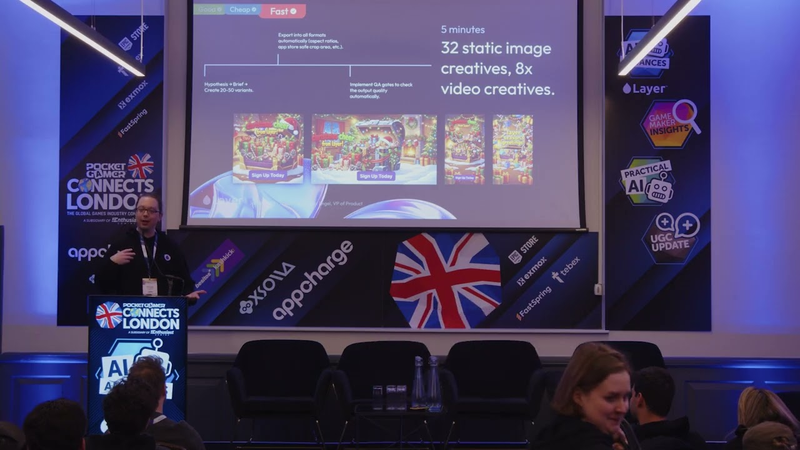
Session: AI Creative Factory: How We Scaled Performance Creative Without Scaling Costs - A. Kempe.
1 Jul 202618 min video
Transcript
[music]
So, right now we have to welcome to the stage Andre Kempe from Admar Media who's going to talk about the AI creative factory, how we scale performance creative performance creative without scaling costs. So, to bring him up here and get him set up. So, just a moment there while you you get set up there on stage.
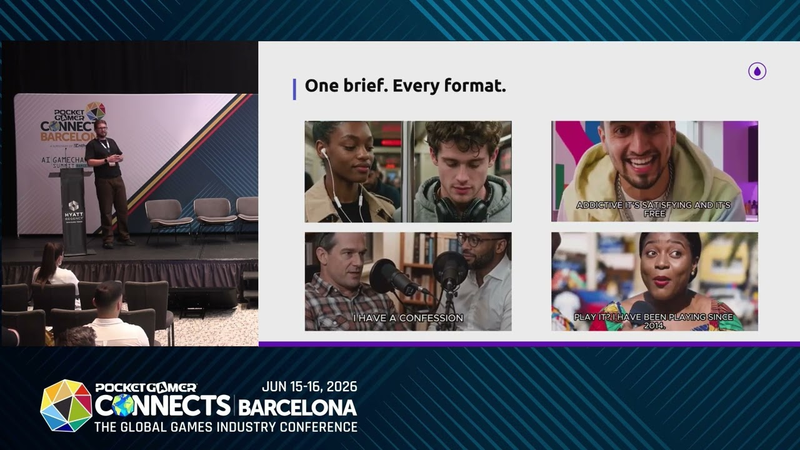
I don't need Thanks for having me. Um Who of you is actually involved in creative production either on the production side or on the demand side from the user acquisition department? Hands up. So, it's a few people. Can you identify yourself with this uh
image here? Um the demand for creatives has increased dramatically over the course of the last 12 months, I would say, or even a little longer. Some years ago, creatives were basically just a little thing that was running on the side. We had maybe um when we worked with clients, we had maybe uh a million-dollar budget spent, but when we we are asking our clients to invest maybe 1,000 euro into creative production, it was super expensive for them. Um this has changed a lot. The investment side on the creative production has increased dramatically. And with that being said, we needed to come from individual workflows where a producer is nowadays using AI to create one ad, we needed to get to a point where we are basically resembling the moving assembly line that Henry Ford invented to make cars cheaper with a way faster way to produce them.
So, this moving assembly line is basically the industrial industrialization that we are seeking in creative production. We need to move away from individual prompting and get to a point where a system is being used department-wide, is using knowledge that exists department-wide or even company-wide, and uses frameworks um that produce creatives on large scale with the click of a button. And this is what I wanted to go through a little bit, not to sell you something, but maybe to give you a little bit of inspiration how you can actually work with AI in a broader scale. So, when you were producing maybe 50 ads a week, you want to scale to 500 ads a week. But why do we need to do this actually? Well, there's plenty of evidence out there that when you increase the creative concepts that you're putting into Facebook, Google, Snapchat, TikTok, you name it, that it will have a positive impact on any of your KPIs that you're trying to
optimize for. If it's CPI, if it's the hook rate, if it's the IPM, whatsoever, there are certainly some sort of case study out there proving that the increased upload of new concepts uh gives you better results. So, when I mean new creatives, I do not necessarily mean new variants of creatives because also the algorithms gets up get updated, right? Facebook just recently released an update that basically requires us to constantly upload new concepts, new completely new uh ideas of creatives. Why is that? Well, the users are bored by just seeing the same thing in a new iteration with a new background, maybe a little bit of a new face, but uh the the copy is the same, the idea of the ad is the same. And the interest of Meta is to keep the user engaged in their feed and with their content. And our ads are content. That's That's the whole point. Um I I guess TikTok got famous by promoting
basically make TikTok not ads. And this is exactly what our job is, right? Before I go into the way we do it in Admiral Media, how we industrialize creative ideation, this is basically the way we produce new concepts. Um Few words about us. I created the company like 7 years ago. I have a long history in mobile app performance marketing, was ahead of CMO head of performance marketing and CMO in different startups. With Admiral Media, we started as a user acquisition agency. So, we know all things about attribution, tracking, campaign management, these kind of things. But we also have a growing creative production department. And AI is obviously a big part of that. We work with a bunch of very big gaming studios already and help them scaling their creative production. I said before we need new concepts, not necessarily just variants. And how do we get there? Well, I guess many of you tried this before. You go into the Facebook ads
library, you type in your competitor name, you get inspired. Maybe you're even using some ads by tool SocialPeta, you name it. There's plenty of tools out there. But again, this is an individual use case. You are the performance marketer, you are the creative strategist, you're going into some tool, you're scanning something, you have your one one concept idea that you're then briefing into the production. You may scroll through App Store reviews. You may have other ideas where you can find hooks or things that your customers are talking about, what they find good so that you can use that as a hook in your ads. And last but not least, obviously, use of AI is happening. We all jump into ChatGPT, Gemini, Claude, you name it, and do some individual prompting. At least that's what I'm seeing when I'm talking to other companies, other people, how they are leveraging AI. There are some CMO who is giving you as a producer or you as a performance marketer subscription a pro subscription
for Claude. And then you're sitting there and you need to develop your own ideas, but I'm saying you need to think about this in a in a in a larger scale. We want to industrialize creative production, and this means the 10 producers that you are having in your team, the 10 UA managers that you're having in your team, they should collaborate on the same tool in the end of the day, and not individual should not do their prompting individually and come up with their own workflows that are very different from each others. This basically leads to a point where you end up with some sort of developers would say spaghetti code. You have a very weird individual use of AI in the entire team. It's not really streamlined. Um so, it's far far away from a moving assembly line to use the picture from the beginning. So, what did we do? I will go into a little live demo in a second. So, what what we did is basically we
we get a client, we are looking into the guidelines of the client brand guidelines, communication guidelines, whatever they are briefing us. Um we get the personas, we do competitor research, we look into historic performance data, app store reviews. We may pull the API from AppTweak or some other tools to put all this information into one LLM. And we basically train the system on this particular project. And then we put a simple front end on top of this, and have basically one interface that everyone can use in the team, either the UA marketer or the creative strategist, um whoever is working on creative ideation. So, So, how does it look? Let me quickly jump in. Mhm, 1 second. I hope the internet is strong. Yes. So, that's a very simple interface that we
are building that everyone can use internally. Don't worry, this is nothing I'm selling. You can't buy this. This is something we use internally. So, simple interface for everyone in the team. You still have a prompt option, but it's not needed because the system is already trained on everything we've put into the system. So, you can basically go in every day and say, "I want to have new video concepts that are In this case, it's Star Chef 2 is the gaming is the game." So, it's obviously a cooking game. And I want to have something that goes into um a new recipe drop. Right? And then I say, "Okay, I want to have videos." And I click generate concepts and it starts producing first ideas. There was zero brain involved, right? So, there was there was no brainstorming meeting. There was no research needed. Nothing. It's already fed with all the information that is needed.
And it will now come up with a bunch of ideas that I could use in the production going forward. That means I'm getting a full storyboard, not just one, several storyboards with different ideas. It's using the game assets. It's using the brand guidelines. It's It's using the communication guidelines. It's using all the things that we were briefing. And when I say, "Okay, in the storyboard, there is maybe a nice hook explained. There's a voice over, an audio description, and so on and so on." So, I have all the information that I need to go into actual production. If I like one of the storyboards, I can just click generate video and I will get a first hook, let's say an 8-second video. This is just a minimized version of what we are building in-house. So, this video can then look like I will do it now. It takes a minute, but I've obviously prepared another one already.
Um where is it? One sec. Ah, there we go. So, this can look like this. A small Does it repeat? Exactly. So, a small video that is using the storyboard that it has produced before, and when the creative producer or the strategist likes the idea, it would then take it out, download it, and put it into the main production. Meaning, we can connect it obviously with, for example, in-game footage. Maybe there's a real UGC street interview thing that we are putting at the very beginning. How amazing is this game? The game is the most amazing game I've seen. Cut into a scene from the in-game footage, cut into a scene we've just produced with this little AI tool, end card done. So, this is what I mean with industrial production. There is a little bit of human involvement needed, but it's going back into just putting the pieces together to make make sense out out of the ad.
The ideation was typically the bottleneck because there was just as many ideas produced as many people were sitting in the room basically. It's a no-brainer. There's AI is there to help us produce more ideas, but usually they're very average. And that's why we need to have a bigger system that goes beyond just, "Hey, give me a new ad idea for my app." And this needs a lot of training data obviously, and that's why we are putting this all together and have such a system. Um maybe I give you one more example. So, I've seen Monopoly Go as a big booth here. So, I told my colleague, "Please make me a quick factory tool to demonstrate this here as well." Um, and I want to prompt something this time. We are in Barcelona. So, let's say Gaudi, you know who Gaudi is, right? The famous designer thing. Gaudi style background. Generate ideas.
And it's again basic So, Monopoly Go is not our client. We just scraped some assets and we are basically using what's available in public. Um, if it's working, no concept because probably the API is broken. Yeah, Um, that's when you do it overnight. But, let me see. Ah, here we go. Obviously, I prepared a little bit
[laughter]
for exactly that case. And this is here again a storyboard where I then just click generate video and it gives us exactly what we wanted, a small video hook, a small video idea that I can then take into production and can basically enhance my team to produce more ads than ever before. Um, let me jump back into the presentation. We can build it for any type of app. Also, we have like weight loss apps and whatnot where we can use real characters, do the street interviews,
other things with real AI AI characters. Um, and the results speak for themselves. So, with with this factory setting, we basically were able to increase the hook rates dramatically. We were able to reduce the CPIs, but probably it's the reason why is a little bit unclear to me, to be honest. I don't think that the ads are better. They are very often very much AI. I mean, you sometimes see what the output looks like. It's very obvious AI. We are trying to make this better. I believe the reason for the success is actually the sheer volume that we are putting into the system. The sheer volume of new concepts, not variants. And I think this is again, I need to repeat this. Producing new concepts is key to find more winners on your campaigns. And um To conclude this, my time is over anyways. You need more ads. Ideally
ideally not variants, but concepts. And you you need to think how you can industrialize AI in your team. This was just an inspiration how we do it. Maybe you have very different ideas. I'm very happy to discuss this with you. Um especially when it comes to the final production of a full 60 video 60-second video ad for AppLovin, for example. are still struggling a little bit. It takes a lot of human time to produce 10-second pieces, stitch them together, make them all look similar. So I'm very happy to find ways to improve that also. Yeah, and now we are coming to the most important slide. We are hosting an event on a boat tomorrow. If you're still around, we have like 80 people confirmed now. I think there's maybe spot space for 10 more. Um with a DJ, we go swimming, dancing, drinking, fooding, the whole thing. So
if you want to join tomorrow, sign up on growboat.io. Happy to see you there. Um and otherwise, if you just want to connect on LinkedIn, that's me.
Great. Thank you very much. Round of applause. Thank you. We started a moment late while you were setting up. So does anyone have a question? We can make time for a for a wavy one question if someone has that. Ah, I'm going to bring you a mic. There we go. We'll take one question and then we'll we'll move on.
Yeah, let's let's try. Thank you for your presentation. So, I have a question which is maybe outside of your normal scope, but I was wondering if you're planning to support also in example CRM on top of that. Like the idea here is like you have ads, but then you want to have a following up content that will be similar to what you are like attracting players towards the game. Is that something that you have in mind? Just like populate a lot of content that we can like pick up later.
Yeah, yeah, absolutely. So, we
definitely So, one thing is to use real in-game footage that we stitch together with the AI footage that we are producing. And the other hand, we are trying to think of playables for example where we obviously depending a lot on the assets from the game itself, but with AI this is still super difficult to be honest. It's the the the output is very bad that we are achieving at the moment. So, we are investigating, but it's but it's not going in the right direction yet. So, yeah, probably the most interesting would be to stitch it together with actual in-game footage. Maybe one thing that's important for some that are concerned about their very important IP in gaming. When you upload this to the AI tools, I haven't touched on this here, but it's important. When you upload your IP to the AI tools, very often in the T&Cs it's written like you give up on your IP. They can do whatever they want with it, right? So, I can understand that
clients say we you can only work with AI tools that have T&Cs that clearly exclude that type of use of intellectual property. Just just a side note.
[music]
Oh.
Auto-generated captions from YouTube — names and numbers may be misheard.
Key insights
Distilling the key insights…
Ask AI about this video
Cite this video
Citation
Generating citation…
















Comments