VideoPocketGamer.biz
Session: From Workflows to Agents: The AI Shift Redefining UA Creative Production - I. Kuznetsov.
1 Jul 202621 min video
Transcript
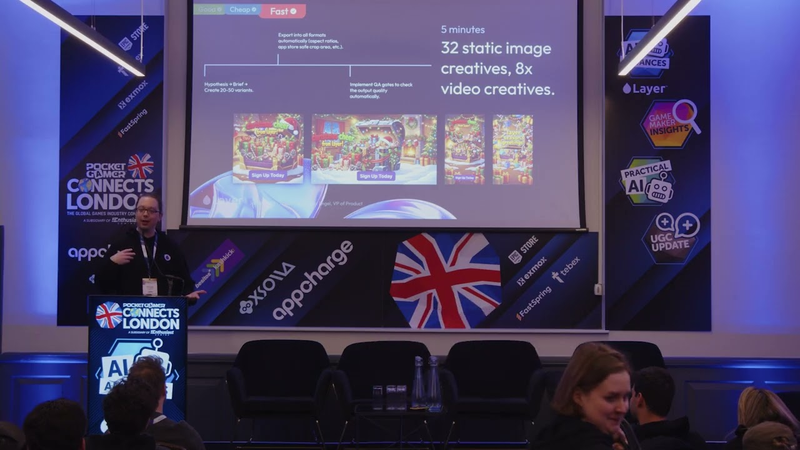
[music] We are going to be talking about from workflows to agents the AI shift redefining UA creative production user acquisition credit production and we've got here Ilia KNS from Leia AI I'd like to welcome you to the stage a round of applause for Ilia thank you hi everyone thanks for coming and I think this should be the hackiest room in this conference AI it's UA and uh people here most definitely know already one thing for sure so I'm going to skip
to the main part. You're not here to find out if AI can make ads. You already know that. You already settled that probably last year. And to really not waste your time, I really want to talk about the hardest part. This part that is still a is still a challenge and uh is where the moat is really hiding. Um before I go to the next slide, let's recall what what happened in the UA industry and the advertising industry. Um the networks, the ad tech providers, they pretty much took away the targeting, the bidding, the pace at which you run the ads. So the last lever that is really left in our hands is the creative. And if before it was all about finding the right user and knowing how to serve the ads in the right way to them, now it is all about finding the right ad and how to make many of them.
So there are many conceptions about how to make that and luckily there are developments in AI space that really allow us to take control of this and produce ads in uh in high volumes. And before we go further, I really want to share a couple of numbers because uh I think you don't need a lot of convincing. However, there has to be a proof that this works. And one of our partners, they shared the results with me uh last couple weeks ago. Uh and the ads that were generated by a fully automated workflow with UGC components have delivered 4% lower CPI versus their control group. It has delivered higher CTR at 7% higher CTR and 8% higher ROS. So that was just one month running this creative pack fully generated by AI. And I think if you look at the numbers singledigit numbers don't really you
know they sound a little bit modest but if you think about it at every every lever there is an increase and when you multiply it by the volume this really makes a difference. So, I see some people taking pictures. Maybe you want to take this up to the uh departments that still believe that AI is all about cutting costs. Not really. It's about improving your uh revenue metrics and uh profitability. And one thing that enabled this transformation was the workflows. um workflows have really helped teams produce creatives at scale. Uh it has automated many parts of it. It has provided uh teams the tools that don't require you to hire hundreds of people. Instead, you set up a workflow that fills uh fulfills a specific mission. For example, this is the format that many
teams have uh created. They they wired the workflows. They run ads like this. This is AIGC interviews kit and I'm sure many of you have seen these on your social media and advertising platforms. Um, and before the workflow uh was a thing uh it would take the team around a week to come up with the brief and then ship uh around three concepts in in the same week. after workflows, you you launch the workflow and you get, I don't know, 50 concepts same day and they're all sorted by geos, by uh targets, by demographic targets, and so on. But let's be honest about what a workflow really is. It's just a set of tasks that have been wired to fulfill and meet us to solve a specific problem. And in the market where we are right now, trends they change really fast. Market moves on steroids. So one workflow that you have
designed that delivered great results last week, this week may already not be useful and you need to go back into this wiring system, change the notes, change the prompts and do a lot of manual work. And that's not really what a lot of UA creative producers and UA managers have signed up for many years ago, but their job has transformed, but they've never asked for this. So the grind still stays the same. You have to manage your inputs by hand because well, the system doesn't know what kind of inputs you want to provide it. You still have to double check every creative output manually to see whether there is slop, whether it has actually delivered the message that you were trying to deliver with the ad. And the consistency, consistency is very important. If you have brand, if you have IP that is very strict and you want the ads to follow it, you still have to
verify it manually and probably send to your brand safety team to check, okay, can we run this? Um, but what if the system really understood what needs to be changed? What if the system knew what performs and it could actually build the pipeline by itself? It would know the trend. It would know you what performs best and it would rebuild the workflow, run it, test it, collect results and basically take away the parts of the job that you really did not want to do. So in this world that I'm talking right now, uh a lot of things are disappearing from your plate. Uh that is actually building the workflow. And I talked to many creative teams out there, artists, and uh many of them are still intimidated by the node based systems and workflows. And I understand, of
course, where it's coming from. Uh you want to do creative um decision-m, you want to use your taste, you want to come up with ideas and decide what the team is going to run and produce. You did you never wanted to build workflows that are pretty much tech arts uh tech artists job. uh with agents building the workflows and the pipeline itself, the QA part also partly disappears from your plate. Um and it it really learns what works better by reading the results that you feed to it. And I'm going to talk about it a little more uh later in the in the presentation. And it also is able to keep the content consistent because it has access to reference images. It has access to your uh game listing and it understands how exactly should the characters look like, what is your art style and so on. But what still stays
is that core skill that many creative producers are proud of and that is judgment. That is the taste. That is understanding why would people want to see the ad? what they would convert with. It's basically deciding whether this ad is worth humans attention. And let me show you, let's say, the evolution of the workflows from pre- agents to after agents. Today, you can fi you can run one simple brief with a task. Let's say, give me 50 ads targeted to for five top geos of our of five of our top geos. Um, make them funny, make them gritty, provocative, and keep the players, keep the you uh, sorry, the characters within these creatives the same. You don't have to prompt anything anymore. Uh, you just give the brief and as a final output,
you receive four different formats. could be 10 different formats. Depends on how you want to structure it. What are the ads that you need? But you no longer need to file sorry write a prompt for every single sorry every single uh ad concept. So we're still with this we are solving the problem that I mentioned before and that is the volume. It's the same idea, the same team, but shipping 10 times 20 times more ads in the same time. But it's not it doesn't end here because an agent when it really runs and builds the pipeline and it is let's say the brain that helps your creative process uh and navigate it, it also reads the world in real time and that is especially relevant today. FIFA World
Cup is happening uh and uh the match outcomes are a perfect statistic or a perfect data input that could be used in country targeted uh uh creatives or hooks. Let's say today I think France is playing with Sagal and as the match ends the agent could pick up the results and immediately implement them into the hook generation and launch the ad while it's still relevant. Before it would require I don't know maybe days depends on how fast and agile the team is but a lot longer and it would require approval processes and so on. Today it's no longer a problem. Agent lives there reads the world reads the insights converts that into prompts that follow your rules and instructions and delivers the ad. And if you look at the market, they the leaders in their niches and the in the specific categories, it's never the
developer with one single good ad or the best ad that really wins the category. It's the teams that are able to ship the most iterations. And uh before it would require large investments, hiring more people uh but nowadays it's no longer the moat. The moat is sorry no it's no longer the challenge. Um and that and the speed and volume of production is really what uh agents are unlocking for UA production teams that are in high fastm moving fastmoving markets where trends are changing and you just need to iterate fast. You you run one uh ad campaign, you get the results, you're like, okay, this didn't work. We need to change some details, some parts of it. Maybe the character has to be different. that is no longer difficult and the whole game now is is the speed.
So as I mentioned before I have a couple of uh findings and I'm sure you can find that as yourself as well. If you go into market intel uh applications like a app magic or sensor tower, you can see the volume of ads that top performing developers are running these days. And in the last three or four months, many of them have tripled the ad iterations and ad variants that they're shipping to the market that they're testing constantly to find the best winning ad. And the metric that I like the most is not the amount of ads that they run but actually the amount of new ads they launched in a given period. And this is this has never been seen before. And when I when I told yesterday I was talking to some developers on the floor and when I told them that there are teams that are shipping 15,000 creatives a quarter and that is I'm not lying. There are developers that are doing this. uh they're like this is not possible but it actually is possible and
uh luckily there are agents that are sorry the systems the AI models and I don't want to steal away the most important part is the judgment so creative teams they still have their judgment they decide what needs to be run they decide what are the briefs that we're launching what are the briefs we're giving to uh the systems to devel to create the content and that is the seat that creative teams are still in. Judgment is scars but it's a very valuable resource because AI models they don't really have taste. They're trained on data but that is not taste. Taste is still a humanly quality and uh I don't believe AI will ever take it away. And with this I would like to bring a little bit of analogy because I come from ad ad monetization background. I I worked in ad networks before and if you look at an
ad network uh by itself it has supply demand and the algorithm right so supply and demand can be easily replicated it's something that is not unique right nobody works exclusively with a specific network everybody shares the pool of supply and demand but the algorithm that is behind it that decides what ad to serve at what time at what price this is the secret source of every ad network. And if you look at the AI or QA creative production platforms, the agent and the underlying skills that have been trained and embedded into its processes is this algorithm. So creative producers and people that are actually coming up with briefs and running ads, they're they're the judgment algorithm, but the engine behind it is the agent with skills. So it's uh these you work in tandem with an agent. Agent does not replace you but it cannot operate without you. So there is a very
good symbiosis that is uh being born these days with uh with agents becoming more developed and mainstream. And of course I cannot leave the stage without mentioning that the next version of layer is shipping this Friday to selected partners and going GA the week after. And the main change in this product is the agentic uh the agentic core that enables this production enables the use of skills that we have trained with our team and takes away a lot of the let's say painful parts of the job. Uh it's not a separate agent. It's a full-on platform with a b with an agent baked in. And I would like to show you a couple of slides how it actually looks like. what are the main changes? So today I'm talking about mobile advertising specifically but it can apply to PC, steam and so on. However,
it's an infinite canvas where all the assets, all the reference sets, uh all your custom loras, everything is on an infinite canvas. You you connect your app store links. The agent understands what is your game about. It reads the um the description of the title. It reads the ASO screenshots and it can capture the feel of the game. It also can connect to your outside drives because a lot of teams especially with high production uh capacity they have very organized uh data libraries, asset libraries that live in your let's say internal um clouds. agent can now read into the plug into this um date uh drive and pull characters, pull assets that you no longer need to manually provide. As you remember, I mentioned when you have a
workflow that has been built by humans, you still have to manually input all the uh reference images that is gone. You just give it access to a well organized drive with all the characters and all the assets from your library and it will decide which images to pick based on reading what's on the image because these days reading an image by AI is not really complicated process. It's pretty simple and of course uh we work a lot with IP heavy titles. Having reference sets that capture the IP characters in a correct manner is very important and that is one of the features we have enabled with the new version of the product. You no longer have to worry whether your mascot has six fingers or whether their face has changed. This is gone and the QA part I mentioned before that it leaves your plate. technology these days allows the AI models, the video models to actually read the video,
understand the context, match it with your instructions and reference images and character references and see whether it has did whether it has done a great job. So you don't have to manually review every asset. You would still want to check before launching them. However, a large part of the QA can now be automated and rerun to let's say we we got an asset where there is slop. AI detects that, optimizes the prompt, changes the reference images, maybe changes the the way it instructs to use the reference image and reruns the generation to get a slopfree asset. Once this has been passed and grin lit by the agent, you now got less assets that you have to review manually because this is painful. And uh another thing that is a pain point for many studios out there that is the the waste of tokens. Like we have all seen the news about Uber limiting the the amount of claw tokens
their employees get because it does get more expensive. And uh I can truly tell you that it the better the models get, the more expensive they get. But that doesn't mean their value is getting worse. It's just that we need to figure out how to use them correctly so we don't waste the tokens. And that is something that our team has incorporated as a skill. Its main goal is to minimize waste of tokens on your generations. How does that work? There's many many different ways. I have two minutes left. Uh first of all whenever you decide to prompt manually it uses the rules that we have taught it to change the prompt and make it le more more consistent and less uh slope risky and as I mentioned before the auto QA part this is where once it already changed the prompt and adjusted let's say the process of the generation it reads the results and
reruns the uh it learns from its past mistakes and delivers better results. So on this m on this moment I'd like to highlight that your job did not disappear. Let's not panic. I believe it actually got promoted because when AI got introduced this was the main fear that oh what am I going to do in 2 three years judgment and taste is irreplaceable. And I believe that uh with the with the better development of AI space right now, especially in the UA creative production uh space, the painful parts of the job are going away and we're getting back into this judgment, deciding what runs, using our taste, and uh yeah, and getting promoted. Thank you. [applause] Heat. Heat. [music]
Auto-generated captions from YouTube — names and numbers may be misheard.
Key insights
6 takeaways · ~2 min read- 01Top-performing mobile developers are now shipping up to 15,000 creative assets per quarter, with many studios tripling their ad iteration volume over the last three to four months.
- 02Fully automated AI creative workflows using UGC components have demonstrated significant performance gains, including 4% lower CPI, 7% higher CTR, and 8% higher ROAS compared to control groups.
- 03The shift from manual node-based AI workflows to agentic systems allows teams to generate multi-format ad campaigns from a single brief, eliminating the need to write individual prompts for every concept.
- 04AI agents now automate the quality assurance process by reading video output, detecting visual errors or 'slop,' and automatically re-running generations to ensure brand consistency and IP accuracy.
- 05Agentic AI platforms can now autonomously manage asset selection by scanning internal asset libraries, removing the need for manual input of reference images for every creative iteration.
- 06The role of the UA creative producer is evolving from manual workflow management to a high-level oversight position focused on creative judgment, taste, and strategic decision-making.
Ask AI about this video
Cite this video
Citation
Generating citation…
















Comments