1 free read left. Create a free account for unlimited reading + AI research.
Create free accountWhitepaper DiGRA
1 free read left. Create a free account for unlimited reading + AI research.
Create free accountWhitepaperDiGRA
The paper examines Jubensha, described as one of the largest LARP industries in the world. It aims to move from describing player experiences toward practical design guidelines.
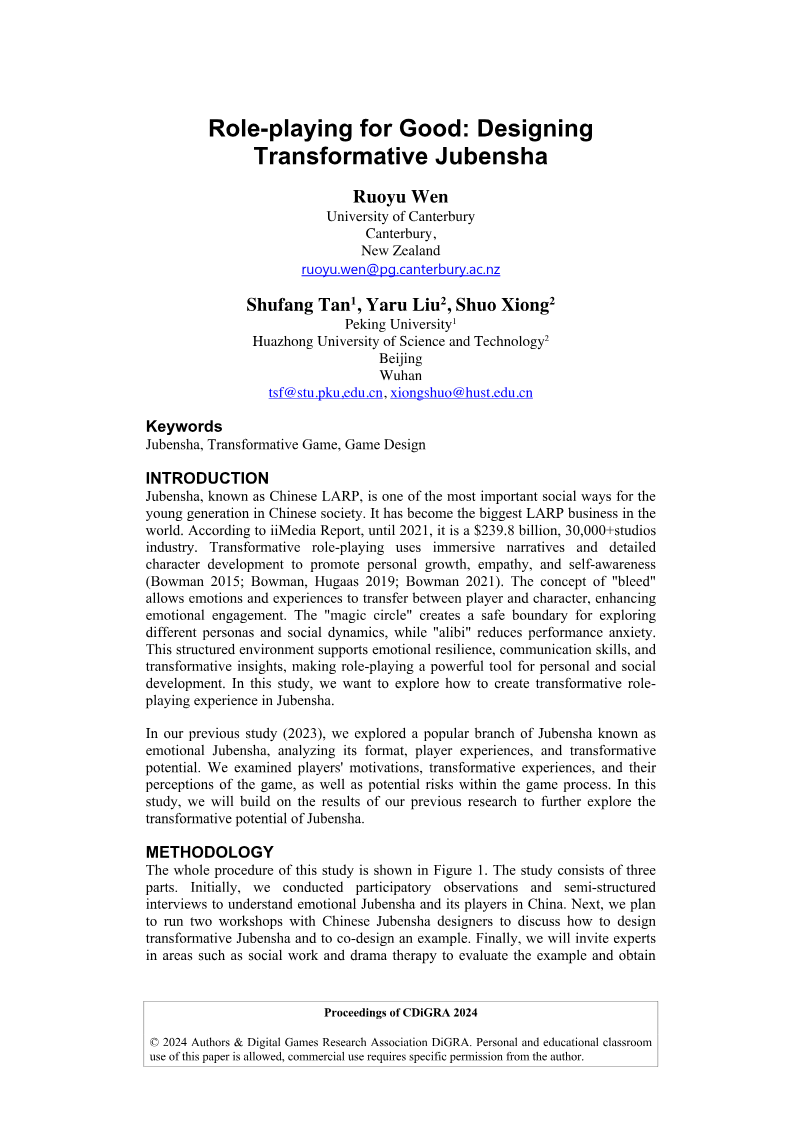
This paper examines how to design transformative Jubensha, the Chinese form of live-action role-playing (LARP) that has grown into one of the largest LARP industries in the world. The authors frame the work as a continuation of prior research on emotional Jubensha, aiming to move from describing player experiences toward establishing practical guidelines for designing games that support personal growth, empathy, and self-awareness. The central premise draws on transformative role-playing theory, including concepts such as "bleed," the emotional spillover between player and character, the "magic circle" as a safe boundary for exploring personas, and "alibi," which lowers performance anxiety.
The research is organized in three stages. It begins with participatory observation of offline and online Jubensha sessions and semi-structured interviews with seven players who had two to five years of experience. These players were mainly motivated by curiosity, social interaction, and a desire for profound emotional experiences, and the authors found that emotional Jubensha offers meaningful opportunities for emotional release and self-discovery, though it also carries identifiable emotional risks. The second stage plans two workshops with Chinese Jubensha designers, the first to discuss suitable themes, design processes, and safety measures, and the second to co-design an example game based on the resulting guidelines.
The final stage proposes evaluation of that example by experts in social work and drama therapy, who would assess its potential for transformation and its applicability to mental wellbeing interventions. The paper's stated contribution is a set of design guidelines for transformative Jubensha and a framework for applying them in mental health contexts. Because the document presents a study plan and preliminary findings rather than completed workshops or evaluations, its conclusions about design effectiveness remain prospective.

DiGRA · 2026

DiGRA · 2026



DiGRA · 2026



DiGRA · 2026



DiGRA · 2026



DiGRA · 2026



DiGRA · 2026



DiGRA · 2026

DiGRA · 2026



DiGRA · 2026



DiGRA · 2026

DiGRA · 2026
DiGRA · 2025