1 free read left. Create a free account for unlimited reading + AI research.
Create free accountWhitepaper DiGRA
1 free read left. Create a free account for unlimited reading + AI research.
Create free accountWhitepaperDiGRA
The paper calls this an "ambivalent alliance".
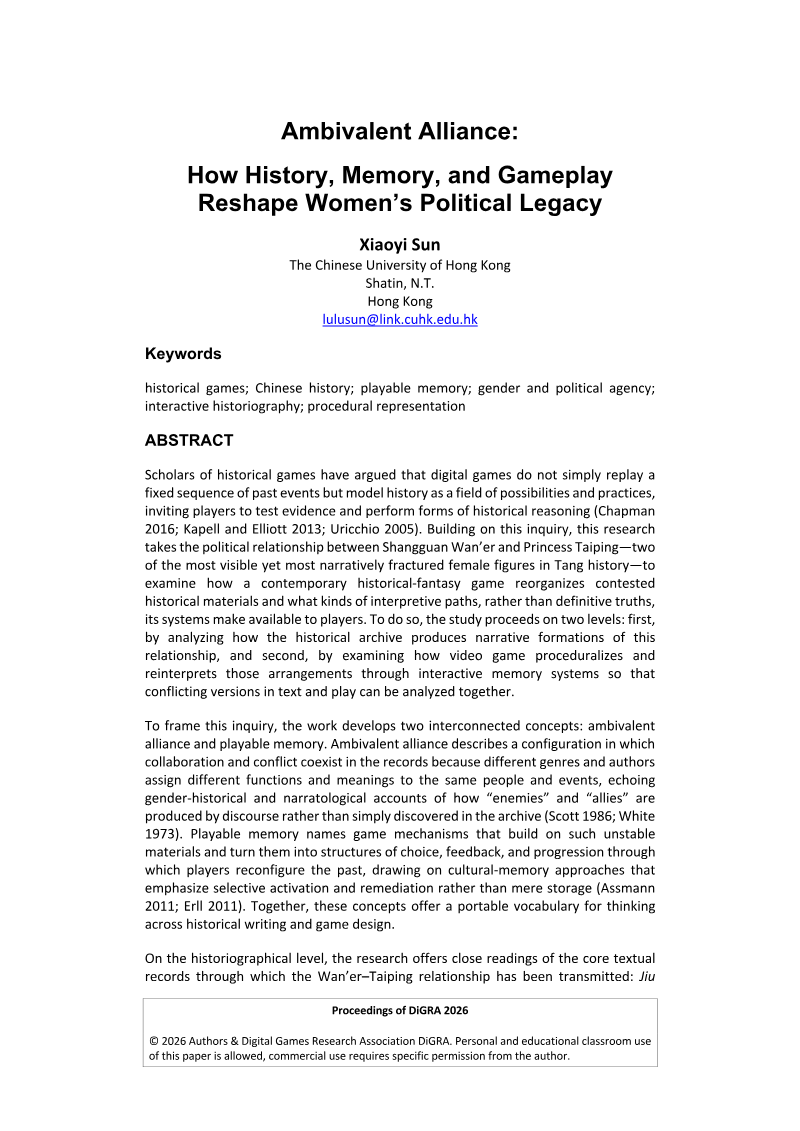
This paper examines the political relationship between Shangguan Wan'er and Princess Taiping, two prominent yet narratively fragmented women of Tang dynasty history, and how a contemporary historical-fantasy game, Dream and Lethe Record (NetEase Games, 2021), reorganizes contested historical material into interactive form. Its central argument is that the relationship is best understood as an "ambivalent alliance," in which collaboration and rivalry coexist across sources, and that games can extend this ambiguity through "playable memory," mechanics that turn unstable evidence into structures of choice, feedback, and progression rather than delivering a single authoritative version of the past.
The historiographical analysis rests on four principal sources: the Old and New Books of Tang, Sima Guang's Zizhi tongjian, and Zhang Yue's commemorative preface to the Quan Tang Wen. These texts were produced under different institutional mandates and generic conventions, and the study identifies three recurring categories of evidence across them: institutional copresence, in which the two women share deliberative authority in state decisions; event-based adjudication, in which they are portrayed as entangled rivals during the Tanglong and Xiantian coups; and posthumous construction, in which Wan'er's literary and political legacy is framed in relation to Taiping as a constitutive counterpart.
The game analysis focuses on the "memory fluctuation" mechanic, which fragments contested interpretations into scenes of childhood recollection, court deliberation, and political decision. Its premise that evil spirits distort memories serves as an allegory for the instability of historical evidence. Through a repeated loop of trigger, discernment, repair, and reaffirmation, players move the relationship from suspicion toward interdependence, with a "bond value" system unlocking dialogue, illustrations, and side stories that tie political alignment to emotional attachment.
The study's broader contribution is methodological. It proposes that historical games can function as experimental spaces where assumptions about evidence, voice, and memory are encoded in rules and feedback, and that such analysis can bring debates in women's history, memory studies, and critical historiography into game studies.
Each row is a game or company this document names, each column a document, oldest first. A mark means that document names it. Select a row to see those documents.

DiGRA · 2026

DiGRA · 2026



DiGRA · 2026



DiGRA · 2026



DiGRA · 2026



DiGRA · 2026



DiGRA · 2026



DiGRA · 2026

DiGRA · 2026



DiGRA · 2026



DiGRA · 2026

DiGRA · 2026
DiGRA · 2025