1 free read left. Create a free account for unlimited reading + AI research.
Create free accountArticle Quantic Foundry
1 free read left. Create a free account for unlimited reading + AI research.
Create free accountArticleQuantic Foundry
This analysis explores the demographic appeal and underlying motivations of players who prefer science fiction themes in games. Data was collected from an optional survey of 13,296 gamers.
This analysis explores how science fiction functions as a thematic setting in digital gaming, examining its demographic appeal and the underlying motivations of players who prefer it. The study utilizes data from an optional survey conducted between February 2022 and October 2023, which gathered responses from 13,296 gamers. The sample primarily consisted of core PC and console players, with a demographic breakdown of 65% male, 25% female, and 7% non-binary, and a strong representation of the 18–34 age cohort.
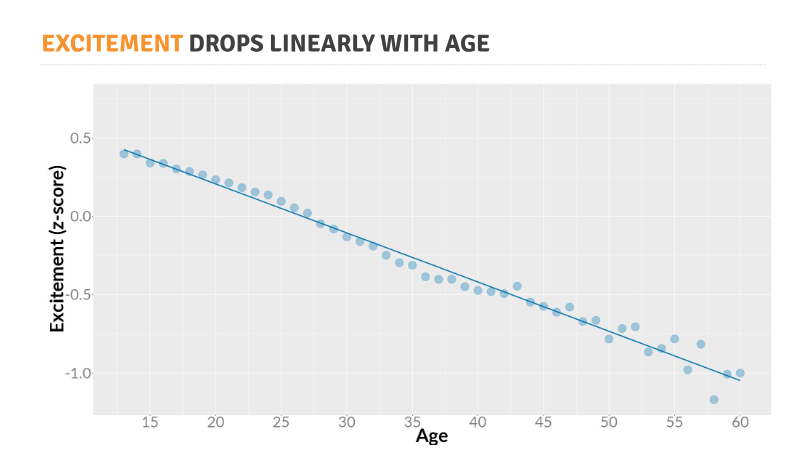
A primary finding is that science fiction, both in its "hard" and "fantasy" iterations, holds significantly higher appeal for older gamers. Specifically, players aged 35 and older are more than twice as likely as those aged 13–17 to rate these settings as highly appealing. While gender differences in preference are minimal within the shooter genre, they become more pronounced in strategy games, where male players are twice as likely as female players to find science fiction themes extremely appealing. The research suggests that these age-related trends are stable across different genres, likely influenced by historical and cultural associations with science fiction media from the 1980s and 1990s.
Regarding player motivations, the appeal of science fiction consistently correlates with a desire for fantasy—the drive to be someone else in a different world. However, secondary motivations vary by genre; for instance, science fiction in strategy games correlates with a preference for destruction and strategic planning, while in shooters, it aligns with interests in narrative and customization. The analysis concludes that thematic settings possess their own distinct motivation profiles, and misalignments between a game’s mechanics and its thematic setting can lead to poor engagement, as the setting may attract players who are not well-suited to the game’s core gameplay loop.
Quantic Foundry · 2026
Quantic Foundry · 2025
Quantic Foundry · 2025
Quantic Foundry · 2025
Quantic Foundry · 2025
Quantic Foundry · 2024
Quantic Foundry · 2023
Quantic Foundry · 2023
Quantic Foundry · 2021
Quantic Foundry · 2021
Quantic Foundry · 2021
Quantic Foundry · 2020