A Deep Dive into the 12 Motivations: Findings from 400,000+ Gamers
3 Sept 201964 min video
Transcript
Hello everyone. My name is Nick Yee. I'm the co-founder and analytics lead of Quantic Foundry. So, three quick notes. Uh turn off your noise makers. Remember to fill in your evaluations. And I do have a link for the download of the PDF of these slides. I'll give it to you at the end of the talk. When we were working on the slides for this year, we were reflecting back on the three talks we've given so far before. And one thing we noticed that was almost surprising even to us was over the span of the past three talks, we've actually only spent about 10 seconds describing each motivation. We did this to be concise uh so that we could spend most of our time talking about what we felt were more interesting things. How our motivations connect with age, with gender, with personality. And how whether gamers consider themselves casual or hardcore. But our
use of these short hands and being concise has inadvertently created a negative space where some misconceptions have been brewing. So, what I'll be talking to you about today is the dark side of the moon. Which we realized late yesterday would have been a great title for this talk. So, what do I mean by negative space? In uh Jason Vandenberg's 2012 GDC talk, he asked a super insightful question. Considering Bartle's player types, which almost everyone in the game industry is familiar with, he asked us, "What is a non-achiever?" I hope it's immediately clear that despite the positioning in the chart, a non-achiever isn't a socializer. Just because someone dislikes leveling up and grinding doesn't mean that they're a social carebear. Jason's answer to this question, a player who isn't driven by grinding and leveling up is a contentment player.
Someone who is comfortable with the status and doesn't want to be caught up in the rat race. The most striking thing, the reason why Jason's question was so insightful, is that it's pointing out something that is missing entirely on this graph. A non-achiever actually isn't even a dot you can place on this map. So, Jason's question really foregrounded the negative space that had literally become invisible in the game industry. It's a blind spot that's quite common across most proposed motivation taxonomies, including our own, especially when we try to be concise. And to be clear, by negative space, I don't mean a bad thing like a closet full of zombies. It's like the elephant in the room that no one noticed before um despite how much space it occupied. But once someone points it out, you can't unsee it. So, even though we knew about this negative space in our attempts to be concise when presenting a motivation
model, we inadvertently created and kept reinforcing this exact negative space. And because of this, we started getting very similar questions from folks that stemmed from this negative space. So, questions like, "What does low completion actually mean? What are game examples of games of low completion? If a gamer scores low on all the motivations, are they just a disengaged gamer? And when a gamer has many high scores, do they just want more of everything?" In our data, we have a way of filling in that negative space empirically. So, to date, over 400,000 gamers have come and taken our gamer motivation profile. Gamers take a 5-minute survey and they receive a personalized report of how their motivations rank relative to other gamers. Alongside the gaming motivation scores, we also ask gamers their demographics and specific game titles that they've enjoyed playing. So, we're able to pivot between these three variable sets. So,
for each game that's mentioned in the data, we can sample the gamers who've mentioned that game and calculate the average motivation profile of that game's audience. So, say we're interested in the strategy motivation. I can tabulate the motivation score uh the motivation score for each game on strategy and then rank order the games by their average strategy score from the lowest all the way to the highest. We can then look at the list of games on both ends of the spectrum to understand the negative space and articulate the spectrum itself. So, figuring out this negative space is looking into this bucket of game titles and playing, "What do these three things have in common?" So, it's like someone came up to you and asked, "What do Little Red Riding Hood, a matador, and Africa have in common?" And the analysis that we went through is slowly figuring out that the three things these things have in common is they all have capes. So, in this talk um we'll go through what we found when we
ran through all the tabulations, chewed on the potential commonalities of the game titles, and how we've tried to make sense of the negative space based on our data set. So, let me start with one quick example and then I'll keep chatting a bit more about this negative space. So, let's start with strategy. We've typically described strategy as part of a cluster of motivations that revolves around more long-term oriented gaming motivations. So, things that take time and planning to accomplish. Strategy is about the decision complexity in the gameplay, the amount of information you have to process to make the next decision, the potential contingencies you have to anticipate and plan for, the number of steps and moves, the time horizon on which you have to plan and accomplish your goals. Do you need to plan one step out or 15 moves out? So, I'll be showing you a chart like this for each motivation. We'll provide
some of the more well-known game titles in the top 20th percent and the bottom 20% of each motivation ranking. So, in other words, if we took all the games in our data set and ranked them on their average strategy score from lowest to highest, what are some of the games in the bottom 20? What are some of the games in the top 20? It doesn't mean that these games are only played by players with extreme motivations, but these are games that exemplify the preferences of gamers with very high or very low scores on these motivations. So, gamers with high strategy, they want a great deal of decision complexity. They want meaty decisions that they can chew on and long-term strategies they can plan out and execute. So, some examples of games that score high on strategy include Starcraft, Crusader Kings, Europa Universalis. Conversely, games of low strategy scores are more spontaneous and reactive gamers. They want gameplay with lower cognitive loads, shorter time horizons, and where
decisions can be made based on processing only a small amount of information, or planning isn't even productive at all because of the many randomized elements in the game. So, in our data, some examples of games in in this space were The Sims, Disney Emoji Blitz, and Mario Kart. I want to clarify one thing before I move on about these scores and these placements. You can absolutely play The Sims in a highly strategic way. Say I have a master plan from the start to create a vampire couple who abducts the alien baby next door and then plants carnivorous plants all over town to murder everyone. You can play The Sims that way, and that is a long-term plan, and that is high strategy. What we're tracking here is how core the core audience of each game, gamers who say they enjoy these games, what their average motivation profile looks like. So, we're not measuring how a game could be played, but rather what an audience a game typically attracts, and thus how that core audience most
typically plays that game. So, when I say the negative space and the dark side of the moon, part of what I mean is that when we, the game industry, talk about gaming motivations, we tend to have far better developed vocabulary and terminology and nuance for certain aspects of gaming. And our language has tended to be shaped by how core or hardcore gamers see the world and things that they want more of in games. And because game researchers and game designers are almost game players themselves, this bias has permeated uh our way of conceptualizing gaming motivations. So, when you scan motivation taxonomies in the literature and industry white papers, you'll often find motivations like competition and challenge like we do in our taxonomy. For this reason, the things that a hardcore gamer wants more of. So, this more of X or less of X way of talking
about gaming motivations is something that Jason Vandenberg has referred to as the thermometer model, and I'll use that term here in my talk as well and I'll expand on that. One problem with the thermometer model is that it leads people to treat the high end of the motivation as being more inherently important or valuable than the lower end. So, for example, we have a tendency to lump everything in the negative space into this amorphous bland bucket that we call casual. And we typically leave it at that. And someone who doesn't like challenging multiplayer gameplay, oh, they're just casual. Even when we have other labels, you know, for these folks, they tend to be value negative labels. So, these game this gameplay is simplistic. It's slow. It's not a real game. So, our collective language for talking about gaming motivations implicitly measures how far someone falls from the ideal hardcore gamer. This is an artifact of the thermometer model, and that's one thing we're trying to surface and correct here.
Let me show you another example with design, one of the two motivations under creativity. In the past, we've described design as the appeal of expressing your own individuality in the context of a game. Can I express my personal flair in this game? Can I leave a mark behind? Does the game provide me with the levers and the color pickers to really design my avatar and spaceship and city? So, you may think that games of low design tend to look bland or generic, but that's not what we found. Let's start on the high end. In our data, games like Guild Wars 2, The Sims, and Animal Crossing had some of the highest design scores. This makes sense given the large range of customization opportunities in these games. But, on the low end, we don't find bland or abstract games. In our data, some of the games with the lowest design scores included Braid, Super Meat Boy, Super Mario Galaxy, games with very unique styles and creative visions. So, rather than simply low or high customization,
another potential way to think about what's going on is the amount of aesthetic control over the game world between the game designer and the player. How much control is the player willing to cede and relinquish to the designer's vision? How willing is a gamer to experience a curated game experience as opposed to wanting to have a direct hand in shaping designing the world themselves. Oops. Sorry about that. I'll show you the um age and gender breakdowns for some of the motivations, so the more interesting ones and also the ones that contrast well with each other. Each motivation kind of has its own unique signature in terms of how it varies by age and gender. So, in these charts, each dot is the average here the design score for all respondents at each age point. So, each dot is the average of thousands of players. The orange
circular dots are the women and the blue triangular dots are the men. So, here we have design. It actually peaks very early. Female gamers are more interested in design, and the appeal of design drops slowly with age, and the delta between men and women stays pretty constant throughout the age span that we have between age 13 to 60 that we're showing you here. With all these charts that I'll show you, you'll notice that there's more fluctuation at the tail end at the older end. This is because we have fewer data points beyond age 50. So, even with the larger data samples, there's still a bit of jitter there. So, this point, you may be asking yourself, wait, so Quantic Foundry didn't know what the low end of each scale meant until now? The answer is yes and no. When we put together the profile app, we knew roughly what the low ends of each motivation likely referred to, but we didn't have the clarity that we now have because of the specific game titles we were able to explore based on the data itself.
Another reason that is that it's very difficult to ask about the absence of something in a survey. It The question is is very difficult to make sense of for respondents. We also didn't want to force false dichotomies into the model based on our own assumptions. So, for example, we don't ask gamers if they prefer lots of customization options or bland game. That's a forced dichotomy. So, we allowed them to motivation items to aggregate naturally when we're doing the data analysis and then to figure out the negative space later on using the data. Excitement is next. We've often described excitement as the appeal of fast-paced, action-oriented gameplay with lots of surprises and thrills. I'm going to take a slight detour into personality psychology. Jerome Kagan's longitudinal study of baby temperament is one of my favorite studies in the field psychology. The study began in the '80s, and temperament is a consistent set of
behavioral responses from a baby and how they react to things because we cannot ask 4-month-olds to take surveys. Kagan found that infants as young as 4 months of age develop temperamental differences where they they behave differently to new things, whether it's new people, new toys, or novel sounds. So, on one end of the spectrum, you have babies where you put them in a in a cradle and you bring out a toy mobile and you start jangling it wildly in front of the baby, and you can jangle for as long as you want, the baby remains calm and entertained. And on the other extreme, you have babies who become visibly distressed the moment you bring out the toy mobile, and they become more distressed the more you jangle the toy in front of them until they start to flail and cry uncontrollably. These temperamental differences at 4 months of age
don't translate one to one into introversion and extroversion when these babies grow up. So, Kagan followed these babies till they were adults. But, these temperamental differences do seem to apply strong constraints. So, the babies who are calm at 4 months of age very rarely become introverts when they're adults. And similarly, the babies who are easily distressed at 4 months of age rarely become extroverts when they're adults. And so, what this study reveals is that there's an important difference between introverts and extroverts in terms of their tolerance of novel stimuli, specifically whether that stimulus is entertaining or overwhelming to them. So, introverts avoid parties and crowds because the sensory stimulation quickly becomes exhausting, draining, and overwhelming, while extroverts love parties and crowds because the sensory stimulation is entertaining and energizing. We've shown you before in in one of our
earlier talks the linkages between the personality trait of extroversion and the gaming motivation of excitement. So, we've typically described excitement again as a speed and pacing of the game, but at its core, it's about the stimulus delta from one moment to the next. How much change, whether that's in the visuals, in the audio. How much change happened just now? It's about the amount of novelty and unexpected change from moment to moment and our desire for that novelty. This is why surprise is one of the keywords in our summary table. So, on the high end, you have action shooters and action fighters like CS:GO, Super Smash Brothers, games that are fast-paced and we're constantly bombarded with new information. And in the low end, we find games that are turn-based or even games that are typically played while paused like Europa Universalis. These are games where you have perfect control over the
pacing. If you need more time, you can take as much time as you need. Nothing in the game world changes until you're ready for a change to happen. So, in this sense, the game experience is predictable. Things tend to change in very incremental and gradual ways. The game state from one moment to the next is very similar. I feel a little dirty showing you this slide, but I want to make an important statistical point, and it's easy to show this via the MBTI. The MBTI, very briefly, makes a strong assumption that people have clear preferences along four dimensions. So, for example, in this first dimension, people tend to prefer and either be introverts or extroverts. That's where the E and I come from in the model. And so, together, these four dimensions create the 16 possible personality types. So, here's a graphical representation of the MBTI's worldview. It is assuming that there are two subpopulations, one that leans towards introversion, another that leans towards extroversion, and
there are some people in between, but they're uncommon. So, you can imagine that these people in the middle, who are uncommon, might feel the need to come up with a new label to describe themselves because they're neither introverts or extroverts. You may have seen these posts on your Facebook wall um about ambiverts. But, the reality, based on decades of research in personality psychology, is that personality traits all fall along a normal distribution, a bell curve. So, we already had a word for ambiverts. That word is average. There are two important properties of the bell curve. So, first, most people fall very close to the average, about 68% of the population falls within one standard deviation of the average. That's a little over two-thirds of the population. And very few people fall in the extremes. Only about 5% of the population falls more than two standard deviations away from the norm. So,
because most people fall near the average, the core statistical and validity problem with the MBTI is that it's ignoring this big hump in the room, and this, among other reasons, is why the MBTI has poor reliability because people, most people who are near the center, when they retake the test, their scores, their types will shift because they were so close to the center and they're being sliced in half on one side of the other. Of course, introverts and extroverts do exist, but most people have weak or almost no preferences, and far fewer people have strong preferences. Going back to the thermometer model, another problem with the thermometer model is that it encourages people to conceptualize gamers and gaming motivations in a biased way because it implicitly measures everyone else against this ideal hardcore gamer. It makes it easy to start talking about some gamers as being low lesser than. So, these are that these folks with low scores are not real gamers. But, the
reason why I bring up the precise psychology is because the extraversion spectrum highlights how lower scores are not simply lesser than. So, for example, people on both ends of the extraversion spectrum have equally strong preferences and attitudes. And people at the extreme ends of both are equally difficult to deal with in real life. So, instead of the thermometer model, the more appropriate reading isn't more of or less of something, but that there are lots of average people in the middle and some really opinionated people on both ends of the extreme. So, more importantly, the thing to keep in mind is that introverts don't have less personality than extroverts. And it's the same with gaming motivations. Many gamers have moderate, near average scores on the motivations, and a smaller number have more extreme, stronger preferences. So, it's your delta from the average that largely defines you. It's the way you stand out from the crowd that are
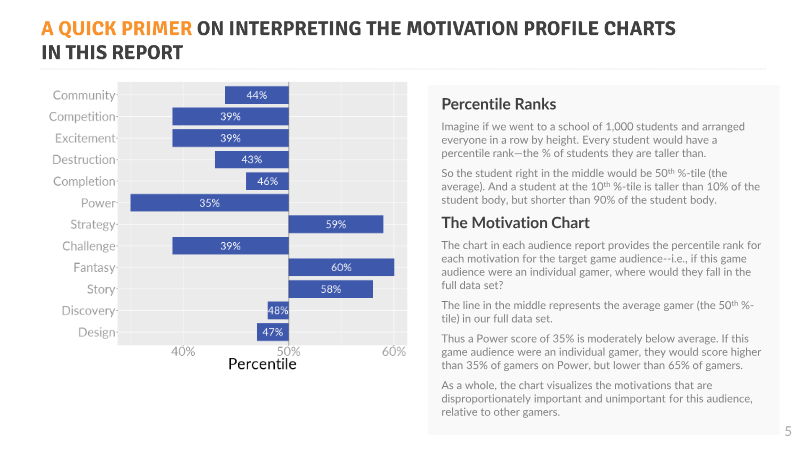
the most interesting and visible parts of you. The ways in which you conform to the norm are the least interesting parts of who you are. No one will remember you for having 10 fingers. This is why in our blog posts and in our talks, we always visualize motivations from the norm. This makes it much easier to then find the motivations that are very different from the average, whereas the bars that are close to the average are very small and less visually prominent. There's a more subtle reason here as well. Traits like extraversion, strategy like in our gaming motivation model, are entirely man-made constructs, and they only exist and are meaningful in relation to other people. If you're the only person left in the world, you're neither tall or short cuz there's no one else to compare you to. Similarly, you care more or less about strategy only relative to other gamers, and thus the population norm is the only meaningful reference point for personality traits and for gaming motivations.
Community is next. Community and competition are the two motivations that fall under social. Community is about working with other players, competition is about working against other players. Community is about shared experiences, of being willing to not be fully in control of your game experience, being open to experiencing the game through someone else's eyes and actions. There's an interplay here between dependence versus independence, collaboration versus control. So, on the high end, we see games like Destiny, Final Fantasy XIV, MMOs, and online team-based shooters that emphasize teamwork and collaboration. On the low end, we see games that emphasize independence, soloable campaigns and content like uh Lego Harry Potter and FarmVille Saga. Games where you're always in full control of the
game experience. Here's the plot of community by gender and age. Uh I'll make two points. We stereotype women as social care bears, but between ages 13 through 35, it's the men who care more about community and teamwork. There's an alternative reading of this chart, and I always try to be careful when you look at the charts for competition and for community. Um the apparent delta here could be an artifact of toxicity in online games, that it dampens the appeal of online games for younger female gamers, and that it recovers past age 40 because in a data in our data and there's a shift towards non-shooter MMOs in that age range where toxicity is less of an issue. So, that's always one thing that we, you know, we want to be careful about in terms of interpreting what these differences in community and competition may or may not mean. The thermometer model tricks us into thinking that higher scores always means more of something.
But, the spectrum model better surfaces that there always trade-offs going on. So, for example, we could conceptualize high community as the willingness to give up some of your control uh in terms of gameplay, whereas low community is a desire to hoard as much control as possible. Laying out both ends of this the motivations highlights how there's a give and take, always a give and take going on, rather than just more or less of a preference. We're moving on to competition, the other motivation under the social pair. One of the things that I've noticed about my own gaming preferences is that I like the strategic gameplay of CCGs, collectible card games like Hearthstone, but I dislike the emotional state playing against another player puts me in. So, it took me a while to realize that that emotional state is an acute stress cascade or what we typically call the the fight or flight response. So, anxiety triggers this response regardless of whether it's a
real bear or a virtual bear. If your hands ever get super cold after playing a competitive game, that's from the adrenaline rush that's diverting your blood flow to your arm and leg muscles, away from your extremities. So, during the fight or flight response, our bodies get flooded with cortisol, adrenaline, which have many downstream physiological effects to help us deal with or flee from danger. And even though we're not actually in danger, it's a carryover effect of old biological circuits in virtual simulations. But, in the same way that some people like watching horror movies, they like getting scared, or people who go skydiving, that mild adrenaline rush is pleasurable for some people because endorphins are also being released during the cascade. So, one way to think of the appeal of competition is that it's a way to hack your own biochemistry to get the adrenaline and endorphin rushes without actually being in real danger. It's a kind of biological hacking.
I find that another useful framing to think about competition is the way we think about conflict in board games. So, on one end, you have high conflict games like Warhammer where my miniature units are directly attacking your units and killing them. There's a middle ground like in Agricola where we're competing against each other for a high score, but we're all largely in our own walled gardens, and I can only indirectly interfere with what you're trying to do. And then there's the other end where there's no conflict. There's no rankings, no duels against other human players. Games that aren't about comparing your skills or abilities against other players. So, here in the high competition end, we have MOBAs, online shooters like League and Call of Duty. On the low competition end, we have games where there are no rankings or duels against other human players. The sorcerer that turns your dragon to attack you isn't competition, that's drama.
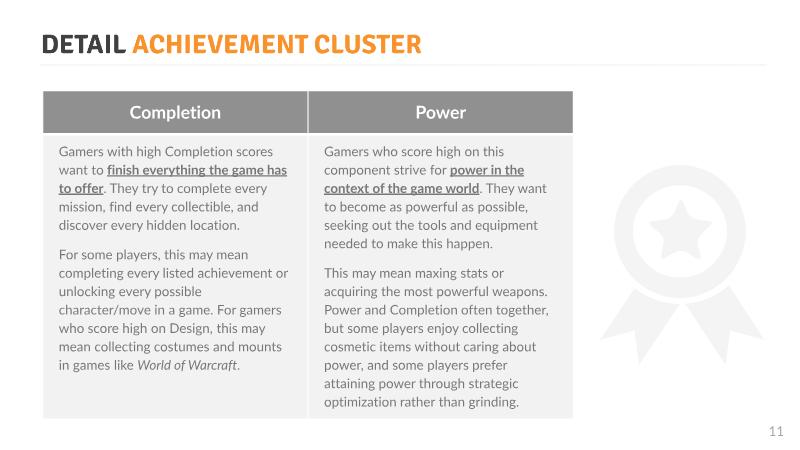
We're on to completion. The achievement pair is about different kinds of point systems. And completion is about quantifiable, persistent progress and rewards. It's about knowing how far exactly you are from a goal. It's about having a clear task with clear instructions and having a clear way to assess how close you are to reaching that goal. So, completion can almost always be converted to a 0 to 100% percentage bar, whether by itself or as part of a larger hierarchy of tasks. Games that score high on completion tend to be very task-oriented with clear, predictable conversion mechanics between time and rewards. So, in our data, MMOs, especially Asian MMOs, like Dragon Nest or Kingdoms, scored very high on completion. Games that score low on completion tend to be more sandboxy games where there are rules, but the players decide what they want to do, where the players have to figure out
what goals they want to pursue on their own. Don't tell me what I have to do. I'm going to decide for myself if I'm going to dominate the world and how I'm going to dominate the world. So, on the low completion end, we have games like Victoria II, Kerbal Space Program. Completion, we've mentioned this before, I think. Completion is the most age-stable motivation in our model. It increases ever so slightly among women over the age span, and it decreases ever so slightly among men over the age span. So, as people get older, the gender difference gets a little wider, but overall, it's the motivation in our in our model that changes the least over age. Over the past year or so, we've been working with Niko Partners on a series of survey-based projects. Niko Partners is a market research and consulting firm that covers the games market in Asia. And in one of these projects, we surveyed 2,000 Chinese gamers and included the motivation assessment questions. It wasn't the direct goal of that study
to do the cross-cultural comparison, but the data allowed us to do it. So, we compared gamers in the US from our data set against gamers in China from Niko's data set using the same motivation questions, translated of course as simplified Chinese. And we first looked at the the differences, and we found these striking differences in gaming motivations between the two samples. So, in this chart, China is the gray bars, and the US is the orange bars. So, in particular, Chinese gamers scored much higher on the two motivations that we just covered, on competition and on completion. Um and they scored lower on fantasy, story, discovery, design, so the creativity uh emergent motivations. To give you a sense of the size of the difference here in let's do competition. The average gamer in Niko sample, Niko Partners sample, cares more about competition
than roughly 75% of the US gamers in our sample. We dug a little deeper into the data. And in other places where we expected there to be differences, the differences turned out to be very small. Um so this is a chart of the motivation differences. We've shown you this data in a different way but in in previous talks. Gender differences in motivations among our our full data set. So we've seen before that the men, the gray bars, they care more about competition, excitement, destruction. The women, they care more about fantasy, design, completion. We've shown you this data before um in in a different in a different graph. So we tried to see, you know, do these differences pan out the same way in China or do different differences come out? And so here's a chart for the China gamers. Most of the So those are the error bars. Most of the different Most of the the bars are not even statistically different. Of the ones that are, the
only one that is substantively meaningful is the one in destruction. So in in the Chinese sample, uh the men cared more about destruction than the women. Uh but across the other 11, there are essentially no gender differences. Whereas in the US, the the western data, there were differences all over the map. So we talk a lot about gender gaming differences in the west in the in the American context, but what this data is kind of hinting and surfacing is that perhaps the gender differences in gaming that we see in the west may be unique to the west and that this would also imply that they could be entirely an artifact of culture and marketing and historical idiosyncrasies without really needing to invoke biology. We saw this paralleled with the age data. So, you know, again, uh let me talk through the column, the second column, the US column. Uh you know, I've been talking about how motivations like competition, like destruction, uh excitement, these are motivations that decline with age. So these are the
correlation coefficients in the US. Um there are seven of the 12 motivations that have a correlation coefficient above 0.10. It's a small to medium-size correlation. In the Chinese data, among the Chinese sample, none of the age correlations were above 0.1. Um so across the age span in China, the the variation in motivations was very very low. So Chinese gamers as a whole are very different from US gamers, but within the audience of Chinese gamers, there's much less variation than one would expect based on what we'd previously seen in our in our western data set. What we can't say, we'd love to know why. What we can't say is why these differences or lack of differences are the way they are, but there there two things that struck out for us when Niko Partners and and and we were looking through this data. The difference, especially in competition, goes against
traditional assumptions between individualist versus collectivist societies. So previous cultural findings in academia would have predicted that a more individualist society like the US should score higher on competition, but we're finding here the exact opposite. The second point is that the Chinese gaming market has been able to develop in a semi-isolated manner due to a variety of governmental regulations such as the ban until recently on western consoles, the cultural review of content, the Great Firewall. Net cafe culture has also encouraged greater adoption of specific genres of games such as online multiplayer games. And of course the Chinese market makes its own games, a large number of them in fact. So part of what we're seeing may stem from the different sensibilities and emphasis that their games have and how their gamers have historically adopted gaming. So for example, many popular Chinese games aren't available or known in the US market. So these two populations aren't really even playing the same games to begin with.
We were just talking about completion. Power is the other motivation in the pair of achievement motivations. Where completion is about getting to 100%. Power is about constant growth in absolute numbers. So power is about getting bigger, getting stronger over time. It's almost always numbers driven because you need numbers to quantify how much you've grown. But power isn't really the end goal. It's more likely that the appeal is centered on the journey of growth that is satisfying, the appeal of getting stronger. So another contrast is with completion is that completion goals tend to stick around on a very persistent basis. The stars you collect, the levels you completed, they stick with your character or your your game. Whereas power can be more transient because it's the journey that matters. So here in high power, we have games
like World of Warcraft and League. And your champion in League gets stronger over each match, but then it resets and you can start it all over again and that's fine because it's the journey that's pleasurable. Low power is not the lack of growth as much as the desire to not be on a treadmill, to not be part of implicit rat race. These games here tend to be more about adventure and stories. Examples here are The Longest Journey and Her Story. We've talked about excitement already and now we're touching on the other motivation in the action pair, destruction. We have guns and explosives under the description for destruction. But at its heart, destruction is about being drawn to chaos and mayhem, the erosion of rules, letting entropy have its day. When I was a grad student at Stanford and I was showing my advisor Second Life so many many moons ago, I was showing him the basics and we were just about to leave the newbie area
and he suddenly got very excited and he asked, "Are you allowed to sit on that person? Can we go sit on people?" That's low-grade destruction. So it's it's not surprising that destruction is highest in games where you can destroy things the fastest, which is shooters. It's watching order turn into to disorder. We had expected that construction would be the other end of destruction, but it's not. It's enduring and evergreen worlds. So these are games that are reliably constant that you can revisit over and over again. Uh games like Professor Layton, like Myst, like Animal Crossing. It's like the virtual corner coffee shop that offers a sense of comforting, reliable familiarity. We had someone ask us recently where we think construction would fit in our model and we thought about it and we think construction is typically a means and not an ends. Let me talk through this. So building an empire in
Civilization, that's strategy. Building a city in SimCity so I can blow it up with disasters, that's destruction. Building King's Landing in Minecraft so I can role-play being Cersei, that's fantasy and story. And seeing if I can build a roller coaster in Kerbal Space Program, that's more discovery. So we've tried experimenting with survey items related to construction and it doesn't quite cling anywhere we think for this reason. It depends on why you're building something and construction in and of itself isn't a clear signal. Destruction is most appealing to the youngest gamers, particularly the youngest men. I'm sure you're all shocked. It then plateaus for about two decades. It doesn't plummet like competition does and then it's only past age 40 that it really starts to drop again. There's a gender difference and it gets slightly larger over the age span.
Fantasy. The immersion pair is about being part of the game world in different ways. So fantasy is the willingness to suspend disbelief and be transported to an alternate reality, the desire to become someone else, somewhere else. It's about the psychological teleportation to another world and it hinges on the richness of that alternate world, its lore, its scope, and its visual design. So in our data, games like Mass Effect and Dragon Age scored highest on fantasy. Again, games with rich worlds and history and lore. Games that score low on fantasy usually fall into one of two camps. They're either abstract puzzle games like Candy Crush or when they have 3D worlds and detailed graphics, the worlds and settings tend to be generic and interchangeable. So like a desert encampment or a rough terrain in a shooter game. Here we see Counter-Strike for example on that end of the spectrum. I have a story to tell about fantasy and the adoption of VR.
We ran a survey alongside the gamer motivation profile uh on VR adoption and satisfaction. We had about 2,400 responses to that survey over a period of the past 12 months um of which 31% were adopters of current gen high-end VR. So one of either Oculus, Samsung VR, Samsung Gear, PSVR, or HTC Vive. So the gray bars are gamers who haven't adopted VR. The orange bars are the gamers who have. When we compare the motivations of the two cohorts, we were expecting fantasy to be a predictor of VR adoption. It turns out it isn't. The best motivational predictors of VR adoption are destruction and excitement. So, people who like fast-paced chaos and mayhem have been more likely to go out and purchase VR, fans of shooter games. This is interesting from a um disposable income point of view because VR is currently expensive and these two motivations, destruction and excitement,
these two motivations both drop quite fast with age. So, older gamers with more disposable income and can afford VR are precisely the gamers who have dampened motivational interest in VR. We looked one step further into the data. So, we looked only at the gamers who had purchased and adopted VR. We asked them, "How satisfied are you with your purchase, with the technology?" Um and we divide them into three groups based on their satisfaction. So, the gray bar are those of low satisfaction. They are not at all or only slightly satisfied. The middle orange bar is medium satisfaction. They are somewhat satisfied. And the blue bar is high satisfaction. They are very satisfied or extremely satisfied. And it's here that we see fantasy along with discovery pop up as being differentiators. VR adopters who also care about fantasy and discovery are more likely to be the
ones to be satisfied with their VR purchase. So, an analogy might be what gets people through the door is not the same as what keeps them happy once they're inside. And in this specific case, the desire to be someone else, somewhere else, isn't enough to get someone to purchase VR. But if they do make the purchase, these are the gamers who are more likely to be satisfied with the technology. We're here with discovering the creativity pair. I often describe discovery as playing games in the broadest sense of the word. So, it's easy to think of discovery as just the exploration of a world, but it's actually more about exploring and poking at the boundaries of the game itself and figuring out what is and isn't possible. So, in this sense, it's about the number of unknowns when you start playing a game, not just in terms of the geography, the places you haven't seen, but the rules of what you can and cannot do in that world. So, games that have high discovery tend to have lots of secrets. There are
hidden caves to discover, hidden quests to find, but also lots of hidden or possible interactions between objects and spells and abilities. So, for example, in Skyrim, is it possible to become a vampire and survive without ever killing a person? I just realized how many vampire examples I have in this talk. Gamers with high discovery would ask such a question and games with high discovery provide the opportunity for many of these questions to be asked. So, games of low discovery on the other hand have fully exposed rule sets from the get-go. It's like chess with very few unknowns in terms of of unknown interactions. No new variables or rules are introduced in the middle of the game. These are gamers who prefer well-defined, well-bounded, unchanging rule sets. Challenge is the other motivation in the mastery pair, both of which revolve around more long-term oriented gameplay.
The appeal of challenge lies in wanting to get better at something. Uh this necessitates a skill component because you can't get better at something that is completely based on chance alone. So, high challenge is reflected in the appeal of skill-based gates, uh barriers, difficult missions and bosses, system complexity, and above all the ability to practice and master a skill. So, in our data, some of the games with the highest challenge are Super Smash Brothers, Dota, Osu. These are all games with complex moves and reward practice and mastery over time. On the other hand is the appeal is the appeal of and I'm totally borrowing from Nicole Lazzaro's Fun Keys here, the appeal of easy fun. And one description that Nicole has given in the past in her model is fun failure states. That the game doesn't punish you for mistakes like ending your game. These games tend to be easy to learn with few or no skill-based gates and barriers in terms of the gameplay.
Challenge is the only motivation in our model that rebounds after age 45. It's also interesting that it that peaks for men around age 20 before declining, whereas it declines right away among female gamers. So, these two lines look very different for about 30 years up through age 35 and then they come together and the gender difference goes away. This doesn't mean that older gamers are rushing out to pick up Super Smash Brothers, but it does imply that older gamers may be more interested in mastering skill-based games and practicing game over and over again than we might assume. Our very last motivation, fantasy and story are both motivations related to being part of the game world. Story is the appeal of the web of possible interactions and relationships among a cast of three-dimensional characters with their own histories and their own personal dramas. It's about the richness of this web of human drama.
So, the more characters with their own quirks, with their own psychoses, with their own grudges, the more potential interactions between characters is possible. So, games with high story tend to have elaborate scripted dramas with a large cast of characters, games like Dragon Age and Life is Strange. On the other hand, games uh with low story, gamers with low who score low on story tend to not be interested in character-driven narratives and stories. In fact, they tend to go for games that don't involve people altogether. So, games like SimCity, Transport Tycoon that focus on non-people entities or games where characters are just pawns to accomplish goals rather than characters with their own motives, histories, and backstories. I'm going to close with a couple of things. I'm going to throw in another nuance in the in the spectrum model. At um at one point, we were working on a project related to compliance to medical
regimens for a biotech company. And we were looking through the literature on how the big five personality traits intersect with regimen compliance. So, taking your meds on time, following diet restrictions. It's not surprising that conscientiousness, which is exactly what it sounds like, would be highly related to regimen compliance. The one that surprised us was neuroticism. Uh so, people with high neuroticism get anxious and nervous easily and worry a lot. Whereas people with low neuroticism are calm and relaxed even in stressful situations. So, you may imagine that neuro low neuroticism is better when it comes to regimen compliance. But the data seems to show that both high and low neuroticism lead to poor outcomes. If you have a very low neuroticism score, you may be too blasé about risks and problems. "My foot is turning blue. I guess I'll wait till tomorrow and see if it changes back color."
And if you have very high neuroticism, the medical regimen may cause you to worry and stress out all the time. "Oh my god, did I take the pill yet today? Have I forgotten to take a pill?" Um wondering if you're doing your diet regimen wrong. And so, it seemed like a mid-level neuroticism had the best outcome like Goldilocks. Similarly, the thermometer model encourages us to think that the highest good and the low end is bad. And we've presented you the spectrum model where there are interesting tradeoffs and on both ends. But one thing to keep in mind is that at the extremes, you have players who are impossible to cater to and please. In a normal distribution, the extremes are rarely good things. Uh my last slide. For all the flaws of the MBTI, it gets one thing right that the big five gets very wrong. If you've ever taken a personality test and the survey items feel incredibly
judgmental, it's probably the big five. It's the test that seems like it's dying to tell you that you're lazy, reclusive, depressed, careless, and mean. Academics hate the MBTI, but they often don't seem to realize just how shitty the user experience of the big five is. They don't seem to understand that people won't share a personality profile of themselves if it says they're lazy, depressed, careless, and mean. To be fair, the big five wasn't meant to be a self-discovery tool. It was designed to be an assessment tool. And in many cases, you're not supposed to see your own results to begin with, and that's why it is the way it is. What the MBTI gets right is the importance of value-neutral language. And I think that's the negative space we're trying to fill here with gaming motivations because if the gaming industry doesn't have a value-neutral way of describing 50% of current, let alone potential, gamers, then that's actually a really
big problem. Imagine if I told you that your new boss is lazy, depressed, careless, and mean and then expecting that to have a good outcome. Um thank you so much for coming to my talk. Here's the link to the PDF. Thank you. And we have about 10 minutes for questions, and then I've been asked to remind you to step up to the mics in the front to ask your questions. Everyone else can hear your questions. Uh hello and thank you for the talk. So one thing I noticed both with the big five survey and with your own survey at the website is that that over time the servers are becoming shorter to allow people to take them more easily and more quickly. But when the surveys become shorter, the questions become very obvious
and almost condescending. So for example, while in earlier version it would ask you something generic about your life and in a vague fashion, later on it will ask you, do you prefer strategic decisions? Yes, no. And then oh, you're a strategy player. So people a lot of us who come to those websites already have an expectation about these surveys and what we should see in the end. So when we see a question like that, it's impossible to answer it with a neutral mindset. Um do you have any thoughts on that? Yeah, I mean a couple of things. Um it's there's Uh uh let me answer one way first. Um you may have a sense of you know, I think I'm a more strategic player. I think one thing that we add to that is putting giving you a sense of on a more quantitative numerical basis where how
exact how different or how far from the average you fall on some of these motivations relative to other gamers. So not just a higher lower yes or no, but relative to other gamers, are you just a little higher or you actually way out here on the extreme? The the other thing is that there's just there's just trickiness in in assessment tools. I think there's there's there's a there's a a weird version of psychology assessment where it's almost like divination where you know, I give you these six color squares and ask you to pick one and I can tell you you're in love with your brother-in-law. You know, there's this vision of psychology as divination and it's it's this I think it's it's tough that when you get to the nuts and bolts of it, you have to ask the most precise and the most grounded questions to get at the the most precise assessments and that's just one of these tradeoffs in there. Yeah, but that that is a great question. And and then one way we try to reduce that fatigue is by reducing it, but you're right then other
there are these kind of tradeoffs in when you do the the reduction. I see. Please let me ask another question. So Okay, let me let me have other people just because we're limited in time, but feel free to come up to me afterwards and we'll be around and we're happy to take your questions after. I just want to make sure that other people have a chance. Thank you. Uh I have a question about the data the the national data that you had between US and China and the the gender differences. Um have you seen real world examples of companies that have launched a game in one area of the world and then completely revamped it to have features in another country and seen real success? And conversely, have you seen something where um a game that has done really well say in North America with a certain feature set completely go into Asia and be completely unchanged and totally fall off the map? I just was wondering how what you're seeing is actually um translating to real world success of games in markets. well I'll give you a couple of examples
that we've run across. So we've talked to company game companies in China who are trying to expand in the US and you know, one of the questions that comes up is you know, what do we what games have they tried to port over and what are their experiences been? And one common reaction one common thread has been a lot of the games in China currently are very very grindy MMOs that are much less palatable for people in the west that they they they come across as being too grindy. Uh whereas they're seen perfectly fine in in the Chinese market. Going the other way, we've seen instances of um I'm trying to think of the example. We and we're going back to the very thing that we were talking about. We actually have seen this example of a game company that had a game in in the US that had a variety of game play modes collaborative and competitive. Um and the one thing we had kind of identified for them was that the
competitive mode was far more appealing in among the Chinese gamers. But at that point we didn't have this data. We didn't have this this prior data. So it was very difficult and so we'd seen this before, but we were they were all staring and they had to make this very big decision on we're seeing this come up in this specific slice of the data, but you know, are you willing to take you know, that bet? But now you know, we've seen this broader survey and we're like, wow, this may actually be a much bigger threat that if you're trying to port a game over in China, one of the things to make sure of is that there's a PvP mode. Um so we've seen it in the survey data, but we've also seen it in some in some client projects as well, yeah. Thanks. Thank you. Hey, uh so thank you very much for the presentation. It's really impressive uh segmentation. My question is um I think a lot of the time we're talking about motivational profile and self-assessment. Um there is a disconnect between people who we can survey and build a model off and the actual players and their behaviors in
game and Yeah. people are constantly trying to tie what uh you know, we have maybe a sample of certain people and we created all these different um 12 different profiles and we want to map that to a million players in a certain game based on the way they play. Um do you have any suggestions on tying this uh self-assessed you know, really language-based uh results to behaviors in games? Yeah, it's it's it's interesting and it's tough. I mean, it's it's tough in one sense because not all games express all motivations. So you cannot track someone's interest in story in a game that has no narrative. So there there's that missing gap, but the other thing is um what was I going to say? I forget what was I going to say. Um but the the other thing is
the complexity in modeling that some motivations may be easier So com- competition may be quite easy to infer based on participation in PvP and ranks, whereas other motivations may be less possible. I guess my biggest thought is to make sure you have a broad base of behavioral telemetry in the game to ensure the best potential coverage and predictors of of the motivations before doing the the the machine learning to do that that prediction. Good. Thanks. Yeah. Hey, thank you for a great presentation. I'm curious when it comes to challenge, you mentioned this concept of fun failure and I'm wondering if that interpretation requires that the player understand there be a fail state where they did something incorrectly or they made a mistake where they know they need to retry or if it just requires that the player understand there's usually a better way they could be doing it and that simply they haven't gotten to that point yet. I feel I feel it's a spectrum. So I think I I and I don't I I can't tell you know, which of those is a
little lower on the spectrum, but I think they're both in that same space of um that that there may be a failure. There may be a failure state, but the and the game may decide to surface this somehow that oh, you did something wrong, but it's okay. Like your character fell, but they just get they get right back up. And I think they're both in the in there's on that space, but I don't have a a concrete answer for whether one of the two you know, you you mentioned is a little higher or lower than the other. But I think they're definitely both in the right end of the spectrum. Yeah. Great. Thank you. Hello. Uh nice presentation. Thank you. Um so for the China uh the differences between China and the West, I'm curious if you're if you believe that the sample size was large enough or if the quality of the sample in terms of the people chosen for that sample. Yeah, that's a good we have this as as a blog post on on our website and there's a little bit more detail on the sampling. So um Niko sample the the 2000, they went
through a panel provider to get that and it was balanced through the different tiers of city. It was balanced by gender. Um Our sample larger more self-selected. We know that our sample leans towards core gamers. So 70% of our sample self-identify as core. We didn't ask that question in the Niko sample, but we know that more of their gamers only play on mobile phones. But in the Chinese context, that doesn't mean they're casual, you know, because you can play MMOs on the mobile phones. So when we first looked at the data, because our sample leans towards core, we assumed that if there were differences in competition and challenge motivations that are markers of hardcore gaming personality, that we would see it on the US side because our data is biased towards core gamers. So the fascinating thing with how the data turned out with with Niko's data is that
in a sense, it almost sets up the lower bound of what the potential difference could be because my intuition is that Niko's data is more representative of casual core hardcore gamers in China. So that to me is even more interesting because I So it was from that point of view, based on our assumptions and the difference in sample sizes, in a sense the actual difference may even be a little larger than that. Is what is what my intuition is telling me because we we had expected it to lean exactly the opposite way. Yeah. Okay, thank you. Thank you. Hi, my question has to do with how the population is distributed since you guys have so many essentially surveys answers. I know with the big five that right now the challenge has been like how does the population distribute itself along you know the five personality traits like what popular what percentage is really high on neuroticism things like that. With you with with the surveys you guys
have do you feel you're in a place to say that 10% of the market is strategy gamers or you know 20% or excitement destructions or leaning towards maybe PUBG or CSGO type things just to kind of How is the gamer population distributed amongst all these different motivations? We've done segmentation studies and we've we've kind of chopped this before in a variety of ways. Um We try not to do like the very broadest cuts because we know that you know our data is is biased towards like a core sample. So that's you know within that particular space you know we can make a cut and I think at one point we did a slide of if you go through the data and you put everyone in the bucket of their highest index motivation what it comes out to be. I forget what the results were but we have it in one of our previous slides. So we've kind of cut it up that way. Um and I remember I think I want to say
that you know for men destruction and excitement buckets came out the highest. I forget what the percentages were and so we have some slides of of that in our previous talks that we've touched on. Yeah. Thank you. And then very last question. Hi. Thank you so much. This was an inspiring talk. Thank you. I was curious about you're doing these surveys on games and what people are engaging with what they prefer doing. Um have you thought about how this expands beyond games to what should people be doing in their careers etc. or education for instance. Um So alongside the gamer the video gamer profile we actually have a a board game profile and then we have this infrastructure in place to to run these surveys and and generate these profiles. One thing we're chewing on Nick Ducheneau's going to make fun of me. I've been saying this for like the
past nine months is we're working on a broader motivation profile that we're broadly thinking of it a life aspirations profile. So it's somewhere between it's it's somewhere between a personality you know profile and like a values profile. So something about I'm someone who desires knowledge and curiosity. I'm someone who cares a lot about family and nurturance. So that's something that we're chewing on in the background that we may or may not get to because I've been talking about this for months. Um and so we'll we'll and we'll run through the same process when we get to it. So we'll run the the pilot survey see what clusters together and see if a lot of people want to take this profile. Um because the the thing that we're trying to chew on is if we can get people to take both gamers who take the gamer profile also take a last life aspirations profile then we get these really interesting data sets on well how do gamers want to behave in the broader context are there interesting relationships there that we can suss out. Yeah.
Thank you. And thanks again everyone for coming to the talk.
Auto-generated captions from YouTube — names and numbers may be misheard.
Key insights
Distilling the key insights…
Ask AI about this video
Cite this video
Citation
Generating citation…





















Comments