The Gamer Motivation Profile: Model and Findings
10 Feb 201730 min video
Transcript
[Music] let me get started uh thanks for coming to my talk my name is Nick ye I'm the co-founder of Quantic Foundry I'm going to be talking about gaming motivations let's say I asked you to come up with a list of key gaming motivations that Gamers vary on in a room full of Gamers and game developers I don't think any of us would have any trouble coming up with our own lists but all our list will be a little different some of us may have four high level motivations others may have dozens of fine grain motivations some of us may propose that socializing and competition are on opposite ends of the same Spectrum some of us may not even agree what competition means in the first place so how do we decide how do we go from there and how do we measure these motivations in the first place there's a standardized process in in Psychology
research to answer this very exact question um it revolves around a technique called factor analysis what it does is it identifies variables that cluster together and those that don't so imagine if we had a lot of Gamers go through a survey on a fivepoint lyard scale how important on a variety of game motivations and we got that data back what the factor analysis does is it surfaces the underlying structure of how those variables actually cluster together or don't so in this case the factor the cluster on the left that focuses on leveling up quickly getting as powerful as possible we may label achievement the one on the right that focuses on chatting with other people making friends we may label as socializing factor analysis is kind of like Celebrity Death Match you throw in a bunch of proposed factors and you can
see what model actually comes out so that's what we did we went through the academic and Industry literature whether they called it gaming motivations player taxonomies models of fun we extracted the proposed motivations to generate a pilot list of 50 survey items items like how much do you enjoy games with an elaborate story line how important is it to you to play a game at the highest level difficulty we used a bootstrap approach to collect the data and iterate on the model we started with a panel of 600 Gamers to create a good enough model we took that early data and created an online app Gamers could come through take a 5minute survey and get a personalized report of their gaming motivations relative to the pool of data that we had and as the data kept coming in we would constant ly rerun the factor
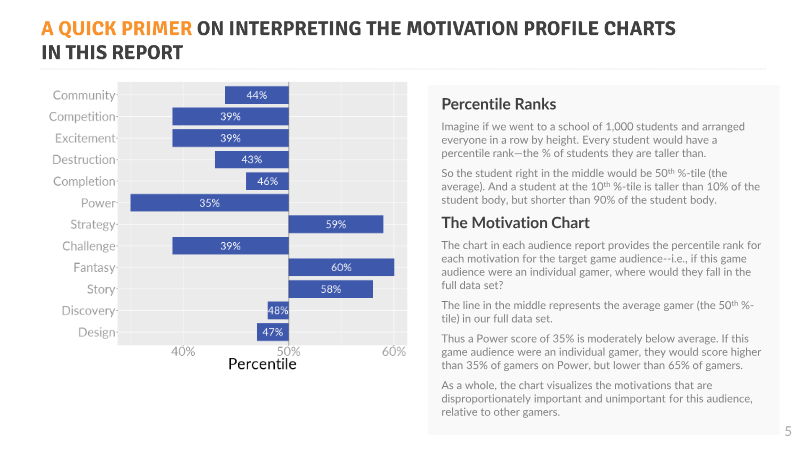
analysis replace survey items that loaded poorly until a robust model emerged um here's a sample report that we had um we also made it easy for gamers to share their reports on social media on Facebook and Twitter and so on uh we released the first pilot version of this model in June of 2015 last year uh in the first wave we got 30,000 gamers fill out the the profile and we did a huge revision of the underlying math the model and we pushed out the second uh the second wave in July in the second wave ARS Technica among other places picked it up what the ARs Technica staffed was they actually had a lot of their editors take the profile and then their write up was how their profiles compare to each other um on the day of the RS Technic hit uh on its peak at its peak we had over 600 concurrent users going through the profile tool um that
day after every big media hit we have a long tale of social media sharing in fact 80% of our respondents come to us via social media primarily Facebook and then Twitter to date we've collected over 220,000 uh data points worldwide uh counted as unique IP addresses most of the data comes from North America the US and Canada uh and the EU but we also have sizable subsamples from Southeast Asia and South America let me show you the model that emerged from all this data we identified 12 unique motivations that grouped into six pairs um so in every column the pairs are highly correlated and the motivations in different columns are less correlated let me go through these fairly briefly most of these should feel fairly familiar because they're based on existing Tex economies uh action is the
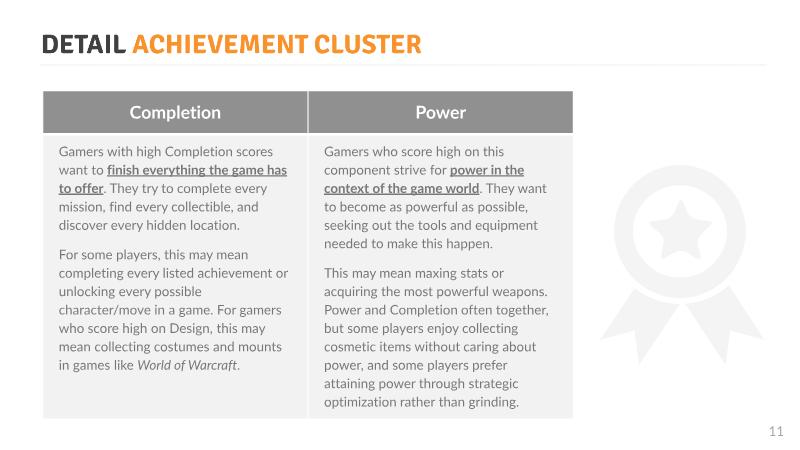
appeal of chaos and Mayhem in exciting fast-paced gameplay under social are both competition and socializing both the social interaction and the teamwork Mastery is about long-term thinking whether that's practicing a game over times you get better at it and you can match the game eventually or the appeal of strategy um you like to think and plan ahead and make complex decisions based on the information that's available to you achievement is different ways of getting points in the game whether it's completion getting points just for the sake of more points um collecting everything in the game or uh getting points in the sense of leveling up gaining power getting better gear getting powerful swords in the game immersion uh is different ways of becoming embedded within the story of the world whether that's the sense of immersion being someone else somewhere else or engaging with a elaborate plot
with a lot of interesting characters with in-depth backstories and finally creativity uh is different ways of making the game your own whether that's creating a unique looking Avatar City spaceship or Discovery uh playing the game in the broadest sense of the word of the of the word you're swimming out to the edge of the ocean in World of Warcraft just to see what happens or doesn't happen I mentioned that the motivations in each column are highly correlated un l so AC cross columns but those correlations vary right some are a little stronger some are a little weaker so ideally what we'd like to be able to do is to visualize that web of relationships across these 12 motivations all at the same time and we can do that and when we did that we found that at the high level there are actually three motivation clusters there's a technique called multi-dimensional scaling that that does exactly what I just said so on this map motivations that are more highly
correlated are positioned closer together and motivations that are less correlated are further apart on the map I'm showing you I'm starting with the the North America data so on the top blue cluster we see a lot of the motivations related to long-term thinking so strategy challenge completion power things that take place over time in the left yellow cluster we have a lot of the storytelling immersion elements story design fantasy discovery on the bottom orange Corner we have a lot of the action social elements so both community and competition as well as excitement and destruction what's interesting is that there are two dots that don't clearly fit into their clusters so Discovery and power they seem to be Bridges right between the Clusters so Discovery is the bridge between the immersion and the strategy and power is the bridge between action social and the strategy this structure is actually consistent for all the geographic
regions that we had the data for I'm going to go through these charts fairly briefly so it's a same dots in their respective colored clusters discovering power are always on the edges on the bridge Western Europe for Eastern Europe for Southeast Asia for Australia New Zealand and for South America the pattern is always the same so I've built upwards in the in the model I started with the 12 I ended up with a three high level I'm going to build outwards now and show you how these motivation clusters relate to existing traits in Psychology um I'm going to start with the action social cluster which I think is the most interesting and also unintuitive cluster and I I say unintuitive in the sense that in the literary review that we did in the taxonomies that we went through few if any of those taxonomies paid any special attention or ascribed
any special relationship between the action social motivations Community competition excitement destruction that there was something special about all all all four of those together but that's what we found in hindsight we realize that this is something that we could have predicted from personality psychology Theory um so in personality Psych the current gold standard for understanding and measuring personality traits is known as the big five um it was developed also using factor analysis of thousands of people around the world Decades of research in um in pop psychology everyone thinks they know what extroversion means right in pop psychology extroversion is whether you're outgoing or whether you're quiet but in personality Psych the research has shown that there's actually a really rich set of traits that cluster around extroversion that we talk about less often so people who are outgoing people who are extroverted also tend to be more
cheerful more optimistic more excitement and thrill seeking and they tend to be more assertive in group situations that's the full cluster of extroversion and that's really the underlying glue right this is the reason why action social clings together it's kind of like an expression of personality in the gaming context the other two connections are a little more straightforward so conscientiousness is the personality for how organized and self-disciplined you are it maps to the long-term thinking motivations long-term oriented motivations openness is how imaginative how curious how unorthodox you are and that maps to the immersion creativity cluster when I say map when I say the motivations map to personality I don't mean just based on sheer intuition we actually have the data for that so alongside the gamer motivation profile we also provide Ed an optional Big Five
profile tool for the gamers coming through and we had data from the people who completed both so here's what that data looks like from the action social cluster extroversion correlates positively with three of them for openness on the right hand side openness correlates positively with all four of the motivations in the emersion discovery cluster uh the the strategy achievement cluster was actually had the weakest correlations we only found consciousness uh correlating highly with strategy so uh this means that for example that people who score high on extroversion also score high on acent social people who are extroverted are the same people who like excite excitement and fast-paced gameplay they like competition they like social interaction in gaming you'll notice for for those of you who are familiar with stats these correlations are fairly low which is interesting I think actually that the big five is a universal framework but as you drill into specific context it can
lose specificity and it fails to catch nuances you kind of need this middle layer to catch all the nuances of specific context like gameplay but it's still enough of a relationship to show the the overall connection as you drill down from the universal layer to this the context specific layer um in the media well and in in the game community in general one typical framing of gaming is that games are escapists that people play games to pretend to be something that they're not but if you buy the data that I'm showing you really the opposite is true games are kind of like an identity management tool um people play games that align with their core personality traits so instead of enabling us to pretend to be something that we're not games actually help us to become more of who we really are let me slice the data now um
demographically um I'll start with gender when we started drilling into the data at first um gender differences seem to align with gender stereotypes um so in our data everyone gets 12 scores and we can take their highest score and say this is your primary motivation uh so here's what it looks at the high level I'm going to slice it by gender where it gets really interesting so at the high level split by gender the women are the blue bars for women the most most common primary motivations are fantasy design and completion for the men it's destruction competition strategy and challenge you know again at a high level it seems like it's all conforming to gender stereotypes but then we dug a little deeper and we threw age into the mix and then we found that a lot of these gender differences are actually dwarfed by age differences here's what I mean here's a chart of competition so we're drilling down just looking at competition the x
axis is age so from 15 to 55 every point is the average of all the people who are that age uh the colored dots green are the women blue are the men there are two interesting Trends in this graph so one is that there is indeed a big gender gap for young players but that Gap goes away past age 45 there's essentially no difference in the appeal of competition between men and women the second I think what's the more interesting finding is that if you look at that starting gap between uh the young players the men and the women that gender gap and then you compare that Delta with the youngest men so the leftmost Blue Dot and the oldest men the rightmost blue dot that in fact there's a bigger difference between older men and young men than between young men and young women we can actually quantify the effect size of gender and age age actually explains twice the variance that gender does in
competition and in a lot of the other motivations um we can also calculate the actual overlap between different groups so here in competition one of the places where there's the biggest gender difference there is still nonetheless an 87% overlap between men and women's uh interest in competition in the game industry we spend a lot of time talking about how men and women are different in terms of gaming motivations what games for women might look like but what the data is saying that the elephant in the room is really age and instead of worrying so much about what games for men and women would look like we should worry more about what games for different age groups what games for people as they grow older look like speaking of age the action social cluster motivations is the most age volatile group that's the group that varies the most dramatically with age and it's a
little different between the men and the women so for the men the entire action social cluster competition excitement challenge Community they all fall and they fall the most dramatically with age for the women you still see excitement in competition there but you get the interesting replacement of story so younger women are a lot more interested in narrative than older women are I spent some time talking about the finding from the mo motivation data I'm going to Pivot a little and talk about the many unexpected ways we've been able to play with the data due to its share size we never thought we were going to collect this much data and we had one question that we added serendipitously to the survey um we asked Gamers to tell us their favorite games and we did this um as a way to potentially debug the survey so if there were any factors we couldn't understand we could look back at the games to figure it out later on we were really glad we asked this
question so Gamers were asked to list up to three of their favorite games we coded the games in Mechanical Turk in triplicate to create a lookup database between the the messy names and the canonical names um and the first thing that came to us was could we try to build a game recommender engine based on this based on this data so for every gamer who comes through and we get their gaming profile we can look up the 1,000 Gamers who are most similar to that person's profile in the whole of our data set essentially we find you 1,000 groupies from our data and we surface the games that were popular and favorites among your groupies to show what you might like based on your motivation profile we then realize that if we get multiple people coming through if me and a friend come through and you both take the profile you both get the recommender we can do the vend diagram of game recommenders that what are games that you like they like and you both like in the middle so here we're going from the motivation
profile to a game to game titles but we realize we could also do it the other way around so if we pick any of the game titles in that we have in our data we can aggregate the audience that listed that game as a favorite the core engaged audience and calculate the average profile for a game so here's what the profile looks like for European universales right so we can calculate the demographic profile motivation profile and also the games that are popular among people who play this game or this franchise or this genre so we have this not just for for youer andalas we have it for almost a thousand games so then we realized if we could drill down into a genre space we could visualize the relationship between specific game titles in that genre space so let's take the strategy space for example here I've I'll tell you how we did this we picked Starcraft and
civilization as the starting seeds and we said we looked at the data to surface the games that are popular among audiences of those two games to get the other games in this list so some people often ask us why is Counterstrike in this list it's being pulled in by Starcraft so I'm plotting just the strategy dimension on the x-axis the excitement dimension on the y- axis before you all get pissed off at me um there's a lot of I'm zooming in on this strategy space right so there's empty space to the left of the of the strategy and there's empty space on the bottom of excitement I'm just zoomed in on a strategy space I'm not saying that there's no strategy at all in League of Legends um one thing you know we've done this with a lot of genres you we've kind of played around and in every space that we've looked at we've seen these interesting relationships and underlying structures that surface so here in the strategy space what's really interesting is that the top right quadrant is ENT empty and in hindsight we're like oh
it's obvious in hset what's happening that if I make a game Europa universalis that's incredibly strategically complex there's a lot of information to process through I have to give you the time to make those decisions in fact I have to to let you be able to pause the game otherwise you wouldn't be able to make those decisions in time and it becomes incredibly frustrating to play the game on the other hand the faster and more fast-paced a game is the game is more based on actions their strategy but not the kind of strategy where I'm giving you 30 pieces of information and asking you make a complex decision so there's kind of a tradeoff right between the amount of cognitive resources I can take from you I can either take them from you via strategic complexity or reaction time but not both because it wouldn't be fun if I push you over that edge the game stops being fun for the majority of Gamers but you know games that are right near that edge or slightly beyond that edge may be really good as as ort candidates right because there there's
that level of challenge that a lot of people can't master but people get the game but they know they themselves cannot play [Music] well so I've shown you this I think all of us all also have an intuition that these dots represent an aggregate gamer audience some of these games probably have more homogeneous audiences than others um and we realized we could drill down in each of these dots right we can drill down into a game title or a Subspace say city building games and do a cluster analysis to surface the personas the distinct personas the coherent personas within a specific space in this gaming map um and we can identify what combinations of motivations tend to tend to come up the most what demographic profiles what platform preference profiles surface with those and also estimate the the distribution of those personas within that
space um you can download the slides at this link um um and that's my talk thank you so much for coming and I'm happy to answer any of your questions [Applause] I Nick um can you tell uh do you have a data how is the relative share of each U major cluster like how many percents of like action social and others sorry say that again uh relative share of each cluster like action social and how many percents uh do you have the data we we do so everyone gets Bo on each of those 12 we've looked at it in
that big chart that I showed you by the 12 I haven't done it by the three it's a really good question email me yeah I'll tell you yeah hi uh I'm a student working on a thesis project that actually I want to take into account player personality so I'm just curious I haven't obviously looked into this yet I'm thank you so much for this presentation because this is really informative I'm wondering how much of your data is available online to like uh look at and reference on projects like no that's that's a really good question so this current data set is proprietary we've done a lot Nick Duo and I we've worked on the gaming psychology space for over 10 years there are past inventories that I can point you to uh that I have and other researchers have so I'm happy to point you to those yeah not emailing thanks y let me take your question hi um I noticed your data on starts at age13 uh do you have any data for children um below the age of 13 no so so you get a lot of um legal restrictions in terms of
surveying children under 13 and we did not we did not survey people who are under the age of 13 are you aware of anyone who has conducted such a study that is a good question I am sure there has but I I don't know it off the top of my head but I remember when there was a point where I was looking at other game Scholars and I know it's been done but I just don't know it off the top of my head okay it just it just gets really really tricky like I I don't have to do irbs anymore um but those of you who are Academia know how painful is to irbs and there are additional set of IRB regulations that come into play for doing any kind of research on people under the age of 13 that makes it particularly tricky yeah it's a great question though thank you yeah and Nick this is Randy angle you and I've talked before and I very much appreciate your talk today um I'm wondering what you've done in terms of mapping brain chemicals and and uh neurobiology and and all that back to this that's you that's a great question and I think you know it's it's
one of these big problems that will take a lot of different researchers to come together my background is not in neuros pych or the or or biocham so it's not you know an era research that you know we've gone into but you know I think you know as more researchers do this stuff I think we'll see some really interesting findings with with how you with chemical changes over age and how that may or may not align with the age findings that we've seen I'll send you some emails yeah that's uh yeah hi thanks for the talk super great um so I was one of those people that saw this shared on Facebook went and took it so I was a little bit primed and I kind of knew what was what was going on here um I wonder how much of your data do you think has some self- selection bias and how do you check for that or is the data set just large enough that it doesn't matter that's a really good question and I think um you know there are a couple of biases in the data that we are aware of so I know we skew towards a core gamer demographic and so that brings along a higher percentage of men and a slightly younger gamer base but it's harder for us to quantify and understand
the the social potential social media biases of this in a sense we were glad that it didn't primarily travel through gaming websites like PC Gamer um and so forth that it was it was more on the social side so that was it was good but again you know it's not clear to us what the other potential confounds may be because of that route it's a great question yeah actually I was going to ask something similar I'm curious if you guys are planning to do any uh studies that aren't uh self-administered online things that will try to build from the same profile OB a lot of sh with that so one of the things that we're working with a lot of our clients is actually targeting their Gamers specifically um and really looking and being able to track those motivations in line with how they actually behave in the game so we can actually you know see you know does what they say correlate with what they do um and so you know we're we're doing a lot of that stuff with with clients likely a
lot of that data cannot be shared but it's something that we're actually doing uh alongside this cool so is that uh surveys on the games of specific like just administer so when people play so right when people so the problem in what we're doing this we don't have a good sense of how rep of the true representativeness of it but if we're working in hand with a game company and we know the actual distribution of retention cohorts or different player segments we can actually sample representatively have a much better sense of the the sample distribution cool thanks yeah uh all right uh I was really interested in your when you talked about Age and and how that was a bigger correlation and you mentioned that younger women were more interested in the narrative than older women were in your study and I was was wondering is that Universal like all countries that was a universal thing or was that more Europe Western yeah that's a really good question so we've we've we've sliced the
data a lot of ways but we we're we're going at a at a moderate Pace but there's some questions like that that we haven't been able to drill down into so that's a question that I actually we have not looked at yet but it's a great question so we know that in a lot of a lot of places where we've drilled down into a specific genre or a specific age group that things tend to change you know a little but I don't know off the top of my head what it does look like you know geographically for that question it's a great question yeah thank you yeah uh hi there uh so uh this is obviously really really cool stuff um so I know somewhere along the line you you kind of said uh you you transitioned you were in phase one and then you had a phase two I guess I'm curious uh what's what's phase three where um how how much are or what ways are you going to expand on this data and what are you going to apply I think that the biggest the hardest thing about what we did so I a lot of my uh past research was in uh virtual in MMOs so I have a taxonomy of
motivations in MMOs where it captures the nuances if do you prefer casual versus rating guilds um you know how much time you spend designing your your avatar where they're really grounded in that genre the biggest difficulty with coming up with a taxonomy at the most General level is you start losing that Nuance so for us the phase three will be figuring out ways to bring it back that new that bring that Nuance back in in a way that's still manageable in a generalized survey um and we're thinking that they will be additions of questions that are targeted of if you play this genre you know which of these things do you generally prefer when you're playing this genre of games that's cool thank you yeah we're out of time but there is a wrap-up room if you don't know where the wrap-up room is it's right around the corner Nick du and I will be there we'll be happy to chat and answer any of your questions after this thank you so much for coming to my talk
Auto-generated captions from YouTube — names and numbers may be misheard.
Key insights
Distilling the key insights…
Ask AI about this video
Cite this video
Citation
Generating citation…

















Comments