1 free read left. Create a free account for unlimited reading + AI research.
Create free accountArticle DiGRA
1 free read left. Create a free account for unlimited reading + AI research.
Create free accountArticleDiGRA
The paper argues that the games treat the city as a symbol of longing rather than a faithful physical or historical place.
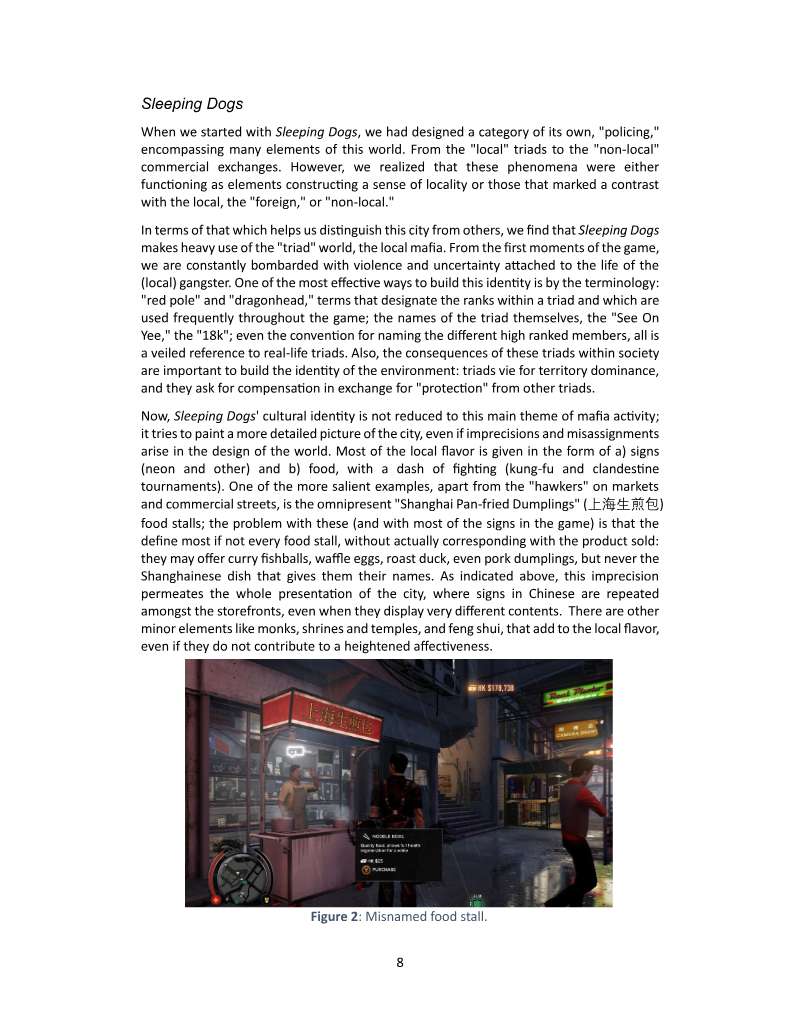
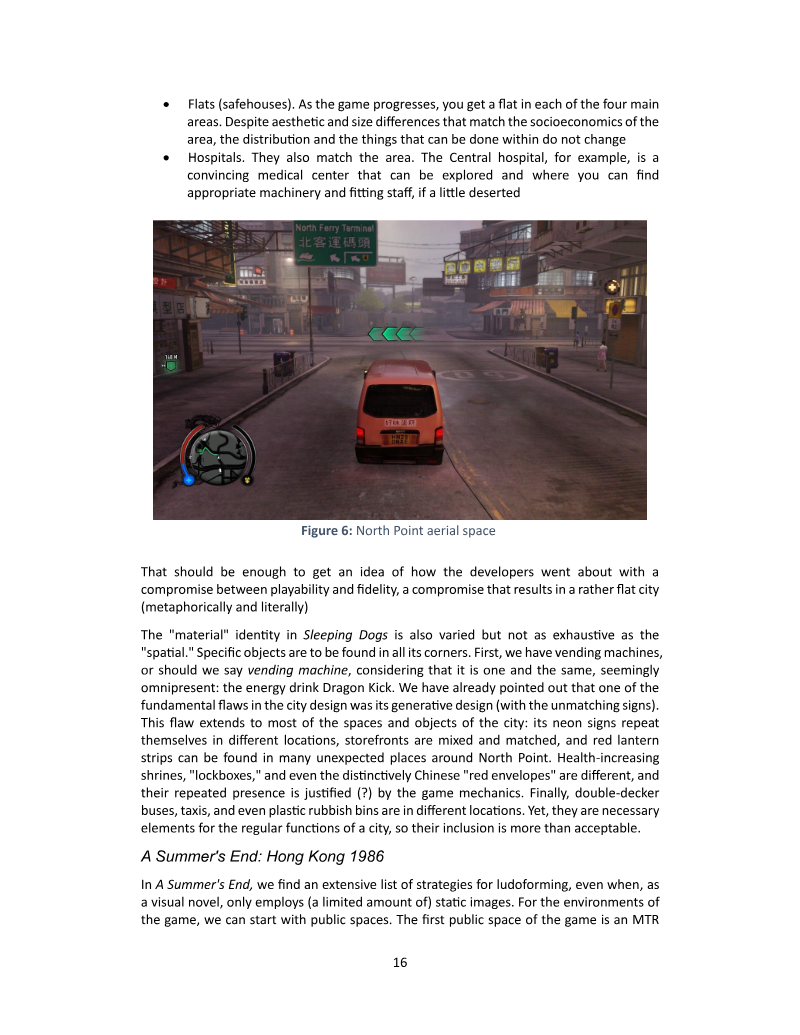
This paper examines how two video games set in Hong Kong but developed outside the city, Kowloon's Gate (Zeque, 1997) and Sleeping Dogs (United Front Games, 2012), reimagine the territory as a symbol of nostalgia rather than a faithful physical or historical place. Its central argument is that, despite their inaccurate and inauthentic depictions of Hong Kong history and culture, these games render the city a playable emblem of longing, one that exists in an ambiguous zone where the familiar and the exotic, the authentic and the invented, coexist. The author frames this as a reconsideration of the "Asian games" genre, proposing that its appeal lies less in historical accuracy than in its capacity to convert Asian lived experience into ludic forms accessible to players worldwide.
The analysis draws on several theoretical strands. Nostalgia is treated not as an objective recovery of the past but as a deliberate, modernized gaze that produces a sense of temporal displacement, a framing drawn from scholarship on Hong Kong nostalgia cinema. The paper also builds on the concept of "ludic race," adapted from Christopher B. Patterson's work on Asian representation in digital games, which suggests that play can allow non-Asian players to inhabit Asianness as a form of virtual identity tourism. It situates these two titles alongside more explicitly historical Asian games such as Detention and Devotion, which pursue a restorative relationship with the past that the author describes as historical authenticity.
The scope of the document is focused and qualitative, centered on two case studies rather than a broad survey, and it makes no claims based on player data, sample sizes, or industry statistics. Its contribution is conceptual and interpretive, offering a framework for understanding how games set in Asia can prioritize emotional and symbolic resonance over documentary fidelity. The argument is positioned within game studies and Hong Kong cultural studies, and it proposes that the coexistence of authentic and inauthentic, familiar and unfamiliar, is central to how such games engage both local and nonlocal audiences.
Each row is a game or company this document names, each column a document, oldest first. A mark means that document names it. Select a row to see those documents.

DiGRA · 2026

DiGRA · 2026



DiGRA · 2026



DiGRA · 2026



DiGRA · 2026



DiGRA · 2026



DiGRA · 2026



DiGRA · 2026

DiGRA · 2026



DiGRA · 2026



DiGRA · 2026

DiGRA · 2026
DiGRA · 2026