Loading the document
1 free read left. Create a free account for unlimited reading + AI research.
Create free account
Puzzle Monthly #7: Sort Keeps Winning, Arrows Needs a Hero and Smash Takes Aim at Angry Birds
Key insights
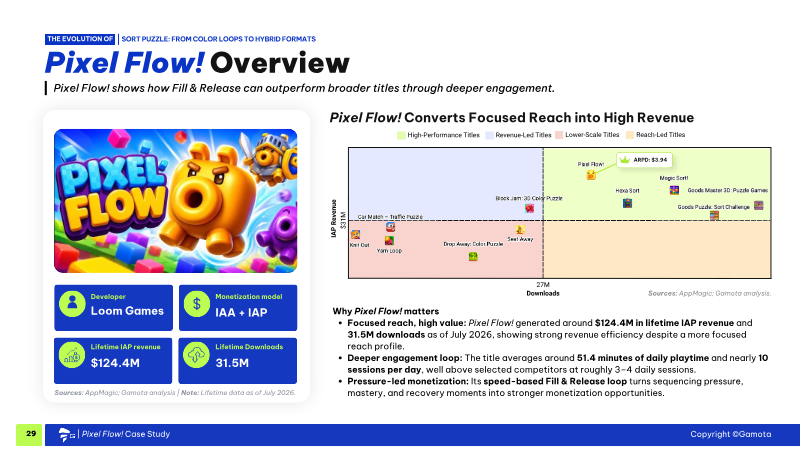
7 takeaways- 01Sort has become the third-largest puzzle subgenre, with Pixel Flow leading top-grossing charts and drawing a high share of its downloads from AppLovin ads.
- 02Rotatelab's Cube Land applied Sort mechanics to This Is Blast by moving it into 3D, borrowing Pixel Flow's dynamism to counter the static feel of This Is Blast.
- 03Sort's appeal rests on depth: newly uncovered colors and unseen layers force fresh tactical decisions, keeping each level dynamic and fresh.
- 04Sort games often fail players late in a level after an early mistake, which makes ad-monetized play more likely and end-of-level purchases harder to sell.
- 05Arrows titles like Color Escape and Cube Away rely heavily on ad-driven revenue, and the subgenre struggles to scale profitably in the US; Maze Out is the candidate to pioneer a purchase-friendly approach.
- 06Color Block Jam and Blockout are hard to copy because their level design takes far more effort than Pixel Flow's, so the subgenre yields few followers after each hit.
- 07Smash games are directly targeting Angry Birds, with Angry Birds 2 at the center of the competition, and Smash Fest was expected in June with a larger push in July.
Ask AI about this video
Transcript
This episode is sponsored by Moloco. More than 2 billion daily active users, over 2.8 million independent apps globally. That's the reach Moloco ads unlock for performance marketers who don't want to stop at the usual walled garden. It's all powered by Kara. Moloco's compound AI system continuously learning from billions of events and getting smarter [music] with every campaign. Hop over the walled garden. Check out moloco.com. That's m o l o c o dot com.
Unless you've been living under a rock, you know this is Web Store Rump Springer. 70% of top apps are using a Web Store, and the best ones, they're doing it with App Charge. Do you want a $20,000 in-app purchase? [music] Yeah, App Charge does that. Do you want to pretend that subscriptions are still a viable monetization strategy for games?
Yeah, App Charge even lets you do that. They get what high average revenue per paying customer means, and they're already doing over half a billion dollars in transactions a year. So, are you going to be the first to do a $20,000 IAP? Don't accept microtransactions, embrace macrotransactions. Learn more at appcharge.com.
Satori. It's the Japanese Zen Buddhist term for sudden enlightenment. That flash where everything clicks. We're told that Heroic Labs team had theirs when they realized that most studios run live ops like a horoscope. Vague, kind of generic, same advice for everyone. So, they built Satori. Real-time experimentation, player-level personalization, events that actually respond to player behavior. Say sayonara to your old live op stack, and konnichiwa to Satori from Heroic Labs.
Hello welcome to Puzzle Monthly Three Amigos Edition. I'm your host on A C Chief Product Officer at Rotate Lab and today I have with me Tom.
Hey, I'm Tom Stowe from Experimentation Group. Looking forward to the discussion today gents.
I'm David Nelson, Chief Magnet. I'm a magnet, that's what I am.
Changing the nickname each episode. I like that. We don't have Laura today, so that's why the Three Amigos episode. And today we're going to talk about something that I think has been occupying the headlines or like panels, events, whatever you follow. The puzzle subgenres that emerged quite recently and some of them like stayed at the top and continued producing some hit games and some of them just produced a couple of winners and then just kind of like suddenly died and they couldn't continue producing like more mid-size games. That distinction between the recently new
emerged puzzle subgenres. And I think the most obvious examples that I think we can focus on today are arrows which started with the I think Lessmore hits about a year ago or so and then a couple of games followed it and now we hardly see any arrows game. And then the other one is Smash which like took the source by storm and it seems to be settling down although it's still like proves some kind of potential for new titles. And obviously Sort which became literally the third largest puzzle subgenre coming right after Match 3 and Merge which are impossible to beat right now. So which makes Sort the most attractive subgenre right now for any puzzle enthusiast or for any team that's working on puzzles. Tom, I think you already have some like numbers and graphs from the market that you can share or talk about. Do you want to take us through that?
Yeah, yeah, yeah, I do. But before we
get into that I was going to say, so I was in Istanbul last week for Mobidictum and whilst I was there, so many people came up to me and were like, "I love the podcast. Thanks guys. It's so interesting. It's really good." So, number one, I wanted to say like, "Nice one guys. Nice one Laura and Phil when he's been on." And number two, like, "Thanks for everybody listening." Like it was so nice to kind of meet a bunch of people in the shop.
also on the first episode.
Oh, yeah, yeah. I Yeah, and I met her also over there. Yeah, just a bunch of people hanging around. It It was so cool. So, happy for that. I was going to share this anecdote as well about Turkish. I had the all these run-ins with this Turkish dairy products. I know this is not at all relevant, but I thought it might be quite funny. Maybe the funniest one was like, on the way over, my flight was delayed and so I didn't end up getting into like into my Airbnb until like 9:30, 9:45, like super late. Luckily, there was a
shop open and I went into this shop and I was able to get all the stuff for breakfast and some dinners and stuff like that and I was just like so smug with myself after just like bit of a nightmare day getting over there. You know, went to bed, woke up, went out for a run, came back, made my breakfast, put cereal in the bowl, put the milk on the top, started eating. Oh lord. That was not milk. You guys don't keep milk in the fridge in Turkey, no? Like it was It was this kind of like salty
yogurt thing.
Yeah, ayran. Probably you bought ayran which is which is the liquid liquid form of yogurt. You got it like since you said it's salty and yeah, keep it kept in the fridge. Yeah, exactly. I'm not sure if I know anyone that tried cereals with ayran, so I think you're the first person that I know that tried cereal with ayran. Yeah, congrats for that.
How How did it taste?
Well, then exclusive tip, it they don't go together. I wouldn't do it
[laughter]
again.
Yeah, well, I was telling you about I got a a big bottle of ayran.
Just [laughter]
But it's big here. It's in all the falafel places in Malmö. It's like full of ayran. And then also I mean I mean you almost always have it with with falafel. It's pretty standard, you know.
No way. Well, that was the confusing thing. It was like when you go to Cyprus and they've got like 40 different types of halloumi. It was the same thing there. That's why I thought it was milk cuz I was just like this white stuff being a bottle [laughter] in the fridge.
Talking about Turkish milk products, maybe we can talk about Turkish puzzle products. That's They That's also quite [laughter] a varied portfolio.
Thanks Thanks to Kipi. Thanks for keeping us on track. So yeah, I guess like my my thought was it feels like definitely this year we're almost like a new era in puzzle with the how AI has kind of shaped the industry and that's the kind of like old model where you like a match kind of model where you would get a player and like develop them over time and kind of
layer up these core loops into a like super kind of profitable uh business. Like that feels like that's kind of cooked now and it's difficult for somebody to enter those genre which is so kind of stable like match basically. But what we're seeing instead is these kind of fits and starts. These like things like sort games like Pixel Flow which come out of absolutely nowhere, explode onto the scene and then they're immediately followed by 50, 100, 200, 400 uh competitors who are trying to kind of do the same thing. But actually when you look at them in the kind of wider context, number one, there's kind of difference. You know, it's interesting to compare the different titles, the ones which work and the ones which don't and the ones which fizzle and the ones which follow and kind of blow up. But it's also kind of interesting to think about it in the wider kind of business context of what's the model that's going to work here, right? Like how do you particularly now at loving is is an extra competitive piece of the puzzle
like what's the process that's going to fit and work in this new context. So, yeah, interesting interesting discussion. Why don't we start by going through Sound So, because obviously we've got Cube Land in there, haven't we, AC? So, which you're a CPO, Rotate Lab, you're going to have a really kind of interesting perspective on this. So, looking at the sort category, like obviously it's kind of in a way it's probably top of mind for most people because of Pixel Flow and the way that like shot out of the gate at the beginning of this year, kind of end of last year. This chart is top 10 by revenue over the past 12 months. But, then kind of over summer what's happened is these new competitors have come out and started to do pretty well, including your game Cube Land. So, it'd be interesting to talk about that. Revenue is IAP. So, obviously we're missing ads here. Carney similar story. When you look at downloads, not a massive difference. Maybe this pink game, which we
unfortunately can't see cuz this is an image, is looking interesting. And then the other thing which I pulled was this data to compare the way that you're going to win these days is by having a good share of iOS players and a good share of players in the US. And by winning AppLovin. So, I thought this this is quite an interesting kind of table actually to look at when you compare these are the top five titles by ordered by the revenue over the past 30 days. I thought it was quite an interesting trend where actually that that Pixel Flow had the at the top has got the highest kind of share of their downloads coming via AppLovin. So, it looks like they in particular are doing pretty well here. And Sand Loot are kind of like a little bit cooked. As you can see the same in the table. So, I guess it would be interesting to to get your perspective on this, AC. Like when you were kind of thinking about Cube Land, like entering this like
mega competitive category, like what was the thought process on your side? What was the thesis where you thought this is the way that we can attack the genre and do something different and make a mark for ourselves.
When we first started like working on Cubeland and uh started first idea to narrow the whole mechanic and all game design, it was almost like a year ago these days, maybe like lot November of 2025. And to be honest, it was obvious from that day that it was right at the beginning of like Pixel Flow's huge starts and uh it was obvious that Pixel Flow was going to lead the market and it was going to drive new iterations, new versions. And that kind of pushed us towards a state where we thought that okay, the sort subgenre is going to be a really like nice place to place our bets on. Because match-three, merge, blast, these are completely out of the picture. They need a different team structure, they need different requirements. You cannot like tackle
those genres, subgenres with 15-20 people right now. It's it's not like a logical move. On the other side, there were these short-lived subgenres, like Arrows is an example. There were other type of like logic puzzles back at the day. They are There are still new logic puzzle type of games right now. They kind of like pop up here and there, but they never give you a like proper pattern or they never give you a proper roadmap to build a hit game. That's also an important factor. Just because you see a like a hit game, you see one game at the top of the charts, it doesn't mean that that's there like a viable business plan. I'm like I'm always talking about this like which subgenre to go after, don't go after blast or don't go after this, don't go after that. There is always that part, like it's important not to be lured by a couple of games. So, it was obvious that the sort space was going to produce a nice middle ground for like high-risk, high-reward type of things
for our size. And to be honest, when we looked at the games on the market, we knew that we didn't want to produce an entirely new game because entirely new games usually fail. Players usually look for something similar, something that they're already used to, but maybe with a kind [clears throat] of a like a different taste, different flavor with a simple iteration. So, we started looking at games in the subgenre that would provide us a nice base, strong baseline to build the game upon. And This is Blast was actually the game that we studied, let's say, that we worked on. Because Pixel Flow is an iteration on This is Blast. It just takes the This is Blast target and blasters and puts a conveyor around it and turns it into this mega hit. So, we thought, "Okay, This is Blast, but this time let's make the target 3D because we know that it works with Scrollar, so that it also
produce its other kind of like followers, which Needle Way, Yarn Away, those type of games. So, we knew that 3D-fication of a puzzle subgenre would work. And we also knew that the baseline with the This is Blast had the really strong retention base, let's say, because like there are lots of Pixel Flow iterations right now who are actually like grandchildren of This is Blast, I would call them that. So, we wanted to 3D-fy the This is Blast gameplay and that's what we tried to go with. Keep the lower half of the screen the same. There's a blaster list, you just put them on to the five dot place and the space is limited as well. But with the targets, you need some I think what lacks in This is Blast, Pixel Flow showed it clearly, dynamism. This is Blast lacked dynamism. It was too static. [clears throat] It was You always saw the same thing and it never
changed. It only kind of changed its shape to certain extent, but it didn't provide you any story because if it didn't provide you any story within the level, Pixel Flow really put the dynamism and that story at the center with the art yet like targets and the conveyor and that's the thing that I think we bought from Pixel Flow. That philosophy that we needed dynamism and we needed a story within the game within the game mechanic itself and that's exactly what we tried to do. 3D find the object was the main challenge because like I said, the rest was the same with This is Blus and I think we were able to create a nice like successful level design with the game. I think the level funnel is also quite enjoyable. The levels are quite original and unique so that even if the game doesn't provide you any new mechanics or events or features, you can continue playing the game or you will come back to the game just like
wondering what the next object is going to look like, wondering what the next level is going to look like, which is quite similar to Pixel Flow in that sense to be honest. And then once we like saw that it has good potential, we just continued iterating based on it and like improving the game through different perspectives from core mechanics, live events, offers and from different sites and there is still like there's still a lot that of course that we want to do with the game, but I think our bet that the sort sub genre was going to be the next thing turned out completely correct and I still think the sort sub genre is going to continue provided proving new hits like producing new hits in the coming weeks or months.
So I haven't heard anyone say it like this before and I mean I spent a lot of time talking about puzzle games and games in general for a long long time. You said there needs to be a story. When I look at a board in Pixel Flow or
Cube Blast or any of these things, I look at like what are my options and then I look at the colors and I start to form a thought about how I need to solve the puzzle. And as I start to play, new information opens up. So to me what you're saying is I think that I need to make some sort of like tactical decisions and then things change during it which causes me to have to adjust and rethink things. And that's why it feels dynamic and interesting. And it's the same thing in match three. You start playing a board, you think it's this you're trying to get, but then things drop, but that means I need to do this and then that thing and then that's what's interesting. And it means that it's always kind of fresh. The way you do it in Cubeland is that it's the depth, right? It's the new on colors, new colors are uncovered as I play through. Plus I don't know what's further down in the chain and as those two things open up I have to make new decisions and sometimes it turns out I made one that wasn't good and I need to try it again etc. So I mean this is the this is the story dynamism, yeah?
Yeah, yeah, yeah, like of course like
you can have that type of dynamism in I don't know Sudoku as well because like the in Sudoku also you need to kind of see the options and you may need to make a tactic, but it's too static with Sudoku. There is no
Is there some dynamism? There's a correct answer, yeah. Yeah, there's a correct answer. I mean that's the
The the explosion is limited, exactly, but with Pixel Flow, with Cubeland, with Jelly Busters, I think we also talked about it as well, that you explore the level almost and I think that draws the players towards it.
Yes, exactly. I mean I don't want to sidetrack into Mudoku, but I spent a good amount of time trying to figure out how to simplify uh Sudoku cuz I really like it. But if you're not like insane, uh then you know, it's like at some point you're like why am I doing this constant like, you know? And I was like there must be a way to simplify it and make it more dynamic. And then I was like uh whatever and I gave up and then Mudoku started scaling. But it is a really interesting question
I think just as a puzzle question. The word story, I like that you said story cuz it's kind of what you To me when you say story you mean like what I hear you say is this like I think this is what's going to happen in this level. And I mean that's what's that's the interesting part. You start to like imagine something, you know? Very cool. Very cool. If it doesn't have it ends up being static.
Exactly. Although although most of the hard or super hard levels of these types of games, especially with with Tubeland, I think it differs a bit because of the 3D dimension. But with like 2D games like Pixel Fower, Jelly Bustards, etc. or Dissipate Blast, they tend to be a bit static with their hard or super hard levels. But even with those levels, because of the way you untangle the level, you don't feel that staticness to its fullest extent. Because that exploration part, that unraveling part kind of covers the staticness of the level, the necessity of you to make
certain moves at certain points. You don't feel it that strongly.
Yeah, I mean and that that is one of the most interesting things, right? A really good I mean you can kind of imagine like the very edges, right? It's like it's Sudoku at one edge. It's like there's a correct answer and you need to work it out. And I mean you know I've worked on puzzle games where the the way it was structured was there was a correct answer. And sometimes you make a mistake early on and you don't realize it until the end. And then there's no really good way to make a sort of an end game purchase where you're going to buy something at the end cuz you need to solve the thing you messed up before. And it's hard to fix that and then it's not a very compelling thing. So you end up getting those tend to end up being ad monetized games cuz there's there's no real way to make a compelling purchase where there is no correct answer and there's just openness. And all you're trying to do is win and then it's like you know well there are you know you might as well just hit the button cuz it there's no point going backwards and starting again. It's the same just hit the button, you know. So like if those are the edges the interesting part is that that mid part where I think Max 3 has owned it
for so long and that is really interesting way to think about it with the those ones. So that was really interesting.
Yeah.
One of the things which I think is quite interesting or has puzzled me anyway, be interested to get your opinion on it on on these sort of games is like
[laughter]
big is is it the levels are quite long, right? Like you can be playing a level for like 3, 4, 5 minutes and actually most of it is quite kind of easy. And so, you don't get the fail points sometimes until quite late on, which has, you know, in in match three, that's like a definite no-no because it kind of makes the level not particularly appealing to play again cuz you have to invest so much time in it. But this is obviously kind of not been a problem for sort in that that's kind of standard, right? Like, average level must be 3 minutes, 4 minutes, something like that and you would like
[clears throat] you would like necessarily like fail towards the end of that. So, I get but I guess that that that's not a problem.
With like the what we are used to with match three games or even blast games, they can use a huge amount of parameters that can change the level difficulty or that can change the level design within that same level. You can still fine-tune things throughout the way. But because sort with sort levels, you have a more like predetermined sequence and you can you even have like videos on YouTube showing like how to solve certain super hard levels of certain games. Our games Our game also has those videos as well. You cannot like force the game to be like match three from that perspective. You have to kind of accept that okay, yeah, this is a sort game and this is going to have, I don't know, 2 minute, 4 minute levels. Sometimes maybe shorter than that, but the average is
going to be like that and I need to build the game around that fact. So, instead of kind of like trying to fight it and trying to change it that natural part of the subgenre, we try to build around it. We'll build towards it so that we could kind of facilitate it as much as possible.
And you think so that's that
it's similar with other sort games as well. I think general has even like longer levels compared to any other sort level that we're talking about today.
So, that means you you might end up with only one or two maybe monetization moments. Does that affect your kind of live ops strategy like the way that you think about the goals that you give to players?
Yeah, I think that determines how you approach your monetization levels, your harder separate levels, how hard or how easy you make them, how you price certain things, price certain actions, price certain items, and it's all an act of balance. At the end of the day, you need
to like hit that end game offer per your kind of mid per session type of metric, and it's by nature a bit lower than a match three game. You need to compensate it through other factors. Maybe through session type, maybe through number of sessions, maybe through other kind type of metrics, so that at the end of the day you're not going to lose because of that simple fact.
We've talked about it a bunch around match three that it's actually kind of it's like nice to look at the cascades and stuff. But, I think one of the things that's really interesting with the sort ones, I mean, it's definitely through uh Cube Blast, Pixel Flow also. There's a lot of effects, there's a lot of particle stuff going on. It is pleasing to watch it happen. And I think that makes the beginning part where you're not necessarily you don't need to make a bunch of strategic decisions. It's like a nice intro to a move or like a movie, you know, like, "Oh, this is pleasant to and
[laughter]
100% Yeah, 100% agree.
This is nice, and then you're like, "Oh, wait. Is that a good pair or bad pair?" And then you start working out. Every level does that, you know.
I'm really leaning into your story your story thing. I mean, this is the
[laughter]
This is the key insight.
Yeah, just look at all the successful sort puzzles right now, and you'll see that all of them start very nicely. All of them start extremely smoothly. You don't have to think about anything. You just tap tap tap tap tap. Destroy a bunch of cubes, and then think start thinking about the puzzle.
The effects are all like, you know, everybody's turned all the effects up to 11.
That takes into consideration the fact that most people multitask when they play. They like I don't know cook, they I mean a train, they watch some show on the TV and sort games also let players like make a couple of moves let the game like sort things out
That's true.
Look at whatever they are looking at and then come back to the game. Except games that use the conveyor a bit harshly, they kind of lock you in after a certain
point. That's the kind of that difference. That's I think where they kind of have a kind of a differentiating layer. But up until that point, you can just like put your blasters onto the deck and then let them do their thing while you you know deal with your own thing at the same time. That's also a plus I think for most sort games that you know that they fit nicely into the like daily life of any Midwestern 40 plus female.
A classic.
Eiffel Tower, iconic. [music] Tower of London, historic. The Two Towers, simply epic. But none of them tell you anything about mobile app intelligence. Downloads, revenue, active users, and my personal favorite, weekly cohorted retention. Get the real story, get the real data, get Sensor Tower today.
In sickness and in health. In soft launch and in live ops. Through every meta shift and every platform policy change. That's the kind
of loyalty Vibe builds between your game and your players. AI powered targeting, a real [music] meta layer, ROAS optimization that actually converts. That's what makes Vibe mobile games. Till churn do us part, Vibe. V Y B S .co
In today's hyper-competitive digital landscape, understanding your app's journey [music] from discovery to download isn't just insightful, it's the difference between scaling and stagnating. [music] Enter Adjuster, the undisputed leader in mobile attribution and marketing analytics. They've mastered the science of making every ad dollar work harder [music] by revealing exactly where your players come from and how they interact with your app. Their platform transform [music] mountains of complex data into clear, actionable intelligence that separates winning campaigns from budget draining experiments. And I know that many of the top game
companies leverage Adjuster and are a key partner in their success. Adjuster, where your app's potential meets performance.
Um okay, cool. I think we could talk probably talk about this all day, uh but we've got two more genre to cover. And the next one I'm like hyped about. So, let us jump onto Arrows. Cuz I think this is really interesting. It's all in in a sense it's kind of almost like the reverse of what we've just been speaking about. And so, you can see on this chart here that point out uh Color Escape is like the Pixel Flow of this genre, kind of. Uh in that it was like the the massive leader came out the blocks and and it's kind of um died a little bit. On the download side, uh cuz it's super kind of ad-driven genre, Arrows has kind of done the same thing. Uh but when we go back to look at um
revenue again, we've got this game Cube Away, which I want to talk about, which is started to kick off. And just to quickly look at this slide here, where we've got Cube Away is the game which is currently making the most money from in-app revenues, 64% IRS, 100% AppLovin. They've really focused on that. I guess like my thoughts on this uh genre are when I first started to play these games, I think Arrows Puzzle Scape was the first one I played, I just love it. It's [laughter] so satisfying to play and I got really sucked in for like 10, 20, 30, 40 levels and then it just got really boring and didn't want to play anymore and then live ops weren't there and it just sucked. Until I then picked up Cube Away 3D puzzle which is basically done what you've done in sort in that it's taken the 2D puzzle which is super kind of flat and it's almost like
the only way really to fail it is to be kind of like really hasty or make a mistake basically which is a really crap way to fail a level, isn't it? When you're just like, "I knew I could do that." and my big fat thumb hit the wrong arrow and now I have to watch an ad. Like that's just frustrating. It's not fun to do that 10 times in a row. Whereas Cube Away because they've got these three-dimensional shapes and also on top of that they introduced various different kind of behaviors. You can tap the arrow to make it go one way or the other or they'll have like an interstitial point on the surface of the shape so you can tap the arrow and it'll go to that point only. It won't disappear off the puzzle and so sometimes that's enough to kind of create a space to move another arrow and then you can move the first arrow. So it introduces a kind of layer of strategy on top of it. So whereas initially when we kind of got to this point here, this
peak where the point out started to die, I was a bit like, "Uh I don't know about this genre. I don't know how much legs it's got in it." The additional gameplay stuff which Cube Away 3D puzzle has put in, I'm a bit more kind of positive about it and and actually they seem to be doing pretty well in spite of the fact that their live ops and the whole matter looks like it they built it in an afternoon. So I don't know. What do you guys think?
The one thing I I wish this chart was active users or downloads also cuz I mean the problem is with these games, it's massively ad-driven. Um so, I mean some of them are Some of them might be better. There we go. Yeah. Yeah, I mean you could Like basically, I mean you If you're looking at monetized games, you need to be looking at can they drive downloads and is it still working because you can't see a huge chunk of the revenue, which I mean is true for other games that are hybrid also, like the
pixel full games and stuff like that, but yeah.
I think this was quite interesting in how like it's not particularly strong in US at all.
Yeah, cuz the downloads are not like cheap enough to justify scaling them in the US probably because it's a ad monetized because it's a mostly ad monetized subgenre. Keep an eye out for maze apps from Gram Games. They have started working on that arrows type of puzzle lately and they are adding that like classical puzzle feeling to that game as well. I haven't played
anybody can solve that then they can solve it. I mean Like what they've done ridiculously good. I mean Magic sort of figuring out how to get the in-app purchase with water sort was brilliant. I mean they've These guys are unbelievable at this.
Yeah, and Blockout is like the other another story which is like dominated color water champ lately and I think these types of arrows like subgenres
that downloads long and that they like too much on ads, I think they either need to be these evergreen subgenres like I don't know, My Own or Solitaire, those types of games where they even their organics are going to be super strong, super powerful
Yeah.
or they need to find a like a pioneer, a game that can pick that subgenre into the in-app purchase top chart top grossing chart because without that like you said from their downloads in the US is not so strong because they cannot scale. The CPIs are not going to justify them gathering that many people in the US because they cannot monetize that well. And when they don't monetize that well, you either end up as like Mobile Tier, those social agents, which is a really great business model, but there's only one Mobile Tier. So, it's a really hard market or you just get lost in the market. You don't uh have the
opportunity to scale the game profitably. So, I think I would keep an eye out on the Maze Up from Great Games to see whether they can be the pioneer of the arrows space. Because if they show how to use arrows like in a purchase positive way, then maybe the whole subgenre can take a new turn. It can kind of revive itself with new followers and new titles, etc. But I think subgenres like arrows need that one pioneer to to be relevant in the puzzle market basically.
Yep.
I mean, it's not that far-fetched to think that this chart we're looking at might become this chart here, right? The Sand Sort revenue where you've got this game, a game that comes out and captures everybody's attention, and a bunch of studios are like bro, I'm going to do that. And then, you know, you have games which start to
solve that. So, yeah, maybe that's Cube Away.
Yeah, Cube Cube Away was also can also be at like It's either Cube Away or Maze Up or some other game, but before someone really like takes the game to the top charts in a sustainable manner, it's hard to be relevant in the puzzle market without that. Like with the ad revenue, it is like it's just not sustainable. Maybe you like you can make a profitable game with ad monetization, but if you need to make a like long-term sustainable hit, of course you need to be successful with in-app purchase monetization, which is extremely tough in the current market. It's extremely extremely tough.
So, perhaps what we're what we're saying then and what we're seeing between these two genre is that in both examples, we've got a game coming out which is arguably kind of new gameplay. And so, that works in UA because players are like, "Oh, this is something different.
I want to play it." And then, because once that's starts to kind of cut through, other studios, well, if the first game it wasn't happening in both of these occasions, the first game hasn't been kind of strong enough to sustain. A bunch of other studios have come along and seen ways to iterate and improve upon that and make the IAP work in that context. And been, you know, potentially been able to grow the genre into something that that lasts.
Yeah. Yeah. Yeah. And something like sometimes in certain cases, for example, with Color Block Jam and Blockout, the followers don't get enough space in the market and it just becomes the game like the market of a couple of games only, a couple of games only. That like I I literally have no idea how that is determined. Like why the Color Block Jam Blockout space didn't turn out to be the short space.
I don't know why that happens, but sometimes like you either become Arrows in its current state, just like Lost and looking for a pioneer, you become Sort which is just thriving with new hits almost every month, or you become Color Block Jam Blockout, which is revived every time a new hit comes, but everybody else just like leaves almost empty-handed. Of course, not completely empty-handed, but compared to those two.
We can propose a reason why it might be like that, Kenny. I mean, Pixel Flow, the designing levels isn't incredibly hard. Like, if you told me that, you know, I had to save my child from a kidnapper, but I needed to design 200 Pixel Flow levels, I could probably do it in a half an hour, you know? If you told me I had to design 200 color block jam levels, I'd have to instead go get a gun and hunt them down like you know, Liam Neeson or whatever. I mean, it's you know what I mean? It's it's not a So, there is one of them is more accessible as a as a maker of
games. Would you agree?
Okay.
I mean, I don't know. I played like 500 levels of Block Jam and I could color Block Jam and I can tell you that like it requires the kind of work and it I mean, where you like you need to look at like does this work? Right? I mean, you have to like go backwards and look at it and the locking mechanism is it needs to be just
Yeah.
It needs to be and and the hard levels need to be hard enough that you need to do this this then this then this then then this and then it opens.
I could agree with that because duplicating that success is harder with the block kind of subgenre compared to the sort subgenre. Yeah, with the sort you can literally apply about mathematical functions and skipping out on the levels with pixel block, yeah.
Yeah, and I mean, I I I think also like the the sort ones, like we said before, it's the feel and look of it that drives a lot of the value. It's not the super puzzly nature, but arrows and color Block Jam are need to be puzzly. If you make a game like that and you don't really understand the puzzliness of it, you can make something that just
is not is either frustrating or boring. And it and it's not a
Yeah. Yeah, yeah. Yeah, and it varies highly [laughter] for those type of mechanics.
Block Out made they made the puzzly nature of it. They kept the puzzly nature of it, but it feels a bit more open and they like used color patterns that felt different and so you like it feels a little more rewarding exciting. They included like, you know, the things get like shredded. Like there's more there's a little more like puzzle feel to it. And that's why I think that it's it's doing well. And you know, I'm still a big fan of Color Block Jam and always will be, you know.
You love that game. You love that game. I'm still loving 3D puzzle. All right, let's go to the last subgenre, smash, which is quite interesting. I mean, everybody I'm sure listening to this knows the backstory that it was a live op and it's been made into a game. And what's this first one came out like May it looks like Smash Fest and it's just in revenue terms anyway. The trend
has been accelerated already like from was it September that Pixel Flow came out and everyone lost their minds and now only like 6-9 months on teams are able to fast follow so quickly. Downloads look similar. Interestingly though, it's kind of dropped off already. My take on gameplay is that I was similar almost with the arrows like Smash Fest just felt in like initially fun but incredibly limited and samey over time and just lost interest very quickly. So although it was like cool fun thing to start to play again after like 30-40 levels it's like come on lads. Can we do something different? Which is what Royal Smash has been been able to do quite nicely I think in that different kind of like rotating levels, different kind of shapes of things. Just like doing the things which we've we've spoken about of the kind of second wave
of games that have come out to kind of improve on the first wave. But here it's happening like like two months basically. Like look uh May uh and actually the next month uh June Smash Fest comes out and they obviously really go for it in July. And now they're you know, the big boys. I don't know. What do What do you guys think about Smash?
I mean if we could just real quick to I mean um if I can share this I think is the striking chart with Smash. Like here you got Angry Birds 2. And it's sitting there almost I mean, you know, it's funny we're talking about Smash and not talking about Angry Birds, right? I mean it's Angry Birds.
true. [clears throat] Yeah. Yeah, yeah.
And there's a bunch of stuff sitting around here, you know, but these are basically going head on attacking Angry Birds. That's what it is. And you've got, you know, some some heavy some heavy hitters like, you know, getting in there and coming after it. So, I mean, somebody took Angry Birds and said, "Why
can't we do this again, better, casual with what we know from puzzle now?" Makes a lot of sense to me. Is this the final answer? Is there one level better than this that we haven't seen yet? The tricky thing for me with this particular thing is that like again, we if we go back to talking about the way we talked about before, it's got what Pixel Flow has, where it looks nice and it's, you know, you knock something down, that's fun. But then, it's not really puzzly. So, you don't get the sort of the puzzly structure of it at the end. And I think that's going to cost it. I mean, it's fun to play for a while, but then there doesn't there isn't like a a little longer I feel smart feeling from it. And if you can find a way to get that weaved into it, I think it could go far. Color Block Jam is puzzly in the heart. I'd put this even another level of like, I mean, or or unsolvable. I don't know if it's solvable.
Yeah, I was just going to say that games like Smash type of like puzzles, they feel too arcadey, too hyper-casual like. So, it's been just a couple of months
two to two to four months since they came on. I don't think they are they have what it takes to be this like five 10-year-old subgenres games to like stay on the market and like continue this success because of their like mechanics and like core gameplay.
Angry Birds again.
Yeah, like it maybe it's a freak of nature, Angry Birds.
Yeah, I mean, and Angry Birds started its life like 10 years ago different market conditions, different different timeline. So, I don't think you can
14 years ago, yeah.
Yeah, yeah. So, I don't think it would it would like survive if it was released today. So, I think somebody again needs to make this like a more proper gameplay without making it too puzzly. As we always say, too puzzly puzzles fail. So, don't make it too puzzly, but still make it feel a bit more like challenging and make maybe a bit complex I think would be a long way with this match space.
Yep.
Nice.
Agreed.
All right. Good chat, guys.
All right. Nice. So, this was the two amigos edition of puzzle monthly. Thank you for Thank you for tuning in and I hope the next time we have Laura and see you next time. Bye-bye.
See you, guys.
I'm Martin Short.
Bye.
You did it. You made it to the end of the episode. As a [music] fan of the show, it would help us out if you'd subscribe and leave us a review on the podcast service of your choice. Those stars and likes, while a small action on your part, mean a lot to us and help to grow [music] the show. More importantly, are you a member of the Deconstructor of Fun Slack group? If you have 5 years or more of games industry experience, go [music] to deconstructoroffun.com/slack and apply to join. Join the games industry's best professional community filled with peers always willing to lend a hand. Or, subscribe to our newsletter to get all the latest insights [music] from the Deconstructor of Fun content creators. Thanks for listening.
Summary
Sort has become the most attractive puzzle subgenre, with Pixel Flow leading the way and Cube Land betting on it as a middle ground for mid-sized studios. Match-3, merge and blast titles typically require larger teams, while short-lived genres such as Arrows rarely offer a repeatable hit pattern. Cube Land's creator explains that the studio 3D-ified This Is Blast, preserving its strong retention base while adding the dynamism that Pixel Flow showed was missing, rather than building an entirely new game, an approach the panel considers prone to failure.
The speakers argue that sort games succeed by pairing a dynamically unfolding puzzle with a built-in sense of discovery, as seen in Pixel Flow and Cube Blast, unlike static Sudoku-style puzzles. Because sort levels run roughly two to four minutes with fixed sequences, developers build monetization around fewer checkpoints and compensate with session counts and other engagement metrics. In the Arrows genre, Color Escape led early downloads before fading, while Cube Away now leads in-app revenue with 64% of IAP revenue, offering a 3D take on the 2D format.
The panel contends that sub-genres such as Arrows and Color Block Jam struggle to sustain themselves because they depend heavily on ad monetization. They argue such genres need a pioneer game that drives in-app purchase revenue to revive them, as Water Sort did for Sort. Sort has delivered a steady stream of hits, whereas Color Block Jam and Blockout follow a boom-and-bust cycle, a difference attributed partly to how difficult levels are to design. Smash, an Angry Birds-style title, is seen as too arcadey and insufficiently puzzle-driven to last beyond a few months, though Cube Away's 3D mechanics may point toward a viable path forward.







Comments