1 free read left. Create a free account for unlimited reading + AI research.
Create free account
The Games Market Is Growing. Or Is It?
Key insights
7 takeaways- 01The global games market is experiencing stagnation, with real-term growth adjusted for inflation at only 2% annually despite higher nominal figures.
- 02Emerging markets currently contribute minimally to total financial performance due to significantly lower average revenue per user compared to mature Western and Chinese markets.
- 03Industry strategy has shifted from new user acquisition to maximizing the lifetime value of existing players through live operations and re-engagement.
- 04The mobile sector is facing a difficult environment for new entrants, marked by a 25% decline in downloads and a 30% increase in cost-per-install (CPI).
- 05Market revenue is highly concentrated, with just five companies responsible for nearly all recent industry gains.
- 06Consumer spending on PC and console platforms is heavily risk-averse, with 93% of revenue directed toward existing titles rather than new intellectual property.
- 07Sustainable development paths are increasingly limited to joining large-scale publishers for blockbuster franchises or targeting niche, lifestyle-oriented projects on platforms like Roblox or Steam.
Ask AI about this video
Transcript
[music]
Should we talk about the fun stuff in the market? How well it's doing?
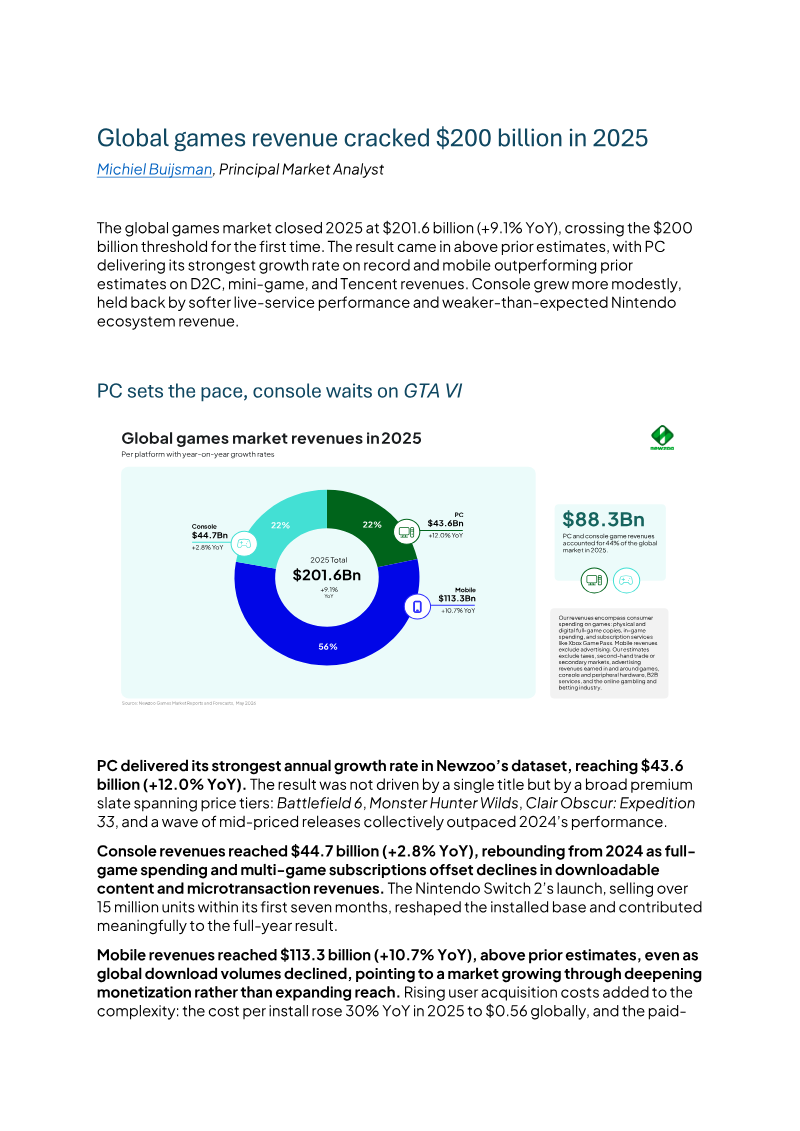
it. [laughter] Well, I don't know if this is if this is fun or not, but Run in Patrick's does a Substack and he is actually an analyst at Newzoo, so he has a lot of access to data. And so, we're going to go through his Substack that has like a thesis of seven key points, so we're going to go through most of them. Newzoo is pegging 2026 games at 214 billion. And Run in says that's still 13% below 2021 after inflation. So, the first thing that I wanted to bring up is please stop comparing [laughter] to COVID. Anything compared to 2021 is just like like the world was in a very, very different place. And I know that, you know, it happened and it's there, but I just want to discount that point. I think last year was our biggest year. And now, the challenge when we see these looking at a
chart, if you're watching us on YouTube or Spotify video, is that 2025 was the biggest year in the industry, but this is nominal. It does not account for inflation, if you hear Phil in your head asking that. So, that's point one. Chris, I think you are going to take us through most of the other points.
Yeah. So, first of all, Run in is kind of like doing God's work right now because he's actually looking at data and doing analysis and being very pragmatic about it as opposed to fleecing and pitching and doing the grift like some of the other analysts that are out there, which I won't name at the at the top of the thing. So, I think what he's doing is really good in terms of understanding what's going on in the market and I wish I wish Newzoo would push and support his analysis more just in general because I think they seem tend to be publishing only the positive pieces and not the ones that are a little bit more analytical. All right. So, the second point that he makes is growth
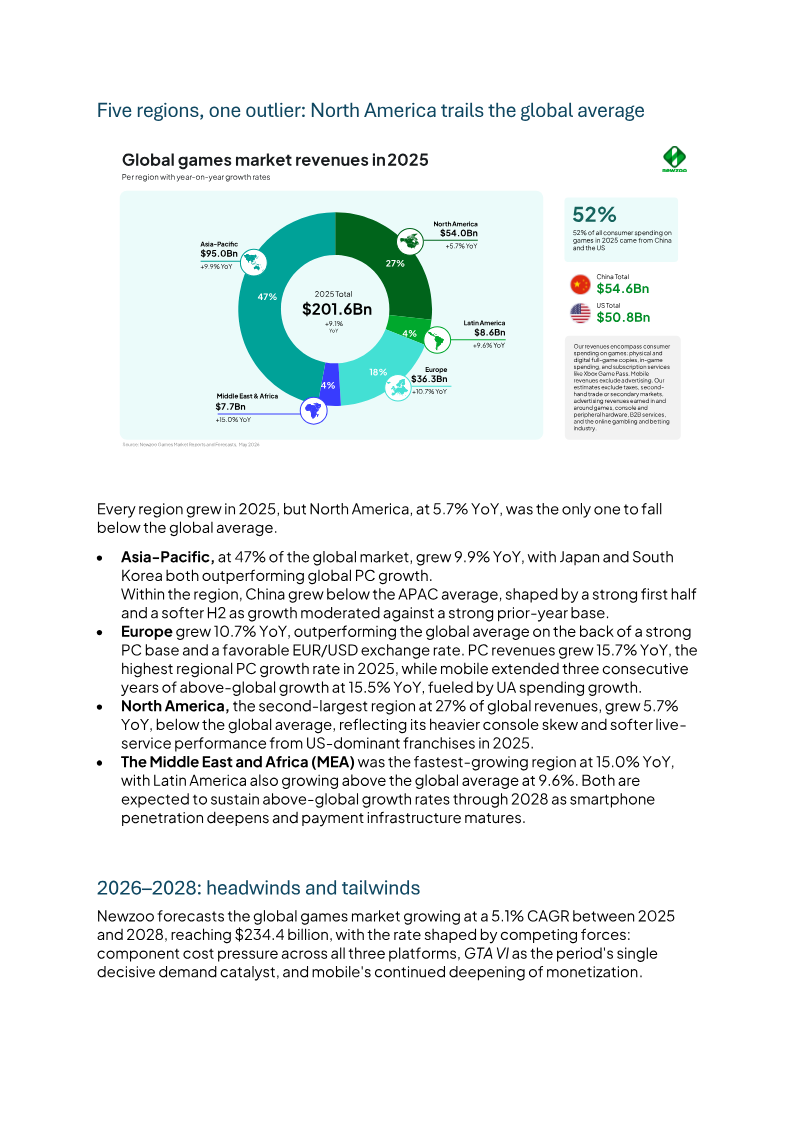
is coming from mature markets, not new players. So, this is one thing that I've been trying to hammer home for a long period of time. If you're trying to build games for sub-Saharan Africa or India or South America, just stop, okay? Because [laughter] those markets are not growing. 71% of the $2025 growth came from the West and came from China, right? So, which is North America, and Europe and China, right? The average North American spender spends $335 versus $36 for MEA, Middle Eastern Africa. Over nine times the revenue. So, that is where all the money is, right? So, emerging markets are posting high percentage growth on a very, very small base, but they are not the driver of this industry. The real driver is really existing players in the West that are spending more money is ultimately what is happening.
Well, this is the point I want to double click on because as I work with a lot of
different folks, I think it is a mindset change that we all have to get used to. In some cases, leaders, you know, think that growth is new players, new players, UA, go get me new people, and that's the equation that comes out in their mind. But, I think we're finally seeing the data coming through that's like, "Okay, the growth needs to come from your current, your lapsed players. How are you developing systems inside of your game to keep your existing people happy? Don't let them fall through a leaky bucket." Like, let's keep them, and the value of keeping them is so important right now. I think one of the things he talked about later on is that UA for their numbers was up 30%, cost per install was up 30% in 2025. I think the number is something like 20% from AppsFlyer this year. UA's on just just going off the chain on how expensive I've I've heard some rumors that the Chinese market to get a 4X player it's $200 to get somebody in 4X right now
from the CPI stand.
I wouldn't call this new just its importance has increased exponentially as the market has matured because my direct experience on mobile free-to-play teams is that as your live ops game manages its life cycle there's long been a focus on not only keeping players engaged from soft launch through years of live ops but also as you get into your product's life running re-engagement campaigns and being creative about how you reactivate lapsed players and lapsed spenders. And it's also just a natural part of a game's growth, right? The longer you're in market the higher your CPIs are assuming that you start off with a game that you can have profitable CPIs at the beginning that's that's a really big challenge right now but CPIs will always grow over time and especially as you're talking about a game that's in the market years and years like I'm still seeing ads recently on Star Wars Galaxies of Heroes. Like the CPI and payback window on that game this many years after launch must be just astronomical. And if I'm seeing that ad,
you know, it's probably the targeting on that is more likely a lapsed player re-engagement than it is a new player re-engagement. But this has been a long part of the landscape and it's just as we mature more and more important.
Okay, I want to add one more thing before I have to listen to Mishka Kakov talk about econ. Okay.
No no no no no
[laughter]
Let me let LET ME GET JUST SO JUST SO I CAN GO pee or something cuz I just [laughter] can't handle it, all right? But all right.
What I really want to what to bring home here is that this is customer demand. This is not a supply problem. This is a customer problem. The customer wants to play the same things over and over and over again. Like this is what they demand both for mobile and console. We are seeing the data it is suggesting the exact same thing. They are driving themselves towards these games, these iterative type games. And people keep saying that people want it customer wants innovation. I don't think they want innovation. I just don't think people are trying anything new really
out there, right? They're all playing the same games over and over and over again and will continue to get drive that point home.
In the words of "All new fails." That was his quote. Anyways, uh so fun fact, Ronan was supposed to come on a podcast. I had all these like I've read through the report. I have all the questions and one I sent the questions to Newzoo. They were like, "Uh maybe next report." So uh
[laughter]
so yeah, um I had had some tough questions. Okay. So Jen, firstly I agree 100% with you. Every time we use 2021 as a meter for anything, it's bananas. Like it doesn't make any sense. Even the graph shows like this is anomaly and then since then we've been growing. So it's just it's just it it's stupid. Anyways, secondly, according to this Newzoo report, spenders grew 5% and average revenue per paying user grew 1.5% which means that roughly three quarters of 2026 growth is more paying people, not per se deeper wallets. That's how I interpret it. Chris, would
you agree?
Okay. Now I've Tell me why not.
Because you're using a blended number of worldwide. You're not isolating North America and Europe. So if we have more spenders in let's say sub-Saharan Africa, then that number is included in that and they're spending bupkis. But if you actually focus on what's driving revenue, what you're driving revenue is the spenders in North
today. I love it. No. Mazel tov.
[laughter]
L'chaim.
I Anyways, go ahead.
[laughter]
Uh three Jews and a goyem. I love it. Yeah.
Okay. [laughter]
That's it.
All right. Once these kids get over this
I'll see you guys again in 9 months. Goodbye.
So, so the part that that that pressed some buttons. So, again, I was looking at this. I was analyzing with my friend AI. And then if the market compounds at 3% against 5% in
this report, half of the growth of the headline is due to dollar weakening. So, basically inflation. So, the cumulative inflation that was just looking at this is 19% over the last 5 years. That's actually pretty insane. Essentially, what I'm trying to say is that the market was expected to add 70 billions nominally from 178 to 243. And if it would be measured by the constant dollar, so basically uh inflation nominate, that would have been $33 billion increase. And so, what I'm trying to say is that the inflation essentially grew the market, was responsible for the market growth in this graph for 50% of the growth. And then you can go into nitty-gritties is like if the half of the revenue according to this chart is coming from Asia, then that is converted to the US dollars and then the US dollar inflation, but they didn't pay in the dollars. So, all I'm trying to say is the market has been compounding and growing annually by 2% in real terms. And I think that's the real value and not the six or the five that that is
being portrayed. Chris, would you disagree with this?
I could disagree with a few of the calculations, but if the conclusion is based upon inflation that we've grown about 2% a year since 2015.
I realize it every month as I pay my credit card bill.
did not know. That's crazy. Anyway, let's talk about China. That that should be fun.
Yeah. The third point was that China is funding its push into the West, but is protected in the home market, something we've been talking about a lot, right? So, the Chinese market is closed to Western publishers, but the PC market though is uncontested because of the bootleg Steam on there, right? So, the gray market Steam is still there and that gives Western publishers actually an an inlet for PC, but they are completely eliminated from the mobile market. But, in North America and Europe, as we've talked about before, the share rose from 19% to 37% from 2019 to 2025. And the America shares went from 11% to 27%. So, they're
kicking our ass in our own market, but we can't compete at all in mobile in their market.
Yeah, and the structural differences here are pretty crazy. So, again, I'm might be criticizing, but let me be clear, I'm criticizing our governments more than than China because best companies I've ever worked with are Chinese, anyways, in terms of game development. So, Chinese developers have 50% larger target addressable market than any Western developer because they can ship in their home market. I know it's very difficult, I know it's very concentrated, so are ours, but still, they have 50% more payers essentially than we do. Their tools are equally as good and maybe even cheaper. Like, even if we compare the the AI tools, like Kimi API is roughly 50% cheaper than OpenAI's flagship pricing. And also, they are not having a moral crisis when it comes to AI tooling. I'm mentioning AI tooling because that's the the latest of the tooling, but they have access to Unity's, the Epics, and Unreal engines, and so forth. They have better access to talent than Western developers because just more headcount, more people talking the same language, etc. Their talent is
cheaper than in the US by far, and I would say it's on par in terms of salaries to Europe. So, meaning that if you hire somebody from Shanghai, that would be probably London pricing, but if you hire somebody from Chengdu, that's closer to Bucharest pricing. So, in that sense, the price parity's there. And then the last one is I saw this article somewhere. It was the manufacturing cost comparison. This is automobile industry and it's comparing Volkswagen's production in Germany versus Volkswagen in at somewhere in China. And this kind of shows the numbers. This is of course manufacturing. It's different than tech. It's different than gaming, but it gives comparatively some numbers. So, the average factory cost per car in Germany it it comes out about 5,000 and in China it's 1,000. Then manufacturing labor costs like it's much lower in China. It's 12 versus Germany 62. But the really interesting part comes from productivity where Chinese factories are able to make 51 vehicles per worker
versus in Germany 29. And the average sick leave rate, this is actually what the German Chancellor referred to in his speech, which I understand you don't watch as Americans, but [laughter] average sick leave rate was 10% in Germany compared to 1% in China.
Why are we bringing up this car And why are we talking about AI?
AI is important because every developer I know is using it, but there's something I have to kind of correct here, which is that the Chinese open weight models like Kim E3 and Deep Seek are not geo-locked to China. Like at an enterprise level, if you're using Amazon Bedrock for example, to spin up local secure models, you can set up Astra, Opus, Kim E3, Deep Seek and a bunch others and route them per task as you need to. So, they a company would not have an advantage unless they were one of the frontier companies developing these models, meaning their internal tooling was 9 18 months ahead of what they
see that happening often or do you see
companies just choosing? Cuz with the companies that I work with, they tend to use just the American version. I've never really worked with anybody who would use Chinese AIs.
I don't know enough, have a broad enough view to know. Um I just know that a lot of people like their Amazon makes it relatively seamless to do at an enterprise level for example. And I do know that as people are hitting individual engineers getting a 9,000 10,000 dollar bill a a month bill right their token cost doubling their actual head count cost. I think people will be looking much more at how they're routing their models.
They have more effective AI tooling. Everything you guys are saying is 1000% true but I don't know what the this has to do with Ronan's piece on gaming right so let's move on. Mobile so mobile revenue is decoupling from installs another thing that we've been tracking for quite a while right so first half downloads in 2026 fell 25% CPI is up 30%
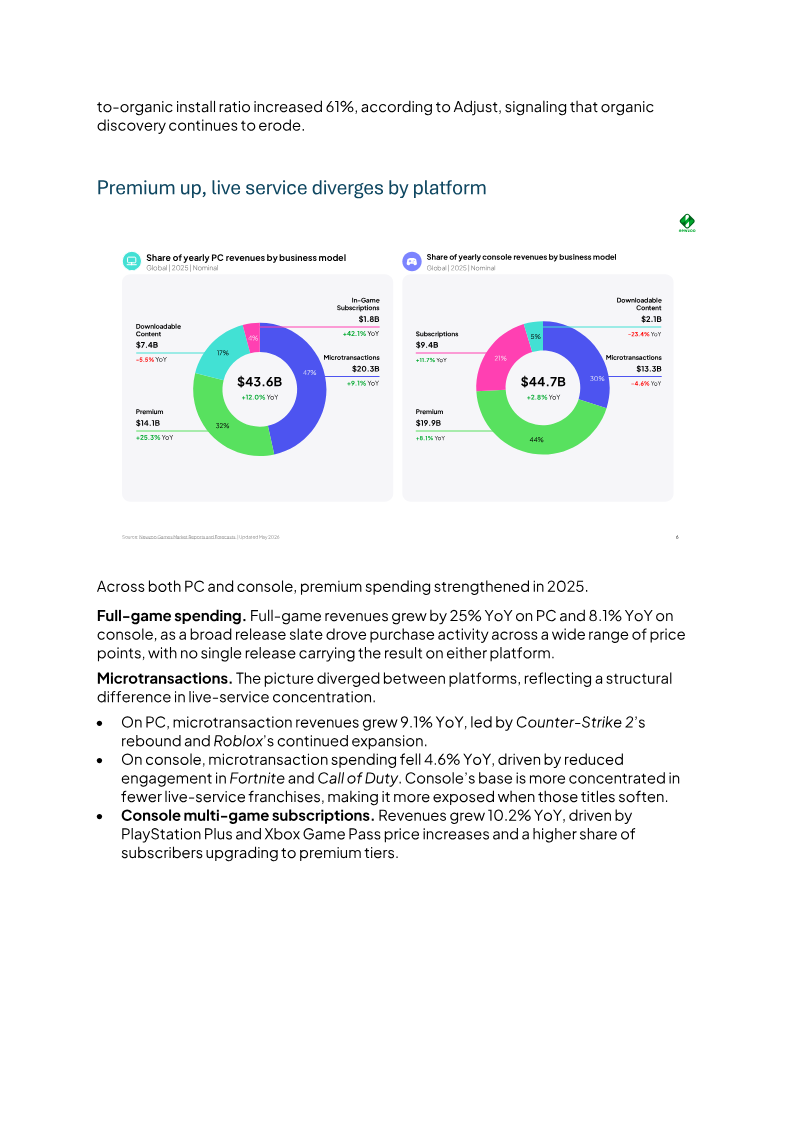
paid to organic ratio rose to 61% so basically paid is big high much higher percentage of the overall mix than organics. Now mobile still growing at 10% and 6.8% forecast for 2026 but all that is being driven by existing games and not new games is the kind of the whole point or the majority of it it's being driven by old games and not new games.
Grow what you got. Yeah this is this is my approach.
CPIs really are the choke hold like as long as I know they have been growing not as long as I know but during the last few years they have definitely been growing double digits every year. I think one of the element that has been increasing the CPIs has been the avalanche of different apps coming in especially the the open AI apps and then sorry AI apps and so forth. When I was looking at the numbers of how many new apps are being released on App Store so currently it's about 10,000 submissions an hour or 1000 submissions an hour
anyways a lot. I think just the other CPI price will continue to rise and even accelerate because there's so many new apps being launched that are vibe coded and they need marketing because there's no organic traffic and that will all contribute to the rise of CPIs that that we're seeing so you don't you don't think so? No
I'm seeing them
Right now. I mean, as new games are being launched, I'm seeing like CPIs increase.
No. No. What's driving up CPIs is the Chinese companies, Scopely, even Zynga with their Turkish games. All the Turkish guys are spending gazillions of dollars driving their games, which is driving up CPIs. It has nothing to do with this chachki that they they don't even have budget to spend on UA, right? So, it's like the hundreds and hundreds of millions of dollars that are being pumped into AppLovin to push all these games. That's what's driving up CPI.
And getting everyone out of the market.
Gambling apps.
You can't compete with that.
And gambling, yes. Other apps as well. 100%.
Yeah. You know, we talked about this last week. AppLovin is going out to brands, e-commerce, and trying to get more diversification. And so, I'm starting to see diversified ads inside of the games that I'm playing. And it's like, "Whoa, for the first time, it's not just somebody else's games." And so, all of these factors, big spending from the big folks, you know, when we get to the end of this, the bigger consolidating and the bigger getting bigger is is the gist of this entire piece.
This is why this vibe-coded slop is not going to actually do anything to the market, right? It's just going to die on the vine. It is not going to get any traction cuz they just can't get the attention.
You know, whether you're an LLM or that is like super funded or whether you are gambling app that is just poison for the uh for the uh humankind, and they know that they're going to be banned like a tobacco anytime soon. So, they're probably spending insane amount of money just to get as many players at or as many users they can before they're banned.
I mean, I talked to these guys a little
bit before, but I think they're just trying to capture as much market share as fast as possible because they know that that will be super valuable if they don't get banned. Like, they're not anticipating getting banned. They're anticipating that there's a winner-take-all scenario. And so, that's why they're spending likely very unprofitably in terms of not only the UA but also the the incentives to gamble like to give them free currency to gamble. So, anyway,
Let's talk about more like what we just talked about. The growth is extremely concentrated into five companies?
Yeah, what his analysis was basically showing is that five companies effectively are all the growth in the industry. So, Tencent, Century, Pokemon Company, Roblox, and Sea Group, you know, Garena Free Fire. They added about $10 billion in 2025, which was basically all the growth. Tencent alone is 6.2 billion of that growth. What I don't like about this analysis is that adds in China. I wish it was just Western focused more, but I I brought that up to him, but he has I
think he has to do worldwide.
Yeah, cuz Garena is is shows the Southeast Asia market, which they own pretty much.
And then Century and specifically and they're making a lot of the 4X games out there, Wild Survival and King's Shot. Their mobile revenue was up 99% in 2025. Dude, they're just crushing with just two games, right? And and they're almost single-handedly driving UA costs really super high for for the mobile market.
games as well. They're doing pretty well.
They haven't hit the
They still make like 50 million a month, you know, just chump change.
This is part of what's been interesting and kind of scary about having basically stepped outside of mobile for a couple years to do UGC and then coming back is that the games are the same, right? Like the games on the top grossing charts are pretty much the same as when I stepped out and I'm not seeing any massive innovation other than Monopoly Go. I can't point to a major North American breakthrough
success that I know of and it's and like it's reflected in the clients I'm working with. I'm working with much more niche apps going after smaller opportunities than anybody trying to be the next chart-topping mobile free-to-play game. It feels like such a mature and conquered market that at least with North American mobile dev costs, it feels very hard to try and compete for the top and instead you're kind of competing for the niche.
The only one thing I would say that is that has different since you left and coming back is the rise of merge two potentially challenging match three. It's not new and innovative. I think the way that they're crafting the rise is through the meta game systems is is the interesting point.
There were merge games when I stopped working on mobile.
But they're in the top now. Like Gossip Harbor is in the
Gossip Harbor supremacy. Yeah, it's it's not that there's no innovation at the top. It's that like when Dragon Ball Dokkan Battle is like still up there, it's like God, this is the same It's
almost the same mobile industry from like eight years ago.
It's musical chairs which is everyone just shifts seats every month of like who's who's number one. So that points. All right, Chris, what's number six?
The final point is big publishers are retreating to core franchises and then buying new ones. So his estimate was that dev costs have risen roughly 10 times per decade, obviously much faster than revenue. On PC and console, there's a retention trap. You can't really validate retention before launch and and you really just get one shot at it. Capcom, 90% of unit sales were back catalog. I don't think Capcom has come out with a new game.
They have the Resident Evil Requiem was a big hit this year.
That's not a new game.
I think that's the point.
So a new game in an existing franchise.
I'm sorry, a new franchise.
We covered this a couple weeks ago where we brought up this I think we were the ones that brought up this point that their back catalog was crushing it.
He says Xbox is concentrating expanding on Forza, Halo, and Gears. Take-Two is obviously sold the private division and focusing on the big games. And then he
reiterated his stat, 93% of console spend goes to titles that already existed, right? So every year for the last few years, it is like the gross majority, 90 93 to 95% of the market is dominated by existing IPs, not new new games that are coming out. And so, what publishers have been doing is they're concentrating on big franchises, and that is taking the majority of the share out there. And then on PC, and people kind of refer to PC as such a great opportunity, is that there are 20,000 games shipped on PC on Steam, and only about 300 make over a million dollars.
1.5%
It's It's insane, you know? So, this is a winner-take-all market, and most of the winners are really the big publishers. I think we're in a very very mature market in the West and in China. And so, if I were to give advice to people, and I do this all the time, is that like this is when working at the big publishers makes a lot of sense, right? Like going out on your own is really really going to be tough in a market like this. Until we see new platforms or
new opportunities, new AI platforms or something, if you want to build games, going to the big publishers will make sense. Or, if you want to have an indie like a lifestyle type business, you know, build for Roblox, build for Steam, that sort of thing, but don't expect a lot of upside from that particular thing. So, that's kind of the state of the state that we're in right now.
Are we in like in in the sense of like only blockbusters from big studios, and then the sort of a surprise hits come from either, you know, tiny studios or just in a different channels like YouTube and and, you know, streamers and that that kind of stuff.
Basically.
Kind of.
Our production model is getting there as well. It's just like teams move around, and nobody keeps like a big big in-house team. Everything is outsourced, and everything is built for occasion. Well, I'll be damned.
[music]
[music]
Hey.
Summary
The global games market is experiencing a period of stagnation when adjusted for inflation, with real-term growth estimated at approximately 2% annually. While nominal figures suggest a robust industry, much of this perceived expansion is driven by inflationary pressures rather than genuine volume growth. The market has reached a high level of maturity, particularly in Western regions and China, which together account for the vast majority of revenue gains. Emerging markets, while showing high percentage growth rates, contribute minimally to the industry’s total financial performance due to their significantly lower average revenue per user.
Industry growth is increasingly concentrated within a small cohort of major companies, with five firms responsible for nearly all recent revenue gains. This consolidation is mirrored by a shift in consumer behavior, where spending is heavily skewed toward established franchises and iterative titles rather than new intellectual property. On console and PC platforms, approximately 93% of consumer spending is directed toward existing titles, creating a winner-take-all environment where only a tiny fraction of new releases achieve commercial viability.
The mobile sector faces a decoupling of downloads and revenue, characterized by a 25% decline in downloads alongside a 30% increase in cost-per-install (CPI). This rise in acquisition costs is largely fueled by aggressive spending from major publishers and gambling-adjacent apps, making it increasingly difficult for new entrants to gain traction. Consequently, the industry is shifting its focus toward maximizing the lifetime value of existing players through live operations and re-engagement strategies rather than relying on new user acquisition. In this mature landscape, the most sustainable paths for developers involve either joining large-scale publishers capable of sustaining blockbuster franchises or pursuing niche, lifestyle-oriented projects on platforms like Roblox or Steam.



















Comments