Apple holds the largest share of the Chinese mobile market. Vivo has surpassed Huawei to become the third-largest brand.
Market Leader. Apple leads the Chinese mobile market with a 25.7% share.
Page 5 of the reportTencent's MyApp holds the largest coverage among Android app stores. 360 Mobile Assistant is experiencing the fastest growth.
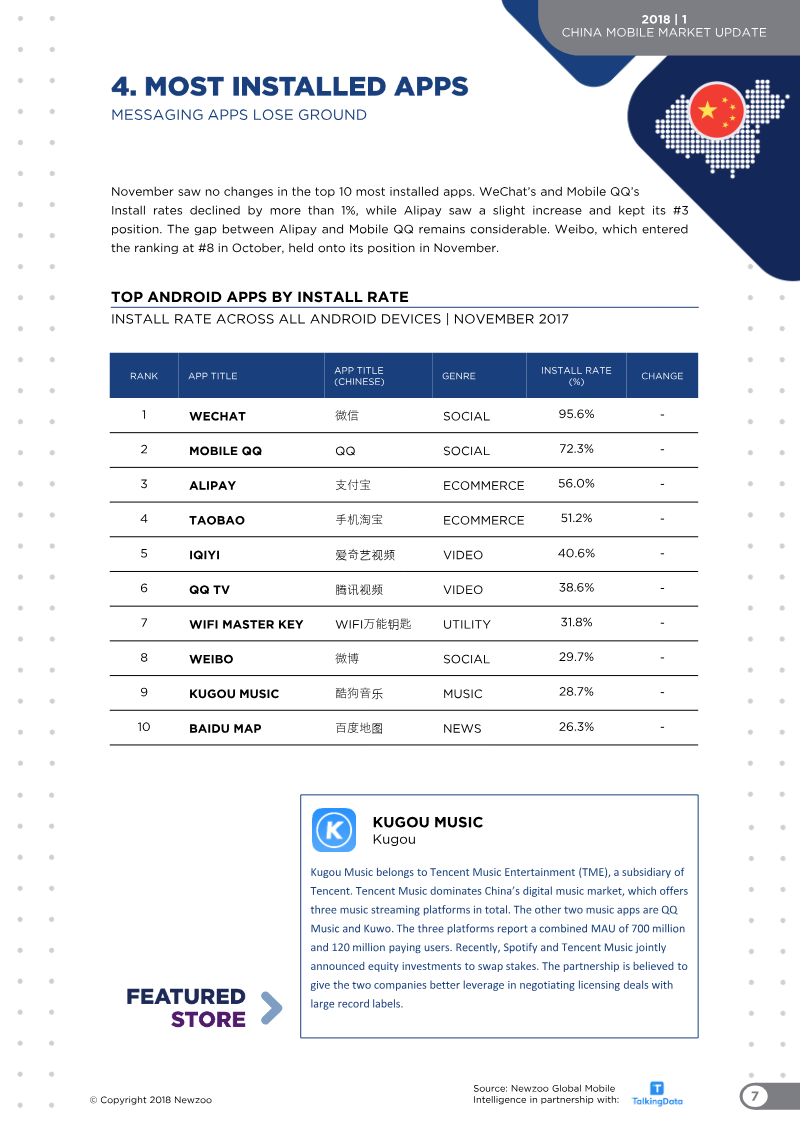
Page 6 of the reportDespite slight declines in install rates, WeChat and Mobile QQ continue to lead the social category. They are the most installed social applications.
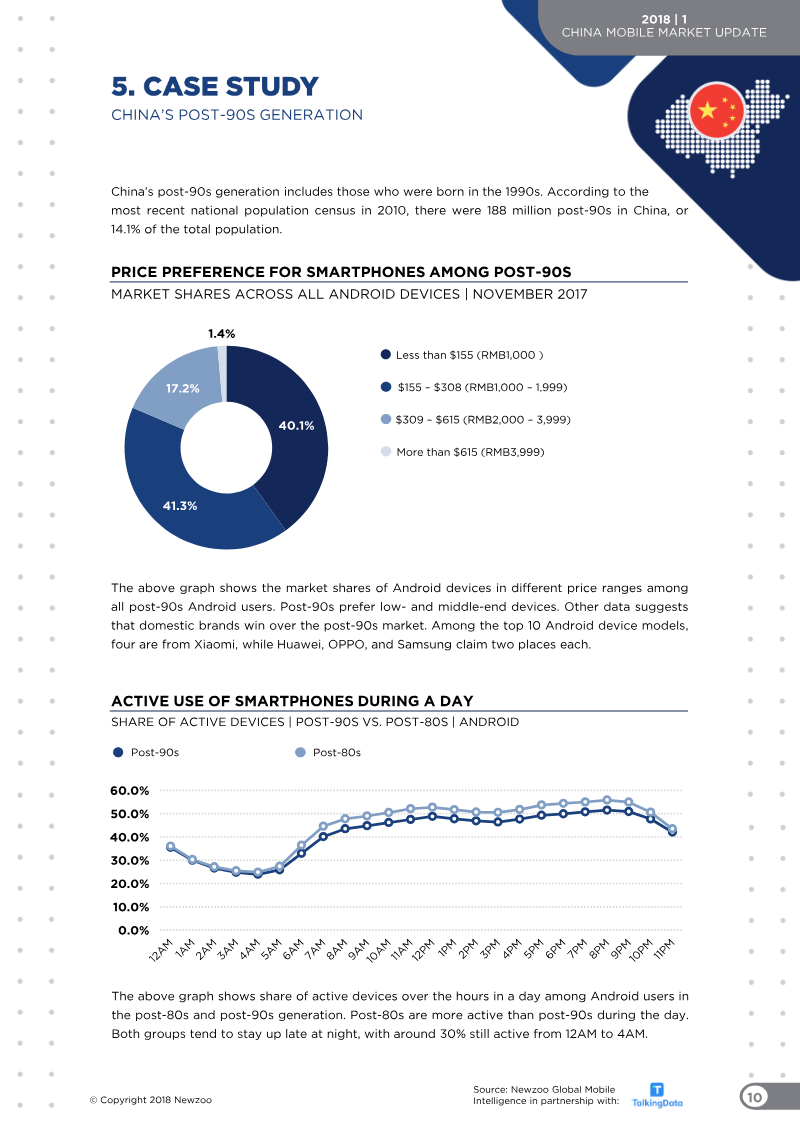
Both post-80s and post-90s cohorts exhibit high levels of late-night mobile activity.
This market update provides a comprehensive analysis of the Chinese mobile landscape as of November 2017. The report examines trends across mobile hardware, app store performance, and consumer behavior, specifically focusing on the demographic characteristics of the post-90s generation. The findings are derived from a sample of 350 million active iOS and Android smartphones and tablets, drawn from a broader pool of over 650 million devices.
In the hardware sector, the market experienced a notable shift as Vivo surpassed Huawei to become the third-largest device brand in China, capturing a 14.5% market share. Apple maintained its lead as the top brand with 25.7% of the market. Within the Android app store ecosystem, Tencent’s MyApp remained the dominant platform with 25.1% coverage, while 360 Mobile Assistant emerged as the fastest-growing store. The most installed apps remained largely static, with WeChat and Mobile QQ continuing to lead the social category, despite slight declines in their respective install rates.
The gaming sector saw significant activity, particularly in the battle royale genre, where NetEase’s titles demonstrated strong performance. On the iOS platform, NetEase secured four of the top five grossing positions, trailing only Tencent’s Honor of Kings. The report also highlights a case study on the post-90s generation, noting a strong preference for domestic smartphone brands and low-to-mid-range price points. Data indicates that while both post-80s and post-90s cohorts exhibit high levels of late-night mobile activity, the post-80s generation maintains higher overall engagement throughout the standard workday. These insights underscore the competitive nature of the Chinese mobile market, characterized by rapid shifts in brand loyalty and the continued dominance of established domestic tech giants.