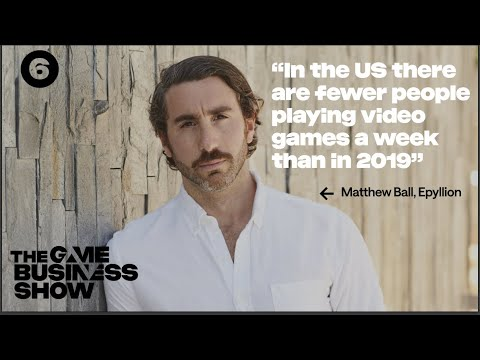
Transcript
A common rhetoric to video gaming's compression over the last few years was of course we were going to come down from the pandemic high. And I need to say no. Actually participation rates in the United States are below prepandemic levels. By some measures, Roblox is now near 425 million MAUs. They are delivering more hours of engagement than the entirety of Steam. Hello and welcome to the game business show with me Christopher Dream. Today we chat to analyst Matthew Bore on the immediate future of the video game industry. But if you're new to the game business, we are a media brand all about the business of video games. As the name suggests, we cover market data, business strategies, trends, policy, platforms, distribution channels, monetizations. If it's about the business of games, then we cover it. If you're listening or watching our show right now, we also have a newsletter and a website. Plus, we'll be doing live events. Check us out and sign up to our newsletter on the gamebusiness.com. But that's enough about that. Matthew, welcome to the show. Thanks for having me. You put out
this incredible 231. Is that right? 231 page report. I think it started at 220 and then I kept adding slides. So, it's probably around 230 232 or something like that. Yeah, I saw it as 231. How have you found the reaction to it? Because it's been so there's been so much chatter around it. It has certainly exceeded really any expectation I had for it. I mean to give the raw numbers, I looked it up and after I think 24 days, it had more lifetime views online than anything else I had published over the preceding 3 years, including a piece that had been out for 3 years. And that's despite the fact that this one had a downloadable PDF, which I know was shared pretty extensively. So even that number probably understates it. I've heard from nearly all of the ecosystem as well. But I'll tell you the thing that I feel best about that has been most shocking and rewarding is the number of creative heroes of mine who make some of the best games of all time and are striving to do so again who I didn't know before with whom I have no
NDA no established trust who just shot notes or DMs emails messages in one instance a LinkedIn message just explaining how they felt about the games industry what they were trying to do what they feared and that level of trust and investment despite, you know, no prior connection was really touching and meaningful to me. You did a piece last year as well which um was sent on to me by by Phil Spencer and what I it actually really influenced me as a journalist because I spend a lot of times looking at what's going on in China, what's going on over in esports, what's going on in these individual silos and sometimes I take a 100 foot view. You seem to take a slightly bigger view and how it all connects together. And I actually that's basically dictated how I write stuff. So it's certainly a very strong piece. I think anyone who's not read it and I don't hopefully the whole games industry has now but uh it just sort of really showcases the full breadth of it but one of the things there's a couple of things in it and we'll talk about I think um uh growth areas I think is probably what we're going to focus on but there was a couple of bits in it that I found even to this day I find baffling because I wrote a
piece back in 2020 2021 um which was all around the fact that the post pandemic the games industry shouldn't expect to grow but is there a way we can retain some of the users that we've managed to attract during um during the pandic PMIC and I got a few notes from like games industry CEOs said that's exactly the message that we need to be delivering. Yeah, it seems to be that there was the expectation of growth um post pandemic. Why do you think that was? It's a great question and I think that there are a few different things that are important. Number one is the games industry grew at a truly remarkable rate for the preceding decade and that was close to 10% perom. I think that there are obvious limitations to abstracting any industry to macro or national, let alone global figures. But to put this in perspective, the games industry grew at three times the rate of world GDP. It grew twice as fast as the US economy over that period. That is to say that when you stack up every industry, it was exceeding not just the average
profession, but merely all of them. And so even though we all knew that the pandemic had quote unquote pulled forward growth, it was not entirely unreasonable to assume that you would see some growth, right? You could have fallen by 90%. And still grown 1% per year. The other thing that was essential here is even if you forecast that there had been a havinging of growth rates, a having of what we had experienced for a decade uninterrupted and by the way 2017 and 2018 2019 was growing at or nearly the same rate of 2020 and 2021. And so even though we think of the heights of the pandemic as being aberant, they actually weren't. And so it's with that in mind that people said, well, maybe not 10%, maybe not 15%, but even 5%. And 5% growth in 2022 would have been another 10 billion per year. Another 5% in 2023 would have added 10 billion on top of that. So that would have been 20 billion more. Then 2024 would have added
again another 10 billion for 30 billion. So that baseline expectation of just saying what if things have would be 60 billion more revenue than we ended up experiencing because we stagnated. And so again Chris you could say well maybe it's not having maybe it's going to go down 2/3 or 75% and you would still be talking but really enormous sums. So I don't actually think it was unreasonable to say that there would be growth. It was hard to imagine there would be no growth. And even to the extent to which you believe that it would largely cease, the idea that three years later and in nearly every market globally we would still be down or flat, that I think was the thing that was hard to imagine. As a sidebar, I think this is where you get to exceptionalism and no person really is accepted from that, which is even if you believe that the industry overall was going to have a few tougher years, the job of every executive, every
creative steward and every financial team was to figure out how their company would grow despite that. And so I do think that you're seeing without speaking to any nonspecific individuals. Yes, most people said let's express caution collectively, but let's ourselves be aggressive. And the cumulative effect effect of that was really shown over the last two years. Yeah. Yeah. Well, people had to play the market they were in in in some ways. But it's interesting because the review of 2024 was an interesting one. I I was doing some rounds um at the beginning of 2024 and I actually anticipated a drop in 2024 and I'm a little bit old school. I've been, you know, I've still brought up in the world where this is still a cyclical industry and dictated by release schedule a lot of the time and I know obviously we've flattened the curve a lot as an industry now, but um the release slate for last year was not great going into it. 2023's release date was amazing and 2024's release late had a couple of interesting titles, but it
didn't look great. certainly on the PC and console side anyway. So I actually I actually was quite pleasantly surprised to see that in some areas there was growth. How did you review it? I'm a little bit more sanguin in the sense of I think 2023 was disappointing because of the strength of the slate. The counterpoint to that was in fact most of the major releases of 2023 happened in the fourth quarter or near the fourth quarter. We had Spider-Man 2 came out I think September 21st or 27th so a few days before the start of Q4. We had Alan Wake. We had Starfield, of course, we had Cyberpunk 2.0 and Phantom Liberty come out. Fortnite OG began, I think, around November 3rd or so. And so, there were a few major titles that released earlier in that year without question. Tears of the Kingdom was one, but the common refrain that I heard over the industry was 2023 disappointed despite its slate because too many of the games came out at the end of the year cannibalizing one another and actually going to kick over into 2024. that was
actually a bull case by the end of 2023 for why this past year was going to be good. And so I do think that we should look that over that 2-year period perhaps cumulatively rather than one year versus another. And that's where I think probably the fairer picture is. The other thing that I think is a little bit more challenging is if we take a look at the United States, the United States last year was up by roughly 1% according to Circana or NPD Group. At the same time, mobile was up 9%. Mobile's more than half of the industry. It turns out that PC and console despite that 2023 strength, despite that hold over into the 2024 purchasing was still down uh I down I think four to 5%. And of course we know hardware and accessories were pretty affected as well. which is to say that actually though the topline number seems to be in some degree of recovery and even if we look over the three-year view and say it's largely flat since 2021, the truth is that's primarily strength on the
mobile side. PC consoles actually still fairly impaired. Yeah, it didn't have a particularly strong slate, but they've got that problem and you know the other analysts have talked about this a lot of trying to upgrade people from the previous generation. I mean the ultimate the console industry hasn't grown in terms of users very much at all in the in 20 years but there is that challenge of if everyone's playing Fortnite and everyone's still playing Grand Theft Auto and you know I think something like the according to news top 10 games but all the other ones and pairs all those sort of ones have the same the top games are all eight years old plus convincing particularly younger people to move from one machine to the other it's it's just I I I have to imagine and this is something I know Sony are talking about this something they that's challenging. Um, and it seems to be taking longer. Um, that's not really a question. It was more of a Well, look, I think it's actually a really unique problem. Some of this is just that the graphical or the perceived customer value of those incremental upgrades has obviously been compressing over time. But separate from
that fact, we can actually think of a number of different levers or disadvantages. Number one is many games on Gen 8 consoles are still 60 bucks a pop. So, in this instance, you're saying, should I upgrade to a Gen 9 console at a cost of $300 to $500 plus tax to then pay an extra 10 bucks per unit? There's another aspect which is kind of the strangeness of saying if 90% of your game play is playing a free-to-play game, it's particularly bizarre to say I'm going to spend $500 in order to keep playing that free game. And then of course you have perhaps this very strange tail effect but which is I think still relevant which is I play a lot of the major BRs and of course many of the best players they really care about FPS and so of course that drives them to PC over console but many of them deliberately downgrade their graphics for competitive reasons. So, you actually have a weird reason, which is to say, putting aside the fact that many people don't incrementally value Gen 9 consoles at their cost over Gen 8
consoles, which have no incremental cost, they already own the device. Many of them are saying, "I actually don't want that incremental graphical fidelity on the games that I play most of the time, making the purchase even harder." Still, I found the games that did quite well last year really interesting. until the new games like something like 70 odd 78% of the market last year were old games but um Hell Divers 2 40,000 Space Marine 2 which caught me by surprise um then Blackmith some of these games they either were doing something quite new or they were doing something we hadn't seen for a while I think Space Marine 2 felt like a sort of Xbox 360 game brought up to date whereas there were the games that you would have banked on I think going into the year Star Wars Outlaws Final Fantasy Dragon Age. Those were the three that jumped to mind that that really missed. Like, you know, they they they some of them scraped the top 50, some of them didn't even do that. We're talking about the visual fidelity of the new consoles and the power of them. But it seems that what gamers, at least the audience seem
to, if they're going to if they're going to jump from whatever it is they're playing, if they're going to try something new, they need to be given something that's notably different to what it is they've experienced or they have been experiencing. I think that's my take away from it. I I don't it's difficult to the industry is so contradictory that it's difficult to to draw those conclusions but it's certainly how I felt about 2024 because the games that did well I did not predict would do well and the games that well not as well as they did and the games that sort of missed I I had anticipated being amongst the best sellers of the year. It was a weird year. I thought 2024 was strange. Um 2023 Hogwarts Legacy Diablo and Zelda and Spider-Man all doing very well. But I, you know, you could have put money on those. The 2024 just seemed unusual to me. Again, not a question. And you sort of uh I found it uh really fascinating to write about, but um difficult to draw from. Yeah. I mean, look, I think you're right. There's this not to get into heady business strategy, right? But but there's this general idea of job to be done theory which is a repackaging of
ideas that have existed management theory for decades. But it basically says the purchase of any product is to meet the job that someone is hiring them to do which is to say Chris when you say I want a new video game. What is it that you're actually asking for? Right? And it's rare that you would say I'm looking for a game to show me hyper realism. It's rare that you actually say I'm looking for a game that is going to tell me a cinematic story. I'm not saying that those elements aren't important, and I certainly wouldn't say that for some titles, it isn't an essential element of how they communicate their entire package, but for most people who are now many, many years in to these top titles, these worlds, they may be thousands of hours, thousands of dollars, they may have built much of their social and cultural identity, especially in high school or college, around those titles, be it Fortnite, COD, or Madden. The question is, what are they asking from a new game? And I do think that when you look at that level of entrenchment, which by the way is also put alongside skill mastery,
they feel good. They know how to play the game. They can be one of the best at the game. That question is, what am I asking for from a new experience? And I do think that the last two years have really narrowed in on the idea of I am looking for a new experience from that new experience. If you that doesn't mean that they still don't want something remixed that is brilliant in its own right in a way that they're familiar with perhaps a decade ago or more. Which is to say we all know that Super Mario Galaxy 2 is one of the best titles Nintendo has ever produced. And obviously Astrobot brought together a lot of the best ideas of those classic Nintendo titles both on the IP mashup and lore side, but that was I'm looking for a new experience that I hadn't had in quite some time. Yeah. Yeah. A new It's new experience that it might not be new, but it's certainly one that I haven't had, you know, for me it was one of the big indie hits of last year was a game called Undisputed, which was a boxing game. There hadn't been one. He had made one years. There were a lot of those in the you know 80s and 90s. Yeah. And then they moved out. Um let's talk
about growth areas. I think you spent 100 pages in the report chatting about that. And one of the areas I I get the sense that you really are a bit of a believer in um UGC get the Roblox and Fortnite as a as a as a potential um growth area for the games industry. Significant growth area for the video game. Is that fair? Have I got that right? It's an interesting question partly because you're asking this question of well yes. Am I a significant believer? I I will tell you I don't spend a lot of time personally playing Roblox or even UFN titles for that matter. What I do think is nevertheless obvious and this is where I would separate believer versus observer and admirer is we have an industry that for 3 years has not grown. And in fact, by most measures in most western and developed economies, there are fewer regular players of video games than there were two years ago, one year ago, 3 years ago. In the United States, if you can believe it, there are fewer people playing video games a week than in 2019. A common retort to video gaming's compression over the last few years was, "Of course, we were going to
come down from the pandemic high." And I need to say, "No, actually, participation rates in the United States are below prepandemic levels." That is what's really astounding. And so putting that all aside, when you're then looking at these UGC platforms and you're saying year after year after year, we are seeing 20% growth, sometimes even higher on a user basis. So you're saying growing remarkably faster than the market, growing consistently so, and their user bases are as enormous as they are. By some measures, Roblox is now near 425 million MAUs. They are delivering more hours of engagement than the entirety of Steam. In fact, you can add up the Switch, PlayStation, and Xbox together, and they are less played and certainly have fewer daily or fewer monthly and nearly as many daily users as Roblox. If you add those three things together, its size, its regularity of growth, and the size of its growth, it's
hard for me to say that I'm not a believer in it as an important growth engine for the industry. If you then say it also happens to be at the top of the funnel or that is to say the bottom of the age pyramid and it is therefore onboarding hundreds of millions. I think that's a reason for optimism. I do think many of those players will scatter to what we traditionally call games but that's good too. It makes it a growth engine by indirect measures. I used to work for IGN and one of IGN's websites is VG247 and they have these code pages. is they do generate a lot of traffic. Mhm. These codes are codes that offer free coins and stuff that in games and amongst their top performing code pages, some of the obvious ones, but are blocks fruits, blue rivals, basketball legends, all Roblox games. to people of a certain age. I think that's um a bit of a a blind spot that TGB we've been speaking to a load of investors and there's some investors unsure about developers there might be investing in who are Roblox
developers whether or not they can break out of Roblox although one investor doesn't think they need to. It was a really fascinating discovery that everyone seems quite interested in this particularly in terms of bringing through new talent and developing new game developers and lowering the the barrier there. But it seems if the consumer is in if the problem is that gamers are playing these live service games and not leaving them or putting the games within these services feels like a feels like the solution. Um I don't know. Um it's interesting but it's interesting. Investors also brought up things like Telegram games and Discord games and this I mean I I look at those and I immediately think of Facebook gaming from you know 15 20 years ago. I'm a bit cynical, but there seems to be certainly all ways of reaching audiences that isn't just those existing digital platforms. Seems to be exciting investors at the minute. Anyway, we can kind of table the investor side though I think it's certainly very relevant. But you brought up a point earlier which is really over 20 years and going on a
quarter century. The console install base has not grown, not on a unique basis. And to the extent in which we found any growth, it's primarily in rest of world in Japan. We're not seeing it in North America. We're not seeing it in Western Europe. And it's largely limited to the Nintendo Switch, which is to say that I love console gaming. That's most of my time. I recognize the supremacy of PC, but I will tell you I have three consoles in my house. They get all regular use, and that's the first place that I go to play most multiplatform and crossplatform games. Uh, I know that I'm going to end up buying a PlayStation 6 and the next generation Xbox. And yet, we should recognize that that growth hasn't occurred. We should also recognize that mobile gaming apps as traditionally defined, things that people download from the app store, those aren't really growing now either. And so, I think it's not so much a question of what do investors want. I think it's instead a stark realization of the reality, which is those other areas of gaming aren't actually growing. There aren't more players. they're
increasingly concentrated on a few titles. And if you are trying to reach new gamers, which is probably the most important thing you can do to restore growth in the industry, or you want to reach players that do play other games, but in a world in which you're not asking them to close out of their Fortnite or COD application and boot up something new, that those no new avenues are going to be pretty important. The other thing that I will say, and it's funny, you we were talking earlier about how many slides were in the deck. There's one slide that I added about two weeks after I released the publication because I was just screwing around with some of the data. But if you can believe it, the top two titles on Roblox, Bloxuits being one that you mentioned, and then Brook Haven RP, which just sold, though we don't know the price, each of those has roughly 60% of the monthly hours of engagement of the entirety of Electronic Arts. They are 60% the size of Fortnite Battle Royale. They're 75% the size of all of Blizzard. They're 85% of the size of all of
Counterstrike. And so it's not just that we're asking this abstract question of are there new players, new times, and new experiences. It's actually that these titles are already as large and in some instances larger than some of the most dominant, enviable gaming ecosystems of the last quarter century, if not longer. Now the question of how much growth is there, is there enough opportunity for new developers? What are the economic limitations of that? All of those irrelevant concerns, but we are now really over the last 2 years at a point in which the comparable size of these platforms now allow you to outstrip any other operator in success. Let's talk about console a little bit um because we have a new one's about to come out in um Nintendo Switch 2. I mean, in your report, talk about how it's potentially exciting for third parties. Um people still buy Nintendo consoles for Nintendo games. I think if anything, I think Nintendo just leaned into that with the Switch in quite a big way. Do
you see much potential for outside of Nintendo to to find find success on there? Look, I I agree with your frame. It's important to put this into numbers, right? The average console usually has it, but for every 10 units of software that are purchased, only one is made by the platform themselves. In the case of Nintendo, it's nearly six in every 10 is made by Nintendo. And that's even excluding some of their, you know, de facto second party relationships, those who only produce for the Nintendo Switch. And so that is to say that for the most part, the second most successful console of all time, perhaps soon to be the most successful console of all time, they are not even per se buying it for the form factor innovation. It's not that those aren't important, but they're mostly buying it because Nintendo has made some of the best titles of all time and in incredible volumes, and you can only get them on the device, and the device is affordable. It's not clear how many people are saying I want a portable games device or how many people are saying that I'm looking to play multiplatform or crossplatform titles
and the Switch is the device that I'd like to do it on. They're mostly saying I need to I want to and the only games I'd like to play are Nintendo Switch. Obviously many of us have all consoles and so that model is the most important or that strategy that success is the most important thing that Nintendo has for the Nintendo Switch 2. And so we should not think of the fact that the Nintendo Switch 2 can run most third-party titles sufficiently as this massive new blue ocean opportunity for third party publishers. At the same time, nearly all of the most popular titles globally have not been available on the Nintendo Switch for the last 8 years it's been out. That means that many of the highest spending, highest engagement, youngest and therefore lifetime brand building consumers have been inaccessible. And so that's definitely a meaningful increase opportunity for third party publishers. And yet at the same time, it's going to be available to all of them. So it's now going to be a new hotly contested platform as opposed to, you know,
potentially 100 million customers you couldn't reach before but now can which is to say I think it's going to be mixed. Yeah. Yeah. I see it's it's is one of the for civilization developers. So this you know Civ 7 was uh is it Civ 7 the one that came out this year rather than launching on PC first they they did multiplatform strategy this time around and one of the cap platforms was switch and apparently that was because of switch it really inspired they changed their entire development pipelines because civ on switch did so well for them so much better than expected but most importantly what they found was it was actually PC gamers that bought the game again on to take it with them they had this I've done that I've played Tony Hawks Pros Skater on my PlayStation I want that highend and you know 60 frames per second experience but I love the game so much I wanted to take it with me so I did um and I mean this is how GTA shipped 200 million units right it's how many people have bought it two three times yeah oh yeah and we touched upon the subject there which I wasn't going to ask about but you brought it up which was the um the fact these form factors
these handheld form factors I've got two young children the amount of time I spend on gaming one of the things I think the problem with console gaming is people age out of it I think they get to a point where people just have less time and maybe they don't have feel the need to upgrade to their next console straight away and they do they do eventually and then the following one they don't get as I my own personal experiences here. Um, what changed for me, what got me back into gaming was the ability to, and I know handheld games since, you know, forever, but what the ability to play console level video games on was transformative for me in my gaming. And you're starting to see some success in Steam, nothing to the Switch level, but I do feel that sometimes that flexibility, that ability to tap into, there's something old school about the Switch. It's it's um it's still a physical dominated device. You know, most people buy games in box. I don't have any data to back it up. Maybe you do, but I feel it's just a machine that just appeals to slightly older people that perhaps previously didn't have that time to game. And I think perhaps that's something that Microsoft's noticed, Sony's noticed with their portal as
well, that there's an opportunity there to um stop people from lapsing out perhaps of of of the ecosystem. I don't really I didn't have a question around that. It was just something that I've I've had. Yeah, this is kind of one of the reasons why we we were talking earlier about the however many 100,000 foot view to the gaming industry. And I think that's something that's been happening at all the platforms and publishers. We saw that with Square Enix saying it's no longer sustainable to be tied to the PlayStation ecosystem. Microsoft is very obviously trying to get on all devices. Even Sony strategy continues to evolve, not just in the fact that they're publishing on PC and publishing faster than ever, but they've unlocked the PlayStation Portal so that you no longer have to be on your home Wi-Fi. That is I think in most regards a reflection and observation and understanding digestion acceptance of a lot of what we were talking about earlier which is the console base has not grown. Time has actually in many regards shrunk. And at a certain point you stop moving from what will the next generation do to change that to what other things do we need to have to change that. And when
you take a look at some of what Herman Hol was talking about the PlayStation Portal, we don't know how many units have shipped. The odds are it's only a few million. It looks like the Steam Deck only has 2 to 3 million units. And so these aren't enormous, but what we know is they by definition skew to the most avid gamers. Those who spend the most, those who spend the most time, those who have the largest social graphs. And so you might be able to say, "We have 6 million PlayStation 5 customers. Only 3 million have a PlayStation Portal." But that's probably not just a 5% increase or hit rate on your base on a time adjusted or spend adjusted basis. Maybe it's 10 or 12. And so if you say that we need to find a way to find growth, reverse player loss, reverse player time loss, enrich our ecosystem, and frankly recoup on development budgets that continue to grow while our addressable base does not, I think that that becomes a really powerful and significant opportunity. And the fact that you to your point no
longer have to really dive deep into your builds to fork it to run on these devices means that the incremental cost ends up being pretty marginal relative to to that opportunity. That all kind of checks out to me. That makes sense. Do you see mobile I think you mentioned in your growth areas as well mobile as a potential home for console style AAA games? Absolutely. And I think that the well look, do I see it? Absolutely. Yes. Let's keep in mind that there's 3 billion mobile devices. I'm not a person who will tell you that I think 5% of the global population is going to want to play single A, AA, or AAA games on their as we define them today, right? Running on a console on a mobile device. And yet, when we're talking about 3 billion, I do believe that we can have a prematerial impact on those devices. And we already have a lot of evidence there. I think one under reportported fact is when Mihoyo launched their second wave of platform expansions for Genshin Impact, they said, "We're going to launch on Nintendo Switch." Guess what? They never did. They just canceled it.
They didn't bother. Why? Because they clearly came to the conclusion that there is no likely customer of Genshin Impact who doesn't play because they don't have a Nintendo Switch. Many of those consumers will. And so, you know, cognizant of the fact that we've long heard people say, "What if Resident Evil went there?" And we know that hasn't worked. And I think there are reasons why that will and won't change in the future. But it's already clear through the success of PUBG or Freef Fire or Fortnite Mobile back in the day, plus growing success of which platforms are being skipped over and the fact that it doesn't matter that that player base can be pretty meaningful as well. I tend to believe that in five or six years when there are a billion people who can play EAFC on their iPhone or iPad that we may not see tens of millions of people buying it and certainly I don't think they're going to do it at a $70 price point. But do I believe that there's a meaningful growth opportunity for EA
that stems from the fact that you can finally reach most of the global fans for football without asking them to have a console or gaming PC and that they can take it anywhere? You bet. I was going to bring up Resident Evil because obviously it hasn't worked. It hasn't wor Well, it hasn't worked for those for those games, but um and um Chris, so so this is interesting when we say it hasn't worked, right? That's true. But there's a weird question which is okay there there's the only people who can actually play Resident Evil on an iPhone have to have bought the very very highestend iPhone over the last two years. There's roughly 40 million people who have that device. The device by the way cost 16 or $1,700 only. And so fundamentally how many of those 40 million people actually play video games? The answer is not going to be many. And then we have the secondary question which is how many of those who would buy a Resident Evil game and have that device haven't already bought it? And then there's that third thing which is how many of the people who might like
Resident Evil games generally as in abstract FPS or third person if you want uh depending on the title games but RE isn't for them. And I think all of those start to become pretty meaningful discounts. In contrast, if we said in 2030 you had a title that was simultaneously released on mobile devices, that is to say, it had never been accessible previously that reaches nearly all of the midcore and up audience. I think you'd see again material, not massive, but material sales. And this is where I love to remind people that FreeFire alone, a mobile only battle royale, has 50% more daily players than Fortnite has monthly players. It is kind of impossible for the average Western shooter game player or Fortnite player or COD or War Zone Apex player to believe that there's 150 million people playing Freef Fire Mobile
every day, primarily on low-end Androids, not iPads. And yet they are. And so part of this is just an audience question. Oh, I should add the other fil filter, which is the people who all have that highestend iPhone again for $1,600 or $1,700. Nearly none of them are the people who today play highfidelity deacto hardcore mobile games because most of those sit in Indonesia and India, Latin, and South America. They certainly can't afford one of those iPhones today. You had an answer. I like that. You've been challenged on that before. And we see well I'm also cognizant of the fact that like this is also one of those things like cloud that has always been the well if not next year the year after that and that often holds and sometimes eventually it breaks. I was going to ask about streaming. Are we going to get there? Cuz surely that's the bit about lowering the barrier to entry to make it easier for more people to play games. It's that's that's got to be the the thing is it not in my view. There's this interesting
line that Tim Sweeney, the founder and CEO of Epic, had a few years ago that I've been, you know, joyfully calling Sweeny's law, which goes something like efforts to place real time processing on the wrong time of the latency wall are bound to fail because while networking infrastructure and latency are improving, it's improving more slowly than processing. which is to say, yes, all of the technical problems that we're facing with cloud game streaming are improving, but the chips on our phone are improving faster, which is kind of the conversation that we were just having, which is right now my iPhone can play basically a stock iPhone 4 specs. I'm cheating a little bit, but for all intents and purposes, you can play what? Sorry, not iPhone 4, a PlayStation 4, PlayStation 4 specs, not a PS4 Pro, and certainly not a PS5 Pro. And so many of the problems that cloud game streaming is intending to solve, many, not all, are being remedied by the fact that by 2030, most smartphones will be able to do a decent
enough job themselves without needing to rely on the network. And so that's solving the accessibility problem that you mentioned, but differently. And Matthew, I've taken up too much of your time. We could talk for hours. We can go for another two hours. Yeah. Yeah. Thank you so much. The subject of today's show will be a major talking point for us going forward. So if you want to stay on top of it all, please do head to the gamebus.com and subscribe to our newsletters and of course sign up to the podcast, follow us on social media, sign up to our YouTube channel, whatever, whatever suits you that we're there. So thank you all for joining us and thank you again to Mackie. Thanks, Chris. Is the console market doomed? No. Will game streaming ever become a mainstream proposition? I don't think it's yes or no. What's the first thing you do when you get to work in the morning? email. Do you think game prices will rise again soon? Yes. Will Nintendo Switch 2 out sell Switch One? No. Best album of all time? You know, if I say Led Zeppelin 4, that's probably a Dodge 2. I haven't
thought about the question for too long. What is the most exciting games company right now? I think anyone who knows me knows that the answer is four letters and Epic. And what one thing should games companies think about, but probably aren't? This is the one you had to send me in advance.
Auto-generated captions from YouTube — names and numbers may be misheard.














Comments