1 free read left. Create a free account for unlimited reading + AI research.
Create free accountReport DiGRA
1 free read left. Create a free account for unlimited reading + AI research.
Create free accountReportDiGRA
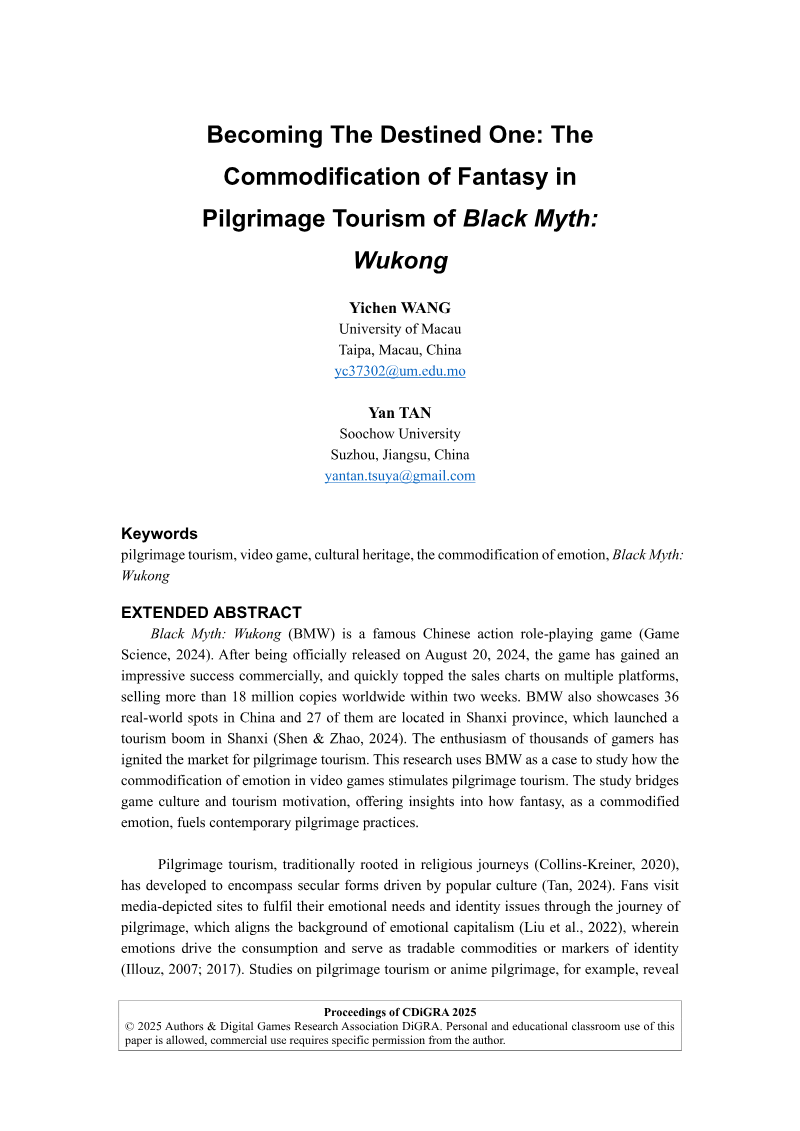
The report examines Black Myth: Wukong after its August 2024 release as a case of wide commercial and cultural reach.
"From Myth to Market" examines Black Myth: Wukong as a case study in how a Chinese mythology-based action game achieved extraordinary commercial and cultural reach following its August 2024 release. The work argues that the game's popularity is significant, but that commercial success alone does not guarantee deep cross-cultural understanding. Its analysis proceeds through four theoretical lenses: representation, cultural hybridity, procedural rhetoric, and ludonarrative resonance. The central claim is that the game's blend of Chinese mythological content with conventions drawn from global gaming operates in a "third space," making the work accessible to international players while raising questions about commodification of cultural material.
The reported figures underpin the argument. The game is said to have sold over 10 million copies and generated roughly $450 million within three days, with more than 17.8 million Steam units and about $850 million in Steam gross revenue by early September 2024. Later claims include 20 million copies in its first month and a peak of over 2 million concurrent Steam players, placing it second on Steam's all-time peak concurrency list behind PUBG. These figures are presented against a 2024 global games market of $187.7 billion, with Asia-Pacific accounting for 46 percent, and are linked to a reported 22 percent tourism increase in Shanxi Province at real filming locations.
The authors contend that procedural rhetoric, technological mediation, and music communicate cultural arguments through gameplay rather than explicit instruction. They frame the game's economic and cultural effects, including tourism growth and international awards, as products of its hybrid design. The reported figures vary across sections and are drawn from secondary sources, so they would require verification against the cited material before being relied upon.
Each row is a game or company this document names, each column a document, oldest first. A mark means that document names it. Select a row to see those documents.

DiGRA · 2026

DiGRA · 2026



DiGRA · 2026



DiGRA · 2026



DiGRA · 2026



DiGRA · 2026



DiGRA · 2026



DiGRA · 2026

DiGRA · 2026



DiGRA · 2026



DiGRA · 2026

DiGRA · 2026
DiGRA · 2025