1 free read left. Create a free account for unlimited reading + AI research.
Create free accountWhitepaper European Conference on Games Based Learning (ECGBL)
1 free read left. Create a free account for unlimited reading + AI research.
Create free accountWhitepaperEuropean Conference on Games Based Learning (ECGBL)
The paper examines the current landscape of disconnected virtual worlds, termed the "Paraverse," as a counterpoint to the not-yet-realized, interconnected Metaverse.
"Enter the Paraverse" examines the current landscape of disconnected virtual worlds, which the authors term the "Paraverse," as a counterpoint to the not-yet-realized, interconnected Metaverse. Its central argument is that small, independent teams can meaningfully contribute to this landscape at low cost, and that listener-centric virtual concerts can model more egalitarian forms of social organization than the hierarchical, commercially driven platforms that dominate the field. The authors ground this claim in Soundscape.social, a standalone virtual concert series built during the COVID-19 pandemic, which offers spatialized pre-recorded performances and anonymous "virtual graffiti" notes for communication. The design draws on John Cage's anarchist Musicircus and positions itself against models such as Fortnite.
The study's empirical basis is modest but detailed. Across three iterations of the series, the team added text chat, tutorials, and spatialized audio, with a third concert hosted in a browser as a homage to David Lynch. Interviews with nine attendees and two musicians, largely graduate students and pre-pandemic concertgoers, found that participants valued the politeness that anonymity encouraged, greater control over their spatial position, and a sense of participatory "liveness." Many, however, wanted richer real-time communication. Attendance declined across the series, from 48 users at Opening Night to 17 at the Follow-Up and 13 at Club Silencio, a trend the authors discuss as a limitation of the work.
The paper's scope is therefore narrow in population and time, reflecting a pandemic-era, small-scale prototype rather than a broad survey of the industry. Its contribution lies in demonstrating a design approach and offering qualitative observations about audience experience, rather than in generalizable market data. Readers should view its conclusions about egalitarian organization and the viability of small-team contributions as proposals grounded in a single case study.
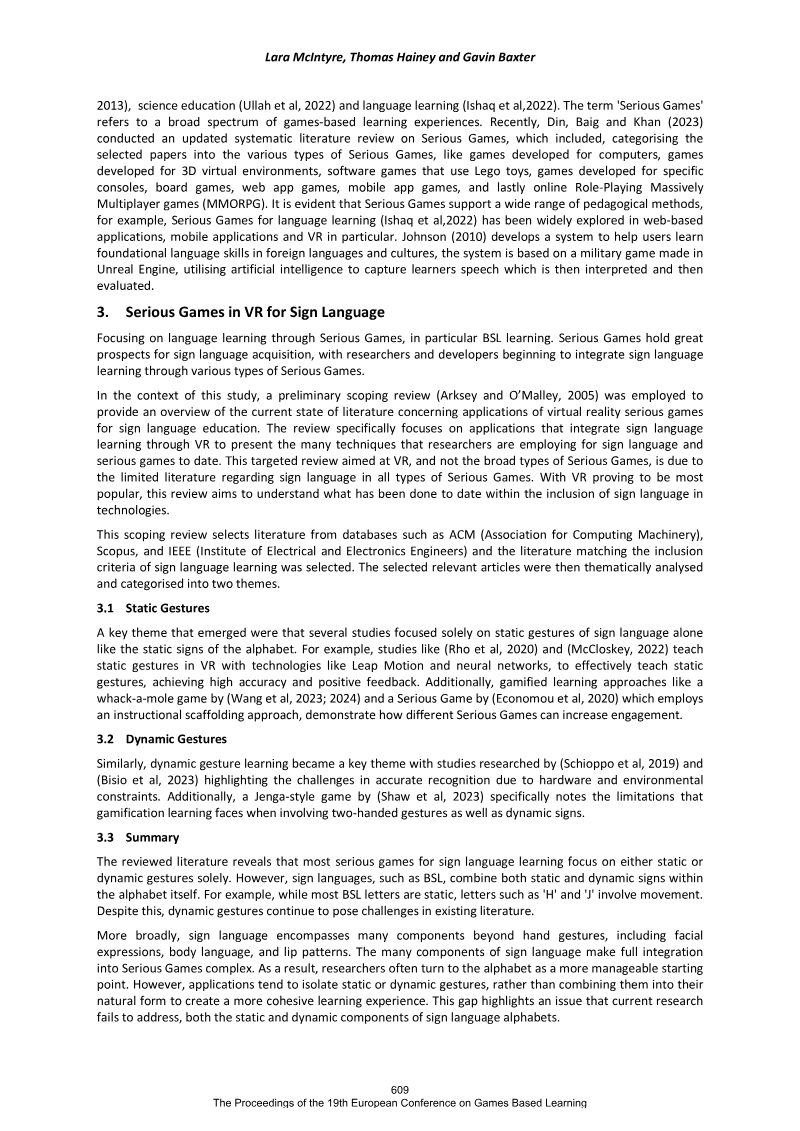
Each row is a game or company this document names, each column a document, oldest first. A mark means that document names it. Select a row to see those documents.
European Conference on Games Based Learning (ECGBL) · 2025
European Conference on Games Based Learning (ECGBL) · 2025
European Conference on Games Based Learning (ECGBL) · 2025
European Conference on Games Based Learning (ECGBL) · 2025
European Conference on Games Based Learning (ECGBL) · 2025
European Conference on Games Based Learning (ECGBL) · 2025
European Conference on Games Based Learning (ECGBL) · 2025
European Conference on Games Based Learning (ECGBL) · 2025
European Conference on Games Based Learning (ECGBL) · 2025
European Conference on Games Based Learning (ECGBL) · 2025
European Conference on Games Based Learning (ECGBL) · 2025
European Conference on Games Based Learning (ECGBL) · 2025
European Conference on Games Based Learning (ECGBL) · 2025