1 free read left. Create a free account for unlimited reading + AI research.
Create free accountWhitepaper European Conference on Games Based Learning (ECGBL)
1 free read left. Create a free account for unlimited reading + AI research.
Create free accountWhitepaperEuropean Conference on Games Based Learning (ECGBL)
The evidence is survey feedback from roughly 17 to 95 students per activity, not definitive proof of learning outcomes.
This paper examines how Sudoku-based educational games can build STEM and computational thinking skills among primary and secondary students in Croatia. Its central argument is that transforming classic Sudoku into a game with interactive, multiplayer, and curriculum-aligned features can reduce math anxiety and increase motivation. The authors present their work as preliminary, offering early evidence from school-based trials rather than definitive proof of learning outcomes.
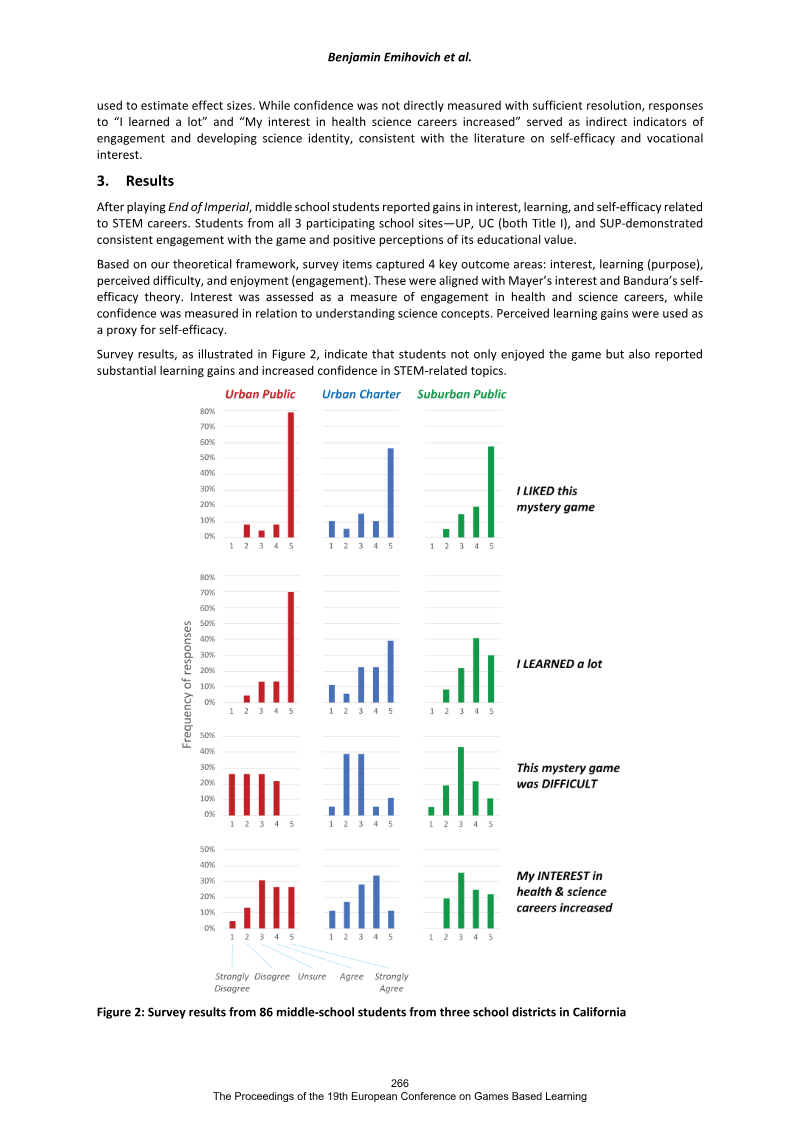
The main findings rest on student feedback collected across several trials and iterative scenarios involving roughly 17 to 95 students per activity. Ratings of games such as Assemble and Play Sudoku were generally positive, with students reporting enjoyment, engagement, and a belief that they had learned something new. Ratings tended to rise across successive rounds of refinement; one scenario's game rating climbed from 3.5 to 4.3, and secondary students gave the highest overall ratings. A notable caveat is that the lowest-rated statements in several groups concerned how rarely such games appear in regular curricula, pointing to a gap between perceived value and classroom integration.
The study's scope is geographically limited to Croatia and temporally limited to the trial periods described, with a focus on primary and secondary school students. Its methodology is descriptive and survey-based, relying on self-reported data without control groups or objective measures of skill acquisition. The authors acknowledge that these constraints limit the strength of their conclusions. The accompanying literature base draws on research into game-based learning in mathematics, Sudoku's relationship to logical reasoning, computational thinking, and STEM applications, situating the work within a broader effort to make abstract quantitative skills more accessible and engaging.
European Conference on Games Based Learning (ECGBL) · 2025
European Conference on Games Based Learning (ECGBL) · 2025
European Conference on Games Based Learning (ECGBL) · 2025
European Conference on Games Based Learning (ECGBL) · 2025
European Conference on Games Based Learning (ECGBL) · 2025
European Conference on Games Based Learning (ECGBL) · 2025
European Conference on Games Based Learning (ECGBL) · 2025
European Conference on Games Based Learning (ECGBL) · 2025
European Conference on Games Based Learning (ECGBL) · 2025
European Conference on Games Based Learning (ECGBL) · 2025
European Conference on Games Based Learning (ECGBL) · 2025
European Conference on Games Based Learning (ECGBL) · 2025
European Conference on Games Based Learning (ECGBL) · 2025