1 free read left. Create a free account for unlimited reading + AI research.
Create free accountWhitepaper DiGRA
1 free read left. Create a free account for unlimited reading + AI research.
Create free accountWhitepaperDiGRA
The study analyzes seven tabletop roleplaying games centered on queerness, defining queer as existing beyond cis-heteronormative norms.
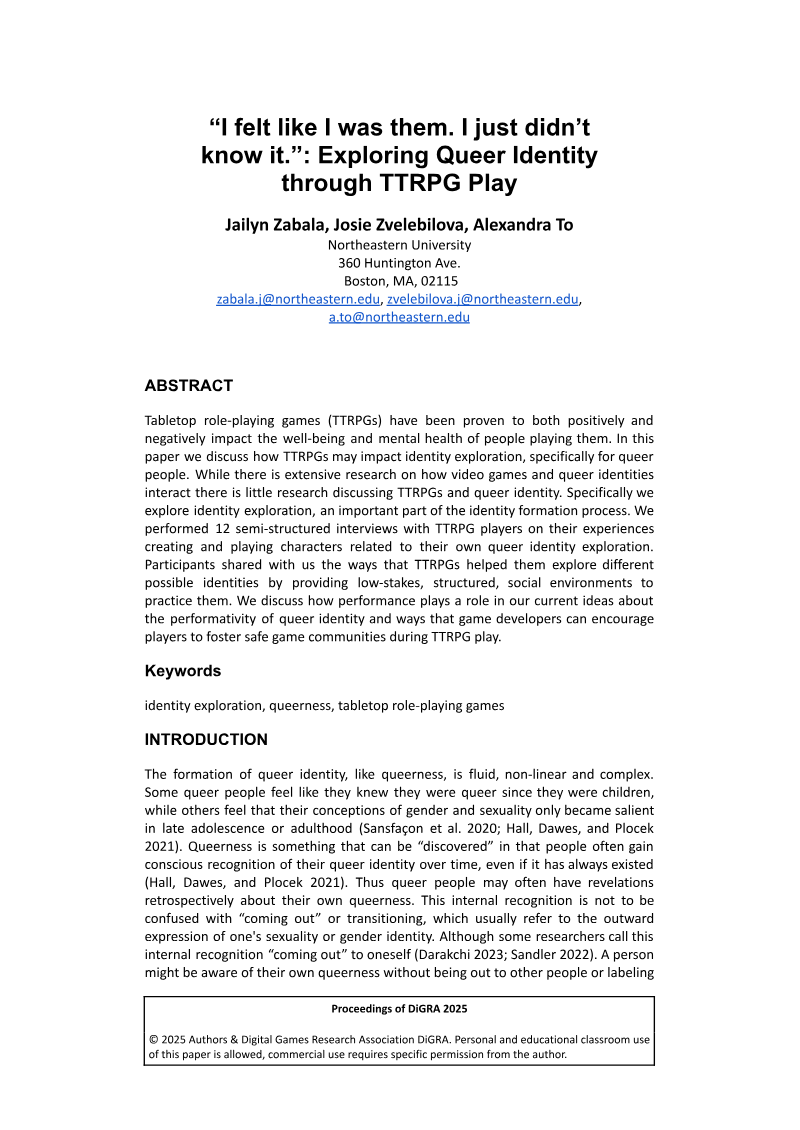
This study examines how queer tabletop roleplaying games (TTRPGs) structure character creation and gameplay to support safe exploration of queer identity. Drawing on the player manuals of seven games centered on queerness, including Thirsty Sword Lesbians, Monsterhearts 2, Dream Askew, Alice is Missing, Sleepaway, Lichcraft, and Wanderhome, the authors define "queer" as existing beyond cis-heteronormative norms. The work is situated within queer games studies and draws on the concept of "bleed," the tendency for players' real-world feelings to carry into roleplayed experiences, to argue that TTRPGs may be particularly well suited to identity exploration.
A central early finding is that none of the seven games in the ludography are combat-based. Consequently, character creation focuses on emotions, interpersonal relationships, and inner conflicts rather than physical abilities or damage output. Thirsty Sword Lesbians, for example, asks players to choose a playbook representing an emotional conflict, such as being who you are versus fitting into the social order, rather than a combat role. Collaborative character creation, in which players ask one another questions to define relationships and traits, also appears across the games as a common practice.
The analysis further finds that these games allow players to create queer player characters with respect to gender and sexuality, but they approach these identities in varied ways. Many leave substantial choice to players, enabling them to shape the societies their games depict, and their emphasis on character stories highlights themes such as community and resistance. The authors conclude that the games provide structure and safety while remaining flexible, and that they do not attempt to mechanically operationalize identity. They argue that queerness in these games extends beyond representation and is embedded in both thematic and mechanical design. The study is preliminary, and the authors propose future interviews with players to examine how character creation contributes to identity exploration.

DiGRA · 2026

DiGRA · 2026



DiGRA · 2026



DiGRA · 2026



DiGRA · 2026



DiGRA · 2026



DiGRA · 2026



DiGRA · 2026

DiGRA · 2026



DiGRA · 2026



DiGRA · 2026

DiGRA · 2026
Extra Credits · 2021