VideoPocketGamer.biz
Becoming a cross-platform company - Mihai Pohontu from Amber
16 Jul 202512 min video
Transcript
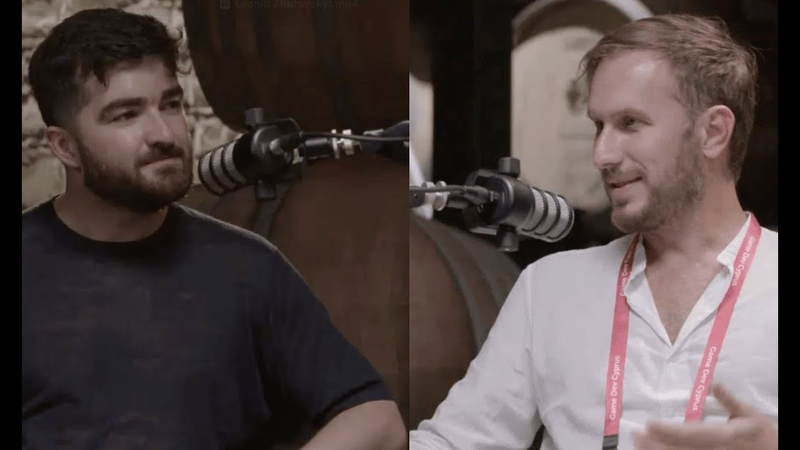
[Music] We are now joined by Mihi Pansu from Amber. How are you doing today?
Fantastic. I'm so happy to be doing this interview again. We had one last year.
That's right.
It was a great experience.
Yeah. Yeah, we were almost right here. But uh I think you maybe did a talk last year. You you've escaped this year without having to do a talk or anything like that, which is lucky for you. Um but we will just do the very quick what is it that Amber does and then we can sort of carry on with new stuff. So for those who aren't familiar what is Ambo?
Amber is a game development agency comprised of a network of five uh creative studios uh each with the different specialization of platform and genres uh as well as an array of service lines. So we're 850 people in nine locations around the world. Uh we're privately held and employee owned. So um you know we've had a good year in 2024 which is u a little bit unusual in in
the external development space. I can talk a little bit about this in in further detail. Uh but you know we're profitable in uh in 2024 $35 million in the revenues. Um and that's very good news for the people of Amber right because a stable company especially in the current market climate um is an absolute thing to appreciate. Well, we certainly touched on that last year. We were in the middle of the kind of the dip as it were. And I'm seeing some optimistic predictions, but I think, you know, we're not quite there yet. Uh it is a very good news, very good thing to hear that, you know, you've been able to weather the storm in style by the sounds of it. Um when it comes to the growth that you're talking about, you say 800 people, 850 people working under you and maybe like 3 4 years ago that was around about 200, wasn't it? quite a lot of growth especially over a time when things are a little bit iffy. What do you put that success down to? Is it the diversification of all those different studios and one can rise while another
falls or you know how do you attribute that success?
Uh excellent question. I think so the core of Amber's business has always been co-development and on top of that we've had full game development uh projects with various top publishers. So I think it's a combination of broad diversification. A number has always been conceived as a crossplatform company. So even though most of our contracts when we started the company were in the mobile space then we quickly expanded to PC, console, VR, AR, even blockchain. So we try to be everywhere wherever the market is, we try to follow the market there. Most of malleable in the sense that you know we train our people to be able to jump from one technology to another, from one platform to another, from one genre to another. We hire people that have this ability and this desire to work on a high diversity of projects as opposed to being constrained to one format and just specializing in one format. So I think that's part of the company strength. The
other thing that helps us tremendously is that over time we've created a talent network. So there are 850 Amber citizens as we call them, but we tap into a network of 3,500 people either freelancers or companies that we have partnered with in the past to kind of draw in additional capacity and that creates a variable workforce model at Amber. It allows us to better control variations in market demand. So that was a saving grace for us uh in when you're meeting new projects uh with new demands or when you have projects that are no longer viable and you can more easily scale up and down your workforce.
Is that something where you also presumably work with lots of different monetization strategies as well? I given the breadth of genres you're talking about and that kind of diversification I assume ad supports and APS and everything is on the table. Everything is on the table. Uh we have broad expertise in free-to-play and obviously
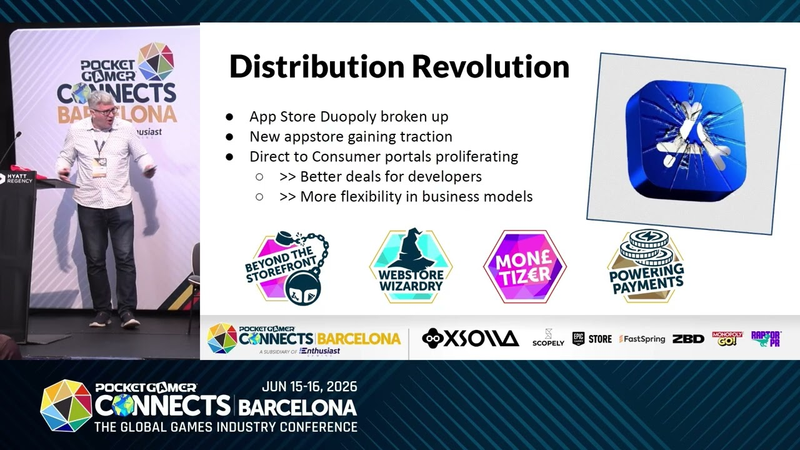
you know premium mechanics, premium u models, subscription models as well. Um ad supported you know in various ways. It really depends of what our publishing partners are looking for. And then we of course we have our original IP line. Some of our creative studios are working on their own products. And this was really enabled by the fact that uh back in 2022 we secured an investment from a Londonbased private equity firm that allowed us to invest in the future. And the future of Amber is like creating our own games alongside the work that we do for our publishing partners. What would your stance be then given what's happened in the EU recently with the the marketplace laws relaxing and the idea that Google Play and the App Store are no longer going to be the only two games in town as it were for the Western market. Obviously, there are loads of app stores and in other markets, but primarily for the West, it's those two. and the idea that third party app stores are going to be allowed to proliferate much more and even the adoption for a
lot of developers of web stores is a direct path to the consumer to the developer. Is that something that Amber's interested in or is that sort of outside what you would traditionally go for?
Our our vision has always been to establish a leading position in every segment of the game development supply chain and we consider distribution to be part of that um as well as self-publishing. So, I think the um the the freedom that comes with having a more diverse set of app stores that cater to particular kinds of customers and offer different kinds of content will unlock a lot of opportunity. Um we're looking at that. We're not making an active investment in that space, but I think other companies are doing so and I think that's very beneficial for the market overall. No, it has been an interesting an interesting transition I think and given that the marketplace moves as fast as it does particularly in mobile uh everyone has to be quite fasile and quite sort of light on their
feet but you you mentioned before that you were kind of primarily a mobile company originally but then you started leading into the HD all and the PC and that sort of thing. Has that been a huge shift? Have you seen that cause a particular drive in revenue or is it kind of you know balances out between the two? Is mobile still the main driver? Uh mobile is not the main driver for us. Most of our work right now is in PC console. Okay. Um and to be very clear, we started doing the shift away from mobile to all the other platforms really back in 2017. So this has been a long time running. When the when the market dipped uh at the end of 2022, beginning of 2023, the mobile sector was um primarily affected like there was a der of demand for services and contracts and full game development all the disappeared from the external development space. So mobile was really no longer viable. If we hadn't made that transition, the company would have been in trouble. So for
anyone that can diversify, that is a really winning strategy for adapting to shifts in market demand because not everything moves at the same time and not everything dips at the same at the same time. Now the good part about being in the mobile space or having a presence in mobile these days is that analysts are figuring out that we will have a positive revenue growth year in 2025. So you know before we celebrate and open the champagne we have to remember that the revenues are concentrated in the hands of the top publishers. So this will not directly translate in a coming back of the external development space. So indies being published or you know service companies receiving new contracts in mobile. We expect 2025 to be an equally challenging year for anyone looking for funding from those traditional sources.
The spend isn't there. The VCs are not opening wallets at the moment. No. No. It's true. Well, with the the expertise that you had in mobile at the time and then shifted over onto onto PC, did that
affect the way that you developed PC games? Is there an ethos that you were able to bring like positives from that space or little learnings that you got? Because there was a a kind of logic at one point that the mobile space was a testing ground for a lot of new ideas. So, if it happened on mobile, you'd see it in all other games two to three years later.
Yeah. I think the really interesting part is that as PC and console games uh became more enamored with the idea of live operations and a long tale of content drops and uh downloadable content. taking the mobile ethos of like really fast iteration and and and engagement with a customer during the life cycle of the product was something very useful um and something that um a lot of PC and console publishers were actually looking for. They wanted to do more of that. They saw the opportunity of like continuing to generate recurrent revenue streams from a game that had launched. And for somebody that had done this for many years in the mobile space,
it was much easier to make that transition. And we knew all the tricks of the trade if you will, right? So we could act in that capacity as consultant consultants to the publishers and suggest new things and new strategies more for monetization and design and uh creating content in a sustainable manner. And that continues to be an advantage you know for any mobile developer thinking okay there may be a safer haven for me on other platforms. some of that expertise absolutely carries through
and I imagine in certain countries as well there is a a a broader PCbased audience where perhaps consoles aren't as popular or as proliferate and so there's something to tap into there. Do you find you mentioned you have lots of international studios that that you work across. Um do they see drastically different types of games for for the different marketplaces and audiences? you you is perfecting the type of game for the right space part of the success?
Um for an indie developer that's
absolutely a winning strategy. Like if you cater to a demographic and you do it very well and that demographic has very special requirements um like for example you know cultural affinity is an important part of the game experience then absolutely that would be very helpful and that's actually recommended that you focus on a market and you perfect whatever the users in that market would want because generally speaking large publishers try to create games for the common denominator and to be globally relevant. So that broadest possible thing.
Yeah. That opens a niche for indie developers to be able to make a living. You know, maybe their game is not going to sell $100 million in uh um in revenues, but uh if they sell $10 million in in one market or in one region, that is still a very successful game from an indie perspective. Um in Amber, that cultural specificity that I've mentioned comes into play because we have this like broad representation across different markets. So the company
was created in Bucharest, Romania. We're still headquartered there, but we have studios in Montreal, Canada, in Guadalajara, Mexico, in Bogotaa, Colombia, in Manila, Philippines. So this is a really diverse set of like, you know, cultural perspectives um that we can use in our original IP. Um, one of the games that we are creating currently has a strong Mexican culture lore and we think that would be broadly representative in some parts of United States and of course in Mexico and some other Latin American countries. So it makes sense that we would tap into that reservoir of tradition and knowledge. [Music]
Auto-generated captions from YouTube — names and numbers may be misheard.
Key insights
Distilling the key insights…
Ask AI about this video
Cite this video
Citation
Generating citation…















Comments