1 free read left. Create a free account for unlimited reading + AI research.
Create free account
Bartle's Taxonomy - What Type of Player are You? - Extra Credits
Key insights
6 takeaways- 01Bartle’s Taxonomy categorizes player motivations into four archetypes—Achievers, Explorers, Socializers, and Killers—based on Richard Bartle’s sixteen years of observation of Multi-User Dungeon (MUD) players.
- 02Achievers are driven by mastery and status, while Explorers prioritize the discovery of hidden mechanics, lore, and secret areas.
- 03Socializers focus on interpersonal connections and community building, whereas Killers seek to assert dominance over other players or game systems.
- 04By shifting from subjective preferences to objective mechanics, developers can better accommodate diverse user needs and maintain long-term community health.
- 05The taxonomy utilizes a two-axis coordinate system—acting versus interacting and players versus the world—to map how specific game mechanics influence user behavior.
- 06Designers can use this framework as a diagnostic tool to evaluate how new content or system changes will impact overall player experience and ecosystem balance.
Ask AI about this video
Transcript
Over the last 5 years, we've talked about a lot of foundational game design theory, but we still haven't even covered all the basics. In fact, there's one piece of theory so old and so foundational that we never really thought to bring it up until now. Bartle's Taxonomy. This was one of the earliest attempts to break down the psychology of players in a multiplayer environment. To this day, we use it not only to try to better understand how we're meeting different types of players' needs when we're crafting multiplayer environments, but also to assess just who we're aiming for as we build out single-player games. But to understand Bartle's Taxonomy, we have to understand where it came from. Richard Bartle was one of the creators of the first mud way back in 1978. For 16 years, he watched and studied players playing in group environments. Then, in the mid-90s, just as MMORPGs were about to make their debut, he released his theory on how to divide up players by what they wanted out of a multiplayer game. Fascinatingly, this all sprang from a long discussion he'd had with high-level players. He asked them a
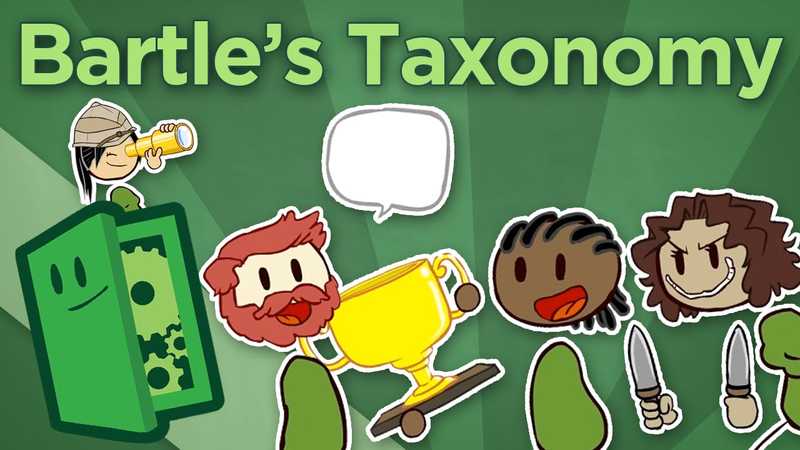
simple question, "What do you want from this game?" It was an eminently practical question. Knowing what players wanted would help him decide how to develop the game. But interestingly enough, they couldn't agree. In fact, they disagreed violently. These players, all of whom had been playing the game for hundreds of hours, had actually been playing the game for radically different reasons. So, Bartle tried to dig down to the root of some of their comments to see if there were any commonalities, any way he could group these seemingly disparate players together. And in the end, he produced his taxonomy. It was clear to him that he couldn't just look at his players as one single group any longer. But he also, after much work, discovered that they weren't just a thousand different voices all with completely different needs, either. Rather, they fell into four distinct groups. He labeled them by playing card suits, but today we know them better as achievers, explorers, socializers, and killers. Achievers are the players who play largely for for stated in-game goals, to beat a level, to get a high score, to win the game, to max their XP,
or to collect the most gold. To encourage these types of players, designers create goals above and beyond what we expect the ordinary player to do. Things like a 100% completion mode or a new game plus are designed to feed the needs of these particular players. And clearly, the achievement systems that are now nearly ubiquitous in gaming were originally designed to find a low-cost way to further engage those players. They feel rewarded by anything that acknowledges their mastery of the game, such as high score lists or leaderboards. Explorers are out for discovery, for the joy of the new, whether it's understanding how esoteric aspects of the game system work or finding places that no one else has gotten to yet. That's why the explorer plays. The actual gameplay is just a tool to enable their exploration. They're not here to master the game. They simply want to garner enough skill at it to be able to explore unimpeded. Easter eggs, hidden areas, layered systems, or large amounts of non-aesthetic customization, these are the factors that draw explorers to a game. These players are particularly rewarded by the moments where they think of something intricate or complex to
execute that should work within the game world, but they think, "Oh, surely not. There's no way they programmed that in." Only to find out that the designers were just waiting for a player to try something that clever. Socializers like the interpersonal aspect of a game. They are there for the community. You'll find these players trading, chatting in town, forming guilds, or helping new players just for the fun of meeting a new person. In a single-player environment, they tend to gravitate toward games that mimic some of those experiences. Tools which facilitate making social connections draw them to play. Of course, the socializer landscape of gaming has changed a great deal since Bartle wrote this. Now with YouTube and Twitch and the FAQ community, there's actually a whole new meta structure for socializers. There are Minecraft socializers and MOBA socializers who participate more in the community out of game than in it. Then there's the killers. These are the players who are in game to assert dominance, pure and simple. Most of the time this takes the form of causing misery to other players. Knowing someone on the other side of the wire is cursing in defeat is the highest thrill for most killers. This can take
other forms, though. The guild leader who runs this town, the trader who corners the market on a good so everybody who wants it has to go through them, these two can be the killer player types. They're just playing parts of the game that don't actually involve killing. The more that PvP allows for an expression of dominance, the more these players enjoy it. That may include being able to spawn camp or the ability to target players who are materially weaker. Any game system that allows them to taunt their prey. Now, some of this information is probably old hat for you, but what's rad about Bartle's thinking is that he didn't stop at these simple observations. He did something profound. He was able to generalize how game design affects each of these players in a simple and elegant graph. The graph has two axes. One which goes from acting to interacting, the other which goes from players to world. Acting in this case simply means to act upon as opposed to interacting, which means to act with. And players refers to the other actual people in the game as opposed to the world, which is the game itself. By viewing design in this sense, he could group player types by what they liked in
the game in an elegant way. One that allows a designer to assess a new mechanic system or dungeon they're adding to the game, even one that's radically new and untested, and figure out what type of player will encourage. The four player types I described each map to one of the four quadrants of Bartle's chart. Achievers like acting on the world. Explorers like interacting with the world. Socializers like interacting with players. And killers like acting on players. The beauty of this system is its utility. It reframes design questions in a much more useful way. Because questions like, is this mechanic good for explorers? Or, what will achievers think of this level? Those questions are not only kind of nebulous and reductive, but they force you to examine each group individually. It's far easier to instead assess whether a change you've made to your game allows more interaction with the world or more acting on the world. See where that change charts on the graph and then consider which group that change will appeal most to. This all leads me to the thing that I'm really excited to talk about. How do you balance an MMO ecosystem so that you have the right mix of players and so it
doesn't all just fall apart. To answer that, we'll be diving into Bartle's work in depth here next week. See you then.
Summary
Bartle’s Taxonomy serves as a foundational framework for understanding player psychology within multiplayer environments. Developed by Richard Bartle following sixteen years of observation of early Multi-User Dungeon (MUD) players, the theory categorizes player motivations into four distinct archetypes: Achievers, Explorers, Socializers, and Killers. This classification system emerged from the realization that players engage with game systems for fundamentally different reasons, necessitating a structured approach to design that accommodates diverse user needs.
The taxonomy defines these groups based on their primary engagement drivers. Achievers seek mastery and status through goals, high scores, and completionism. Explorers prioritize discovery, finding joy in uncovering hidden mechanics, lore, or secret areas. Socializers are motivated by interpersonal connections and community building, both within the game world and through external meta-structures like forums or streaming platforms. Killers focus on asserting dominance over others, whether through direct combat or by manipulating economic and social systems to exert control.
To provide a practical tool for developers, the taxonomy maps these archetypes onto a two-axis coordinate system: acting versus interacting, and players versus the world. This model allows designers to evaluate how specific mechanics influence player behavior by determining whether a feature encourages acting upon or interacting with either the game environment or other participants. By shifting the focus from subjective player preferences to objective design mechanics, this framework enables developers to balance game ecosystems more effectively. Ultimately, the taxonomy provides a diagnostic lens for assessing how new content or systems will impact the overall player experience and community health.