Updated Mar 17, 2026 by AEVI
Report · January 1, 2023
Published by AEVI
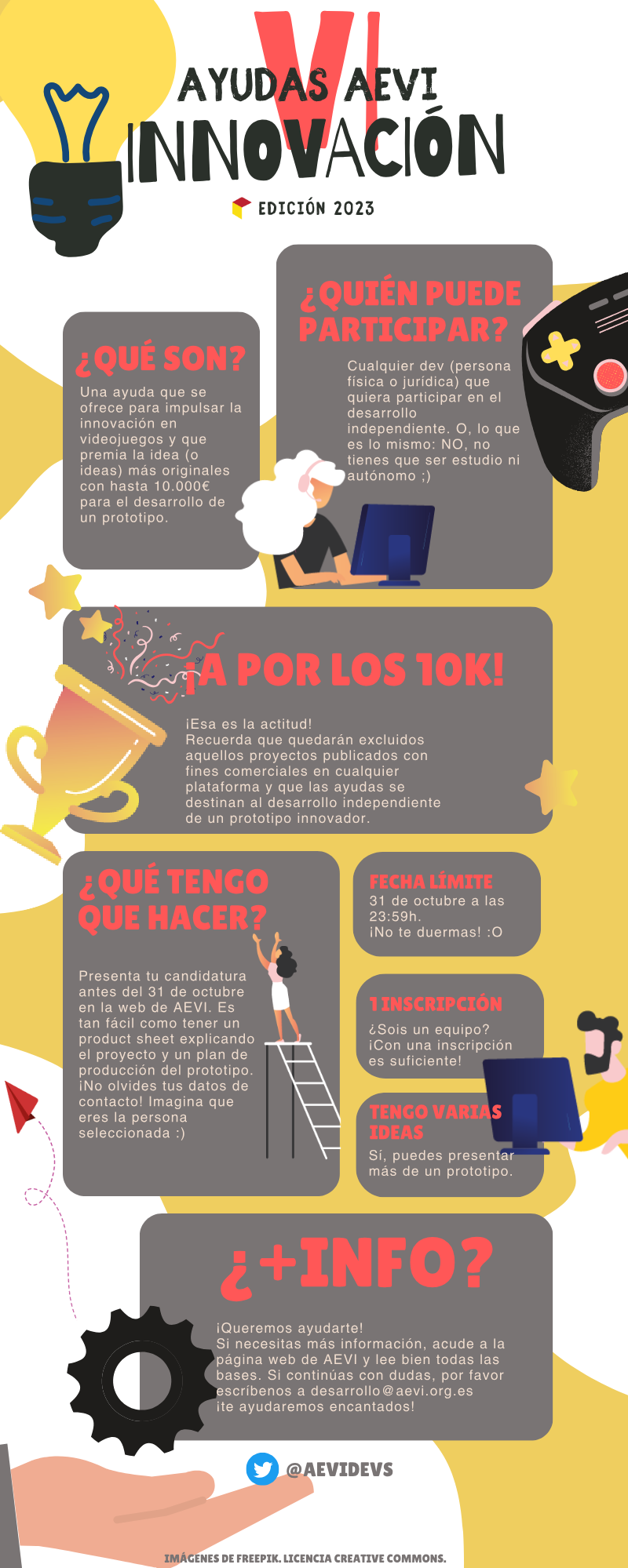
The AEVI Innovation program for 2023 offers financial support of up to €10,000 to independent developers—both individuals and legal entities—who wish to create an innovative prototype in the video‑game sector. The aid is expressly targeted at non‑commercial projects, and any work that has already been published on any platform for commercial purposes is excluded from eligibility. Applicants may submit more than one prototype idea, provided each proposal meets the program’s criteria. Eligibility is open to any developer, regardless of prior experience, who can demonstrate a novel concept and a clear production plan for the prototype. The application process is streamlined: candidates register through the AEVI website, upload a concise product sheet describing the project, and provide contact details. The deadline for submissions is 31 October at 23:59, and the program emphasizes a proactive attitude, encouraging developers to act promptly. The initiative focuses exclusively on the Spanish independent game development ecosystem, with no geographic restrictions beyond the national context. No statistical data or survey methodology is presented, as the program functions as a grant call rather than a research study. The primary objective is to stimulate creativity and technical experimentation within the indie sector by reducing financial barriers to prototype development.
INNOVACIÓN edición 2023 LQUIENᴾᵁᴱᴰᴱ ¿QUIÉN PUEDE PARTICIPAR? QUE SON? PARTICIPAR? Cualquier dev (persona ¿QUÉ SON? fisica jurídica) que que O ece para impulsar la Cualquier dev (persona física o jurídica) que desarrollo Una ayuda que se quiera participar en el O, lo que ofrece para impulsar la desarrollo NO, NO, no no mismo: innovación en (0 independiente. O, lo que que ser estudio ni videojuegos y que es lo mismo: NO, no : premia la idea (o tienes que ser estudio ni ideas) más originales autónomo ;) con hasta 10.000€de para el desarrollo de un prototipo. ¡A POR LOS 10K! actitud! la ¡Esa es la actitud! que quedarán Recuerda que quedarán excluidos publicados aquellos proyectos publicados con proyectos fines comerciales en cualquier cualquier plataforma y que las ayudas se ayudas que las destinan al desarrollo independiente desarrollo a de un prototipo innovador. innovador. prototipo nnovador. ¿QUÉ TENGO FECHA LÍMITE QUE HACER? 31 de octubre a las octubre las las de octubre a a a 23:59h. 23:59n. ¡No te duermas! :O duermas! :0 iNo te iNo duermas! iNo duermas! :0 :O te duermas! te
destinan al desarrollo independiente desarrollo a de un prototipo innovador. innovador. prototipo nnovador. ¿QUÉ TENGO FECHA LÍMITE QUE HACER? 31 de octubre a las octubre las las de octubre a a a 23:59h. 23:59n. ¡No te duermas! :O duermas! :0 iNo te iNo duermas! iNo duermas! :0 :O te duermas! te Presenta tu candidatura antes del 31 de octubre 1 INSCRIPCIÓN en la web de AEVI. Es FECHA LÍMITE tan fácil como tener un ¿Sois un equipo? product sheet explicando Spathiphyllum, ¡Con una inscripción equipo? Espatifilo. Son un el proyecto y un plan de es suficiente! inscripción iCon producción del prototipo. una suficiente! ¡No olvides tus datos de es contacto! Imagina que TENGO VARIAS eres la persona IDEAS seleccionada :) TENGO TENGO VARIAS IDEAS Sí, puedes presentar IDEAS más de un prototipo. Si, puedes Si, puedes Sí, puedes presentar presentar de más de un de más un prototipo. más un prototipo. ¿+INFO? ¡Queremos ayudarte! Si necesitas más información, acude a la página web de AEVI y lee bien todas las ayudarte! bases. Si continúas con dudas, por favor acude másinformación, acudeescríbenos a [email protected] a AEVI ¡te ayudaremos encantados! lee bien web y todas de lee bien todas y dudas dudas Si continuas con favor ntinuas con por por aevi.org. desarrollo aevi.org.es @ j.es desarrollo a @ encantados! encantados! @AEVIDEVS
The catalogue presents AEVI’s strategy to strengthen Spain’s video‑game development sector through a suite of collaborative services and targeted initiatives. Central to the effort is the celebration of the second anniversary of the association’s development area, which underscores a commitment to expand support for local studios, from established references to emerging independents. Since the start of 2020, six new development studios have joined AEVI, bringing the total roster to more than thirty members, including Artax Games, Binary Box Studios, Blackmouth Games and others. Financial assistance is offered through a €10,000 grant programme, while an affordable annual membership fee of €150 eases entry for smaller firms. AEVI also operates a mentor network, a job‑matching platform, and a €10,000 aid scheme, and has conducted outreach across 15,000 km, meeting over 300 developers in cities such as Madrid, Barcelona, Bilbao and Seville. Key partnerships extend legal, technological and commercial expertise to members. Bird & Bird provides free initial legal consultations on intellectual‑property, labour and tax matters; Tutelio supplies blockchain‑based IP protection services; B2Boost grants access to weekly market‑intelligence reports covering PSN, Xbox Live, Steam and Nintendo e‑shop sales; Sorastream enables cost‑free integration of games into its cloud‑gaming platform with revenue‑share terms for AEVI affiliates. Additional collaborations with Enumbers, Screenglitch, Make Good Art Agency and Gamingates deliver accounting tools, marketing support, digital‑strategy advice and visibility in professional networks. Collectively, these measures aim to create a sustainable ecosystem for Spanish developers, fostering talent, facilitating market entry and enhancing the international profile of locally produced games.
NHK Enterprise is launching the “Kami‑Ge Creator Evolution” contest as a dedicated platform for nurturing the next generation of Japanese game developers, and from 2024 it will incorporate the Japan Game Awards’ Amateur and U18 divisions. The initiative, begun in 2022 under the theme “Evolve the Game,” seeks to discover and develop talent through a series of contest events, community support, and media exposure, including a documentary broadcast on NHK General in February 2023 that generated strong public interest. The competition invites creators from across Japan to submit original games, which are evaluated for innovative expansion of the medium’s boundaries by a diverse panel of established game designers, media artists, and other industry figures. In addition to expert judging, a public popularity vote is conducted, and the contest awards a Grand Prize, Excellence Awards, and Honorable Mentions in the Amateur category, while the U18 category focuses on participants aged 18 or younger, reflecting the Japan Game Awards’ long‑standing commitment to youth development since 2018. The 2024 schedule begins with an entry period from 1 February to the end of April, followed by nomination, second‑round video submissions in July, third‑round game submissions in October, finalist announcements at the end of October, and a final event slated for December. A closed Discord community supports participants with exclusive benefits, knowledge sharing, and mentorship, reinforcing the project’s role as a learning environment. Special cooperation from the Computer Entertainment Supplier’s Association (CESA) provides additional industry credibility and resources. The contest is open to individuals, teams, corporations, and organizations regardless of age, gender, nationality, or the number of entries, emphasizing inclusivity and broad outreach. By integrating the Amateur and U18 awards, the “Kami‑Ge Creator Evolution” aims to broaden the creative framework of Japanese games, foster innovative design, and strengthen the pipeline of skilled developers. The organizers are actively seeking sponsors to sustain the project’s growth and align with NHK Enterprise’s broader commitment to sustainable development and cultural enrichment.
VENTSPILS HIGH TECHNOLOGY PARK ERHVERVSAKADEMI DANIA TECHNOLOGY PARK This model scheme illustrates “how to run” an incubation programme for game development companies, drafted in form of a manual for business support providers and intermediaries working with Dania University of Applied Sciences Kaunas Science and Technology Park Ventspils High Technology Park für internationale Zusammenarbeit mbH Title page: © iStock.com-bedya, 1.
The guide aims to equip video‑game developers and publishers with a practical framework for safeguarding the creative and technical assets that constitute a game’s intellectual and industrial property. It clarifies the dual nature of IP under Spanish law—copyright and related rights on the one hand, and industrial property (patents, trademarks, designs, trade secrets) on the other—explaining which categories protect specific game elements such as scripts, music, graphics, code, user‑interface designs, character names and logos. Key conclusions stress that copyright arises automatically upon creation, lasting 70 years after the author’s death (or 70 years from disclosure for collective works), while related rights endure 50 years. Trademark protection requires registration and lasts ten years per filing, renewable indefinitely; design protection covers the external appearance of a GUI for five‑year periods, renewable up to 25 years. Trade‑secret measures rely on confidentiality agreements and technical safeguards rather than formal registration. The guide also outlines the legal regimes governing ownership of works created by employees, freelancers or collaborators, noting that Spanish law lacks a “work‑for‑hire” concept and therefore mandates explicit written assignments of exploitation rights, typically detailed in employment or service contracts. Practical recommendations include a step‑by‑step checklist for identifying each asset, determining the appropriate protection mechanism, confirming that all contributors have assigned their rights, and implementing NDAs to preserve secrecy during development. The guide further outlines limited exceptions for using third‑party material—public‑domain works, specific statutory limits, and narrowly defined descriptive uses of trademarks—while warning that doctrines such as “fair use” are not recognized in the EU. Overall, the document provides a comprehensive, Spain‑focused roadmap for building a robust IP portfolio that enhances a game’s market value and minimizes infringement risk.