Velocity
Company
9 documents in the library are about Velocity, from writers such as Game Developers Conference, Mobile Dev Memo and Extra Credits. Each has a summary and key insights with the page they come from.
Connections
The documents about Velocity on the inner ring, the other games and companies they name on the outer one. Select a cover to see it up close and open it in a new tab; drag to move, pinch or Ctrl + scroll to zoom.
Documents about Velocity

Creative Velocity and Player Intelligence Reshape Mobile Game Marketing in H1 2026
The mobile game marketing landscape in the first half of 2026 is defined by a significant expansion in advertising activity and a strategic shift toward integrated artificial intelligence workflows.
- Global mobile game advertising expanded significantly in H1 2026, with monthly active advertisers reaching 109,500, a 31.1% year-over-year increase.
- An 'AI maturity gap' persists in the industry, where 49% of projects utilize AI for creative production, but only 30% have achieved measurable ROI growth.
- Playio’s STORM engine, which leverages behavioral intelligence from rewarded gameplay, demonstrated a significant performance boost in a campaign example by increasing ROAS from 330% to 724%.

S07, E23: Building ad tech for the chatbot era (with Tal Shoham)
The emergence of AI-native applications has created an urgent need for sustainable monetization models to offset the substantial operational costs associated with high-frequency inference.
- AI-native applications face high operational costs due to inference and token usage, necessitating a shift toward ad-supported monetization models to maintain sustainable profit margins.
- The granular intent signals captured in LLM conversations provide superior targeting capabilities compared to traditional search-based advertising, leading to higher click-through rates and conversion performance.
- Velocity, which recently emerged from stealth with $27 million in seed financing, is building an ad-tech mediation platform that allows developers to manage multiple ad networks through a single tool.

Building Ad Tech for the Chatbot Era
The primary objective is to demonstrate how Velocity’s newly raised $27 million seed capital will enable the creation of an ad-monetization framework tailored for AI-native applications.
- AI startups will need more disciplined monetization strategies beyond pure user growth, adapting established ad-tech infrastructure from mobile gaming to monetize AI experiences.
- Velocity aims to create a new monetization layer for AI-native apps by delivering native ads within AI experiences, leveraging user intent and conversation context to serve relevant, non-intrusive advertisements.
- The mobile gaming industry's evolution, particularly in monetization and user acquisition tactics (e.g., rewarded video, aggressive creative testing), is seen as a blueprint for the emerging AI-native app ecosystem.
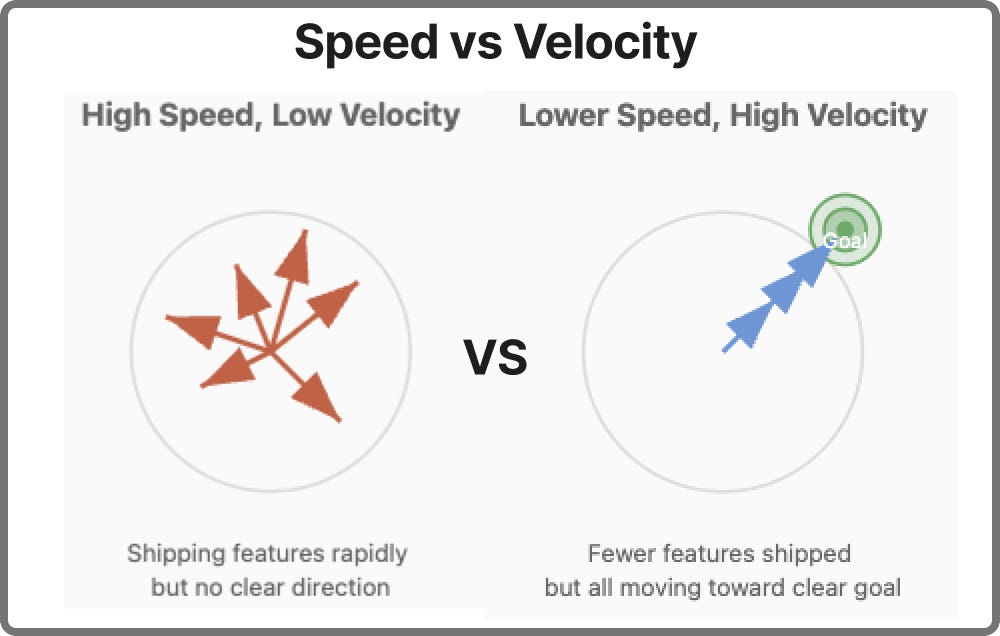
On Product Velocity
Product velocity in the video game industry is defined as a vector requiring both speed and correct strategic direction.
- Product velocity is defined as a vector requiring both speed (execution) and direction (strategy); teams must optimize both to achieve success.
- Improving development speed requires mapping the iteration cycle to identify bottlenecks, measuring cycle time from start to deployment, and being willing to replace personnel who cause delays.
- The gaming market is shifting from hypercasual to hybridcasual, with in-app purchase revenue in the sector growing by 67% year-over-year.
What Is Wishlist Velocity and Is It a Better Indicator of Success?
Wishlist velocity, defined as the rate of wishlist acquisition over time, serves as a critical indicator of player excitement and potential commercial success for games on Steam.
- No single metric, including total wishlists or wishlist velocity, can guarantee a game's success because Valve ultimately relies on actual revenue generated at launch to determine visibility and featuring.
- Wishlist velocity—the rate of new wishlists over time—is a superior indicator of market excitement compared to total raw count, as high velocity suggests viral interest and higher conversion potential.
- Total wishlist counts remain critical for accessing specific Steam visibility tools, such as 'Popular Upcoming' (5,000–7,000 wishlists) and the 'Steam Popup' (typically 100,000+ wishlists).

Why Hard Games Feel Great - Extra Credits Gaming
Effective game design requires a deep understanding of velocity (V) and the change in velocity (delta V) to maintain consistent player progression.
- Game balance relies on managing both velocity (V), the current rate of player progress, and delta V, the rate of change in that progress.
- The 'jerk principle' refers to the second derivative of velocity, representing sudden, noticeable shifts in gameplay pacing that players perceive as jarring or unfair.
- Poorly planned progression curves often force designers to use 'kludge math' or disjointed equations to force balance, which frequently introduces bugs, exploits, and inconsistent player experiences.
How Escape Simulator Hit 'escape Velocity' & Sold 2 Million Copies
Escape Simulator, a $15 co-op escape room title from Pine Studio, has achieved significant commercial success on Steam, surpassing 2 million copies sold since its October 2021 launch.
- Escape Simulator has sold over 2 million copies since its October 2021 launch, maintaining a high sales-to-review ratio of 177:1 due to its casual co-op player base.
- The game’s paid DLC maintains an attach rate exceeding 30%, despite the availability of extensive free user-generated content.
- Strategic collaborations with Portal and Among Us have served as effective, non-monetized tools for player acquisition and retention.

Inside The New Xbox Series X|S With Microsoft's Jason Ronald - GDC Podcast
The development of the Xbox Series X and Series S consoles was driven by a developer-centric philosophy aimed at removing technical barriers to creative expression.
- Microsoft prioritized developer feedback starting in 2016 to remove technical barriers, focusing on CPU performance, IO throughput, and graphical fidelity.
- The Xbox Velocity Architecture and hardware-accelerated features like DirectX ray tracing and variable rate shading were implemented to enhance overall console performance.
- The Series X and Series S share symmetrical CPU and IO performance to allow developers to scale titles across hardware tiers without significant engine rework.

Tuning the Muzzle Velocity of the Plasma Rifle Bolt on Legendary Difficulty in HALO
The design of the plasma rifle within the Halo franchise serves as a case study for the distinction between long-term competitive balancing and iterative tuning.
- To increase game difficulty, developers should prioritize increasing the speed of combat—such as projectile velocity and AI firing rates—rather than simply increasing global damage scales, which often results in a punishing experience rather than a challenging one.
- Tuning is distinct from balancing; while balance focuses on long-term game longevity, tuning involves the specific calibration of mechanics to ensure they feel effective and responsive to the player in real-world scenarios.
- Projectile-based weapons like the plasma rifle require a visible contrail and a velocity that is slow enough to allow for human reaction and dodging, but fast enough to avoid appearing comical or disconnected from the game's frame rate.