Velocity
Company
Documents about Velocity

Creative Velocity and Player Intelligence Reshape Mobile Game Marketing in H1 2026
The mobile game marketing landscape in the first half of 2026 is defined by a significant expansion in advertising activity and a strategic shift toward integrated artificial intelligence workflows.
- Global mobile game advertising expanded significantly in H1 2026, with monthly active advertisers reaching 109,500, a 31.1% year-over-year increase.
- An 'AI maturity gap' persists in the industry, where 49% of projects utilize AI for creative production, but only 30% have achieved measurable ROI growth.
- Playio’s STORM engine, which leverages behavioral intelligence from rewarded gameplay, demonstrated a significant performance boost in a campaign example by increasing ROAS from 330% to 724%.

Building Ad Tech for the Chatbot Era
The primary objective is to demonstrate how Velocity’s newly raised $27 million seed capital will enable the creation of an ad-monetization framework tailored for AI-native applications.
- AI startups will need more disciplined monetization strategies beyond pure user growth, adapting established ad-tech infrastructure from mobile gaming to monetize AI experiences.
- Velocity aims to create a new monetization layer for AI-native apps by delivering native ads within AI experiences, leveraging user intent and conversation context to serve relevant, non-intrusive advertisements.
- The mobile gaming industry's evolution, particularly in monetization and user acquisition tactics (e.g., rewarded video, aggressive creative testing), is seen as a blueprint for the emerging AI-native app ecosystem.
On Product Velocity
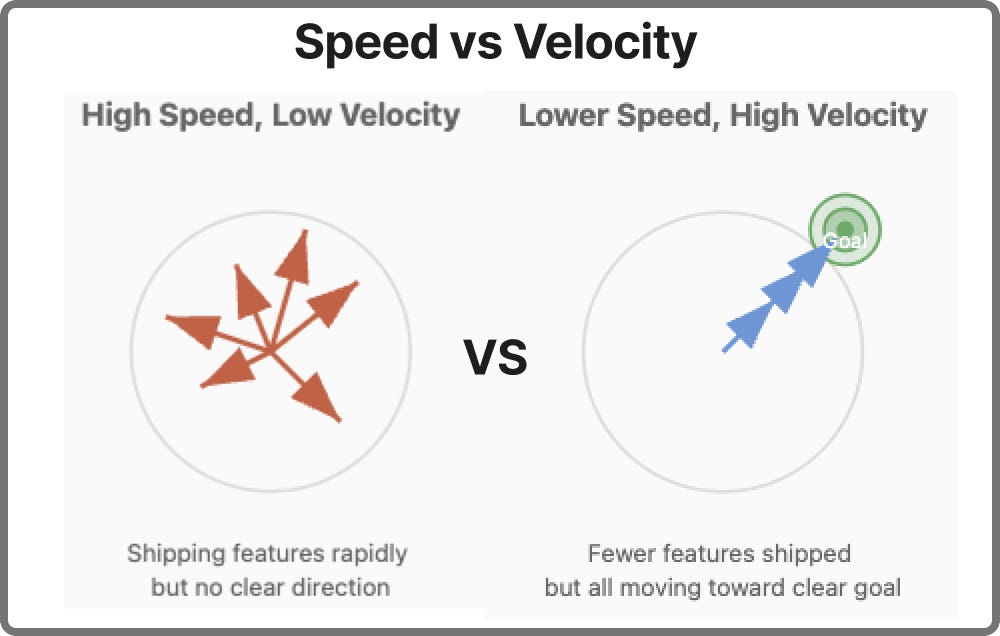
Product velocity in the video game industry is defined as a vector requiring both speed and correct strategic direction.
- Product velocity is defined as a vector requiring both speed (execution) and direction (strategy); teams must optimize both to achieve success.
- Improving development speed requires mapping the iteration cycle to identify bottlenecks, measuring cycle time from start to deployment, and being willing to replace personnel who cause delays.
- The gaming market is shifting from hypercasual to hybridcasual, with in-app purchase revenue in the sector growing by 67% year-over-year.
What Is Wishlist Velocity and Is It a Better Indicator of Success?
Wishlist velocity, defined as the rate of wishlist acquisition over time, serves as a critical indicator of player excitement and potential commercial success for games on Steam.
- No single metric, including total wishlists or wishlist velocity, can guarantee a game's success because Valve ultimately relies on actual revenue generated at launch to determine visibility and featuring.
- Wishlist velocity—the rate of new wishlists over time—is a superior indicator of market excitement compared to total raw count, as high velocity suggests viral interest and higher conversion potential.
- Total wishlist counts remain critical for accessing specific Steam visibility tools, such as 'Popular Upcoming' (5,000–7,000 wishlists) and the 'Steam Popup' (typically 100,000+ wishlists).
How Escape Simulator Hit 'escape Velocity' & Sold 2 Million Copies
Escape Simulator, a $15 co-op escape room title from Pine Studio, has achieved significant commercial success on Steam, surpassing 2 million copies sold since its October 2021 launch.
- Escape Simulator has sold over 2 million copies since its October 2021 launch, maintaining a high sales-to-review ratio of 177:1 due to its casual co-op player base.
- The game’s paid DLC maintains an attach rate exceeding 30%, despite the availability of extensive free user-generated content.
- Strategic collaborations with Portal and Among Us have served as effective, non-monetized tools for player acquisition and retention.