Headspace
Company
5 documents in the library are about Headspace, from writers such as data.ai, gamevironments and GDev. Each has a summary and key insights with the page they come from.
Connections
Each row is a game or company named alongside Headspace, each column a document, oldest first. A mark means that document names it. Select a row to see those documents.
Key figures from the reports
App Store Optimization (ASO) strategies focused on localized listings and AI-driven keyword research can yield significant growth, as demonstrated by Headspace achieving a 40% visibility lift and an 18% increase in installs over six months.
SocialPeta, 2025 · User Acquisition: 5 Popular Trends of 2025
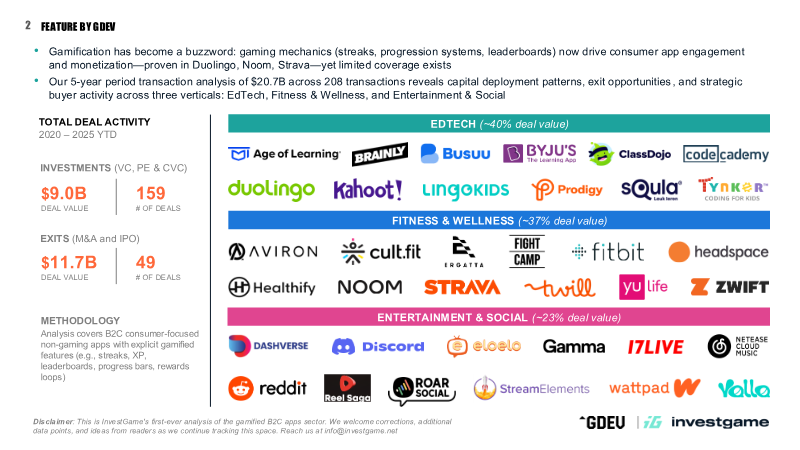
Fitness & Wellness shows high growth potential with capital spread across many platforms, despite being anchored by mega-deals like the $3 billion Headspace and $2.1 billion Fitbit acquisitions.
InvestGame · Beyond the Game: How Gamification is Becoming Mainstream, p. 8
Documents about Headspace

Beyond Play: Towards a Non-Gaming-Centric Gaming Research
Holroyd and Parker's article critically examines subscription-based "digital ludic wellness" services that use video games to treat neurodivergent youth, particularly those with autism and ADHD.
- The article argues that subscription 'digital ludic wellness' services for neurodivergent youth, such as Hero Journey Club, MindJam, and Mightier, are expressions of neoliberal healthism rather than neutral technological solutions, and that they commodify gameplay and profit from neurodivergence.
- The services are priced at roughly $40 per session or week in the US, or £24–25 per hour in the UK, and emerge against pharmaceutical reliance, privatised insurance, and lengthy NHS waiting lists that push neurodivergent people toward out-of-pocket care and wellness apps like Calm and Headspace.
- Promotional materials frame neurodivergence as a deficit to be corrected through self-help, locating responsibility for healing in the individual rather than in structural or public healthcare provision.
User Acquisition: 5 Popular Trends of 2025
Mobile app and game developers face an increasingly crowded marketplace in 2025, and this article outlines five user acquisition trends that emphasize authenticity, personalization, and creativity over generic ads and broad targeting.
- App Store Optimization (ASO) strategies focused on localized listings and AI-driven keyword research can yield significant growth, as demonstrated by Headspace achieving a 40% visibility lift and an 18% increase in installs over six months.
- User-generated content (UGC), including short-form videos and gameplay clips, currently outperforms traditional advertising on platforms like TikTok and Instagram by leveraging social proof.
- Influencer marketing in 2025 has shifted toward long-term partnerships with micro-creators, prioritizing performance-based collaborations over traditional broad-reach campaigns.

India: Mobile Market Spotlight: A Booming Mobile Economy
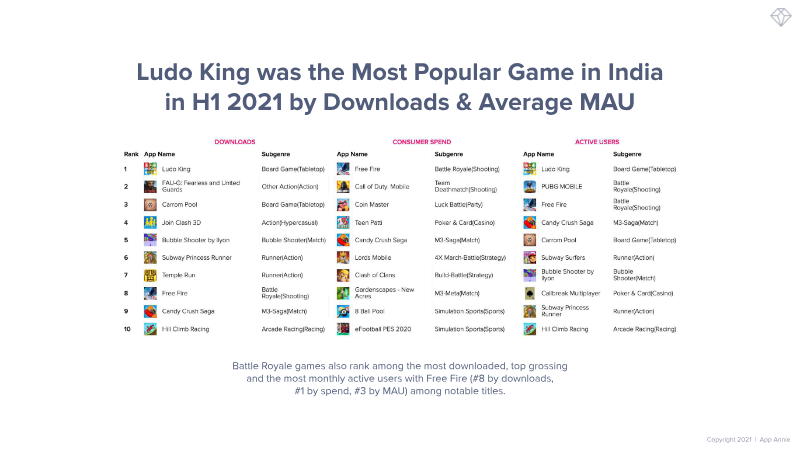
India's mobile economy expanded sharply across 2020 and 2021, driven by rising engagement, a leading position in global games, and fast-growing fintech adoption.
- India is a global mobile-first leader, ranking second in total app downloads with 24 billion installs in 2020, a 28% year-over-year increase.
- India became the world's largest market for game downloads in the first half of 2021, accounting for nearly 20% of global installs.
- Daily mobile usage per user surged from 3.3 hours in 2019 to 4.8 hours by Q3 2021, fueled by pandemic-driven engagement.
What Happens to Free-to-Play Mobile Gaming During a Recession?
Mobile gaming's reputation for recession resistance rests on a questionable conflation, according to this April 2020 analysis written during the early COVID-19 downturn.
- Mobile gaming's resilience during a recession is unproven, as the freemium model was not a dominant force during the 2008 financial crisis.
- While mobile game engagement surged by 75% according to Verizon data during the early COVID-19 period, this quarantine-driven activity is structurally distinct from the economic impact of a recession.
- In-app purchases (IAPs) should be classified as luxury goods rather than recession-proof entertainment, meaning demand for them is likely to track closely with consumer income levels.


Beyond the Game: How Gamification is Becoming Mainstream
This analysis examines the mainstreaming of gamification in B2C consumer-focused non-gaming apps, covering transaction activity from 2020 to Q2 2025 YTD.
- Gamified non-gaming apps have surpassed mobile games in net revenue, generating $21.2 billion in Q2 2025 compared to $19.8 billion for games.
- Gamified apps are driving a 24% year-over-year growth in mobile consumer spending, while traditional mobile gaming revenue has stagnated.
- EdTech, Fitness & Wellness, and Entertainment & Social account for $20.7 billion in transaction value, with EdTech dominating deal volume (43%) and exit activity (45%).