Ares Interactive
Company
7 documents in the library are about Ares Interactive, from writers such as Mobilegamer.biz, Aream & Co and Deconstructor of Fun. Each has a summary and key insights with the page they come from.
Connections
The documents about Ares Interactive on the inner ring, the other games and companies they name on the outer one. Select a cover to see it up close and open it in a new tab; drag to move, pinch or Ctrl + scroll to zoom.
Documents about Ares Interactive

Video Game Market Update: Q1 2026
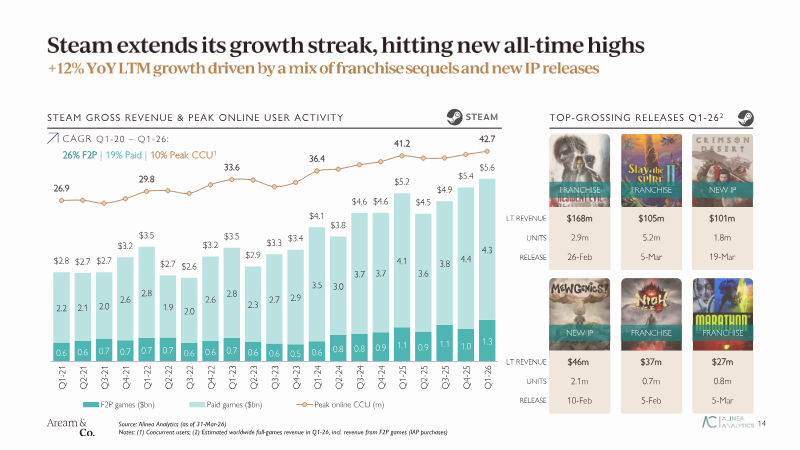
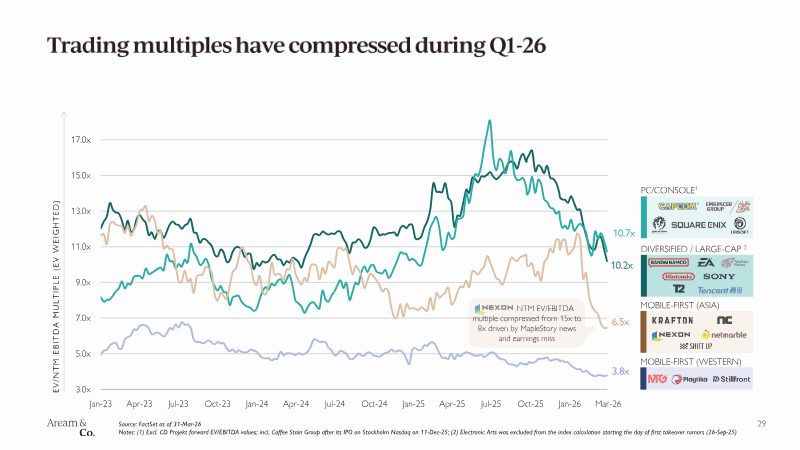
The global video game industry experienced a period of significant divergence during the first quarter of 2026, characterized by record-breaking consumer engagement alongside a tightening capital environment.
- The console market reached a record $21.7 billion in Q1 2026, primarily driven by the Nintendo Switch 2's first holiday season, while Sony and Microsoft experienced year-over-year revenue declines.
- Mobile gaming's in-app purchase (IAP) revenue has plateaued, with Q1 2026 gross IAP revenue at $20.6 billion, while install volumes hit multi-year lows, indicating a shift towards monetization efficiency.
- Mergers and Acquisitions (M&A) activity in Q1 2026 saw a high quarterly deal value of $7.7 billion across 52 deals, with mobile studios accounting for the majority of headline acquisitions.

Ares' gameplan, Honkai: Star Rail drama, Moonton's Savvy sale, Rovio's write-down, DICE awards, more
The mobile games industry is currently navigating significant shifts in investment, corporate restructuring, and geopolitical influence.
- Savvy is in negotiations to acquire Moonton, the developer of Mobile Legends: Bang Bang, for approximately $7 billion, signaling a potential exit from mobile gaming for ByteDance.
- Sega recorded a $200 million write-down for Rovio, citing intense market competition and a lack of recent successful titles.
- Financial performance across the sector is polarized: AppLovin reported a 70% revenue increase to $5.48 billion and Krafton reached $1.2 billion in mobile revenue, while Embracer Group saw mobile game sales decline by 66%.

The Ares Gameplan: UA Financing, Non-US Developers, and Kim Kardashian
Ares Interactive is positioning itself as a successor to Glu Mobile, leveraging a strategic focus on user acquisition (UA) financing and partnerships with non-US development studios.
- Ares Interactive has secured $70 million in funding to expand its portfolio of cross-platform free-to-play games.
- The company is led by founder Niccolo de Masi and executive Mike DeLaet, both of whom are former Glu Mobile veterans, leading to industry comparisons of Ares as 'Glu 2.0'.
- Ares is actively exploring the development of a celebrity-licensed game similar to the success of 'Kim Kardashian: Hollywood'.

What do game developers really think of Project Genie? | Week in Mobile Games podcast
Google’s introduction of Project Genie, an AI-driven tool capable of generating playable environments from text prompts, has sparked significant market volatility, notably impacting the stock valuations of established platforms like Unity and Roblox.
- Google’s Project Genie has caused market volatility for Unity and Roblox, but industry professionals view the tool as an experimental prototype that currently lacks the mechanical depth and narrative sophistication required for professional game production.
- Nintendo is approaching a milestone of one billion total console sales, reflecting a successful recovery from the Wii U era and the sustained strength of its current hardware ecosystem.
- Arz Interactive secured $70 million in Series A funding to target specific genre gaps within the sports gaming market.

TWiG #369: Genie 3 Explodes, Game Stores Die, & High Guard Stumbles
The gaming industry is currently undergoing a period of intense volatility, characterized by the rapid obsolescence of traditional retail models and the disruptive, often speculative, influence of generative artificial intelligence.
- The unveiling of Google DeepMind’s Genie 3, capable of generating 3D environments, triggered a $47 billion valuation drop across the gaming sector as markets reacted to the potential disruption of traditional production models.
- Physical game retail is in a state of collapse, evidenced by widespread storefront closures in the UK and the downsizing of major chains, cementing digital distribution as the industry's undisputed standard.
- High-budget marketing playbooks are failing to sustain player retention, as demonstrated by Highguard’s rapid decline despite high initial visibility, highlighting the necessity of clear value propositions and transparent community engagement.

Google's Project Genie, Take-Two, Stillfront, Ares, January's top games and more
The mobile gaming industry is currently navigating a period of significant financial restructuring and technological speculation.
- Take-Two Interactive reported a 19% year-over-year increase in mobile revenue, which now accounts for 49% of the company's total net bookings.
- Google's Project Genie generative AI technology caused a temporary market sell-off in game stocks, though industry leaders like Unity and Epic Games clarified that such models are intended to supplement, not replace, professional game engines.
- Stillfront Group is undergoing a restructuring that includes further game closures and the sale of its narrative games division, despite achieving a 27% EBITDAC margin in Q4 2025 through cost savings and disciplined user acquisition.
Global Gaming Report Q1 2026
The global gaming industry experienced a complex start to 2026, characterized by a sharp divergence between high-level strategic consolidation and broader market volatility.
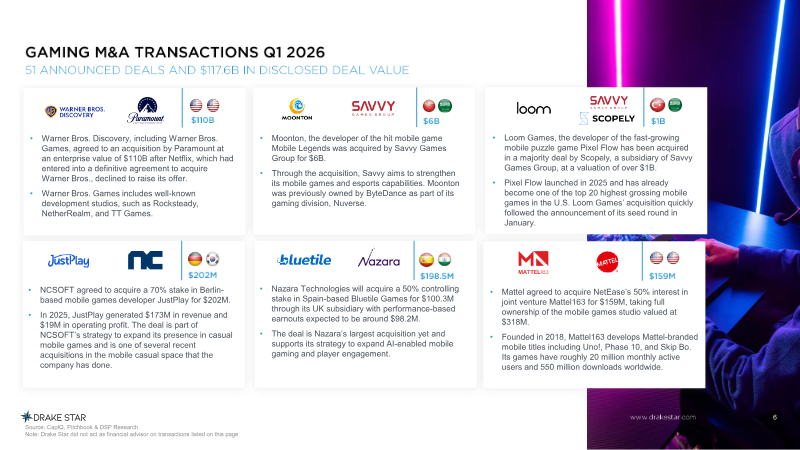
- M&A activity reached a 15-month peak in Q1 2026 with 51 transactions totaling over $100 billion, headlined by the Paramount acquisition of Warner Bros. Discovery and Savvy Games Group's purchase of Moonton.
- Private financing remained steady with $785 million raised across 106 deals, showing a clear investor preference for AR/XR hardware and infrastructure over traditional software.
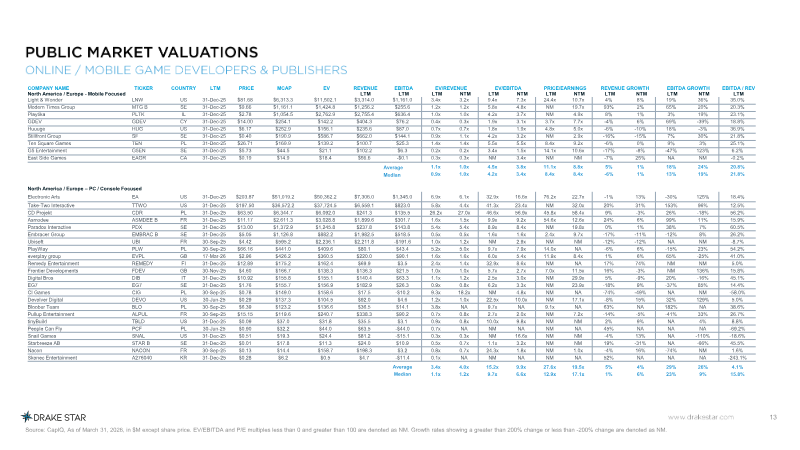
- The Drake Star Gaming Index declined by 1.8 percent, driven by market weakness in Western regions and the mobile gaming sector.