Koei Tecmo
Game Co.173 documents
Japanese developer/publisher. Dynasty Warriors, Nioh, Dead or Alive, Atelier, Romance of the Three Kingdoms.
Documents
Financial8 pages
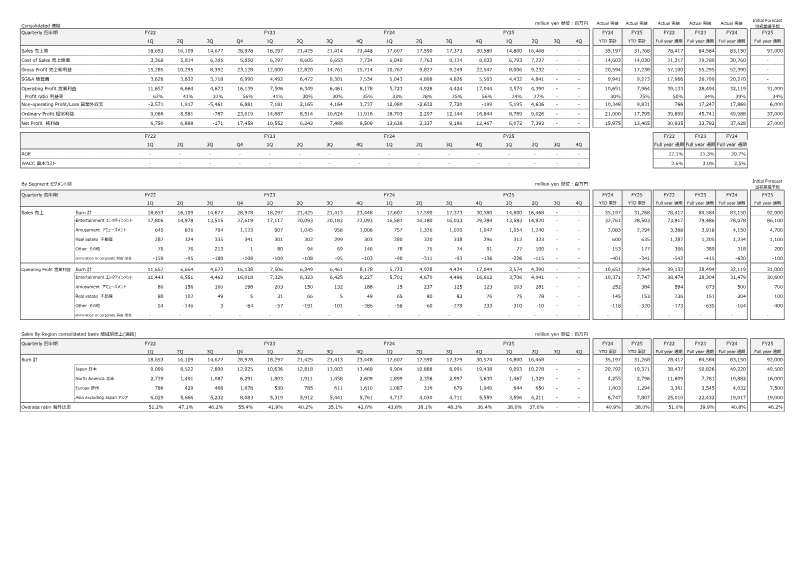
Consolidated Financial Results: FY2025 2nd Quarter Data Appendix
The consolidated financial appendix presents quarterly and annual performance for FY22 through FY25, focusing on sales, cost of sales, gross profit, SG&A, operating profit, and net profit across entertainment, amusement, real‑estate, and other segments. Sales peaked in FY25 Q4 at ¥28,978 million, driven largely by the entertainment segment (¥27,619 million), while cost of sales rose proportionally, resulting in a gross profit margin decline from 62 % in FY22 Q1 to 30 % by FY25 Q2. Operating profit fluctuated, with a notable dip in FY24 Q3 (¥4,673 million) before rebounding to ¥16,139 million in FY25 Q4. Net profit followed a similar pattern, reaching ¥17,458 million in FY25 Q4 after a negative result in FY24 Q3. Segment analysis shows entertainment consistently dominates revenue, contributing over 90 % of total sales, with amusement and real‑estate providing modest but stable contributions. Geographic revenue distribution indicates Japan remains the largest market (≈49 % of total sales), followed by North America and Asia excluding Japan, with overseas ratios ranging from 35 % to 55 %. Headcount grew from 2,413 employees in FY22 Q1 to 2,873 by FY25 Q4, reflecting expansion. Capital expenditure totals ¥789 million in FY22 and increased to ¥1,967 million in FY24, with real‑estate and equipment investments comprising the bulk. Digital sales maintain a high digital ratio (≈70 %) and online/mobile units account for 60–80 % of total sales units, underscoring a strategic shift toward digital platforms. Overall, the data illustrate robust revenue growth driven by entertainment titles, moderate margin compression due to rising costs, and a strategic emphasis on digital distribution across multiple regions.
- The entertainment segment is the primary revenue driver, consistently contributing over 90% of total sales and fueling a peak quarterly revenue of ¥28,978 million in FY25 Q4.
- Gross profit margins have experienced significant compression, falling from 62% in FY22 Q1 to 30% by FY25 Q2 due to rising costs of sales.
- The company has successfully pivoted to a digital-first model, with digital sales accounting for approximately 70% of revenue and online/mobile units representing 60–80% of total sales volume.
- Financial performance showed a strong recovery in FY25 Q4 with ¥16,139 million in operating profit and ¥17,458 million in net profit, following a period of volatility that included a net loss in FY24 Q3.
- Japan remains the core market at 49% of total sales, while the company maintains a global footprint with overseas revenue ratios fluctuating between 35% and 55%.
+1
Koei Tecmo

Financial47 pages
Financial Results for the First Quarter: Fiscal Year Ending March 2026
Financial results for the first quarter of the fiscal year ending March 2026 1. Financial Highlights and Forecasts 1. Financial Highlights and Forecasts 3. Frequently Asked Questions - Summary of Disclosed Information Financial Highlights: Consolidated Results FY24 Q1 FY25 Q1 Vs Previous Year Amount Profit Ratio Amount Profit Ratio Amount Percent Sales 17,607 - 14,800 - (2,807) -15.9% Operating Profit...
- Koei Tecmo Holdings' total sales for Q1 FY25 decreased by 2,807 million Yen to 14,800 million Yen, and operating profit decreased by 2,149 million Yen to 3,574 million Yen, compared to Q1 FY24.
- The Entertainment segment experienced the largest decline, with sales dropping by 2,998 million Yen to 13,583 million Yen and operating profit falling by 1,995 million Yen to 3,706 million Yen, primarily due to a decrease in the online mobile sector.
- Within the Entertainment segment, mobile game sales saw a significant decrease of 2,370 million Yen, from 9,720 million Yen in Q1 FY24 to 7,350 million Yen in Q1 FY25, attributed to declining sales and licensing royalties from FY2023 titles.
- Koei Tecmo's 4th Medium-Term Management Plan (MTMP4) aims for a cumulative operating profit of over 100 billion Yen and cumulative sales of over 300 billion Yen over three years, re-challenging an annual operating profit of 40 billion Yen with a 30% or more operating profit margin.
- MTMP4 focuses on strengthening the development system, including hiring over 200 new graduates for FY24 and establishing an AAA Studio, alongside improving graphic technology (KATANA ENGINE) and utilizing other general-purpose engines like Unreal Engine.
+1
Koei Tecmo
Financial20 pages
Financial Results for the First Half: Fiscal Year Ending March 2026
Koei Tecmo Holdings reported first‑half fiscal 2026 results, showing sales of ¥35.2 billion and operating profit of ¥10.7 billion, both surpassing the company’s initial forecasts but falling 11.2 % and 25.2 % respectively compared with the same period in FY24. Net profit declined 15.7 % to ¥13.5 billion, driven mainly by a contraction in the online and mobile entertainment segment; repeat sales of existing titles offset declines in new releases. Labor costs rose, yet variable and outsourcing expenses fell, improving operating efficiency.
Segment analysis revealed a 12 % drop in entertainment sales to ¥28.5 billion, while amusement and real‑estate units grew modestly (¥2.3 billion and ¥635 million respectively). The “Other” segment recorded a loss of ¥320 million, reflecting venture‑capital management costs. Forecasts for FY25 maintain a conservative outlook: projected sales of ¥92 billion, operating profit of ¥31 billion, and net profit of ¥27 billion, with a dividend per share of ¥43. The company expects the second half to benefit from new title launches scheduled for Q3 onward.
The presentation also covered corporate governance and compliance, noting a successful treasury‑share disposal in September 2025 that raised tradable shares to 37.3 %, meeting Tokyo Stock Exchange Prime Market criteria. Strategic highlights include the fourth medium‑term plan, “Creating a Foundation for Growth,” targeting cumulative operating income of ¥100 billion over three years and a single‑year profit goal of ¥40 billion. Emphasis is placed on balanced pipeline development, multi‑platform releases, and global expansion through strengthened overseas marketing and publishing partnerships. The IP division’s focus on licensing and merchandise, particularly for the Atelier series, aims to diversify revenue streams and enhance brand value worldwide.
- Koei Tecmo reported H1 FY2026 sales of ¥35.2 billion and operating profit of ¥10.7 billion, exceeding initial forecasts but representing year-over-year declines of 11.2% and 25.2% respectively.
- Net profit fell 15.7% to ¥13.5 billion, primarily due to a contraction in the online and mobile entertainment segment, though repeat sales of existing titles partially mitigated the impact of weaker new releases.
- The company maintains a conservative full-year outlook for FY2025, projecting ¥92 billion in sales, ¥31 billion in operating profit, and ¥27 billion in net profit, with expectations for growth driven by Q3 and Q4 title launches.
- Under the 'Creating a Foundation for Growth' medium-term plan, Koei Tecmo is targeting ¥100 billion in cumulative operating income over three years and a single-year profit goal of ¥40 billion.
- Entertainment segment sales dropped 12% to ¥28.5 billion, while the amusement and real-estate units saw modest growth, and the 'Other' segment reported a ¥320 million loss due to venture-capital costs.
Koei Tecmo
Report6 pages
Financial Highlights: 2nd Quarter FY2025
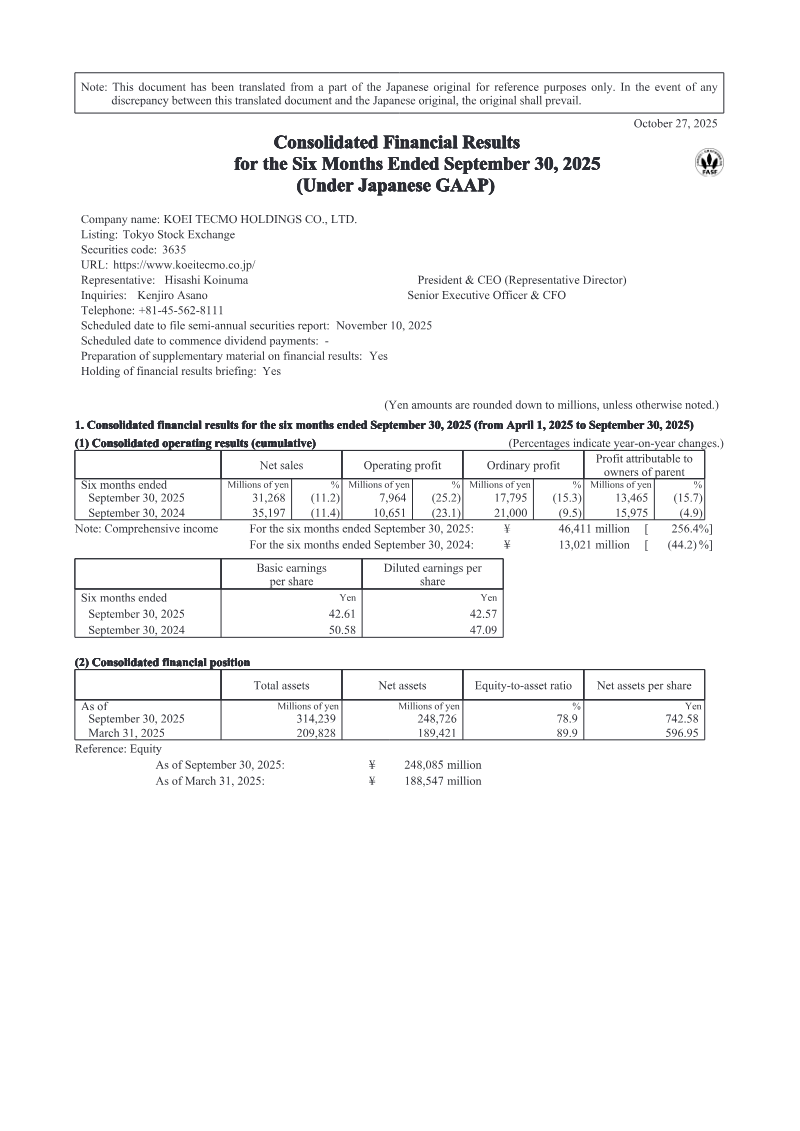
The financial highlights cover the first half of fiscal year 2025 for Koei Tecmo Holdings, a Tokyo‑listed video game and entertainment company. The six‑month period ending September 30 shows net sales of ¥31,268 million, down 11.2% YoY, while operating profit fell 25.2% to ¥7,964 million and ordinary profit declined 15.3% to ¥17,795 million. Comprehensive income surged 256.4%, driven largely by gains on investment securities and derivatives, reaching ¥46,411 million versus a 44.2% loss of ¥13,021 million in the prior year’s half.
Profitability metrics reveal a decline in gross margin from ¥20,593 million to ¥17,238 million and operating margin from 30.6% to 25.4%. Net income attributable to the parent fell 15.7% to ¥13,465 million, with basic earnings per share decreasing from ¥50.58 to ¥42.61. Total assets increased 49% to ¥314,239 million, largely due to a rise in investment securities and cash balances. Net assets grew 31% to ¥248,726 million, with the equity‑to‑asset ratio improving from 89.9% to 78.9%.
The report notes no significant consolidation changes, accounting policy shifts, or restatements. Treasury shares were reduced from 20.25 million to 2.01 million during the period, reflecting a public offering and secondary issuance. Dividend policy remains unchanged, with no cash dividends declared for the first half of FY 2025. The company’s financial position is strengthened by higher liquidity and a solid equity base, but operating performance has weakened relative to the previous year.
- Koei Tecmo Holdings experienced a decline in core operating performance for the first half of FY2025, with net sales falling 11.2% YoY to ¥31,268 million and operating profit dropping 25.2% to ¥7,964 million.
- Comprehensive income surged 256.4% to ¥46,411 million, primarily driven by significant gains from investment securities and derivatives compared to a loss in the same period last year.
- Profitability margins tightened during the six-month period ending September 30, with the operating margin decreasing from 30.6% to 25.4% and net income attributable to the parent falling 15.7% to ¥13,465 million.
- Total assets grew by 49% to ¥314,239 million, supported by increased cash balances and a rise in investment securities, while the equity-to-asset ratio shifted to 78.9%.
- Basic earnings per share declined from ¥50.58 to ¥42.61, reflecting the overall contraction in net income.
+1
Koei Tecmo
Financial16 pages
Financial Results for the Q3: Fiscal Year Ending March 2026
The quarterly briefing outlines KOEI TECMO HOLDINGS’ financial performance for the third quarter of fiscal 2026, highlighting a modest decline in consolidated sales to ¥52.57 billion from ¥51.73 billion, a 1.6 % year‑on‑year drop driven primarily by weaker online and mobile segments. Operating profit fell to ¥15.08 billion, a 3.3 % decline, while ordinary and net profits decreased by 6.2 % and 5.5 %, respectively, reflecting higher employment costs offset by reduced variable expenses. Segment analysis shows entertainment sales contracted by ¥1.25 billion, whereas amusement and real‑estate units posted gains of ¥333 million and ¥34 million, respectively. The company’s earnings forecast for FY25 remains unchanged, projecting sales of ¥92 billion and operating profit of ¥31 billion, with a 28.2 % drop in net profit to ¥27 billion and a dividend reduction of 28.3 % to ¥43 per share.
Cost trends indicate employment expenses rising by roughly 10 % annually, while outsourcing and advertising costs are lower than the initial FY25 forecast. New console/PC titles such as “NINJA GAIDEN 4” and “Hyrule Warriors: Age of Imprisonment” contributed to a 2.3 billion yen increase in that segment, whereas online/mobile sales declined by ¥3.8 billion despite the launch of two new mobile titles. The company emphasizes a balanced pipeline strategy, combining major releases with mid‑tier and licensed IPs to stabilize revenue streams. The outlook for Q4 focuses on multiple console/PC releases, including “Nioh 3,” and continued promotion of existing mobile titles, with advertising spend expected to rise but no significant new capital expenditures anticipated.
- KOEI TECMO reported a 1.6% year-on-year decline in consolidated sales to ¥52.57 billion and a 3.3% drop in operating profit to ¥15.08 billion for Q3 of fiscal 2026.
- The company maintained its full-year FY25 forecast of ¥92 billion in sales and ¥31 billion in operating profit, despite projecting a 28.2% decline in net profit to ¥27 billion and a 28.3% dividend reduction to ¥43 per share.
- Entertainment segment performance was mixed, as a ¥2.3 billion gain from console/PC titles like 'NINJA GAIDEN 4' and 'Hyrule Warriors: Age of Imprisonment' was offset by a ¥3.8 billion decline in online and mobile revenue.
- Rising operational costs are primarily driven by a 10% annual increase in employment expenses, which were partially mitigated by lower-than-forecasted spending on outsourcing and advertising.
- Non-entertainment segments showed minor growth, with amusement and real-estate units posting revenue increases of ¥333 million and ¥34 million, respectively.
+1
Koei Tecmo
Report6 pages
FY2025 Third Quarter Financial Highlights: Japan
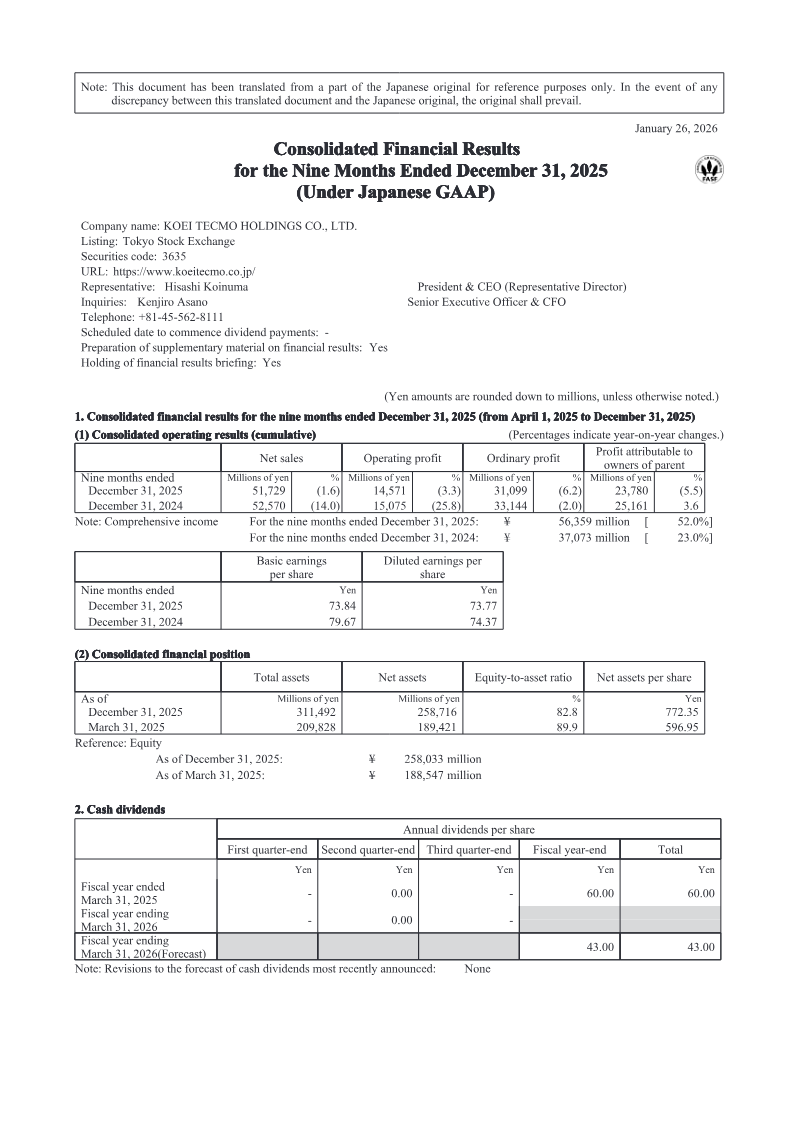
The FY2025 third‑quarter financial highlights for Koei Tecmo Holdings detail a modest decline in core operating metrics while comprehensive income rises sharply. Net sales for the nine months ended December 31, 2025 fell 1.6% to ¥51,729 million from ¥52,570 million in the prior year. Operating profit slipped 3.3% to ¥14,571 million, and ordinary profit decreased 6.2% to ¥31,099 million. Despite these contractions, comprehensive income surged 52.0% year‑on‑year to ¥56,359 million, driven by significant gains in non‑operating items such as interest income and foreign exchange gains. Basic earnings per share declined slightly to ¥73.84 from ¥79.67, reflecting a higher weighted‑average share count due to treasury share disposals and secondary offerings.
Total assets expanded from ¥209,828 million at March 31, 2025 to ¥311,492 million by December 31, 2025, largely through increases in investment securities and property, plant, and equipment. Net assets rose to ¥258,716 million, with the equity‑to‑asset ratio improving to 82.8% from 89.9%. Treasury shares reduced dramatically, lowering the average number of outstanding shares to 322 million from 315 million.
Dividend policy remains unchanged, with a forecast of ¥43.00 per share for the fiscal year ending March 31, 2026, and no revisions to cash dividend forecasts. The report covers Japan‑based operations for FY 2025, presenting consolidated quarterly financial statements without significant changes in consolidation scope or accounting policies.
- Koei Tecmo Holdings reported a 1.6% decline in net sales to ¥51,729 million and a 3.3% drop in operating profit to ¥14,571 million for the nine months ended December 31, 2025.
- Comprehensive income surged 52.0% year-on-year to ¥56,359 million, primarily fueled by non-operating gains from interest income and foreign exchange fluctuations.
- Total assets grew significantly to ¥311,492 million by December 31, 2025, up from ¥209,828 million at the start of the fiscal year, driven by increases in investment securities and property, plant, and equipment.
- Basic earnings per share fell to ¥73.84 from ¥79.67, impacted by an increase in the weighted-average share count following treasury share disposals and secondary offerings.
- The company maintains its dividend forecast at ¥43.00 per share for the fiscal year ending March 31, 2026, with no changes to its current dividend policy.
+2
Koei Tecmo
Report8 pages
Consolidated Financial Data: FY2025 3rd Quarter
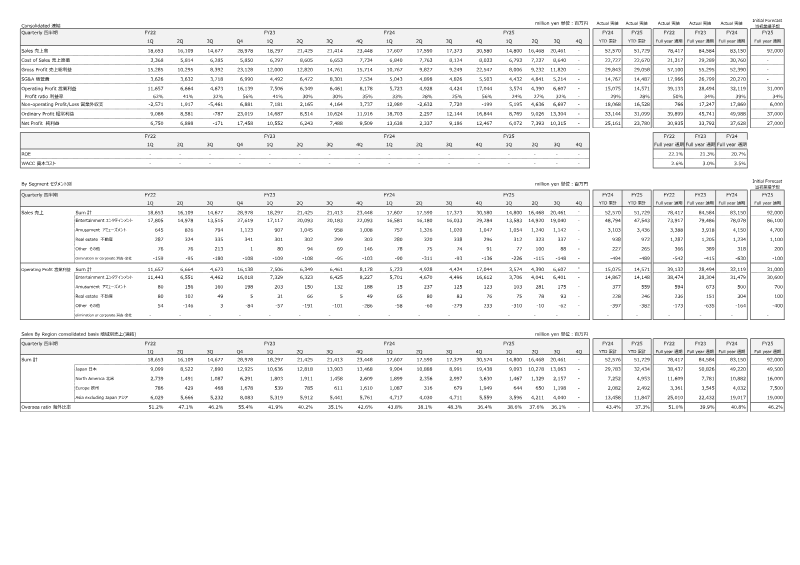
The consolidated financial data for FY2025 third quarter presents a mixed performance across the company’s core segments. Total sales reached ¥30,580 million in Q3 FY25, a 5.4% increase from the same period in FY24 but still below the ¥28,978 million recorded in Q3 FY22. Gross profit improved to ¥22,547 million, up 0.6% YoY, while operating profit fell to ¥17,044 million, a 15.5% decline driven by higher SG&A and cost of sales in the entertainment segment. Net profit for Q3 FY25 stood at ¥12,467 million, a 6.4% YoY increase, supported by a positive non‑operating profit of ¥3,737 million. Profitability ratios show operating margin at 56% and ROE rising to 22.1%, reflecting efficient capital use.
Geographically, Japan remains the largest market with ¥19,438 million in Q3 FY25, followed by North America at ¥3,630 million and Europe at ¥1,949 million. Overseas sales accounted for 51.0% of total revenue in FY25, up from 46.2% in FY24, indicating a strategic shift toward international expansion. The entertainment segment dominated sales at ¥29,284 million (95% of total), with console/PC and online/mobile channels contributing 60.5% and 71.2% of digital sales respectively.
Headcount increased from 2,384 to 2,531 employees by year‑end FY25, a 6.7% rise aligned with new product launches and expanded online services. Capital expenditures for FY25 totaled ¥1,967 million, primarily in real estate and equipment, while depreciation expenses reached ¥1,776 million. The data suggest a focus on sustaining growth through digital monetization and overseas market penetration, while managing cost pressures in traditional entertainment operations.
- Operating profit declined 15.5% YoY to ¥17,044 million in Q3 FY25, primarily due to rising SG&A and cost of sales within the entertainment segment.
- Total sales grew 5.4% YoY to ¥30,580 million, though this figure remains below the ¥28,978 million recorded in Q3 FY22.
- Overseas revenue grew to 51.0% of total sales in FY25, up from 46.2% in FY24, signaling a successful strategic shift toward international market penetration.
- Net profit rose 6.4% YoY to ¥12,467 million, bolstered by a positive non-operating profit of ¥3,737 million.
- The entertainment segment accounts for 95% of total sales, with digital revenue driven by a 60.5% contribution from console/PC channels and 71.2% from online/mobile.
+1
Koei Tecmo

Financial24 pages
Financial Results for the Q3 of the Fiscal Year Ending March 2026
Financial results for the fiscal year ending March 2026 show a modest decline in consolidated sales, falling 1.6 % to ¥52,570 million from the previous year’s ¥51,729 million. Operating profit decreased by 3.3 % to ¥15,075 million, while ordinary and net profits fell 6.2 % and 5.5 %, respectively, reflecting a 1.6 % drop in entertainment‑business revenue and unchanged overall costs. Employment costs rose by ¥1,540 million, whereas outsourcing and advertising expenses fell slightly, keeping total cost trends flat.
Segment analysis indicates a 2.5 % decline in entertainment sales, driven by weaker online/mobile performance; however, amusement‑facility revenue rose 10.8 % to ¥3,436 million, and real‑estate sales increased modestly. The company’s earnings forecast for FY25 remains unchanged: projected sales of ¥92,000 million (up 10.6 % from FY24), operating profit of ¥31,000 million (down 3.5 % from FY24), and net profit of ¥27,000 million (down 28.2 %). Dividend per share is projected at ¥43, a 28.3 % reduction from FY24.
Methodology relies on consolidated financial statements and explanatory materials released via the corporate IR portal; data cover Japan‑based operations across entertainment, amusement, real estate, and other segments. The forecast assumes stable cost structures, no major temporary expenses, and an exchange rate of ¥140 per dollar. The company emphasizes a medium‑term strategy focused on expanding its title pipeline and strengthening human capital to support long‑term growth toward a top‑10 global position.
- Consolidated sales for Q3 FY2026 fell 1.6% to ¥52,570 million, while operating profit declined 3.3% to ¥15,075 million.
- Net profit dropped 5.5% due to a 1.6% decrease in entertainment-business revenue and a ¥1,540 million increase in employment costs.
- The entertainment segment saw a 2.5% sales decline driven by weak online and mobile performance, partially offset by a 10.8% revenue increase in amusement facilities to ¥3,436 million.
- The full-year FY2025 forecast remains unchanged, projecting a 28.2% drop in net profit to ¥27,000 million and a 3.5% decrease in operating profit to ¥31,000 million.
- The projected dividend per share for FY2025 is ¥43, representing a significant 28.3% reduction compared to the previous fiscal year.
+1
Koei Tecmo
Financial6 pages
Consolidated Financial Results for the Nine-Month Period Ending December 31, 2025
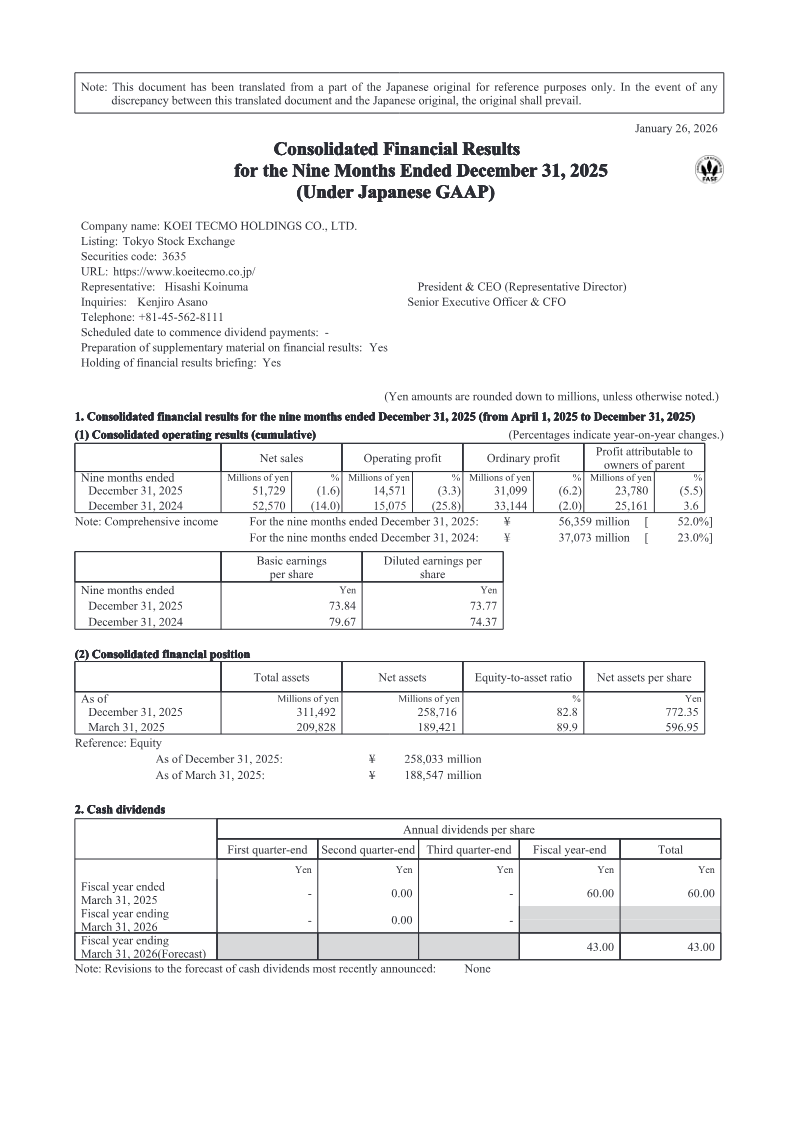
Koei Tecmo Holdings Co., Ltd. reports its consolidated financial results for the nine-month period ending December 31, 2025, reflecting a period of slight contraction in sales and profitability compared to the previous year. Net sales reached ¥51,729 million, a 1.6% decrease year-on-year, while operating profit fell 3.3% to ¥14,571 million. Ordinary profit and profit attributable to owners of the parent also saw declines of 6.2% and 5.5% respectively, with the latter totaling ¥23,780 million. Despite these dips in earnings, comprehensive income rose significantly by 52.0% to ¥56,359 million, driven largely by a substantial increase in valuation differences on available-for-sale securities.
The company’s financial position strengthened considerably during this period, with total assets increasing from ¥209,828 million at the end of March 2025 to ¥311,492 million by December 31, 2025. This growth was supported by a rise in cash and deposits to ¥51,319 million and a significant expansion in investment securities, which reached ¥127,532 million. Net assets grew to ¥258,716 million, although the equity-to-asset ratio moderated from 89.9% to 82.8%. A notable corporate action during the period included the disposal of over 18 million treasury shares through public and secondary offerings in September 2025, which contributed to the shift in shareholders' equity.
Looking ahead to the full fiscal year ending March 31, 2026, the forecast anticipates net sales of ¥92,000 million, representing a 10.6% increase over the previous year. However, profitability is expected to remain under pressure, with projected declines in operating profit (down 3.5%), ordinary profit (down 26.0%), and net profit (down 28.2%). The company maintains a dividend forecast of ¥43.00 per share for the fiscal year-end. These results and projections, prepared under Japanese GAAP, cover the company’s global operations across its various entertainment and investment segments.
- Koei Tecmo reported a contraction in core performance for the nine months ending December 31, 2025, with net sales falling 1.6% to ¥51,729 million and operating profit declining 3.3% to ¥14,571 million.
- Despite lower operating earnings, comprehensive income surged 52.0% to ¥56,359 million, primarily fueled by valuation gains on available-for-sale securities.
- The company’s total assets grew significantly to ¥311,492 million by December 31, 2025, driven by an expansion in investment securities to ¥127,532 million.
- Full-year forecasts for March 31, 2026, project a 10.6% increase in net sales to ¥92,000 million, yet profitability is expected to decline, with net profit projected to drop by 28.2%.
- In September 2025, the company executed a major capital action by disposing of over 18 million treasury shares through public and secondary offerings.
Koei TecmoDec 2025
Financial6 pages
Consolidated Financial Results for the First Six Months of the Fiscal Year Ending March 31, 2025
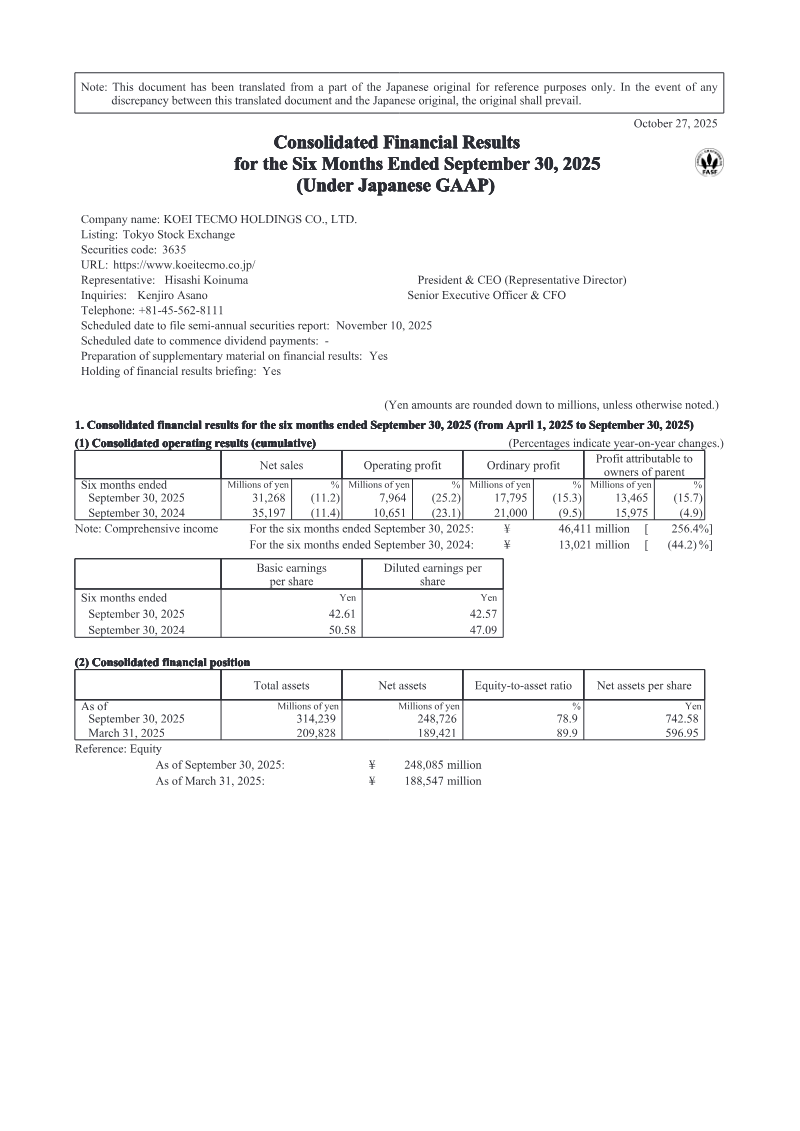
Koei Tecmo Holdings Co., Ltd. reported its consolidated financial results for the first six months of fiscal year 2025, covering the period from April 1, 2025, to September 30, 2025. Prepared under Japanese GAAP, the data reveals a year-on-year decline across primary profitability metrics. Net sales fell 11.2% to ¥31.27 billion, while operating profit decreased 25.2% to ¥7.96 billion. Ordinary profit and profit attributable to owners of the parent also saw double-digit declines of 15.3% and 15.7%, respectively. Despite these drops in operational earnings, comprehensive income surged by 256.4% to ¥46.41 billion, primarily driven by a significant ¥32.4 billion valuation difference on available-for-sale securities.
The consolidated balance sheet shows a substantial increase in total assets, rising from ¥209.8 billion at the end of March 2025 to ¥314.2 billion by September 30, 2025. This growth is largely attributed to a rise in investment securities and cash holdings. On the liabilities side, the company recorded ¥35 billion in short-term borrowings. Shareholders' equity improved to ¥214.9 billion, supported by the disposal of treasury shares through a public offering in September 2025, which reduced treasury share holdings from ¥37.7 billion to ¥3.7 billion.
Looking ahead to the full fiscal year ending March 31, 2026, the company maintained its previous forecasts. It expects net sales to reach ¥92 billion, representing a 10.6% increase over the prior year, though it anticipates year-on-year declines in operating profit (down 3.5% to ¥31 billion) and ordinary profit (down 26% to ¥37 billion). The projected annual dividend is set at ¥43 per share. These forecasts account for the increased number of outstanding shares following the recent public and secondary offerings.
- Koei Tecmo reported a double-digit decline in core profitability for the first half of fiscal year 2025, with net sales falling 11.2% to ¥31.27 billion and operating profit dropping 25.2% to ¥7.96 billion.
- Comprehensive income surged 256.4% to ¥46.41 billion, driven primarily by a ¥32.4 billion valuation gain on available-for-sale securities.
- Total assets grew significantly from ¥209.8 billion in March 2025 to ¥314.2 billion by September 30, 2025, bolstered by increased cash holdings and investment securities.
- The company strengthened shareholders' equity to ¥214.9 billion by executing a public offering in September 2025 that reduced treasury share holdings from ¥37.7 billion to ¥3.7 billion.
- Full-year forecasts for fiscal year 2026 remain unchanged, projecting a 10.6% increase in net sales to ¥92 billion alongside a 26% decline in ordinary profit to ¥37 billion.
Koei TecmoOct 2025
Financial8 pages
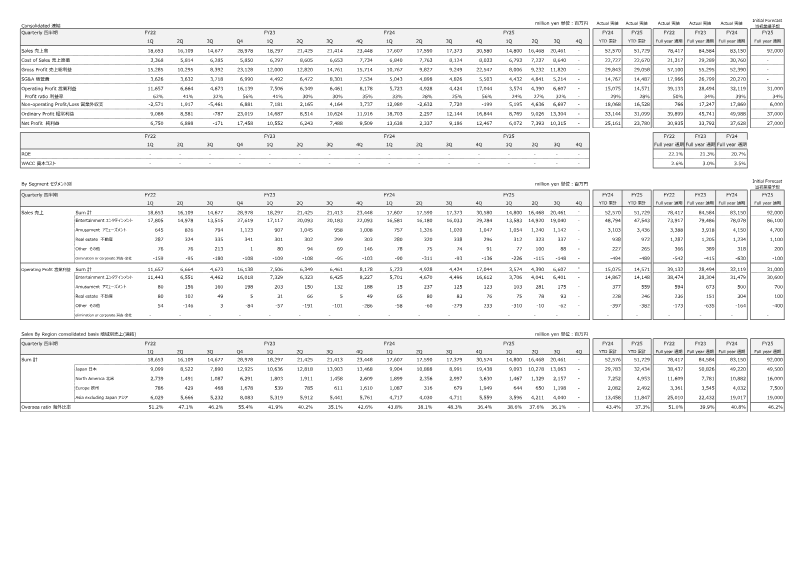
Consolidated Quarterly Data Appendix: FY2025 3rd Quarter
Koei Tecmo’s financial performance through the third quarter of fiscal year 2025 demonstrates robust growth driven by a strong international presence and the steady expansion of its core intellectual properties. Consolidated sales reached 51,729 million yen year-to-date, supported by a healthy 32% profit ratio in the third quarter. The Entertainment segment remains the primary engine of this success, contributing 47.5 billion yen to total revenue. This performance is increasingly global in scope, with overseas sales accounting for 36.1% of total revenue and a significant 75.9% of total game units sold. Digital transformation remains a key trend for the firm, as evidenced by a 68% digital download rate across 6.06 million units sold during the period.
The company’s long-term stability is anchored by its flagship franchises, with Dynasty Warriors and Nobunaga’s Ambition reaching lifetime milestones of 24 million and 11 million units, respectively. While the Online and Mobile sector slightly edges out Console and PC sales in terms of year-to-date revenue, both segments remain vital to the corporate strategy. To support this continued growth, the organization has expanded its consolidated headcount to 2,849 employees, positioning itself to meet a full-year sales forecast of 92,000 million yen.
Future growth is predicated on an aggressive multi-platform release schedule extending into 2026. Strategic focus is shifting toward next-generation hardware, with several high-profile titles slated for the Nintendo Switch 2, including Hyrule Warriors: Age of Imprisonment and Pokémon Pokopia. The pipeline also features major sequels to established action franchises, such as Ninja Gaiden 4 and Nioh 3, alongside continued investment in the mobile market through both in-house development and licensed IP for the Chinese market. This diversified approach across hardware cycles and geographic regions underscores a commitment to maintaining high profitability through a mix of legacy brand management and new platform adoption.
- Koei Tecmo achieved 51,729 million yen in year-to-date sales through Q3 FY2025, with the Entertainment segment contributing 47.5 billion yen and a 32% profit ratio in the third quarter.
- The company is heavily reliant on international markets, which now account for 36.1% of total revenue and 75.9% of total game units sold.
- Digital transformation is accelerating, with a 68% digital download rate across 6.06 million units sold during the period.
- The firm maintains a full-year sales forecast of 92,000 million yen, supported by a workforce that has expanded to 2,849 employees.
- Flagship franchises continue to drive long-term value, with Dynasty Warriors reaching 24 million lifetime units and Nobunaga’s Ambition reaching 11 million.
+1
Koei TecmoOct 2025
Financial14 pages
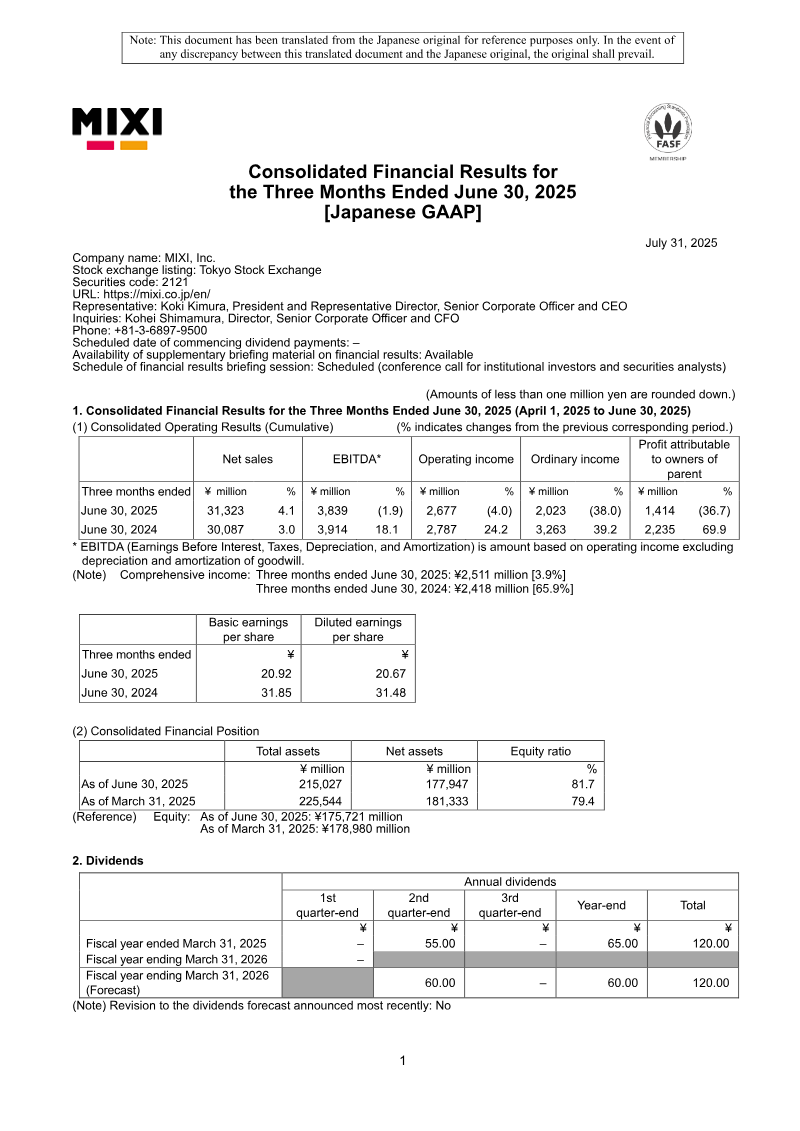
Consolidated Financial Results for the Three Months Ended June 30, 2025
MIXI, Inc. reports consolidated financial results for the first quarter of the fiscal year ending March 31, 2026, covering the period from April 1, 2025, to June 30, 2025. The data reflects a period of strategic transition where growth in sports and lifestyle services offset declines in the company’s core digital entertainment segment. Net sales rose 4.1% year-over-year to ¥31,323 million, though operating income fell 4.0% to ¥2,677 million. Ordinary income and profit attributable to owners saw more significant declines of 38.0% and 36.7% respectively, impacted by non-operating expenses and a decrease in share of profit from entities accounted for using the equity method.
The Digital Entertainment Business, primarily driven by the mobile game Monster Strike, remains the largest revenue contributor but saw an 11.4% decline in sales to ¥16,076 million due to lower monthly active users. Conversely, the Sports Business experienced a 29.8% surge in revenue to ¥11,143 million, turning a previous segment loss into a ¥604 million profit. This growth was fueled by increased online car ticket sales via the TIPSTAR betting service and expanded ticket and sponsorship revenue for the Chiba Jets following the opening of the LaLa arena TOKYO-BAY. The Lifestyle Business also showed improvement, with revenue increasing 28.1% to ¥3,505 million as the FamilyAlbum app successfully monetized premium features and expanded its overseas user base.
The company maintains a strong financial position with an equity ratio of 81.7%, despite a decrease in cash and cash equivalents to ¥86,444 million. This liquidity decline was largely driven by ¥13,892 million used in operating activities, including significant advance payments to suppliers and income tax payments. Looking forward, the full-year forecast remains unchanged, projecting net sales of ¥155,000 million. While the company anticipates a year-over-year decline in annual profits, it plans to maintain a stable dividend policy of ¥120 per share.
- MIXI, Inc. reported Q1 FY2026 net sales of ¥31,323 million, a 4.1% year-over-year increase, while operating income declined 4.0% to ¥2,677 million.
- The core Digital Entertainment segment, led by Monster Strike, saw an 11.4% revenue decline to ¥16,076 million due to a reduction in monthly active users.
- The Sports Business segment grew 29.8% to ¥11,143 million, swinging to a ¥604 million profit driven by TIPSTAR betting volume and revenue from the Chiba Jets' new LaLa arena TOKYO-BAY.
- The Lifestyle Business segment revenue rose 28.1% to ¥3,505 million, supported by the successful monetization of premium features and international expansion of the FamilyAlbum app.
- Net profit attributable to owners fell 36.7% year-over-year, impacted by non-operating expenses and reduced equity-method investment gains.
MIXI, Inc.Jul 2025