Koei Tecmo
Game Co.173 documents
Japanese developer/publisher. Dynasty Warriors, Nioh, Dead or Alive, Atelier, Romance of the Three Kingdoms.
Documents
Financial12 pages
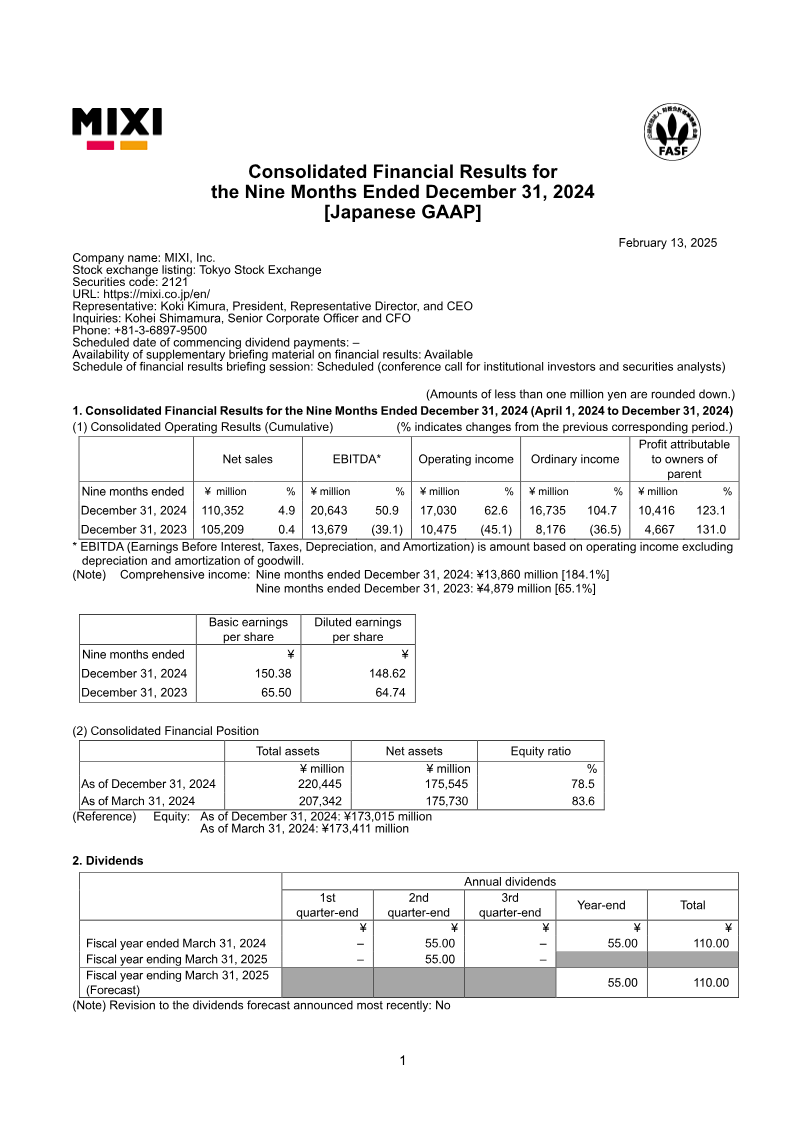
Consolidated Financial Results for the Nine Months Ended December 31, 2024
MIXI, Inc. reported strong financial growth for the first nine months of the fiscal year ending March 31, 2025, characterized by significant increases in profitability despite moderate revenue growth. Net sales reached ¥110,352 million, a 4.9% increase over the previous year, while operating income surged 62.6% to ¥17,030 million. Profit attributable to owners of the parent rose by 123.1% to ¥10,416 million. This performance was driven by a substantial reduction in selling, general, and administrative expenses and improved margins across several business segments.
The Digital Entertainment Business remains the primary revenue driver, largely supported by the mobile game Monster Strike, contributing ¥65,455 million in sales and ¥28,479 million in segment profit. The Sports Business showed a notable turnaround, moving from a loss in the previous period to a profit of ¥1,113 million on sales of ¥28,394 million. The Investment Business also saw a dramatic increase in revenue, rising from ¥1,117 million to ¥5,052 million, while the Lifestyle Business maintained steady growth.
Geographically focused on the Japanese market, the results cover the period from April 1, 2024, to December 31, 2024. The financial position remains stable with an equity ratio of 78.5% and total assets of ¥220,445 million. However, the period was impacted by an internal investigation into improper transactions at the subsidiary Chariloto Co., Ltd., involving ¥1,026 million in unauthorized dealings. This resulted in a net loss of ¥552 million attributable to the parent company after tax adjustments.
Based on these nine-month results, the full-year forecast has been revised upward. The company now expects annual net sales of ¥153,000 million and a profit attributable to owners of the parent of ¥17,500 million, representing a 147.1% increase over the prior fiscal year. Dividends are projected to remain steady at ¥110 per share for the full year.
- MIXI, Inc. reported a 62.6% surge in operating income to ¥17,030 million and a 123.1% increase in profit attributable to owners of the parent to ¥10,416 million for the nine months ended December 31, 2024.
- The company revised its full-year profit forecast upward to ¥17,500 million, representing a 147.1% increase over the previous fiscal year, while maintaining a steady dividend of ¥110 per share.
- The Digital Entertainment Business remains the core revenue driver, generating ¥65,455 million in sales and ¥28,479 million in segment profit, primarily supported by the mobile game Monster Strike.
- The Sports Business achieved a financial turnaround, moving from a loss in the prior period to a segment profit of ¥1,113 million on ¥28,394 million in sales.
- An internal investigation into unauthorized transactions at subsidiary Chariloto Co., Ltd. involving ¥1,026 million resulted in a net loss of ¥552 million for the parent company.
MIXI, Inc.Feb 2025
Financial6 pages
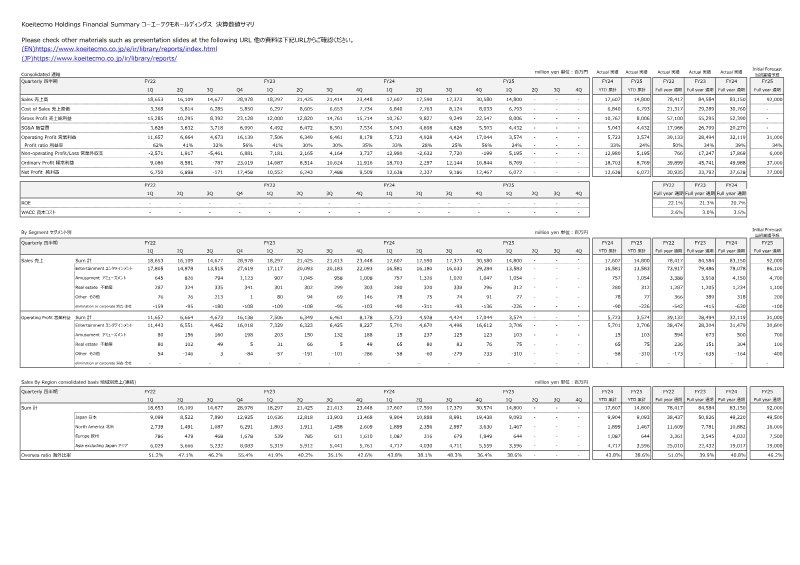
Consolidated Financial Results Data Appendix: FY2025 1st Quarter
This financial data appendix details the consolidated results for the first quarter of fiscal year 2025, ending June 30, 2024. The data covers the company’s global operations across Japan, North America, Europe, and Asia, focusing primarily on its Entertainment, Amusement, and Real Estate business segments. The figures provide a year-over-year comparison against FY2024 and historical performance dating back to FY2022.
For the first quarter of FY2025, sales reached 14.8 billion yen, a decrease from the 17.6 billion yen reported in the same period the previous year. Operating profit for the quarter stood at 3.57 billion yen with a 24% profit ratio, while ordinary profit reached 8.77 billion yen, bolstered by 5.19 billion yen in non-operating income. Despite the quarterly dip, the full-year forecast remains ambitious, targeting 92 billion yen in sales and 31 billion yen in operating profit. The Entertainment segment remains the primary driver of revenue, contributing 13.58 billion yen to the quarterly total.
Geographic data indicates that Japan remains the largest market, accounting for 9.09 billion yen of quarterly sales, followed by Asia and North America. The overseas sales ratio for the quarter was 38.6%, with total software sales units reaching 1.56 million copies. Notably, the digital sales ratio rose significantly to 88.5% for the quarter, up from 75.2% in the prior year’s first quarter.
The data also tracks the performance of major intellectual properties. The Dynasty Warriors series leads cumulative lifetime sales at over 23 million units, followed by Nobunaga’s Ambition at over 10 million units. In the mobile sector, long-term operational titles such as Romance of the Three Kingdoms: Hadou and Dead or Alive Xtreme Venus Vacation continue to support the portfolio. Personnel costs have trended upward, with total headcount reaching 2,873 employees by the end of the first quarter.
- Q1 FY2025 sales reached 14.8 billion yen, down from 17.6 billion yen in the same period last year, though the company maintains a full-year target of 92 billion yen in sales and 31 billion yen in operating profit.
- Digital sales penetration grew significantly to 88.5% of total revenue, up from 75.2% in Q1 FY2024.
- The Entertainment segment remains the core business driver, contributing 13.58 billion yen to the quarterly total of 14.8 billion yen.
- Japan is the primary market with 9.09 billion yen in sales, while the overall overseas sales ratio for the quarter stands at 38.6%.
- Operating profit for the quarter was 3.57 billion yen, while ordinary profit reached 8.77 billion yen, supported by 5.19 billion yen in non-operating income.
Koei TecmoJan 2025

Financial18 pages
Financial Results for the First Quarter of the Fiscal Year Ending March 2026
Koei Tecmo’s financial performance for the first quarter of the fiscal year ending March 2026 reflects a transitional period characterized by a temporary decline in revenue and profit. Net sales fell 15.9% year-on-year to ¥14.8 billion, while operating profit decreased 37.6% to ¥3.57 billion. This downturn is attributed to a lack of major new software releases and a contraction in mobile and online revenue. Despite these immediate headwinds, operating profit exceeded internal expectations, and the full-year sales forecast remains steady at ¥92 billion. Management anticipates a significant recovery in the second half of the fiscal year, supported by a robust pipeline of high-profile titles including Dynasty Warriors: Origins and upcoming entries in the Nioh and Ninja Gaiden franchises.
The strategic focus under the current Medium-Term Management Plan emphasizes aggressive investment in human capital and infrastructure to ensure long-term growth. This includes a planned 10% annual increase in labor costs and a ¥25 billion office acquisition. Financial stability is maintained through a conservative accounting approach where development costs are recognized as incurred, mitigating future impairment risks. Simultaneously, the company is working to meet Tokyo Stock Exchange Prime Market listing criteria by increasing its tradable share ratio to 35% by March 2026, while maintaining a shareholder return policy of a 50% total allocation ratio.
Geographically, the growth strategy bifurcates by platform and region, prioritizing console and PC expansion in North American and European markets while focusing on mobile dominance in Japan and China. Emerging markets in India and Southeast Asia are also being targeted for research and development through the company’s Singapore operations. With the Nioh series already surpassing 8 million units sold, the upcoming release of Nioh 3 in early 2026 serves as a cornerstone for the company’s global software strategy. By balancing major intellectual properties with low-risk titles, the organization aims to stabilize profitability across diverse global segments.
- Koei Tecmo reported a Q1 fiscal year 2026 revenue decline of 15.9% to ¥14.8 billion and a 37.6% drop in operating profit to ¥3.57 billion, primarily due to a lack of major software releases.
- Management maintains a full-year sales forecast of ¥92 billion, anticipating a second-half recovery driven by the release of 'Dynasty Warriors: Origins' and a new entry in the 'Nioh' franchise.
- The company is aggressively investing in long-term growth through a 10% annual increase in labor costs and a ¥25 billion office acquisition, while maintaining a 50% total shareholder return allocation ratio.
- To meet Tokyo Stock Exchange Prime Market listing criteria, the company plans to increase its tradable share ratio to 35% by March 2026.
- The 'Nioh' series has surpassed 8 million units sold, with 'Nioh 3' scheduled for release in early 2026 as a cornerstone of the company’s global software strategy.
Koei TecmoJan 2025
Financial8 pages
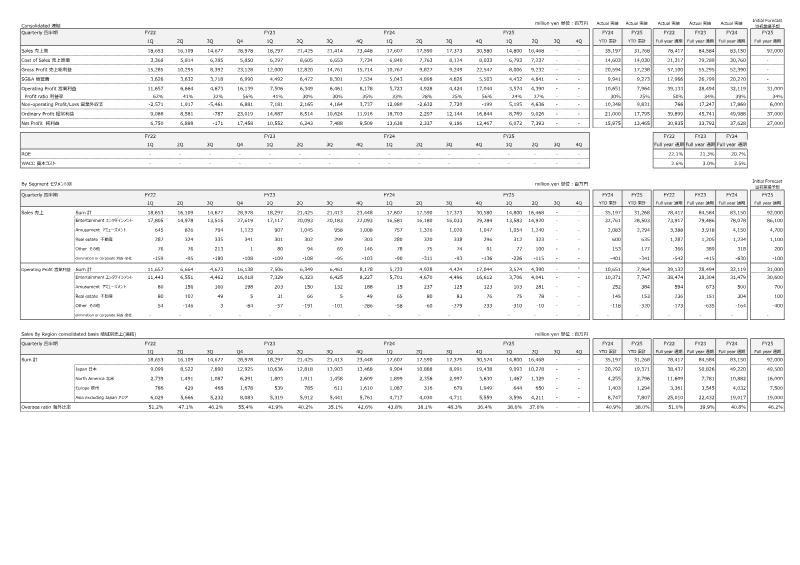
Consolidated Financial Results Data Appendix: FY2025 Q2
Koei Tecmo’s financial performance for the second quarter of fiscal year 2025 reflects a transitional period characterized by a year-to-date decline in consolidated sales to 31,268 million yen and an operating profit of 7,964 million yen. Despite this temporary downturn compared to the previous fiscal year, the organization maintains an optimistic full-year sales forecast of 92,000 million yen. This projected growth is predicated on a recovery in North American and European markets and the continued strength of the Entertainment segment. Operational costs have risen alongside a growing workforce, with headcount reaching 2,871 employees and employment expenses totaling 13,080 million yen.
The strategic focus has shifted heavily toward digital and international markets, with digital sales now accounting for 83.1% of total revenue and overseas markets representing 72.1% of unit sales. The long-term growth strategy is supported by a robust pipeline of high-profile intellectual properties scheduled for late 2025 and early 2026. These upcoming releases include major sequels such as Ninja Gaiden 4 and Nioh 3, alongside several titles specifically optimized for the successor to the Nintendo Switch.
The enduring value of established franchises remains a cornerstone of the business model. The Dynasty Warriors series continues to lead the portfolio with over 24 million lifetime units, followed by Nobunaga’s Ambition at 11 million and Romance of the Three Kingdoms at 9.5 million. Newer successes like Nioh and Atelier have each surpassed 8 million units, while Wo Long: Fallen Dynasty has secured over 5 million users. This console and PC success is complemented by a resilient online and mobile segment, where titles such as Dead or Alive Xtreme Venus Vacation have demonstrated significant longevity through more than seven years of continuous service.
- Koei Tecmo reported a year-to-date decline in Q2 FY2025 with consolidated sales of 31,268 million yen and an operating profit of 7,964 million yen.
- The company maintains a full-year sales forecast of 92,000 million yen, driven by anticipated recovery in North American and European markets and the Entertainment segment.
- Digital sales now constitute 83.1% of total revenue, while overseas markets account for 72.1% of unit sales.
- The future release pipeline includes major sequels such as Ninja Gaiden 4 and Nioh 3, with several titles currently in development for the successor to the Nintendo Switch.
- Operational costs have increased due to a workforce expansion to 2,871 employees, resulting in 13,080 million yen in employment expenses.
+1
Koei TecmoJan 2025

Financial47 pages
Financial Results for the First Quarter of the Fiscal Year Ending March 2025
Koei Tecmo experienced a transitional first quarter for the fiscal year ending March 2025, characterized by a 15.9% year-on-year decline in sales to 14.8 billion yen and a 55.5% drop in net profit. This downturn stems primarily from a lack of major new releases and a contraction in the online and mobile sectors. Despite this initial volatility, the company maintains its full-year sales forecast of 92 billion yen, representing a projected 10.6% annual increase. This optimism is anchored in a release schedule heavily weighted toward the second half of the fiscal year, featuring major titles such as Dynasty Warriors: Origins and upcoming projects for next-generation hardware.
The current fiscal year marks the commencement of the Fourth Medium-Term Management Plan, which seeks to position the firm among the world’s top ten digital entertainment companies. Strategic priorities focus on achieving a cumulative operating profit exceeding 100 billion yen over three years while maintaining an operating profit margin of at least 30%. To support these goals, the company is aggressively expanding its global publishing infrastructure and targeting growth in North America, Europe, China, and emerging markets like the Middle East. The development strategy emphasizes a multi-platform approach, utilizing the proprietary Katana Engine alongside Unreal Engine to elevate titles to AAA quality standards.
Long-term stability is being pursued through significant investments in human capital and governance. The company plans to allocate over 100 billion yen toward personnel and infrastructure, including a 10% annual increase in personnel costs to attract and retain talent. Governance reforms are also underway to meet Tokyo Stock Exchange requirements, including a transition to a board composed of over 50% external directors. Furthermore, a commitment to shareholder returns remains central to the financial strategy, with a target consolidated payout ratio of 50% and a minimum annual dividend of 50 yen, balancing aggressive global expansion with consistent investor value.
- Koei Tecmo reported a 15.9% year-on-year decline in Q1 sales to 14.8 billion yen and a 55.5% drop in net profit, primarily due to a lack of major releases.
- The company maintains its full-year sales forecast of 92 billion yen, anticipating a 10.6% annual increase driven by a second-half release schedule that includes 'Dynasty Warriors: Origins'.
- Under the new Fourth Medium-Term Management Plan, the firm aims to become a top-ten global digital entertainment company with a cumulative operating profit exceeding 100 billion yen over three years and a minimum 30% operating profit margin.
- Koei Tecmo is investing over 100 billion yen in human capital and infrastructure, including a 10% annual increase in personnel costs to support global expansion and AAA development.
- The company is shifting toward a multi-platform development strategy using the proprietary Katana Engine and Unreal Engine to target growth in North America, Europe, China, and the Middle East.
+1
Koei TecmoJan 2025

Financial20 pages
Financial Results for the First Half of the Fiscal Year Ending March 2026
Koei Tecmo experienced a year-on-year decline in financial performance during the first half of the fiscal year ending March 2026, with sales dropping 11.2% and operating profit falling 25.2%. This downturn resulted primarily from a sparse release schedule and lower revenue within the online and mobile segments. However, the company outperformed its internal forecasts due to resilient back-catalog sales and disciplined expense management. Full-year guidance remains unchanged as management anticipates a significant recovery in the second half, driven by a concentrated launch window for major titles such as Dynasty Warriors: Origins.
The strategic focus for the remainder of the fiscal year involves a robust pipeline of eleven console and PC titles alongside two mobile releases. By prioritizing high-profile remakes like Romance of the Three Kingdoms 8 and Fatal Frame II, the company seeks to secure stable profit margins while transitioning toward a global, digital-first marketing infrastructure. This shift includes a move toward in-house publishing for large-scale projects and a concerted effort to expand market share in North America, Europe, and emerging regions such as the Middle East and North Africa.
Long-term objectives are anchored by the Fourth Medium-Term Management Plan, which targets a cumulative three-year operating income of 100 billion yen. To achieve this, the company is balancing the maintenance of established franchises with the development of new intellectual properties and cross-media expansions into anime and merchandise. Furthermore, corporate governance milestones were met through a treasury share offering that increased the tradable share ratio to 37.3%, ensuring continued compliance with Tokyo Stock Exchange Prime Market listing criteria.
- Koei Tecmo reported a year-on-year decline for the first half of the fiscal year ending March 2026, with sales down 11.2% and operating profit down 25.2% due to a sparse release schedule.
- Management maintained full-year guidance, anticipating a second-half recovery driven by a concentrated launch window that includes the release of Dynasty Warriors: Origins.
- The company plans to release eleven console and PC titles and two mobile games in the second half of the fiscal year, prioritizing high-profile remakes like Romance of the Three Kingdoms 8 and Fatal Frame II.
- Strategic growth initiatives include transitioning to in-house publishing for large-scale projects and expanding market presence in North America, Europe, and the Middle East and North Africa.
- The company is pursuing a three-year cumulative operating income target of 100 billion yen as part of its Fourth Medium-Term Management Plan.
+1
Koei TecmoJan 2025
Financial6 pages
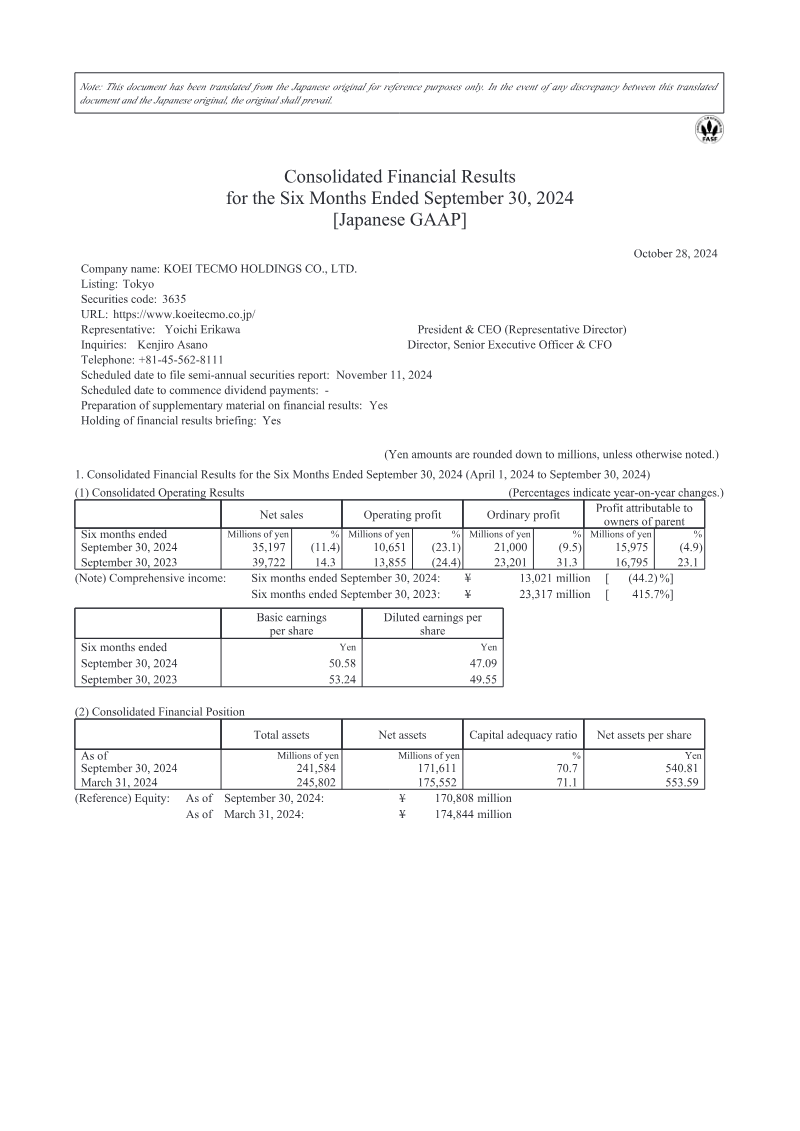
Consolidated Financial Results for the Six Months Ended September 30, 2024
Koei Tecmo Holdings Co., Ltd. reported its consolidated financial results for the first half of the fiscal year ending March 31, 2025, covering the period from April 1, 2024, to September 30, 2024. The data reflects a period of contraction across several key performance indicators compared to the previous year. Net sales decreased by 11.4% to ¥35.19 billion, while operating profit saw a significant decline of 23.1%, falling to ¥10.65 billion. Profit attributable to owners of the parent also decreased by 4.9% to ¥15.97 billion.
The financial position remains stable with total assets valued at ¥241.58 billion and a capital adequacy ratio of 70.7%. Despite the downturn in operating profit, ordinary profit was bolstered by substantial non-operating income, including ¥9.94 billion in interest income and ¥3.27 billion in gains on the redemption of securities. However, comprehensive income fell sharply by 44.2% to ¥13.02 billion, primarily driven by a ¥2.68 billion loss in the valuation difference on available-for-sale securities.
Looking ahead to the full fiscal year ending March 31, 2025, the company maintains a forecast of ¥90 billion in net sales and ¥30 billion in operating profit, representing modest year-on-year growth of 6.4% and 5.3%, respectively. Conversely, ordinary profit and net profit are expected to decline by double digits for the full year. The company plans an annual dividend of ¥48.00 per share. These results were prepared under Japanese GAAP and represent the consolidated performance of the Japanese-based gaming and entertainment entity.
- Koei Tecmo Holdings reported a contraction in the first half of the fiscal year ending March 31, 2025, with net sales falling 11.4% to ¥35.19 billion and operating profit dropping 23.1% to ¥10.65 billion.
- Profit attributable to owners of the parent decreased by 4.9% to ¥15.97 billion, while comprehensive income saw a sharp 44.2% decline to ¥13.02 billion due to valuation losses on securities.
- The company’s ordinary profit was supported by significant non-operating income, including ¥9.94 billion in interest income and ¥3.27 billion in gains from the redemption of securities.
- Despite the weak first-half performance, management maintains a full-year forecast of ¥90 billion in net sales and ¥30 billion in operating profit, representing modest growth of 6.4% and 5.3% respectively.
- Full-year projections indicate a double-digit decline for both ordinary profit and net profit compared to the previous fiscal year.
Koei TecmoOct 2024

Financial51 pages
Financial Results for the First Half of the Fiscal Year Ending March 2025
Koei Tecmo experienced a transitional first half for the fiscal year ending March 2025, characterized by an 11.4% decline in sales to 35,197 million yen and a 23.1% drop in operating profit. This downturn resulted from a sparse release schedule compared to the previous year, though the impact was mitigated by robust back-catalog performance and disciplined cost management regarding advertising and outsourcing. Despite these short-term headwinds, the organization exceeded initial profit forecasts and remains on track to meet full-year targets, anticipating a significant recovery driven by a dense schedule of major releases in the second half of the fiscal year.
The long-term strategic objective is to secure a position among the top ten global gaming companies by maintaining a 30% operating profit margin and achieving an operating income target of 40 billion yen. This growth plan centers on the development of AAA-class titles, with a specific focus on establishing new intellectual properties capable of selling five million units. To facilitate this, a dedicated AAA Studio has been established alongside seven distinct development departments. These teams utilize the proprietary Katana Engine to enhance graphical fidelity and production efficiency through integrated AI and automation, ensuring a steady pipeline of self-published hits across console, PC, and mobile platforms.
Global expansion remains a primary focus, with strengthened publishing infrastructures in North America, Europe, and China, alongside targeted entry into emerging markets in Southeast Asia and India. While domestic Japanese revenue is expected to soften, international growth is projected to drive a 6.4% increase in annual sales to 90 billion yen. To sustain this momentum, the organization is aggressively investing in human capital, planning to hire over 200 employees in the current fiscal year while implementing industry-leading salary increases and expanding corporate infrastructure. This multi-layered revenue strategy balances high-margin IP licensing with large-scale global development to ensure long-term financial stability and shareholder returns.
- Koei Tecmo reported an 11.4% decline in sales to 35,197 million yen and a 23.1% drop in operating profit for the first half of the fiscal year ending March 2025 due to a sparse release schedule.
- Despite the first-half downturn, the company remains on track to meet its full-year target of 90 billion yen in sales, representing a 6.4% annual increase driven by a dense second-half release schedule.
- The company’s long-term financial goals include achieving a 40 billion yen operating income and maintaining a 30% operating profit margin to secure a position among the top ten global gaming companies.
- Strategic growth is centered on developing new AAA intellectual properties with five-million-unit sales targets, supported by a newly established AAA Studio and the proprietary Katana Engine for AI-integrated production.
- To support global expansion and development, the company is aggressively scaling its workforce by hiring over 200 employees this fiscal year while implementing industry-leading salary increases.
Koei TecmoOct 2024
Financial7 pages
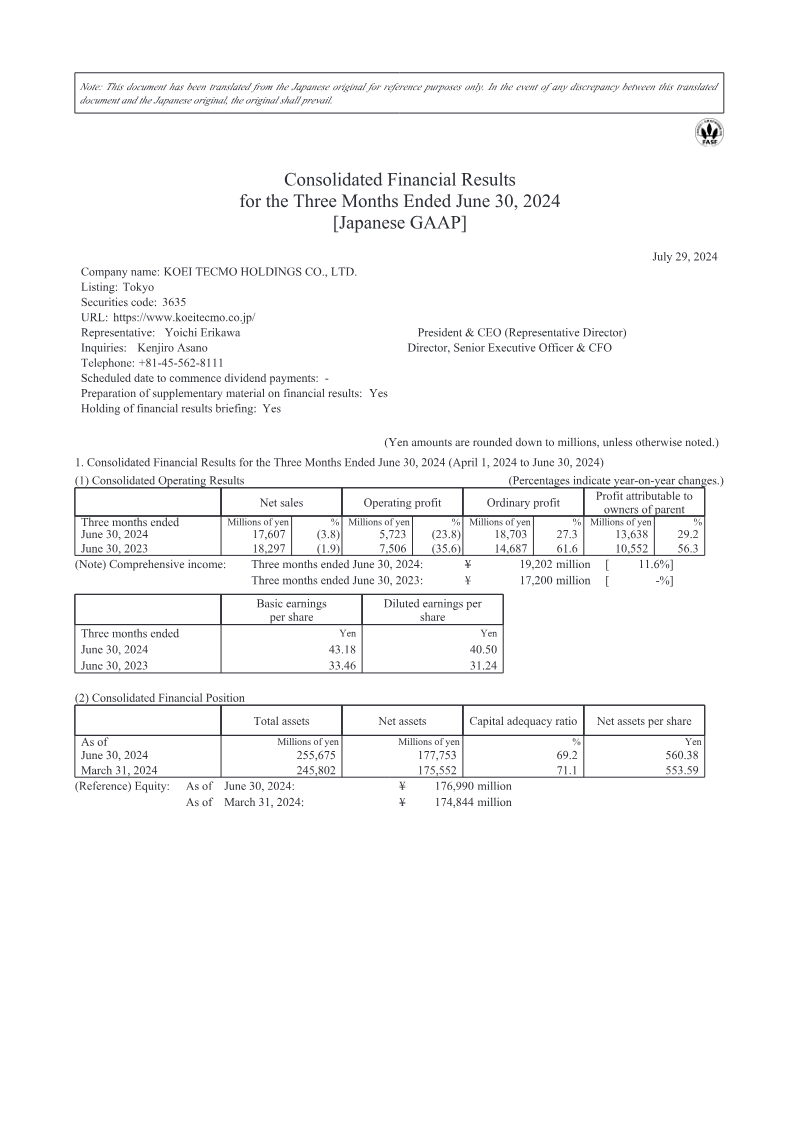
Consolidated Financial Results for the Three Months Ended June 30, 2024
This financial report details the consolidated results for Koei Tecmo Holdings Co., Ltd. for the first quarter of the fiscal year ending March 31, 2025, covering the period from April 1 to June 30, 2024. The primary purpose of the document is to provide shareholders and the public with an update on the company’s financial health and progress toward its Third Medium-Term Management Plan, which focuses on the management policy of creating and developing global intellectual property.
Financial performance for the quarter was mixed. Net sales reached 17.6 billion yen, a 3.8% decrease year-on-year, while operating profit fell 23.8% to 5.7 billion yen. This decline was attributed to a lack of new mobile title launches compared to the previous year and increased costs associated with in-house mobile operations. Conversely, ordinary profit rose 27.3% to 18.7 billion yen, and profit attributable to owners of the parent increased 29.2% to 13.6 billion yen, both reaching record highs for a first quarter. These gains were significantly bolstered by non-operating income, including 5.8 billion yen from the valuation of derivatives and 4.9 billion yen in interest income.
The entertainment segment remains the company's core driver, contributing 16.5 billion yen in sales. Key activities included repeat sales of Rise of the Ronin and the continued performance of mobile titles like Nobunaga’s Ambition: Hadou and the licensed Three Kingdoms Tactics, which surpassed 100 million global downloads. Looking ahead, the company is focusing on its "AAA Studio" to ensure a continuous pipeline of large-scale titles, such as the upcoming Dynasty Warriors: Origins. For the full fiscal year, the company forecasts net sales of 90 billion yen and a profit of 30 billion yen, maintaining a neutral but growth-oriented outlook despite short-term fluctuations in operating income.
- Koei Tecmo achieved record-high first-quarter profits, with ordinary profit rising 27.3% to 18.7 billion yen and profit attributable to owners of the parent increasing 29.2% to 13.6 billion yen.
- Operating profit declined 23.8% to 5.7 billion yen, driven by a lack of new mobile title launches and higher operational costs compared to the previous year.
- Net sales for the quarter fell 3.8% year-on-year to 17.6 billion yen, with the entertainment segment accounting for 16.5 billion yen of that total.
- Bottom-line growth was significantly bolstered by 10.7 billion yen in non-operating income, specifically 5.8 billion yen from derivative valuations and 4.9 billion yen in interest income.
- Key revenue drivers included repeat sales of 'Rise of the Ronin' and the continued performance of 'Nobunaga’s Ambition: Hadou' and 'Three Kingdoms Tactics,' the latter of which surpassed 100 million global downloads.
Koei TecmoJul 2024

Financial39 pages
Financial Results for the Fiscal Year Ending March 2024
Koei Tecmo achieved record-high sales of 84.6 billion yen for the fiscal year ending March 2024, primarily driven by a 40.6% surge in the mobile and online sectors. While net profit rose by 9.2% due to record-level non-operating income and successful financial management, operating profit declined by 27.2% to 28.5 billion yen. This contraction reflects a strategic shift from high-margin royalty partnerships toward in-house publishing, which necessitated increased expenditures in advertising, outsourcing, and employment. The company expanded its workforce by hiring 158 new graduates and raising base pay, a trend set to continue as the firm scales its internal development capabilities.
The transition toward large-scale, global intellectual properties reached a milestone with the launch of Rise of the Ronin, the company’s first AAA open-world title. Although some console releases underperformed initial expectations, Rise of the Ronin surpassed the early sales pace of the Nioh series and received strong user feedback. To sustain this momentum, a dedicated AAA Studio has been established to develop major titles independently of traditional brand frameworks. This organizational change aims to professionalize AAA development management, ensuring stricter adherence to quality standards, delivery timelines, and budget constraints.
Looking toward the fiscal year ending March 2025, the strategy focuses on returning to an upward trend in operating profit through a balanced portfolio of console and mobile titles. Management is targeting 7.6 million unit sales and 30 billion yen in operating profit while integrating generative AI into production workflows to optimize costs. Furthermore, the company is prioritizing its transition to the Tokyo Stock Exchange Prime Market by improving its tradable share ratio. These financial and structural adjustments serve as the foundation for the upcoming 4th Mid-Term Management Plan, which seeks to establish the firm as a global leader in the gaming industry.
- Koei Tecmo achieved record-high annual sales of 84.6 billion yen, fueled by a 40.6% surge in the mobile and online sectors.
- Operating profit declined 27.2% to 28.5 billion yen as the company shifted from high-margin royalty partnerships toward cost-intensive in-house publishing.
- The company established a dedicated AAA Studio to centralize management and improve quality control, following the successful launch of its first open-world title, Rise of the Ronin.
- Net profit increased by 9.2% to record levels, supported by strong non-operating income and active financial management.
- For the fiscal year ending March 2025, the company targets 30 billion yen in operating profit and 7.6 million unit sales through a balanced portfolio and the integration of generative AI.
+2
Koei TecmoApr 2024
Financial10 pages
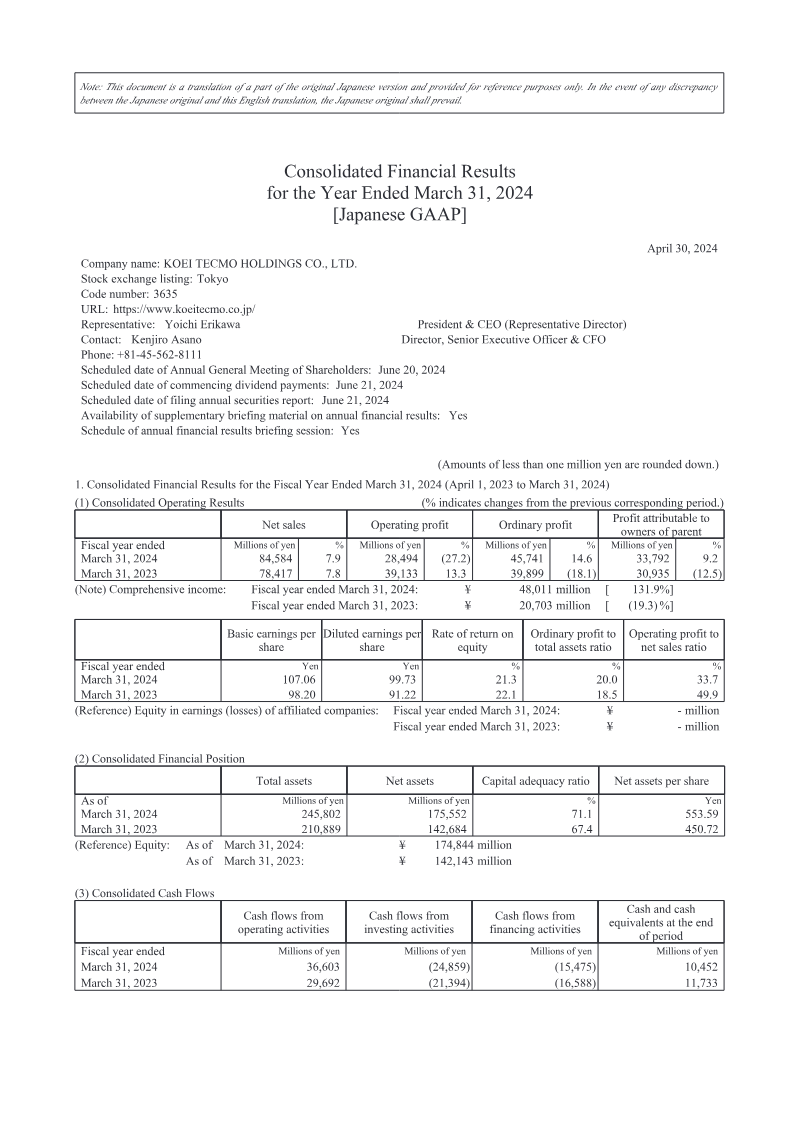
Consolidated Financial Results for the Year Ended March 31, 2024
Koei Tecmo Holdings achieved a 7.9% increase in net sales to ¥84.6 billion for the fiscal year ended March 31, 2024, reflecting a period of steady top-line growth. While profit attributable to owners rose 9.2% to ¥33.8 billion, the company experienced a notable 27.2% decline in operating profit, which fell to ¥28.5 billion. This contraction in operating margins was primarily driven by rising selling and administrative expenses. However, ordinary profit remained resilient, growing 14.6% to ¥45.7 billion due to substantial non-operating gains derived from investment securities and derivative valuations.
The financial position of the organization strengthened considerably throughout the year, with total assets expanding to ¥245.8 billion and net assets reaching ¥175.6 billion. Cash flow from operating activities remained robust at ¥36.6 billion, supported by efficient trade receivable collections and higher pre-tax profits. These inflows effectively balanced a ¥24.9 billion net outflow in investing activities, largely attributed to the strategic acquisition of investment securities. Despite distributing ¥15.7 billion in dividends, the company maintained a stable liquidity position with ¥10.5 billion in cash and cash equivalents at the close of the period.
Looking toward the fiscal year ending March 31, 2025, the outlook suggests continued revenue expansion alongside tightening profitability. Net sales are projected to grow by 6.4%, yet profit attributable to owners is expected to decline by 11.2%. This forecast indicates a transitionary phase where increased market activity and sales volume may be offset by shifting investment returns or continued pressure on operating costs. The overall trajectory emphasizes a shift toward leveraging a strong balance sheet and non-operating income to navigate fluctuations in core gaming profitability.
- Koei Tecmo Holdings reported a 7.9% increase in net sales to ¥84.6 billion for the fiscal year ended March 31, 2024, though operating profit fell 27.2% to ¥28.5 billion due to rising selling and administrative expenses.
- Profit attributable to owners rose 9.2% to ¥33.8 billion, while ordinary profit grew 14.6% to ¥45.7 billion, bolstered by significant non-operating gains from investment securities and derivative valuations.
- For the fiscal year ending March 31, 2025, the company projects a 6.4% increase in net sales but anticipates an 11.2% decline in profit attributable to owners.
- The company maintained a strong financial position with total assets reaching ¥245.8 billion and net assets totaling ¥175.6 billion by the end of the fiscal year.
- Operating cash flow remained robust at ¥36.6 billion, which supported a ¥24.9 billion investment in securities and the distribution of ¥15.7 billion in dividends.
+1
Koei TecmoApr 2024

Financial2 pages
Koei Tecmo Holdings Financial Summary: FY2024 Q3
This financial summary details the consolidated fiscal performance of Koei Tecmo Holdings for the third quarter of FY2024, ending December 31, 2023. The data reflects a period of stabilizing revenues compared to the previous fiscal year, with third-quarter sales reaching 17.37 billion yen. While operating profit for the quarter stood at 4.42 billion yen, the company experienced a significant boost in ordinary profit, which rose to 12.14 billion yen due to 7.72 billion yen in non-operating income. This follows a volatile second quarter where non-operating losses had previously impacted the bottom line.
The Entertainment segment remains the primary driver of the business, contributing 16.03 billion yen to quarterly sales. Within this segment, the balance between Console/PC and Online/Mobile remains significant; Console/PC sales reached 7.3 billion yen, while Online/Mobile—driven almost entirely by mobile titles—contributed 8.63 billion yen. Geographically, Japan continues to be the largest market, accounting for 8.99 billion yen in quarterly sales, followed by Asia (4.71 billion yen) and North America (2.99 billion yen).
Key operational metrics indicate a strong shift toward digital distribution, with the digital ratio for software sales reaching 72.9% in the third quarter. Total software sales units for the quarter were 1.68 million copies, contributing to a nine-month cumulative total of 4.34 million units. Despite a slight decrease in total headcount to 2,713 employees, employment costs have risen steadily, reflecting a broader industry trend of increasing fixed costs. The company maintains a full-year forecast of 90 billion yen in sales and 30 billion yen in operating profit, suggesting an expectation of a strong fourth-quarter performance to meet these annual targets.
- Koei Tecmo reported Q3 FY2024 sales of 17.37 billion yen and an operating profit of 4.42 billion yen, with an ordinary profit of 12.14 billion yen bolstered by 7.72 billion yen in non-operating income.
- The Entertainment segment remains the core revenue driver, generating 16.03 billion yen, with mobile titles outperforming Console/PC sales at 8.63 billion yen versus 7.3 billion yen.
- Digital distribution is a dominant sales channel, accounting for 72.9% of total software sales during the third quarter.
- Japan remains the company's primary market with 8.99 billion yen in quarterly sales, followed by Asia at 4.71 billion yen and North America at 2.99 billion yen.
- Cumulative software sales for the first nine months of the fiscal year reached 4.34 million units, with 1.68 million units sold in Q3 alone.
Koei TecmoMar 2024