GREE
Game Co.192 documents
Documents
Financial3 pages
FY2020 1Q Financial Results Presentation
The presentation reports fiscal year 2020 first‑quarter results for a Japanese entertainment company. Net sales reached 15.8 billion yen, operating income was 1.2 billion yen and EBITDA 1.3 billion yen, surpassing the mid‑to‑high hundred‑million yen forecast and maintaining a stable operating margin despite a quarter‑on‑quarter sales decline driven by post‑anniversary event effects and the transfer of some game titles to improve profitability. Cost controls, particularly a 1.5 billion yen reduction in advertising and outsourcing expenses, offset the sales drop and kept operating income flat. An extraordinary income from equity issuance related to a listing event contributed positively to net income.
Geographically, the company expanded its flagship title “DanMachi” into 27 European markets and continued global distribution in Japan, Asia, North America, and Europe. The live‑entertainment segment launched a reality virtual platform, hosting festivals and new program formats to broaden content offerings. The advertising and media arm focused on strengthening community engagement through targeted campaigns and anime tie‑ins, while the game development pipeline aimed to release two new titles in FY 2020 and plan four to six additional releases for FY 2021.
Methodologically, the figures derive from consolidated financial statements and internal cost‑tracking systems. The outlook for Q2 projects operating income around 0.5 billion yen, with increased advertising spend to activate promising titles and a continued decline in browser game revenue. The company’s investment securities, notably the Bushiroad listing, are expected to continue appreciating in value.
- The company achieved 15.8 billion yen in net sales and 1.2 billion yen in operating income for Q1 FY2020, exceeding initial mid-to-high hundred-million yen forecasts.
- Operating income remained flat despite a quarter-on-quarter sales decline, supported by a 1.5 billion yen reduction in advertising and outsourcing costs.
- The flagship title 'DanMachi' expanded into 27 European markets, contributing to a global distribution strategy spanning Japan, Asia, North America, and Europe.
- The company plans to release two new game titles in FY2020, with a further four to six titles scheduled for development in FY2021.
- Q2 FY2020 operating income is projected to reach 0.5 billion yen, reflecting planned increases in advertising spend and an anticipated decline in browser game revenue.
+5
GREE
Financial5 pages
FY2019 Fourth Quarter Financial Results Briefing
The briefing presents fiscal year 2019 results and outlines strategic priorities for FY20. Net sales reached ¥70.9 billion, operating income stood at ¥5.5 billion and EBITDA was ¥6.4 billion, with the fourth‑quarter figures of ¥17.4 billion in sales and ¥1.3 billion in operating income matching forecasts and remaining flat from the prior quarter. The company attributes performance to robust overseas distribution of existing titles, successful anniversary releases such as SINoALICE and Another Eden, and cost‑efficiency initiatives that lifted organic profit by ¥250 million.
Geographically, the firm expanded into key Asian markets—including Hong Kong, Taiwan, and China—while launching titles in North America and Europe. Distribution strategy emphasizes self‑distribution on platforms like Nintendo Switch, LINE, and Facebook Games to enhance profitability. The live entertainment pillar introduced the VTuber platform “REALITY,” adding avatar functions and official programs, while advertising and media efforts focused on vertical media expansion.
FY20 plans center on aggressive investment in three pillars: game development (engine, IP, global strategy), live entertainment (REALITY platform enhancements and new VTuber production), and advertising/media (vertical media growth). The company aims to launch two new titles in FY20, with a pipeline of four to six projects for FY21 and beyond. Dividend policy will target a 2 % payout ratio, with a ¥10 dividend proposed for the current year. The overall outlook remains positive, emphasizing stable earnings from existing titles and growth potential from new IPs and overseas markets.
- FY2019 net sales reached ¥70.9 billion with an operating income of ¥5.5 billion and EBITDA of ¥6.4 billion.
- Q4 performance met forecasts with ¥17.4 billion in sales and ¥1.3 billion in operating income, remaining flat from the previous quarter.
- Profitability was supported by robust overseas distribution, successful anniversary releases for SINoALICE and Another Eden, and cost-efficiency initiatives that increased organic profit by ¥250 million.
- The company is shifting toward self-distribution on platforms like Nintendo Switch, LINE, and Facebook Games to improve margins.
- FY20 strategic investment focuses on three pillars: game development, the REALITY VTuber platform, and vertical media expansion.
+2
GREE
Report2 pages
Summary of main supplementary explanations questions and answers at the FY2020 First Quarter GREE results briefing held on October 30, 2019
The briefing addressed key financial and operational questions for GREE’s first quarter of FY2020. A decline in sales was attributed to a reactive drop following anniversary events for major titles in the previous quarter and strategic title transfers aimed at improving profitability. Management projected operating income of roughly ¥0.5 billion for the second quarter, with strong expectations for core titles but a continued decline in browser game revenue; advertising spend was to increase on high‑potential games. Overseas distribution of SINoALICE remains uncertain in China due to regulatory approval, while other regions rely on local partners and progress is ongoing. Global release strategy now allows simultaneous launches in Japan and abroad, with timing set on a case‑by‑case basis after partner consultation. Challenges for AFTERLOST – Shoumetsu Toshi include attracting new fans while retaining existing ones, despite extensive fan‑targeted measures. Cost‑cutting through title transfers is viewed as a means to improve profitability, with plans to broaden the title lineup. Earnings contribution from REALITY depends on internal factors such as lifetime value enhancement and external 5G infrastructure development; the focus is on steady content portfolio expansion and platform functionality rather than rapid growth before full infrastructure deployment.
- GREE projects an operating income of approximately ¥0.5 billion for the second quarter of FY2020.
- First-quarter sales declined due to the conclusion of major title anniversary events and the strategic transfer of titles to improve overall profitability.
- Management expects browser game revenue to continue its decline while increasing advertising spend on high-potential mobile titles.
- The global release strategy has shifted to allow for simultaneous launches in Japan and international markets, contingent on partner consultation.
- The release of SINoALICE in China remains stalled due to pending regulatory approval, while other international markets rely on local distribution partners.
+3
GREE
Financial3 pages
FY2020 2Q Financial Results Presentation
The presentation reports GREE Inc.’s second‑quarter 2020 financial performance, highlighting a net sales figure of ¥16.4 billion and operating income of ¥0.8 billion, surpassing forecasts. EBITDA reached ¥1.1 billion, while net income climbed to ¥2.6 billion largely due to a ¥3.0 billion gain from the sale of investment securities. Year‑over‑year and quarter‑on‑quarter profit growth is emphasized, with operating income projected for the third quarter between ¥0.5 billion and just under ¥1.0 billion.
Key business drivers include the successful launch of a third‑party distributed title in November, which boosted net sales and coin consumption. The first‑party IP “Another Eden” expanded overseas sales, achieving a 2.7‑fold increase from November to December across the United States, Europe, and Asia, supported by intensified global marketing. The live‑entertainment platform REALITY continues to grow, introducing low‑latency mode and partnering with Cluster Inc. for integrated avatar functionality.
Operationally, variable costs rose due to higher commission and advertising expenses, while fixed costs remained stable except for a one‑time depreciation increase from office relocations. The investment securities portfolio maintained a book value of ¥19 billion against an assessed value of ¥36 billion, confirming strong performance.
Strategically, GREE plans to release one additional title in FY20 and 4–6 new titles for FY21 onward, including collaborations with Visual Arts (Heaven Burns Red) and SYMPHOGEAR (Assault Lily: Last Bullet). Existing titles such as SINoALICE, DanMachi, SYMPHOGEAR, and Shoumetsu Toshi continue to receive fan‑community engagement campaigns. The company’s advertising and media initiatives aim to broaden user acquisition through targeted partnerships and campaigns.
- GREE Inc. reported Q2 2020 net sales of ¥16.4 billion and operating income of ¥0.8 billion, both exceeding initial forecasts.
- Net income reached ¥2.6 billion, bolstered significantly by a ¥3.0 billion gain from the sale of investment securities.
- The first-party IP 'Another Eden' saw overseas sales increase 2.7-fold between November and December 2019, driven by intensified global marketing in the U.S., Europe, and Asia.
- The company’s investment securities portfolio holds an assessed value of ¥36 billion against a book value of ¥19 billion, indicating strong asset performance.
- Future growth strategy includes the release of one additional title in FY20 and 4–6 new titles in FY21, featuring collaborations such as 'Heaven Burns Red' with Visual Arts and 'Assault Lily: Last Bullet' with SYMPHOGEAR.
+5
GREE
Report1 pages
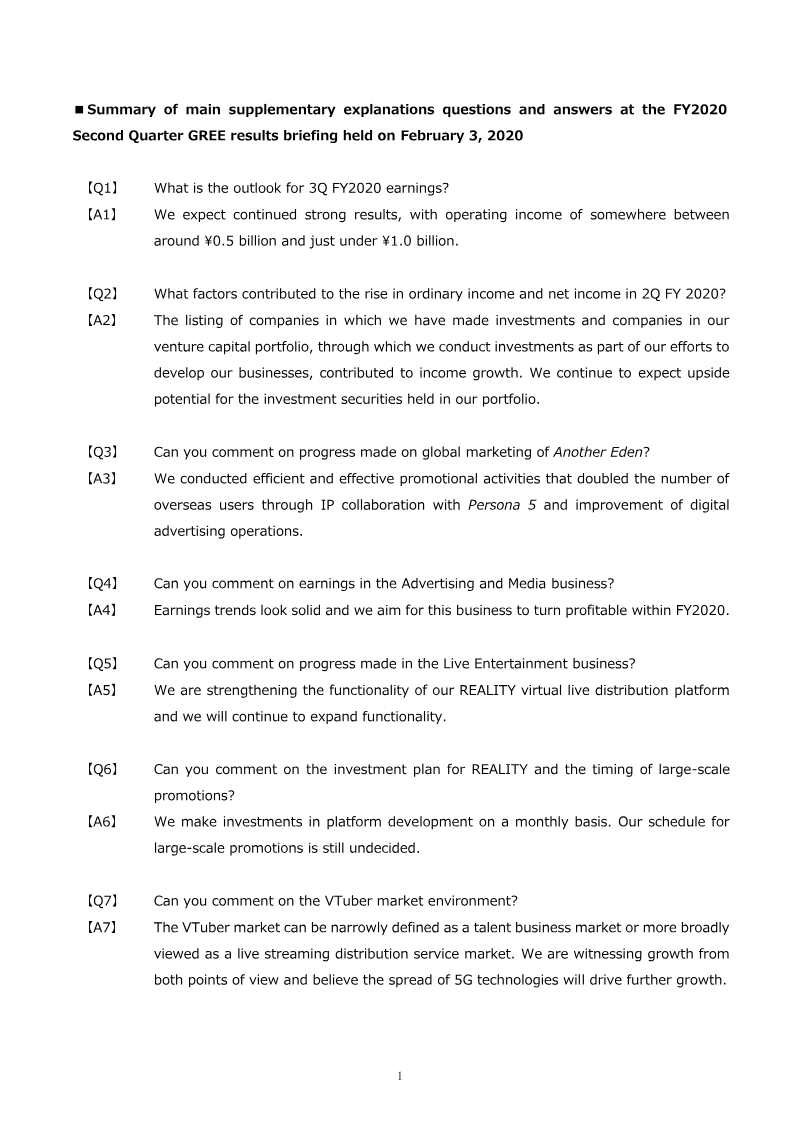
Summary of main supplementary explanations questions and answers at the FY 2020 Second Quarter GREE results briefing held on February 3, 2020
The briefing focused on GREE’s financial outlook, investment performance, and strategic initiatives across its entertainment and advertising segments. Management projected operating income for the third quarter of FY2020 to range between ¥0.5 billion and just under ¥1.0 billion, reflecting confidence in continued strong results. The rise in ordinary and net income during the second quarter was attributed to gains from listed companies and venture‑capital investments, with expectations of further upside in portfolio securities.
Marketing efforts for the game “Another Eden” were highlighted, noting a doubling of overseas users through an IP collaboration with Persona 5 and enhanced digital advertising operations. In the Advertising and Media business, earnings trends were described as solid, with a target of achieving profitability within FY2020. The Live Entertainment division emphasized ongoing enhancements to the REALITY virtual live‑distribution platform, with monthly investments in development and an undecided schedule for large‑scale promotions.
Regarding the broader VTuber market, management characterized it as both a talent‑based business and a live‑streaming distribution service, observing growth from both angles. The anticipated impact of 5G technology was cited as a catalyst for further expansion in the sector. Overall, the briefing underscored GREE’s focus on diversified revenue streams, strategic investment in emerging platforms, and a proactive marketing approach to sustain growth across its core business segments.
- GREE projects Q3 FY2020 operating income to range between ¥0.5 billion and just under ¥1.0 billion.
- Q2 FY2020 net and ordinary income growth was driven by gains from venture capital investments and listed company holdings.
- The game 'Another Eden' doubled its overseas user base following an IP collaboration with Persona 5 and optimized digital advertising.
- The Advertising and Media segment is performing steadily with a firm target to reach profitability within the 2020 fiscal year.
- The Live Entertainment division is prioritizing ongoing development of the REALITY virtual live-distribution platform, with large-scale promotional spending currently on hold.
+1
GREE
Report1 pages
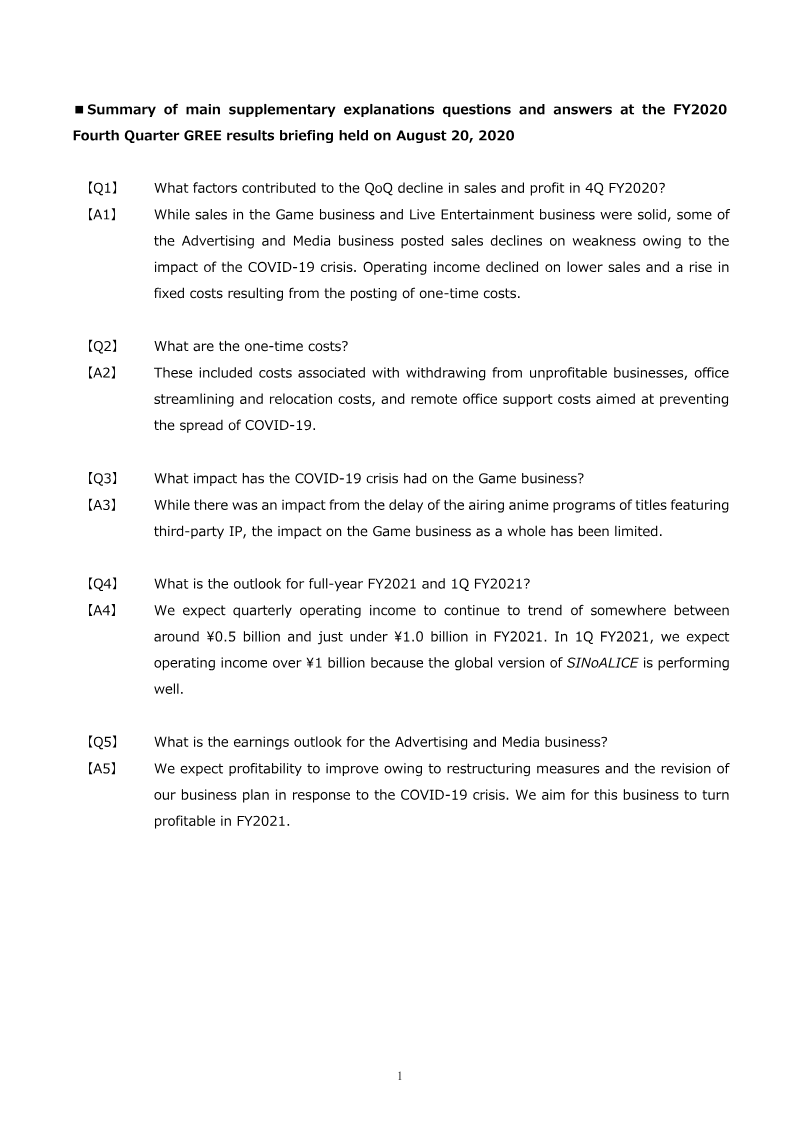
Summary of Main Supplementary Explanations Questions and Answers: FY2020 Fourth Quarter Results Briefing
The briefing clarified the reasons behind the quarter‑over‑quarter decline in sales and operating income for the fourth quarter of fiscal 2020. Core revenue streams from Game and Live Entertainment remained robust, while the Advertising and Media segment suffered sales drops linked to COVID‑19 disruptions. Operating income fell further due to lower sales and increased fixed costs, notably one‑time expenses such as divestitures of unprofitable units, office consolidation and relocation costs, and remote‑office support to curb virus spread. The Game business itself experienced only limited impact despite delays in anime broadcasts featuring third‑party intellectual property.
Looking ahead, the company projects full‑year fiscal 2021 operating income to stay within a range of approximately ¥0.5 billion to just under ¥1.0 billion per quarter, with a stronger first‑quarter outlook of over ¥1 billion driven by the successful global launch of SINoALICE. For the Advertising and Media division, profitability is expected to improve through restructuring initiatives and a revised business plan tailored to the pandemic context, with an aim to achieve profitability within fiscal 2021. The analysis covers Japan‑based operations across gaming, live entertainment, and advertising/media segments during the 2020–2021 fiscal period.
- The company projects fiscal 2021 quarterly operating income to range between ¥0.5 billion and just under ¥1.0 billion, with a Q1 forecast exceeding ¥1 billion.
- The Q1 2021 earnings surge is driven by the successful global launch of the game title SINoALICE.
- Fiscal 2020 Q4 operating income declined due to decreased sales and one-time costs, including unit divestitures, office consolidation, and remote-work support.
- The Advertising and Media segment is undergoing restructuring to reach profitability within fiscal 2021, following pandemic-related sales declines in 2020.
- Core revenue streams from Game and Live Entertainment remained robust throughout fiscal 2020 despite COVID-19 disruptions.
+1
GREE
Financial3 pages
FY2021 First Quarter Financial Results Briefing
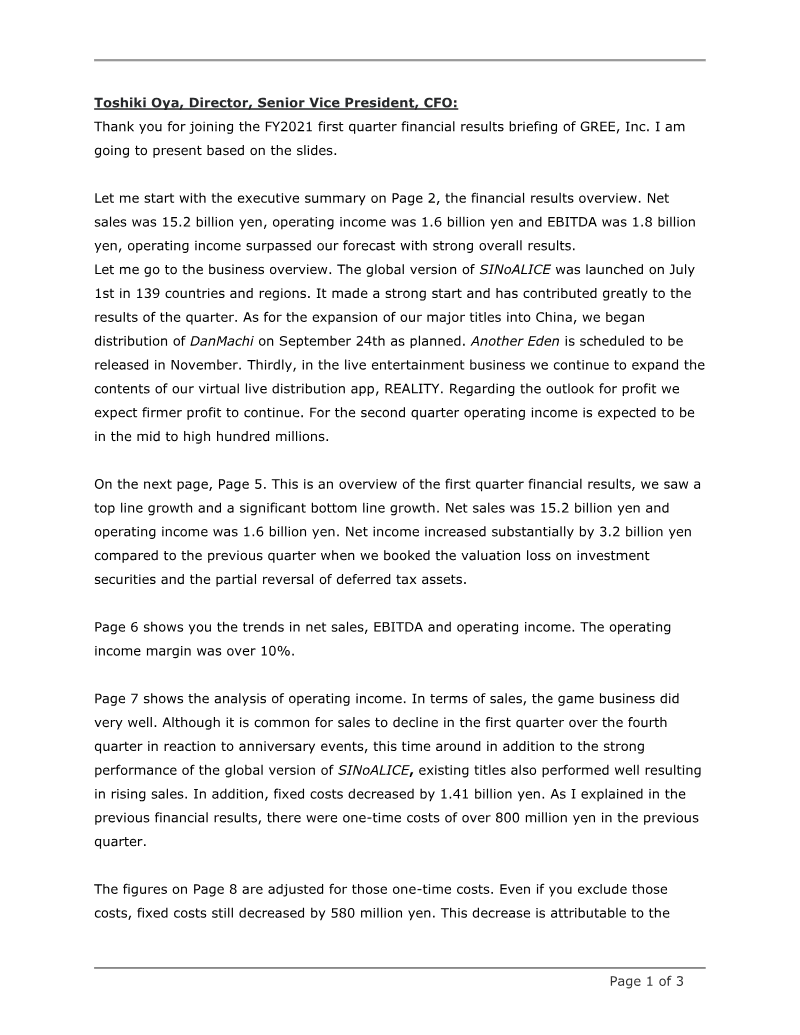
FY2021 first‑quarter results for GREE, Inc. show a robust financial performance with net sales of 15.2 billion yen and operating income of 1.6 billion yen, exceeding forecasts and achieving an operating margin above 10 %. Net income rose sharply by 3.2 billion yen compared to the prior quarter, largely due to a valuation loss on investment securities and a partial reversal of deferred tax assets. EBITDA reached 1.8 billion yen, underscoring healthy profitability.
The company’s game business drove the growth, highlighted by the global launch of SINoALICE on July 1st across 139 countries. Coin consumption in the app increased by 40 % from the previous quarter, and existing titles maintained strong sales momentum. Fixed costs fell by 1.41 billion yen, with a further 580 million yen reduction after excluding one‑time expenses, attributed to restructuring and lower outsourcing costs. The company also announced a share repurchase program capped at 20 million shares and 12 billion yen to enhance shareholder returns.
Strategic expansion into China continued with the September release of DanMachi and a November launch of Another Eden, supported by local partners. The live‑entertainment platform REALITY added new content and avatar options, while the advertising and media segment grew its user base to over 10 million monthly users. Looking ahead, GREE plans to release two to three new in‑house titles annually, including Assault Lily: Last Bullet and licensed properties such as One‑Punch Man, with additional projects in development. The company expects operating income for Q2 to remain in the mid‑to‑high hundred million yen range, reinforcing its earnings pillars across game, live entertainment, and advertising/media businesses.
- GREE, Inc. reported Q1 FY2021 net sales of 15.2 billion yen and operating income of 1.6 billion yen, exceeding forecasts with an operating margin above 10%.
- The global launch of SINoALICE across 139 countries on July 1st drove a 40% increase in in-app coin consumption compared to the previous quarter.
- Fixed costs decreased by 1.41 billion yen due to restructuring and reduced outsourcing, while the company authorized a share repurchase program of up to 20 million shares or 12 billion yen.
- Strategic expansion into the Chinese market progressed with the September release of DanMachi and the November launch of Another Eden.
- The company’s live-entertainment platform, REALITY, expanded its content and avatar offerings, while the advertising and media segment reached over 10 million monthly active users.
+2
GREE
Report1 pages
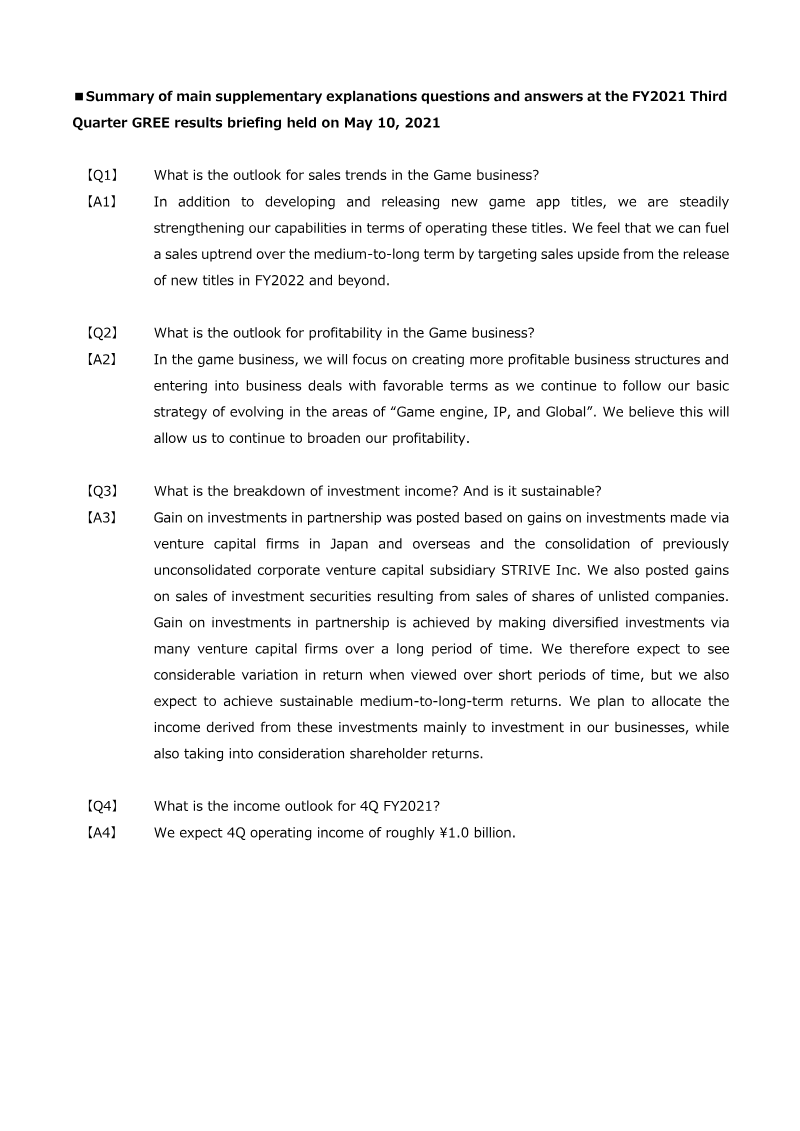
Summary of Main Supplementary Explanations Questions and Answers: FY2021 Third Quarter GREE Results Briefing
The briefing outlines GREE’s strategic outlook for the remainder of FY2021 and beyond, focusing on its core Game business, profitability trajectory, investment income sustainability, and short‑term financial expectations. GREE anticipates a medium‑to‑long‑term sales uptrend driven by the release of new game titles in FY2022 and subsequent years, while simultaneously strengthening operational capabilities for existing titles. Profitability is expected to broaden through the creation of more profitable business structures and favorable contractual terms, aligned with a strategy centered on Game engine development, intellectual property acquisition, and global expansion.
Investment income derives primarily from gains on venture‑capital partnerships in Japan and overseas, as well as the consolidation of previously unconsolidated subsidiary STRIVE Inc. The company notes that short‑term returns may fluctuate due to diversified investment portfolios, but medium‑to‑long‑term sustainability is projected. Planned allocation of these gains targets reinvestment in core businesses and shareholder returns.
Financially, GREE projects operating income for the fourth quarter of FY2021 at approximately ¥1.0 billion, reflecting confidence in its current revenue streams and cost management. The briefing covers Japan’s domestic market with implications for global expansion, covering the period up to FY2021 and projecting into FY2022. Methodological details are limited, but the focus remains on strategic investment, operational efficiency, and incremental revenue growth.
- GREE projects operating income for the fourth quarter of FY2021 to reach approximately ¥1.0 billion.
- The company anticipates a medium-to-long-term sales uptrend driven by a pipeline of new game titles scheduled for release in FY2022 and beyond.
- Strategic growth initiatives focus on game engine development, intellectual property acquisition, and global market expansion.
- Investment income is bolstered by gains from venture-capital partnerships and the consolidation of the subsidiary STRIVE Inc.
- Profitability improvements are being pursued through the restructuring of business models and the negotiation of more favorable contractual terms.
+3
GREE
Report1 pages
Summary of main supplementary explanations questions and answers at the FY2021 Second Quarter GREE results briefing held on February 12, 2021
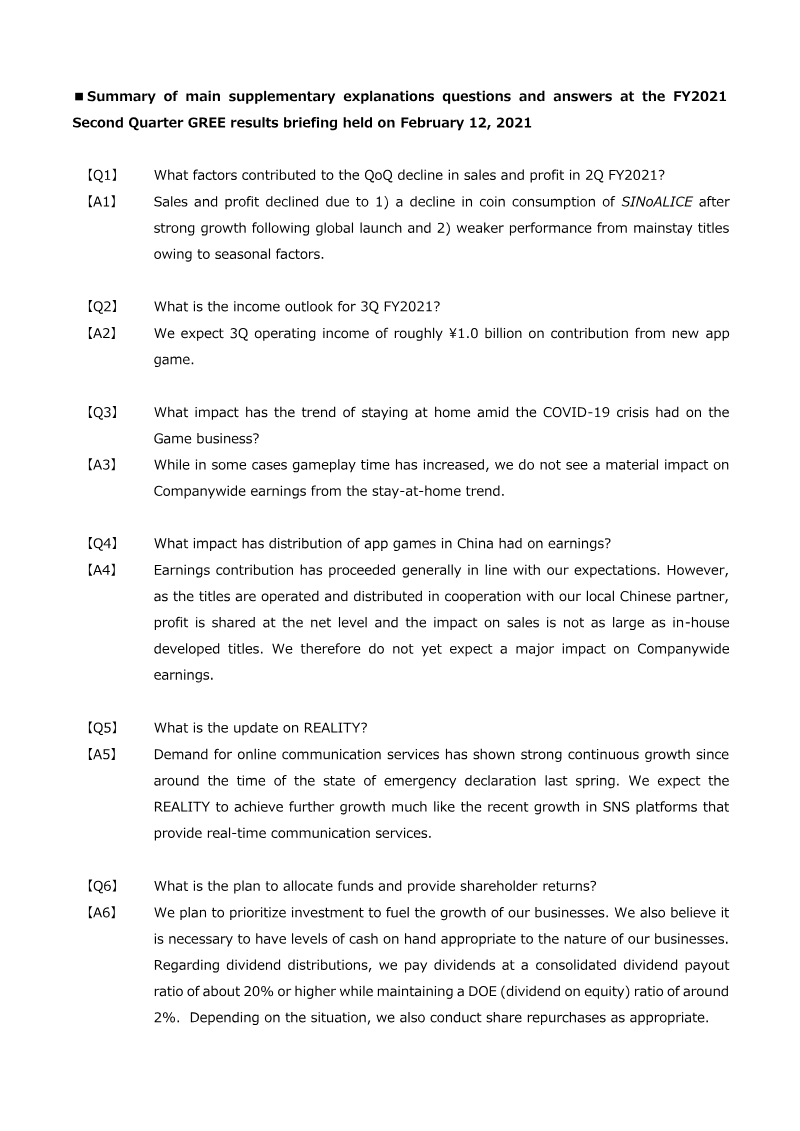
The briefing clarified that the quarter‑over‑quarter drop in sales and operating income for FY2021 Q2 stemmed mainly from a slowdown in coin consumption of the mobile title SINoALICE after its strong global launch, coupled with seasonal weakness in other flagship games. Management projected operating income for Q3 FY2021 at approximately ¥1.0 billion, driven largely by a new app‑game launch.
The impact of the COVID‑19 stay‑at‑home trend was deemed limited; while overall playtime rose in some segments, companywide earnings were not materially affected. Distribution of app games in China was described as meeting expectations, though profit sharing with local partners reduces the net contribution relative to in‑house titles, leaving no significant effect on consolidated earnings.
Real‑time communication services under the REALITY brand have experienced sustained growth since the spring state of emergency, and management anticipates continued expansion comparable to that seen in social networking platforms offering real‑time interactions.
Capital allocation plans emphasize reinvestment into business growth and maintaining adequate liquidity. Dividend policy targets a consolidated payout ratio of at least 20 % with a dividend‑on‑equity (DOE) ratio around 2 %. Share repurchases may be undertaken as circumstances allow. The briefing covered domestic and international markets, focusing on mobile gaming and online communication services over the 2021 fiscal year.
- GREE projects Q3 FY2021 operating income at approximately ¥1.0 billion, primarily supported by the launch of a new app game.
- The quarter-over-quarter decline in FY2021 Q2 sales and operating income was driven by a slowdown in SINoALICE coin consumption and seasonal weakness in flagship titles.
- The REALITY brand for real-time communication services has seen sustained growth since the spring 2020 state of emergency, with management expecting continued expansion.
- COVID-19 stay-at-home trends had a limited impact on companywide earnings, despite increased playtime in specific segments.
- App game distribution in China is meeting expectations, though profit-sharing agreements with local partners limit the net contribution to consolidated earnings.
+1
GREE
Financial3 pages
FY2021 Third Quarter Financial Results Briefing
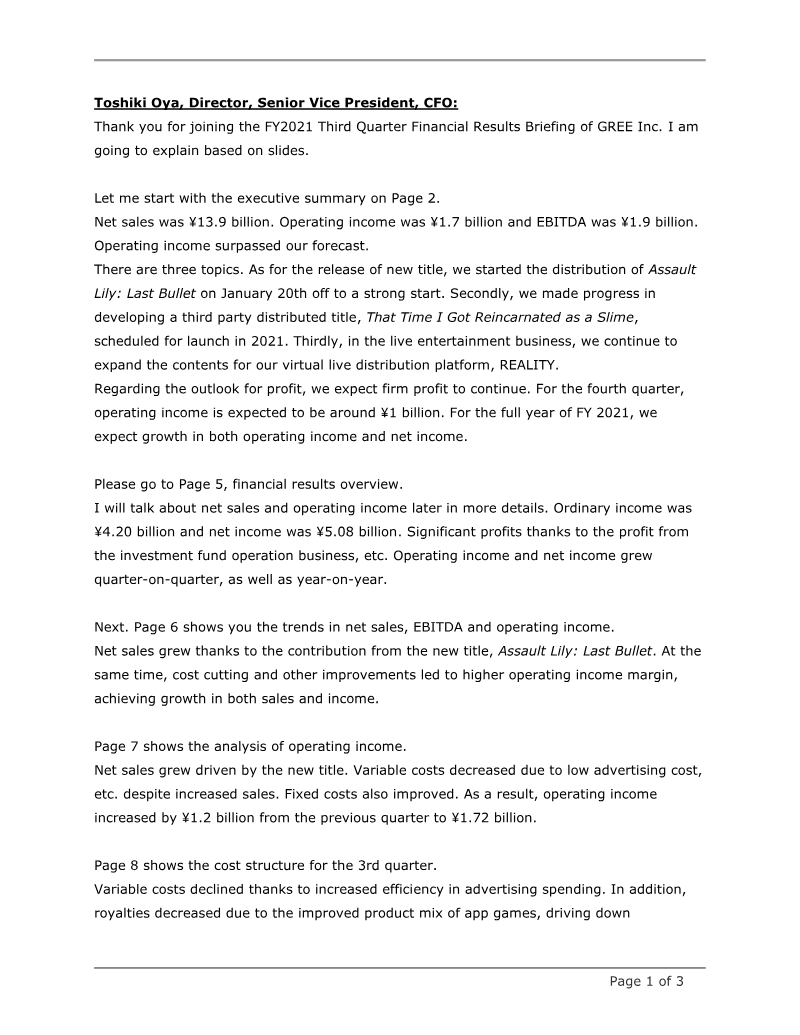
The briefing presents FY2021 third‑quarter financial results for GREE Inc., highlighting a net sales figure of ¥13.9 billion, operating income of ¥1.7 billion and EBITDA of ¥1.9 billion, all exceeding forecasts. Operating income rose by ¥1.2 billion from the prior quarter to ¥1.72 billion, driven by strong performance of the newly released title “Assault Lily: Last Bullet” and cost‑control measures that reduced variable costs, royalties, and fixed labor and outsourcing expenses by ¥0.9 billion to a total cost of ¥12.2 billion.
Key operational developments include the launch of “Assault Lily: Last Bullet” on January 20, its rapid climb to 16th in app‑sales rankings, and the planned release of “That Time I Got Reincarnated as a Slime” later in 2021. The company maintains a pipeline of two to three new in‑house titles annually, with additional IP collaborations such as “SINoALICE” and “DanMachi.” Live‑entertainment activities on the REALITY platform expanded through new avatar gacha offerings and user events, while advertising campaigns continued to energize communities.
Financial outlook remains positive: operating income for Q4 is projected at roughly ¥1 billion, and full‑year FY2021 forecasts anticipate growth in both operating income and net income. Dividend policy targets a 2 % distribution of earnings, with an FY2021 payout forecast of ¥11 per share. Stock repurchase activity has reached 60 % of a planned upper limit of ¥12 billion, underscoring management’s commitment to shareholder value.
- GREE Inc. exceeded Q3 FY2021 forecasts with ¥13.9 billion in net sales, ¥1.7 billion in operating income, and ¥1.9 billion in EBITDA.
- Operating income grew by ¥1.2 billion quarter-over-quarter, bolstered by the successful January 20 launch of 'Assault Lily: Last Bullet' and a ¥0.9 billion reduction in operating costs.
- The company is executing a shareholder return strategy, having completed 60% of its ¥12 billion stock repurchase program and projecting an FY2021 dividend of ¥11 per share.
- Management maintains a positive outlook for the remainder of the fiscal year, forecasting Q4 operating income of approximately ¥1 billion and overall growth in full-year net and operating income.
- The 'Assault Lily: Last Bullet' title reached 16th in app-sales rankings, supporting a pipeline that includes two to three new in-house titles annually and upcoming releases like 'That Time I Got Reincarnated as a Slime'.
+2
GREE
Financial4 pages
FY2022 1Q Financial Results Briefing
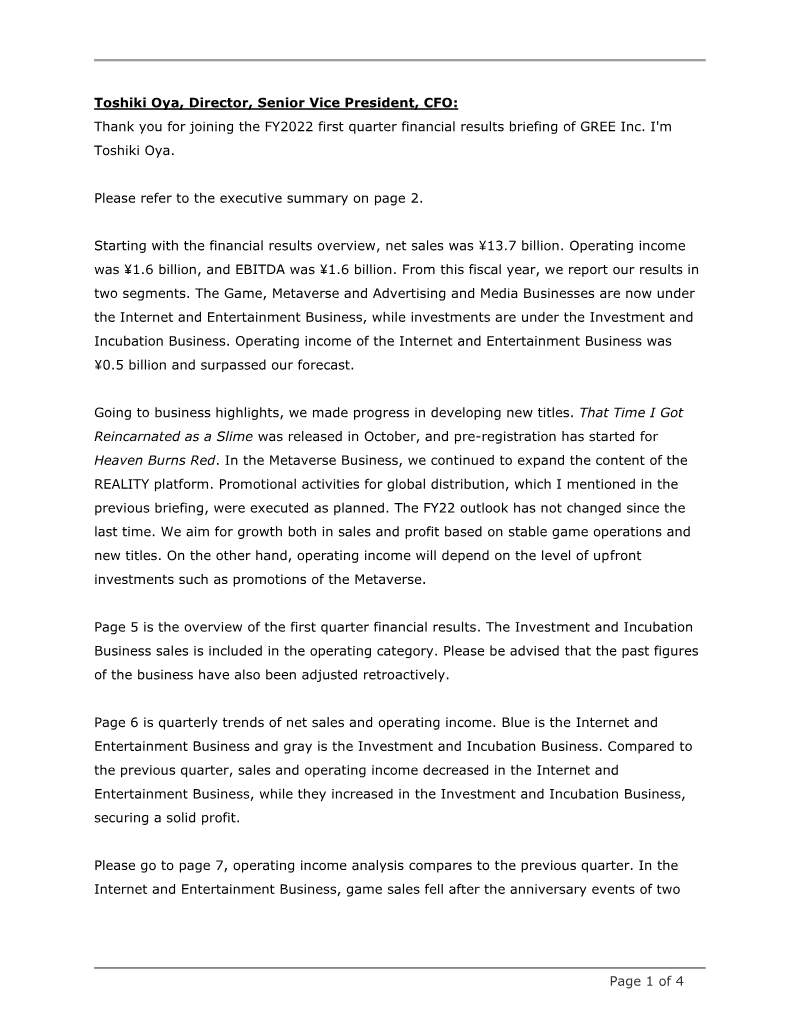
GREE Inc. reported FY2022 first‑quarter results with net sales of ¥13.7 billion and operating income of ¥1.6 billion, both figures reflecting a shift to a two‑segment reporting structure: Internet and Entertainment Business (games, metaverse, advertising) and Investment and Incubation Business. Operating income for the Internet segment reached ¥0.5 billion, surpassing forecasts, while the Investment segment contributed a significant profit margin that offset declines in game sales following anniversary events for flagship titles such as Another Eden and SINoALICE. Total costs amounted to ¥12.1 billion, down ¥0.6 billion quarter‑on‑quarter, with advertising expenses rising by ¥0.30 billion due to metaverse promotion and variable costs falling as sales dipped.
The company highlighted new game releases, notably “That Time I Got Reincarnated as a Slime,” which entered the top‑10 app sales ranking, and pre‑registrations for “Heaven Burns Red.” Metaverse activity expanded the REALITY platform’s content and global user base, while advertising and media collaborations (e.g., aumo, LIMIA) continued to strengthen community engagement. Investment activities were detailed: assets under management stood at ¥43 billion, with a valuation of invested startups around ¥67 billion; direct investments totaled ¥31.1 billion, reflecting unrealized gains that roughly doubled the invested capital.
GREE announced a stock‑repurchase program of up to 35 million shares (¥35 billion) to enhance shareholder returns and drive ROE toward 10%+. The outlook for Q2 anticipates operating income in the several‑hundred‑million‑yen range, tempered by higher outsourcing and advertising costs linked to new titles and metaverse growth.
- GREE Inc. reported FY2022 Q1 net sales of ¥13.7 billion and operating income of ¥1.6 billion, supported by a new two-segment structure consisting of Internet/Entertainment and Investment/Incubation.
- The company launched a stock-repurchase program of up to 35 million shares valued at ¥35 billion, aiming to improve shareholder returns and drive ROE above 10%.
- Investment activities generated significant profit, with ¥43 billion in assets under management and direct investments of ¥31.1 billion yielding unrealized gains that roughly doubled the invested capital.
- Operating income for the Internet segment reached ¥0.5 billion, exceeding forecasts despite a decline in game sales following anniversary events for flagship titles Another Eden and SINoALICE.
- New title 'That Time I Got Reincarnated as a Slime' reached the top-10 app sales ranking, while the company continues to focus on the metaverse through the expansion of the REALITY platform.
+2
GREE
Report2 pages
Summary of Main Supplementary Explanations Questions and Answers: FY2021 Fourth Quarter
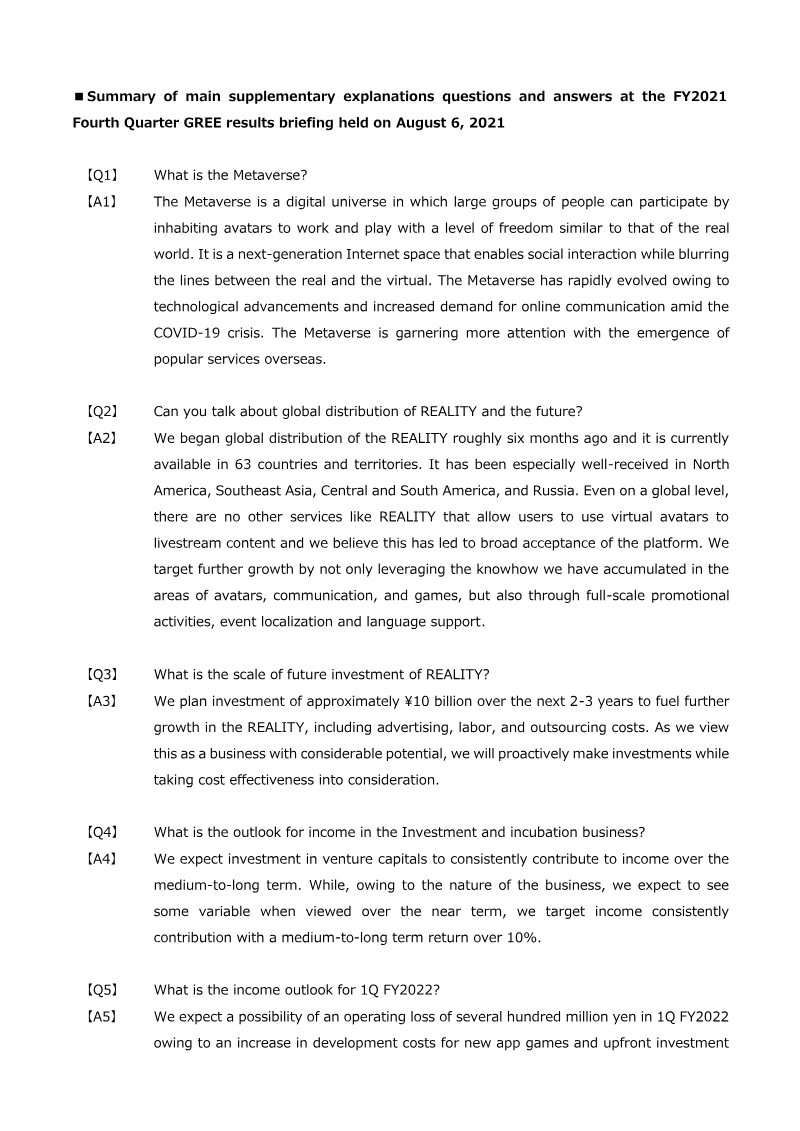
The briefing clarified GREE’s strategic focus on its Metaverse platform, REALITY, and financial outlook for the coming year. The company defined the Metaverse as a digital universe where users inhabit avatars to work and play, emphasizing its rapid growth driven by technology advances and heightened online interaction during the COVID‑19 pandemic. REALITY, launched globally six months prior to the briefing, is now available in 63 countries and territories, with strong reception in North America, Southeast Asia, Central and South America, and Russia. GREE highlighted the platform’s unique ability to livestream content with virtual avatars, a feature not offered by competitors, and outlined plans for further expansion through localized events, multilingual support, and extensive promotional activities.
Investment plans for REALITY are set at approximately ¥10 billion over the next two to three years, covering advertising, labor, and outsourcing costs. The company views this as a high‑potential business and aims to balance growth with cost efficiency. In its investment and incubation segment, GREE anticipates venture capital activities to provide consistent medium‑to‑long‑term income, targeting a return of at least 10 % despite short‑term volatility. For the first quarter of FY2022, GREE foresees a potential operating loss in the hundreds of millions of yen, attributed to increased development costs for new app games and upfront investments. The overall narrative positions REALITY as a central growth engine while acknowledging the financial risks associated with early‑stage expansion.
- GREE is committing approximately ¥10 billion over the next two to three years to scale its Metaverse platform, REALITY, focusing on advertising, labor, and outsourcing costs.
- REALITY has expanded to 63 countries and territories globally, with particularly strong market reception in North America, Southeast Asia, Central and South America, and Russia.
- GREE anticipates an operating loss in the hundreds of millions of yen for the first quarter of FY2022, driven by upfront investments and increased development costs for new app games.
- The company’s investment and incubation segment targets a minimum return of 10% on venture capital activities to ensure consistent medium-to-long-term income.
- REALITY differentiates itself from competitors through a unique livestreaming feature that allows users to broadcast content using virtual avatars.
+1
GREE