GREE
Game Co.192 documents
Documents

Financial32 pages
FY2015 First Quarter Financial Results
The first‑quarter fiscal 2015 results show net sales of ¥25.4 billion and operating income of ¥6.4 billion, a decline in sales but a flat operating margin compared with the previous quarter due to a ¥1.4 billion cut in advertising costs. Net sales fell 9.9% year‑over‑year, driven by softer performance of existing titles in Japan and overseas markets. EBITDA rose modestly to ¥8.01 billion, while ordinary income increased by ¥2.27 billion largely from a ¥17.2 billion exchange gain on USD‑denominated loans. An extraordinary loss of ¥2.03 billion was recorded from write‑downs of assets related to discontinued titles, reducing net income to ¥3.48 billion.
Cost structure analysis indicates a 7% reduction in total costs to ¥19.0 billion, largely from advertising (down 13% QoQ) and commission fees. Variable costs fell by ¥1.19 billion, while fixed costs decreased marginally. The company’s strategy focuses on accelerating native game development, having shifted resources from web games and added 12 new production lines. Three first‑party native titles are slated for launch in the winter, and partnerships with LINE and KDDI aim to expand cross‑border reach.
For FY15 first half, the company forecasts net sales of ¥49.0 billion and operating income of ¥10.5 billion, assuming minimal seasonal impact and continued cost control. The outlook emphasizes native hit titles as the primary growth driver, with web games supporting earnings and new ventures in mobile video advertising and venture capital investments.
- Net sales for Q1 FY2015 fell 9.9% year-over-year to ¥25.4 billion, driven by the underperformance of existing titles in both domestic and international markets.
- Operating income remained flat at ¥6.4 billion despite the sales decline, supported by a ¥1.4 billion reduction in advertising expenditures.
- Ordinary income saw a significant boost of ¥2.27 billion, primarily attributed to a ¥17.2 billion exchange gain on USD-denominated loans.
- Net income was reduced to ¥3.48 billion after accounting for a ¥2.03 billion extraordinary loss related to asset write-downs for discontinued titles.
- The company is shifting its strategic focus toward native game development, having added 12 new production lines and scheduled three first-party native titles for a winter launch.
+5
GREE
Financial31 pages
FY2017 First Quarter Financial Results: GREE
FY2017 First Quarter Financial Results Copyright © GREE, Inc. All Rights Reserved. Financial & Net Sales ¥14.9 billion, Operating Income ¥2.5 billion Results ⁃ QoQ profit growth on strong performance from new titles, successful cost & Native game new release blitz off to a good start ⁃ Domestic native game business: Two new titles driving growth ⁃ Overseas native game business: Targeting further growth through Business ⁃ acquisition of hit titles Overview Web game busines...
- GREE reported Q1 FY17 net sales of ¥14.91 billion and operating income of ¥2.54 billion. While net sales decreased by ¥0.73 billion QoQ and ¥4.40 billion YoY, operating income increased by ¥0.33 billion QoQ due to cost-cutting measures.
- Net income for Q1 FY17 was ¥10.82 billion, a significant increase of ¥8.79 billion QoQ and ¥8.43 billion YoY.
- GREE forecasts net sales of ¥30 billion and operating income of ¥4 billion for the first half of FY17. This includes conservative targets for domestic native games and expected contributions from the recently acquired title DragonSoul in overseas markets.
- GREE has six domestic native game titles in development, including original and IP-based titles, with two from Wright Flyer Studios and three from Pokelabo slated for release in Q2-Q4 FY17.
- The company acquired the overseas native game 'DragonSoul' on October 6th, an RPG targeting mid-core gamers which has seen its coin consumption increase 2.4 times since the beginning of 2016 and has over 9 million total downloads since its July 2015 release.
+1
GREE
Report2 pages
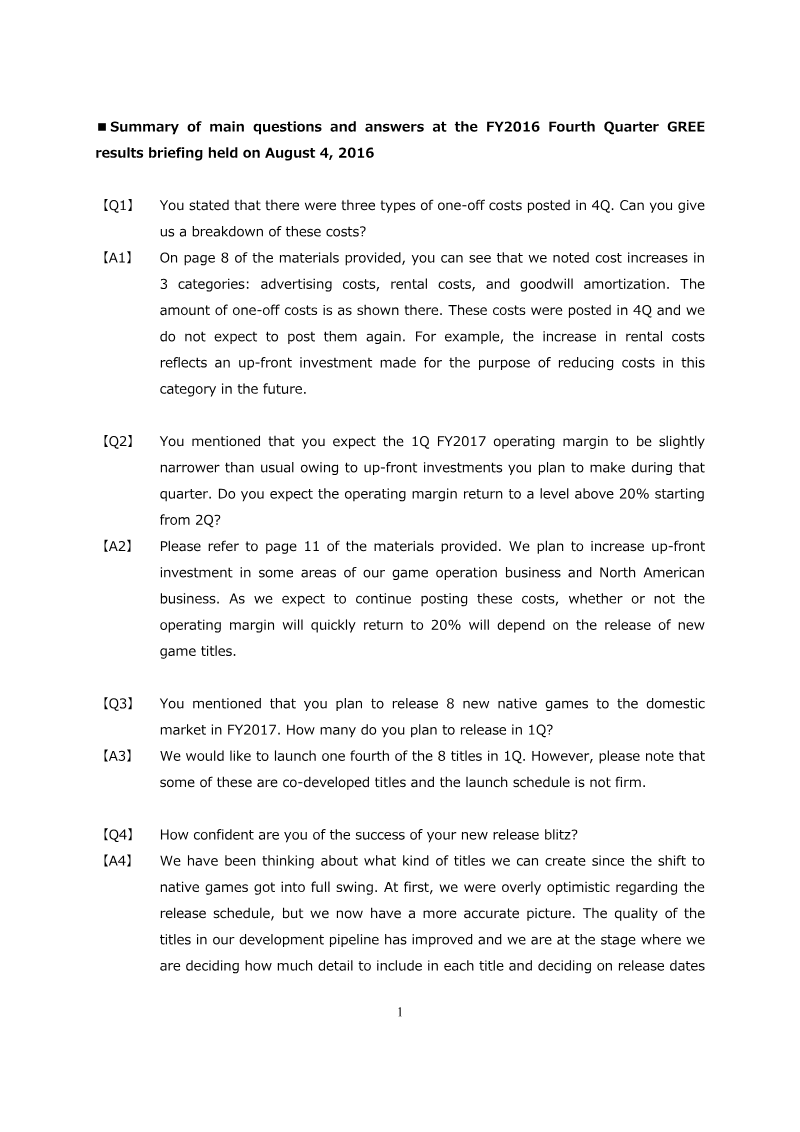
Summary of Q&A: FY2016 4Q GREE Results Briefing
The briefing clarified GREE’s financial and strategic outlook for FY2016–FY2017. One‑off costs in Q4 were broken into advertising, rental and goodwill amortization, with rental increases reflecting upfront investments aimed at future cost reductions. These expenses are not expected to recur. Operating margin for Q1 FY2017 is projected to be slightly below normal due to continued upfront spending, particularly in game operations and North America; a return above 20% is contingent on new title releases. GREE plans to launch eight native games in FY2017, with a quarter‑backed schedule of one‑quarter releases for roughly two titles, though co‑development timelines remain fluid. Confidence in the release blitz has improved as development pipelines mature and release dates are refined based on competitive market conditions.
Strategically, each studio is positioned to leverage core strengths: Wright Flyer focuses on action RPGs and IP integration, while Pokelabo targets GvG titles built on card‑battle expertise. Hit titles are defined by top‑ten App Store rankings in the games category. Financially, GREE aims to use its strengthened capital base to sustain long‑term game development and pursue selective M&A or IP acquisitions, exemplified by the 4Q acquisition of ad‑media firm ADFULLY. The scope covers domestic Japanese markets, with implications for North American expansion, and the time frame spans FY2016 Q4 through FY2017. The briefing relied on internal financial statements and strategic planning documents to outline cost structures, margin expectations, product pipelines, studio focus areas, success metrics, and capital deployment strategies.
- GREE plans to launch eight native games in FY2017, targeting a release cadence of two titles per quarter.
- Operating margins for Q1 FY2017 are expected to remain below 20% due to upfront investments in game operations and North American expansion, with a return to higher margins contingent on new title performance.
- The company defines 'hit titles' as games that achieve top-ten rankings within the App Store games category.
- One-off costs incurred in Q4 FY2016—including advertising, rental, and goodwill amortization—are non-recurring expenses intended to facilitate future cost reductions.
- Studio strategies are specialized: Wright Flyer is focused on action RPGs and IP integration, while Pokelabo is focused on GvG titles leveraging card-battle expertise.
+1
GREE

Financial35 pages
FY2017 Third Quarter Financial Results: Japan
The FY2017 third‑quarter results show a modest but steady upward trajectory in sales and operating income, driven primarily by domestic native game revenue. Net sales rose to ¥15.9 billion, up ¥500 million QoQ, with paid‑service sales accounting for ¥14.37 billion and ad‑media sales contributing ¥1.51 billion. Operating income increased to ¥1.55 billion, a ¥50 million gain attributed to higher sales volume and improved cost efficiency. EBITDA reached ¥2.21 billion, reflecting a slight decline in variable costs and a modest rise in fixed expenses linked to new title development.
Cost analysis indicates total expenditures climbed ¥0.5 billion QoQ, with advertising costs falling as a percentage of sales (from 6.9 % to 5.5 %) and commission fees rising in line with sales growth. Labor costs remained stable, while depreciation and goodwill amortization increased due to the consolidation of the 3Minute subsidiary. The company projects full‑year net sales of ¥62 billion and operating income of ¥7 billion, assuming a steady Q4 performance similar to Q3 and additional revenue from upcoming releases.
Operationally, the group released two first‑party titles in Q3 and is advancing four new releases slated for Q4, alongside a robust pipeline of ten native games. Advertising and media businesses, particularly the 3Minute unit, achieved record monthly sales and a 20 % rise in page views. The overall strategy focuses on expanding video‑centric advertising, sustaining game operation profitability, and investing in key development areas while maintaining strict cost controls.
- The company projects full-year net sales of ¥62 billion and operating income of ¥7 billion, contingent on Q4 performance and upcoming releases.
- Q3 net sales reached ¥15.9 billion, a ¥500 million quarter-over-quarter increase, with ¥14.37 billion derived from paid services and ¥1.51 billion from ad-media.
- Operating income rose to ¥1.55 billion, a ¥50 million gain driven by increased sales volume and improved cost efficiency.
- Advertising efficiency improved as costs fell from 6.9% to 5.5% of total sales, while the 3Minute subsidiary achieved record monthly sales and a 20% increase in page views.
- Total expenditures rose by ¥0.5 billion quarter-over-quarter, impacted by higher commission fees and increased depreciation and goodwill amortization from the 3Minute consolidation.
+2
GREE
Report3 pages
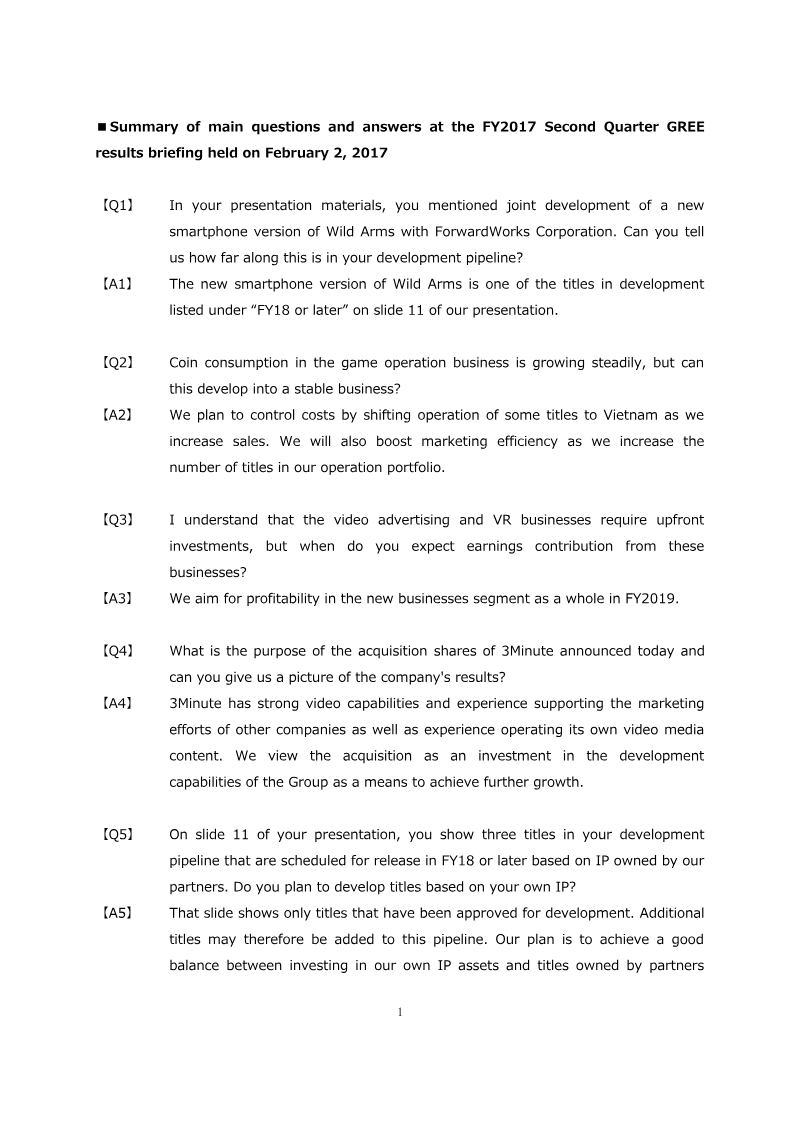
Summary of Questions and Answers: FY2017 2Q GREE Results Briefing
The briefing clarified GREE’s strategic focus for FY2017 and beyond. The company confirmed that a smartphone adaptation of Wild Arms, developed with ForwardWorks Corporation, remains in the FY18‑later pipeline. To stabilize coin‑consumption revenue from its game operation segment, GREE plans to shift operations of select titles to Vietnam and enhance marketing efficiency as its portfolio expands. New ventures in video advertising and virtual reality are expected to reach profitability by FY2019, while the acquisition of 3Minute is positioned as an investment in video‑content capabilities to support broader growth.
Regarding intellectual property, GREE indicated that its development pipeline includes both partner‑owned IP and its own assets, aiming for a balanced mix. The company highlighted Rara‑MAGI’s strong launch performance and noted that coin consumption for other overseas native titles has declined quarter‑over‑quarter, though a new title is slated for late second half release. Seven titles scheduled for the latter half of the year will see roughly half released in Q3 and the remainder in Q4, with Rara‑MAGI already live.
Operating income is projected to dip in Q3 due to increased fixed costs from new releases. GREE will evaluate ongoing titles, closing those unlikely to grow while reallocating resources to high‑potential games. Poor performance is attributed mainly to insufficient content depth or breadth at launch, and lessons learned will inform future development.
- GREE expects Q3 operating income to decline due to increased fixed costs associated with a pipeline of seven new game releases scheduled for the second half of the fiscal year.
- The company is shifting operations for select titles to Vietnam and improving marketing efficiency to stabilize coin-consumption revenue within its game segment.
- New business ventures in virtual reality and video advertising are targeted to reach profitability by FY2019.
- GREE acquired 3Minute to bolster its video-content capabilities as part of a broader growth strategy.
- The smartphone adaptation of Wild Arms, developed in partnership with ForwardWorks Corporation, is confirmed for release in FY2018 or later.
+3
GREE
Report3 pages
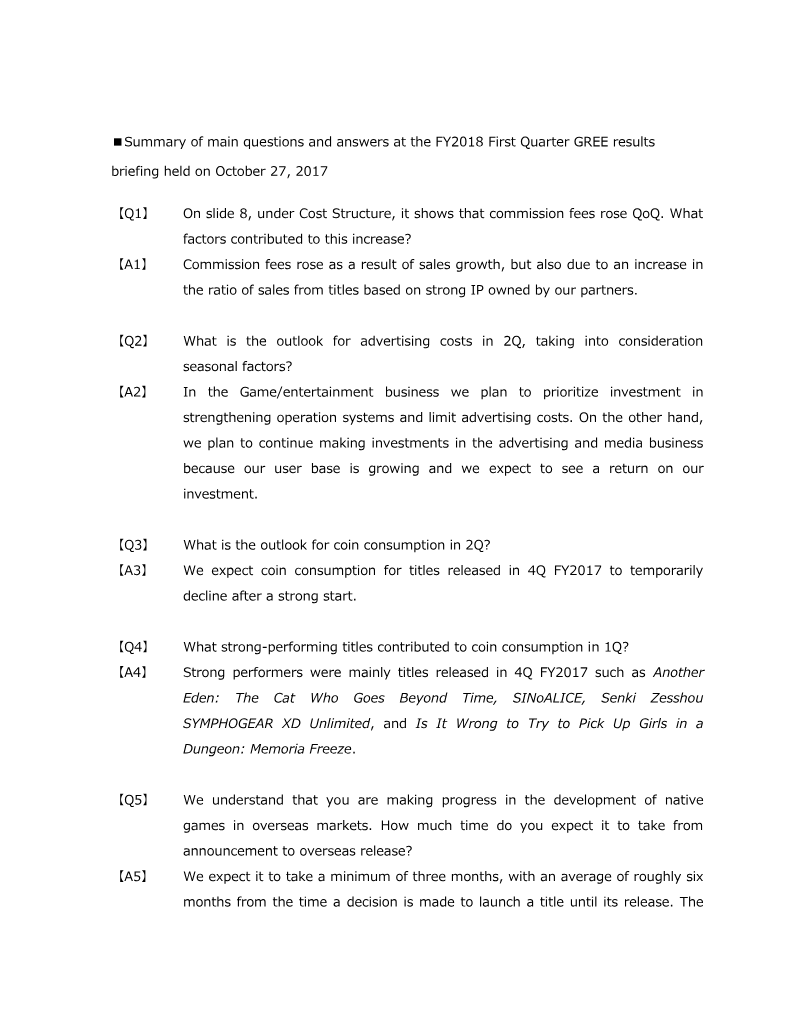
Summary of Main Questions and Answers at the FY2018 First Quarter GREE Results Briefing
The briefing, held on October 27 2017, focused on GREE’s first‑quarter FY2018 performance and future strategy. Commission fees rose quarter‑on‑quarter, driven by overall sales growth and a higher proportion of revenue from partner titles with strong intellectual property. Advertising spend outlook for the second quarter varies by segment: the game and entertainment arm will tighten costs while continuing to invest in advertising for its expanding user base, expecting a return on investment. Coin consumption is projected to dip temporarily after the strong start of Q4 FY2017 releases, yet titles such as Another Eden: The Cat Who Goes Beyond Time, SINoALICE, Senki Zesshou SYMPHOGEAR XD Unlimited, and Is It Wrong to Try to Pick Up Girls in a Dungeon: Memoria Freeze drove robust coin usage in Q1.
GREE’s overseas native‑game development pipeline is expected to take a minimum of three months from announcement to launch, averaging six months. The company emphasizes delivering versions faithful to the original Japanese product and local operation for success in China, noting that Chinese users prefer authenticity and require localized fine‑tuning with strong local partners. In the VR arena, GREE is expanding its development knowledge base and partnering to provide access points for users lacking personal VR hardware, anticipating market growth.
Regarding the domestic native‑game environment, GREE acknowledges rising user expectations and a challenging acquisition landscape. Leveraging its financial strength and industry relationships, the company plans large‑scale development and mixed‑media initiatives to deliver hit titles. Sales of native games are expected to experience a temporary decline before operations are strengthened—through larger support teams, content enhancement, overseas launches, and tailored promotional activities—to drive subsequent growth.
- GREE’s Q1 FY2018 revenue growth was driven by increased commission fees from partner titles that leverage strong intellectual property.
- Key titles driving robust coin consumption in Q1 included 'Another Eden: The Cat Who Goes Beyond Time', 'SINoALICE', 'Senki Zesshou SYMPHOGEAR XD Unlimited', and 'Is It Wrong to Try to Pick Up Girls in a Dungeon: Memoria Freeze'.
- The company expects a temporary decline in native game sales as it transitions to larger support teams, enhanced content, and more aggressive promotional activities to drive future growth.
- GREE’s overseas native-game development pipeline requires a minimum of three months from announcement to launch, with an average lead time of six months.
- Success in the Chinese market is predicated on delivering versions faithful to original Japanese products while utilizing strong local partners for necessary fine-tuning.
+3
GREE
Report5 pages
FY2018 2Q Result Presentation
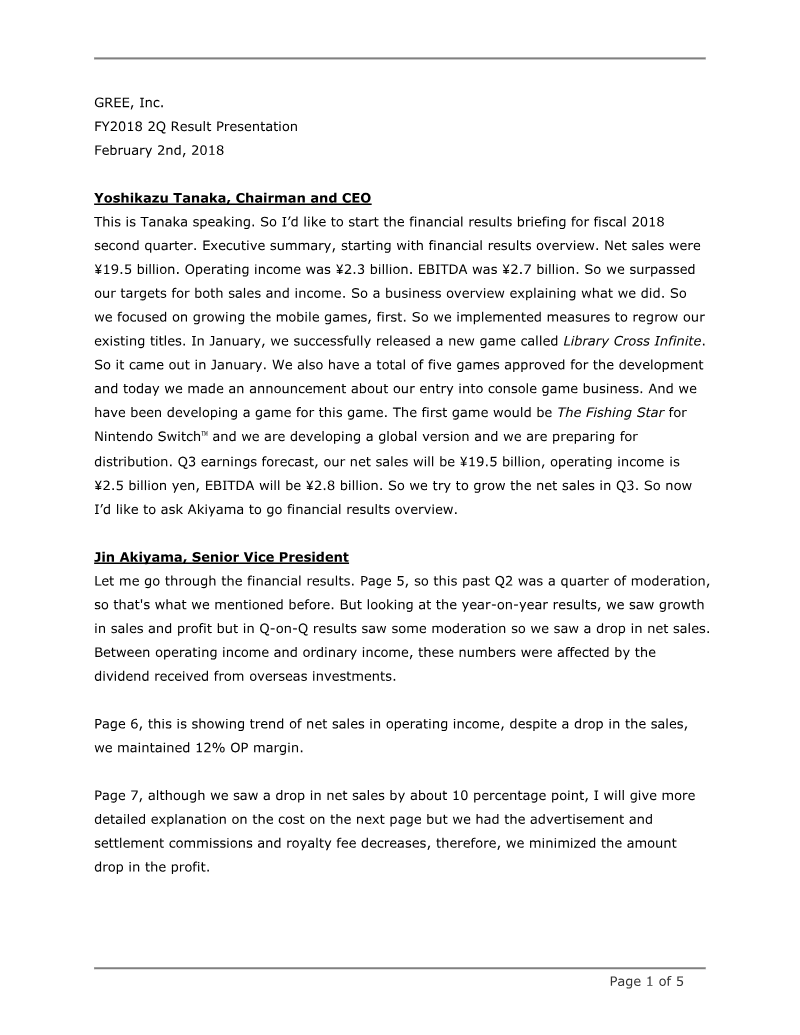
GREE, Inc. reported FY2018 second‑quarter results on February 2, 2018, with net sales of ¥19.5 billion and operating income of ¥2.3 billion, exceeding targets for both metrics. EBITDA reached ¥2.7 billion. Year‑on‑year growth was achieved, though quarter‑over‑quarter sales moderated by roughly 10 percentage points; operating margin remained at 12 %. The company attributed the sales dip to reduced advertising spend and lower commission fees, while cost controls on labor and outsourcing mitigated profit erosion. A strategic shift toward console gaming was announced, with the first title “The Fishing Star” slated for Nintendo Switch and a global release in development. Mobile game performance was bolstered by the launch of “Library Cross Infinite” and ongoing content updates for titles such as Another Eden, Danmachi, SINoALICE, SYMPHOGEAR, and Puchiguru Love Live. Five new mobile titles are approved for development, with three slated for release this fiscal year.
The FY2018 Q3 forecast projects flat net sales at ¥19.5 billion and operating income of ¥2.5 billion, aiming for a year‑to‑date total of ¥60.6 billion. GREE plans to sustain growth through aggressive title reinforcement, overseas expansion, and cost discipline across mobile, console, VR, advertising, and media segments. The presentation covered financial performance, cost structure adjustments following overseas operation closures, and a pipeline of upcoming releases across multiple platforms.
- GREE reported FY2018 Q2 net sales of ¥19.5 billion and operating income of ¥2.3 billion, both exceeding internal targets.
- The company is pivoting toward console gaming, with 'The Fishing Star' confirmed for Nintendo Switch and a global release currently in development.
- While year-on-year growth was positive, quarterly sales moderated by approximately 10 percentage points due to reduced advertising spend and lower commission fees.
- Operating margin held steady at 12%, supported by strict cost controls on labor and outsourcing that offset the impact of lower sales.
- Mobile performance was driven by the launch of 'Library Cross Infinite' and ongoing updates to key titles including 'Another Eden,' 'Danmachi,' 'SINoALICE,' 'SYMPHOGEAR,' and 'Puchiguru Love Live.'
+2
GREE
Financial29 pages
FY2019 Third Quarter Financial Results
The FY2019 third‑quarter results demonstrate a solid operating performance driven largely by overseas distribution of first‑party IP and cost efficiencies in existing titles. Net sales reached ¥17.6 billion, slightly below the forecasted ¥18 billion range but up 0.23 % YoY, while operating income rose to ¥1.6 billion, surpassing the forecasted ¥1.5 billion and marking a 0.59 % QoQ increase. EBITDA stood at ¥1.8 billion, reflecting a 0.60 % QoQ gain and a 1.35 % YoY decline, largely attributable to one‑off events that added ¥390 million in sales and ¥460 million in income. Adjusted figures, excluding these events, show net sales of ¥17.25 billion and operating income of ¥1.09 billion, underscoring the underlying strength.
Key drivers include a successful launch of “Another Eden” in eight overseas markets, which contributed significantly to paid‑service sales (¥13.65 billion), and a global simultaneous collaboration event for “DanMachi” that boosted user engagement. The company also advanced its mobile pipeline, with five titles in development and pre‑registrations for “AFTERLOST” underway. Cost management improved markedly, with total costs falling ¥700 million QoQ to ¥16.1 billion, driven by reduced outsourcing and streamlined operations.
Geographically, the focus remains on Japan with expanding presence in North America, Europe, and Asia‑Pacific through self‑distribution and partner agreements. The 4Q forecast projects net sales of ¥17–18 billion and operating income of ¥1.0–1.5 billion, anticipating continued momentum from anniversary events and new title releases. The company’s workforce totals 1,693 employees across game‑entertainment, advertising, and other businesses.
- Net sales reached ¥17.6 billion, a 0.23% year-over-year increase, while operating income rose to ¥1.6 billion, exceeding the ¥1.5 billion forecast.
- Adjusted net sales were ¥17.25 billion and adjusted operating income was ¥1.09 billion after excluding ¥390 million in one-off sales and ¥460 million in one-off income.
- Paid-service sales reached ¥13.65 billion, driven primarily by the overseas launch of 'Another Eden' in eight markets and a global collaboration event for 'DanMachi'.
- Operating costs decreased by ¥700 million quarter-over-quarter to ¥16.1 billion due to streamlined operations and reduced outsourcing.
- The company is expanding its mobile pipeline with five titles currently in development and pre-registrations active for 'AFTERLOST'.
+2
GREE
Report2 pages
Summary of main questions and answers at the FY2019 First Quarter GREE results briefing held on October 26, 2018
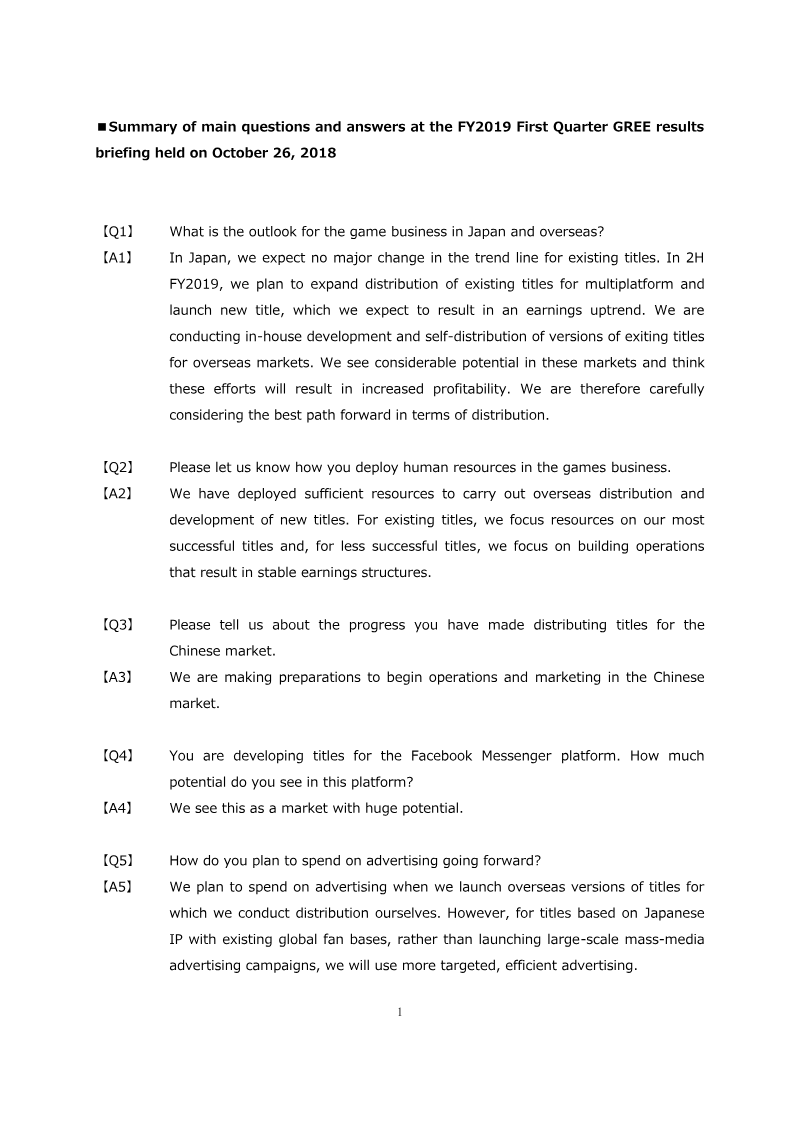
The briefing clarified GREE’s strategic outlook for FY2019, emphasizing a steady domestic game portfolio while pursuing growth overseas. In Japan, the company expects no major shift in performance for existing titles but plans to broaden multiplatform distribution and launch new releases in the second half of FY2019, projecting an earnings uptrend. Internationally, GREE is developing and self‑distributing overseas versions of current titles, targeting markets with high profitability potential. Human resource allocation reflects this focus: sufficient staff are dedicated to overseas distribution and new title development, while existing titles receive concentrated support for top performers and operational stability for less successful ones.
China is identified as a priority market, with preparations underway to initiate operations and marketing. The company also highlights the Facebook Messenger platform as a high‑potential channel for new titles, indicating an expansion into social media gaming. Advertising strategy will be selective; overseas launches of self‑distributed titles will receive targeted, efficient campaigns rather than broad mass media spend.
Regulatory compliance and consumer protection are addressed through company‑wide measures to prevent gacha system issues, including strengthened evaluation protocols and employee training. The REALITY livestreaming platform for VTubers is in an exploratory phase, with ongoing data collection on technology, planning, and marketing to build know‑how for future content expansion. Overall, GREE’s FY2019 strategy balances domestic stability with aggressive international diversification and platform innovation.
- GREE is prioritizing international expansion by self-distributing existing titles in high-profitability markets, with China identified as a key target for upcoming operations and marketing.
- The company plans to drive an earnings uptrend in the second half of FY2019 through new title releases and expanded multiplatform distribution in Japan.
- GREE is diversifying its distribution channels by targeting social media gaming, specifically highlighting Facebook Messenger as a high-potential platform for new releases.
- Advertising strategy for overseas launches will shift away from mass media spend in favor of targeted, efficient campaigns for self-distributed titles.
- Human resource allocation is being restructured to concentrate support on top-performing domestic titles while maintaining operational stability for lower-performing ones.
+5
GREE
Financial4 pages
FY2019 Q1 Financial Results Briefing
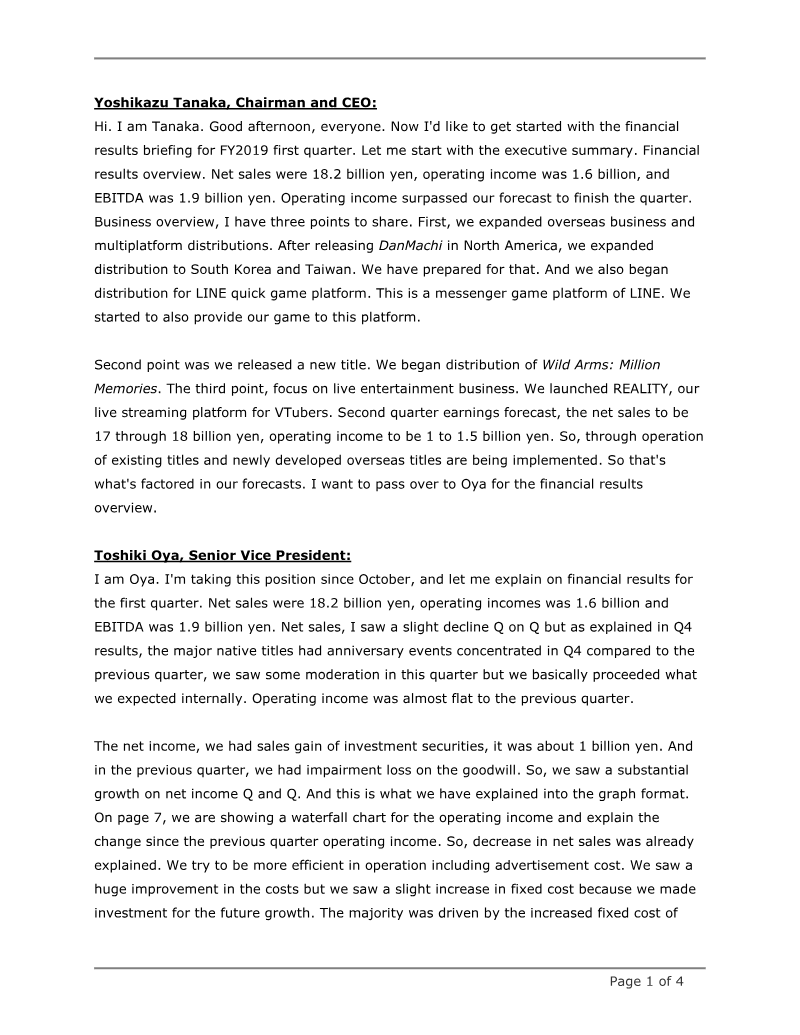
The briefing presents FY2019 Q1 financial results for a Japanese game and entertainment company, highlighting net sales of 18.2 billion yen, operating income of 1.6 billion yen, and EBITDA of 1.9 billion yen—slightly below the previous quarter but meeting internal forecasts. Net income benefited from a 1 billion yen gain on investment securities, offsetting prior goodwill impairment losses. Operating costs improved markedly through advertising efficiency, though fixed expenses rose due to strategic investments in future growth and an acquisition of ORATTA.
Strategic initiatives focus on expanding overseas mobile game distribution, launching new titles such as Wild Arms: Million Memories and DanMachi in South Korea, Taiwan, Hong Kong, and planned releases in Macau. The company is also developing multi‑platform messenger games (Fishing Star QUICK, Driland) and a live‑streaming platform for VTubers called REALITY, which enables gifting and single‑smartphone VTuber creation. Partnerships with King Records, Idea Factory, and others support music and event projects for VTubers.
The Q2 earnings forecast projects net sales of 17–18 billion yen and operating income of 1–1.5 billion yen, reflecting anticipated fluctuations from new overseas distribution and the performance of titles like Another Eden. Methodologically, the company bases forecasts on recent business trends and incorporates a range to account for volatility inherent in game sales. The briefing covers domestic and international markets, mobile and console segments, live entertainment, and media advertising, underscoring a diversified growth strategy across multiple platforms.
- FY2019 Q1 results recorded 18.2 billion yen in net sales, 1.6 billion yen in operating income, and 1.9 billion yen in EBITDA, meeting internal forecasts despite a slight decline from the previous quarter.
- Net income was bolstered by a 1 billion yen gain on investment securities, which effectively offset previous goodwill impairment losses.
- Strategic growth initiatives include the acquisition of ORATTA and the development of the REALITY live-streaming platform, which features VTuber creation tools and a gifting economy.
- The company is aggressively expanding its mobile game footprint in South Korea, Taiwan, Hong Kong, and Macau with titles such as Wild Arms: Million Memories and DanMachi.
- Operating costs improved due to increased advertising efficiency, though this was partially countered by higher fixed expenses related to strategic investments.
+5
GREE
Financial6 pages
Financial Results for the Second Quarter of FY2019
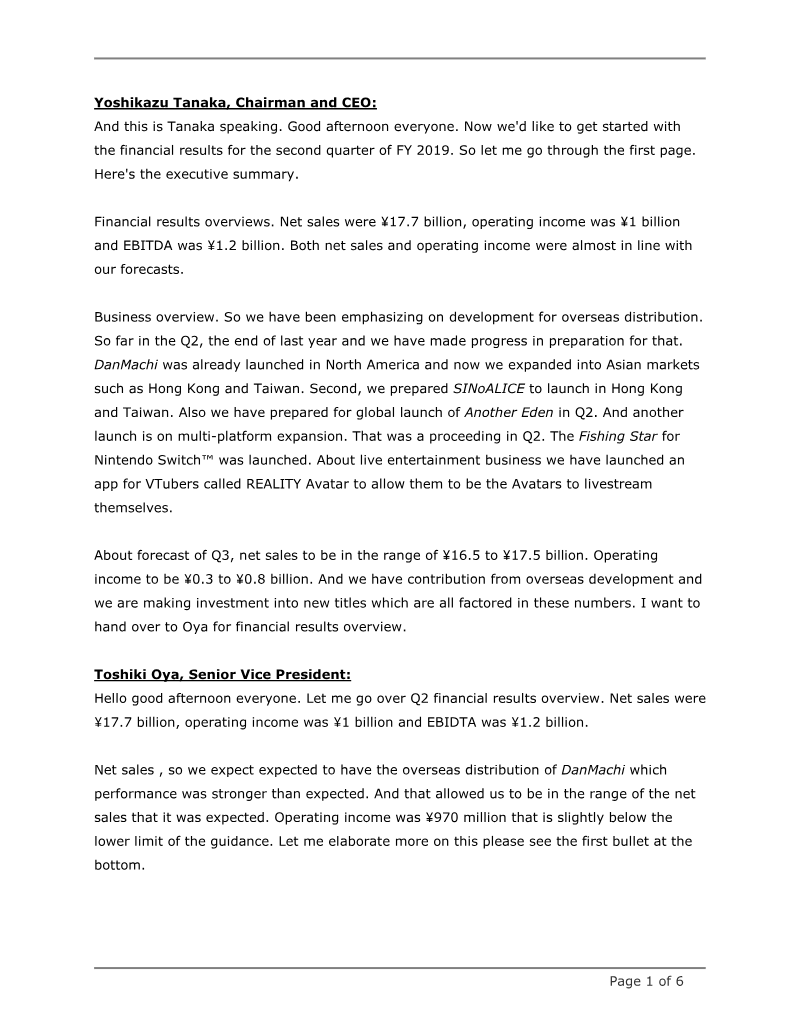
The second‑quarter fiscal 2019 results show net sales of ¥17.7 billion, operating income of ¥1.0 billion and EBITDA of ¥1.2 billion, aligning closely with forecasts after adjusting for a ¥160 million variable‑cost revision that had been misrecorded in the prior quarter. Operating margin stands at 5.4 %. Variable costs fell to ¥7.27 billion, aided by a ¥400 million reduction in advertising spend and declining commission fees; fixed costs rose by ¥430 million due to increased outsourcing for full‑scale development investment, bringing total costs to ¥16.76 billion.
Geographically, the company expanded overseas distribution of its flagship titles—DanMachi and SINoALICE—to Hong Kong, Taiwan, and North America, with another first‑party IP, Another Eden, slated for global self‑distribution. Multi‑platform releases included Fishing Star on Nintendo Switch and a new VTuber livestreaming app, REALITY Avatar. The company’s strategy emphasizes nurturing first‑party IPs to improve long‑term profitability, while maintaining third‑party titles and leveraging self‑distribution where possible.
For the third quarter, net sales are projected between ¥16.5 and ¥17.5 billion with operating income ranging from ¥300 to ¥800 million, reflecting continued investment in new titles and the expected impact of overseas expansion. The balance sheet remains solid, with fixed assets at ¥17 billion and investment securities valued at approximately ¥25 billion, including venture‑capital holdings. Overall, the company maintains confidence in its financial base while pursuing aggressive international growth and IP development.
- The company reported Q2 FY2019 net sales of ¥17.7 billion, operating income of ¥1.0 billion, and an operating margin of 5.4%.
- Operating costs totaled ¥16.76 billion, driven by a ¥430 million increase in fixed costs for development outsourcing, partially offset by a ¥400 million reduction in advertising spend.
- The company is prioritizing long-term profitability by expanding the global distribution of flagship IPs, including DanMachi, SINoALICE, and the upcoming self-distributed Another Eden.
- Q3 FY2019 projections estimate net sales between ¥16.5 billion and ¥17.5 billion, with operating income expected to fall between ¥300 million and ¥800 million due to ongoing development investments.
- The balance sheet remains stable with ¥17 billion in fixed assets and approximately ¥25 billion in investment securities, including venture-capital holdings.
+2
GREE
Financial4 pages
FY2019 3Q Presentation: Financial Results
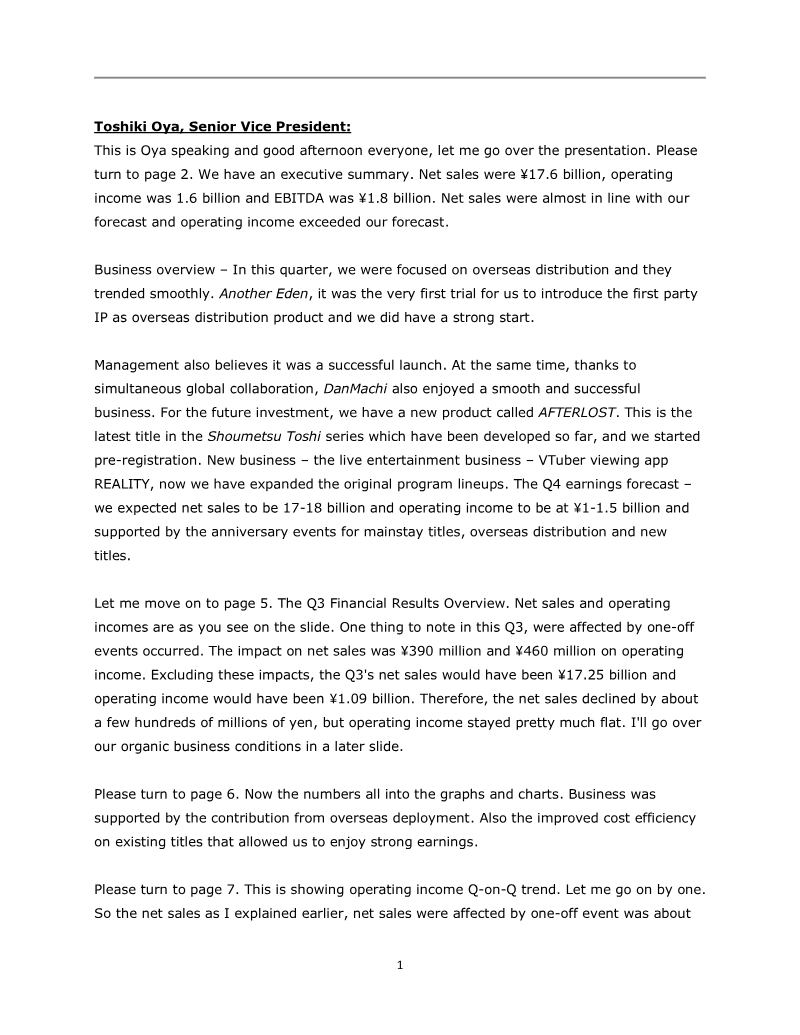
The presentation reports FY2019 Q3 financial results, highlighting net sales of ¥17.6 billion and operating income of ¥1.6 billion, both near forecasted targets with operating income exceeding expectations. Net sales were slightly impacted by one‑off events, reducing revenue by ¥390 million; after adjusting for these, organic sales were ¥17.25 billion and operating income ¥1.09 billion, indicating stable profitability despite a modest sales decline. Cost structure improvements—particularly reduced fixed costs through outsourcing and operational restructuring—offset higher advertising spend on overseas launches such as “Another Eden.”
Geographically, the company expanded its overseas distribution footprint, launching self‑distribution in eight countries for “Another Eden” and achieving a 1.5× increase in daily active users following a global collaboration with “Date A Live.” Domestic and overseas sales volumes have converged, supporting the company’s strategy to balance core titles with new IPs. New first‑party IP “AFTERLOST” entered pre‑registration, with a planned end‑of‑fiscal‑year release in Japan, Hong Kong, and Taiwan. The live entertainment arm “REALITY” continues to grow its VTuber viewing app lineup, while media and advertising partnerships broaden content offerings.
The Q4 forecast projects net sales of ¥17–18 billion and operating income of ¥1–1.5 billion, driven by anniversary events for flagship titles, ongoing overseas expansion, and the launch of “AFTERLOST.” The company maintains a stable investment level in promotions and development, anticipating future upside if new titles achieve hit status. The analysis is based on quarterly financial statements, operational metrics, and strategic rollout plans presented by senior management.
- FY2019 Q3 results reached ¥17.6 billion in net sales and ¥1.6 billion in operating income, with operating income exceeding initial forecasts.
- Adjusting for ¥390 million in one-off events, organic sales were ¥17.25 billion and operating income was ¥1.09 billion, reflecting stable profitability.
- The company achieved a 1.5× increase in daily active users for the title “Another Eden” following a global collaboration with “Date A Live” and expansion into eight new countries.
- Operational restructuring and increased outsourcing successfully reduced fixed costs, offsetting higher advertising expenditures for international title launches.
- The new first-party IP “AFTERLOST” is scheduled for release in Japan, Hong Kong, and Taiwan by the end of the fiscal year.
+3
GREE