1 free read left. Create a free account for unlimited reading + AI research.
Create free accountArticle gamevironments
1 free read left. Create a free account for unlimited reading + AI research.
Create free accountArticlegamevironments
Its video content was reportedly viewed more than 100 million times worldwide in the first days.
Scale. Gamescom 2019 drew roughly 373,000 visitors and over 1,100 exhibitors across 218,000 square meters.
This research report by Kathrin Trattner offers a critical retrospective of gamescom 2019, the world's largest gaming event held in Cologne, Germany, drawing on the author's one-day visit to the fair. Its central interest lies in the entanglements between politics and gaming that became visible at the event, particularly the presence of German state institutions and the broader question of how gaming culture is engaged with political and social issues. The piece combines firsthand observation with secondary commentary from journalists, scholars, and public figures, and it situates the event within the context of Germany's relationship to gaming and its youth audience.
The report establishes the scale of gamescom 2019, which drew roughly 373,000 visitors and over 1,100 exhibitors across 218,000 square meters, with video content reportedly viewed over 100 million times worldwide in the first days. Its main case studies are the German armed forces, whose recruitment booth featured a VR jet fighter simulator and drew criticism for conflating gaming with warfare, and the Verfassungsschutz of North Rhine-Westphalia, whose provocative booth used burned flag imagery and satire about Islamist radicalization. The author questions the legitimacy of a domestic intelligence agency conducting public education at a gaming fair, and argues that satirical depictions risked relying on religious and racial stereotypes.
A notable finding is the discrepancy between the visible political presence on the fairgrounds and the limited discussion occurring within the exhibition halls themselves, where critical engagement was largely absent. Political discourse was concentrated in the gamescom congress, where the opening panel featured major German parties but focused on practical policy issues such as federal game funding and internet infrastructure while omitting topics like online hate speech and extremist use of gaming platforms. The report suggests that sociopolitical reflection occurred mainly at the margins of the event, and that gamers are increasingly recognized as a politically significant demographic.
The analysis is qualitative and reflective rather than systematic, based on a single day of attendance supplemented by media reports, podcasts, and public statements. Its scope is limited to one event in one country, and its conclusions are interpretive, though it situates gamescom 2019 as a useful lens on the broader integration of gaming, politics, and public institutions in contemporary Germany.
gamevironments · 2026
gamevironments · 2026
gamevironments · 2026
gamevironments · 2026
gamevironments · 2026
gamevironments · 2025
gamevironments · 2025
gamevironments · 2025
gamevironments · 2025
gamevironments · 2025
gamevironments · 2025
gamevironments · 2025
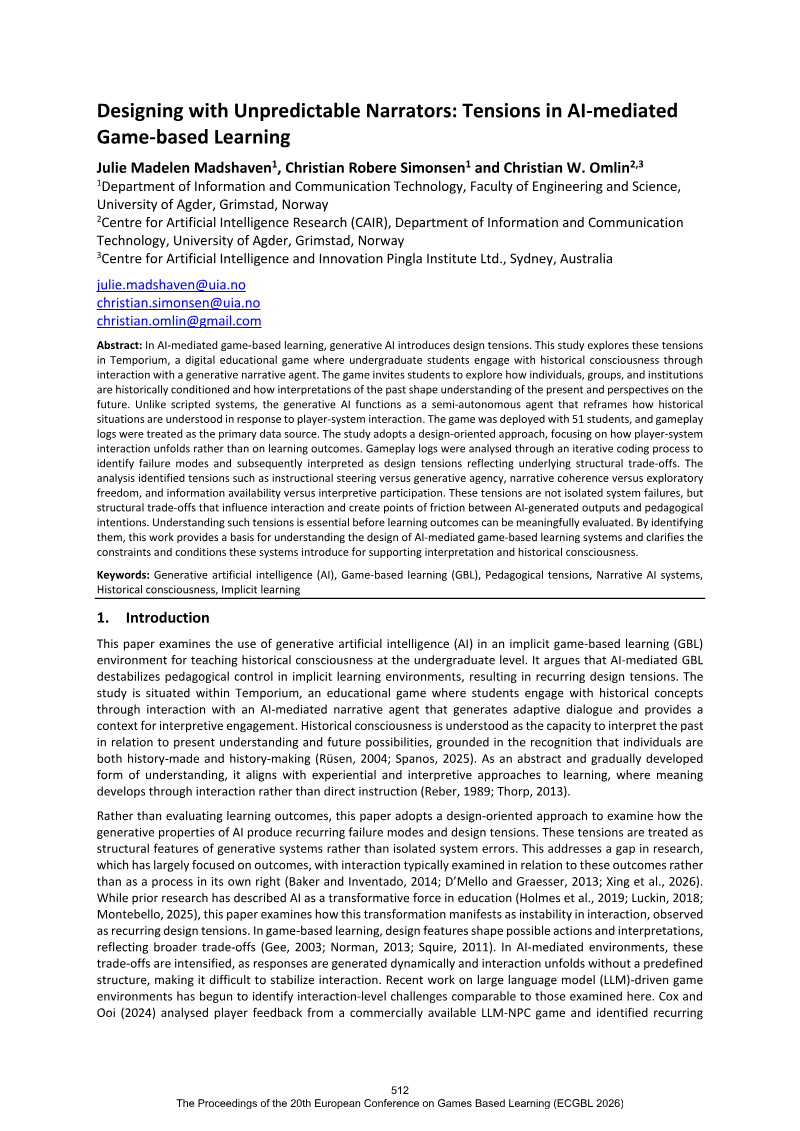
European Conference on Games Based Learning (ECGBL) · 2026



European Conference on Games Based Learning (ECGBL) · 2026
The Game Business · 2026