
Game Developers Conference
Game Developers Conference (GDC, now the GDC Festival of Gaming) is the professional event for the games industry. It publishes recorded talks and interviews, annual industry survey reports such as the State of the Game Industry, and news articles.
Documents
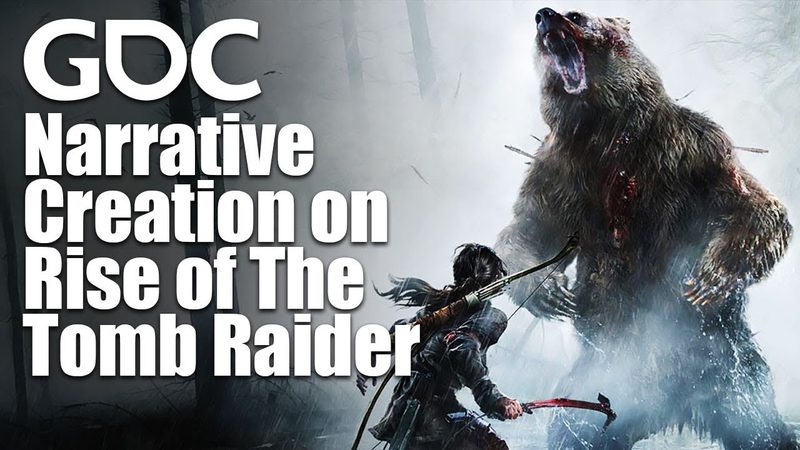
Raid on Rise: Narrative Creation on Rise of The Tomb Raider
The narrative development of Rise of the Tomb Raider centers on a collaborative, cross-disciplinary framework that rejects isolated creative silos in favor of studio-wide world-building.
- Crystal Dynamics utilizes a 'story pillar' framework for narrative development, centered on a three-act structure where the protagonist's character arc serves as the primary backbone of the entire experience.
- The narrative team employs a holistic tracking system using digital boards and hashtags to map out all character arcs and plot threads, allowing them to proactively manage emotional pacing and identify potential narrative logjams.
- To ensure internal consistency and world-building veracity, the team conducts deep research into historical and archaeological subjects, aiming for 'plausible Google-ability' so players can verify game elements against real-world facts.
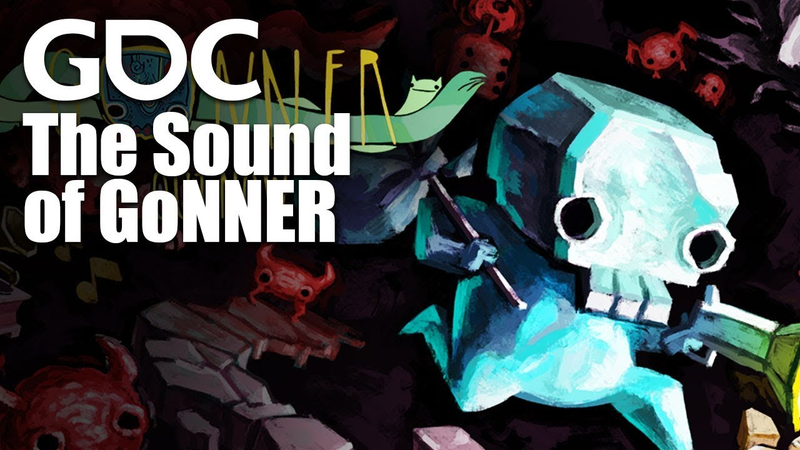
The Sound of GoNNER: Exploring the Intertwined Relationship Between Sound and Game Design
The development of the roguelike platformer GoNNER serves as a case study for the symbiotic relationship between sound design and game mechanics.
- The development of GoNNER relied on a rapid, iterative workflow where the team prioritized speed over perfection, operating under the motto: 'If you can't do it quickly enough, there's probably a better way.'
- The project utilized a 'placeholder' philosophy for both sound and design, which reduced creative friction and allowed the team to experiment freely without the pressure of finality.
- The audio-visual feedback loop involved the sound designer generating hundreds of synth-based sounds in short bursts, which were then rapidly implemented and tested by the game designer to see what felt satisfying in the moment.
Procedurally Generating History in Caves of Qud
The procedural history system in Caves of Qud prioritizes the creation of evocative, mythic narratives over the implementation of a computationally expensive, bottom-up historical simulation.
- Caves of Qud prioritizes evocative, mythic narrative generation over computationally expensive, bottom-up historical simulations.
- The system focuses on the lives of five ancient Sultans, using their biographies as the foundation for world-building artifacts like shrines and paintings.
- Historical complexity is managed through a constrained set of exactly twelve specific triggers that govern life events and faction relationships.
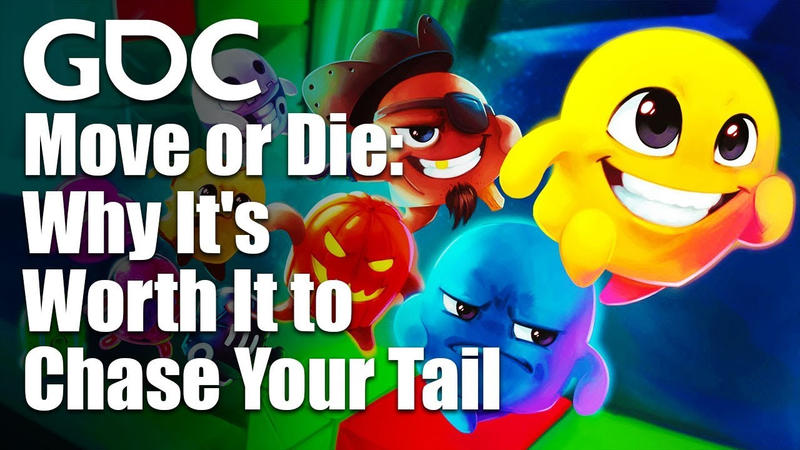
Move or Die: Why It's Worth It to Chase Your Tail
The success of the multiplayer title Move or Die demonstrates that long-term viability in the independent games market relies on a symbiotic relationship between developers and their community.
- Success for 'Move or Die' was not driven by a single event, but by a continuous stream of updates, community engagement, and strategic marketing over a two-year period that resulted in over 500,000 players.
- Early Access was used as a financial necessity rather than a design choice, with the developer maintaining transparency by explicitly instructing players not to buy the game until it was polished.
- Strategic collaborations, such as integrating Rick and Morty characters, were timed to coincide with external events like the Steam Summer Sale to maximize visibility and press coverage.
Architecting a Multiverse - Cooperative Design in Dead Space 3
The integration of cooperative play into the Dead Space franchise required a sophisticated architectural approach to preserve the series' signature horror atmosphere while accommodating two simultaneous players.
- Developers implemented a multiverse narrative structure to enable seamless transitions between solo and cooperative campaigns without requiring a complete overhaul of existing game systems.
- The team utilized desynchronized assets to trigger character-specific hallucinations, allowing players to experience fractured realities independently to maintain the series' signature sense of isolation and horror.
- Memory management was optimized through modified door-streaming logic, which allowed for stable technical performance while supporting the addition of cooperative-specific content.
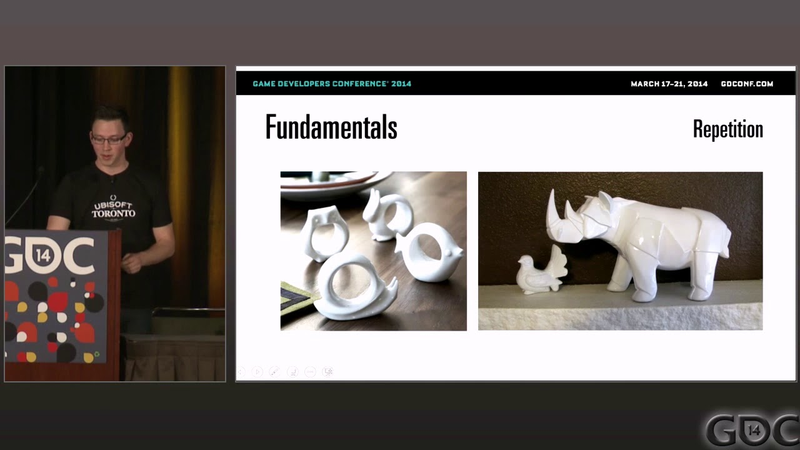
What Modern Interior Design Teaches Us About Environment Art
Modern interior design offers a robust framework for environment artists to improve the clarity, flow, and narrative quality of game spaces.
- Environment artists should shift from 2D-focused film and game references to 3D interior design principles to better balance aesthetic form with functional player navigation.
- Design principles such as lighting, contrast, and emphasis can be used to intuitively guide player behavior and highlight interactive elements without relying on heavy-handed visual cues.
- Applying the 60-30-10 color rule helps maintain visual balance and prevents environments from becoming cluttered or overwhelming.
On All Fours: Creating Realistic Quadruped Motion
This presentation outlines a practical, performance-oriented approach to animating quadruped locomotion within real-time environments, specifically developed for the Microsoft HoloLens.
- Realistic quadruped locomotion in resource-constrained environments like the Microsoft HoloLens is best achieved through procedural spine manipulation rather than computationally expensive full-body inverse kinematics.
- Path generation for quadrupeds requires a two-stage process: an initial A search followed by refinement using the Chambolle-Pock primal-dual optimization algorithm to ensure waypoints remain within valid navigation nodes.
- Spine flexing, a technique that uniformly rotates spine bones to align the character's body with path curvature, provides more fluid movement than blending canned animations, which often suffer from transition and positioning errors.
The Missing Link - Bungie's Technical Designers in Animation
The role of the Technical Designer in Animation (TDIA) serves as a critical cross-disciplinary bridge within Bungie’s development structure, specifically designed to facilitate communication and workflow between animation, design, and engineering teams.
- Bungie established the Technical Designer in Animation (TDIA) role to act as a cross-disciplinary bridge, eliminating production silos between animation, design, and engineering teams.
- The TDIA role focuses on liberating creative talent by managing complex technical tasks such as vehicle interaction, AI state machine setup, and runtime debugging.
- By providing real-time debugging tools and simplifying the transition from Maya to the game engine, TDIA professionals reduce production costs and prevent technical bottlenecks.
A Long Dark Road: Blending Player and Authored Story in a Sandbox Survival Game
The development of The Long Dark illustrates the complex tension between authored narrative and emergent, player-driven gameplay within the sandbox survival genre.
- Hinterland Games separated 'The Long Dark' into distinct sandbox and story modes to allow for an Early Access launch without spoiling narrative content, a strategy that resulted in 250,000 players in the first three months and 500,000 within the first year.
- The long-term separation of sandbox and story modes created a dissonance in player expectations, as the sandbox community became accustomed to a non-narrative experience and resisted the shift toward a more linear, authored story.
- Development of a narrative mode in a sandbox game should ideally integrate with existing systems rather than creating a split experience, as seen in titles like 'Subnautica' and 'The Forest' which successfully blended both approaches.

Tools Tutorial Day: Tools to Reduce Open Bug Count at Media Molecule
Media Molecule maintains a highly stable development environment for user-generated content titles by prioritizing engine determinism and integrating bespoke automation tools.
- Media Molecule achieves high stability by enforcing engine-level determinism, which allows for the serialization of game states and inputs to ensure reliable bug reproduction.
- The 'Autobot' automation system utilizes a large-scale farm of development kits to continuously monitor for crashes and hangs across the build environment.
- A custom web dashboard and Chrome extension integrate Jira and Perforce to automatically populate bug reports with critical diagnostic data, including call stacks, performance metrics, and video replays.
Rocket League: Language Ban System Postmortem
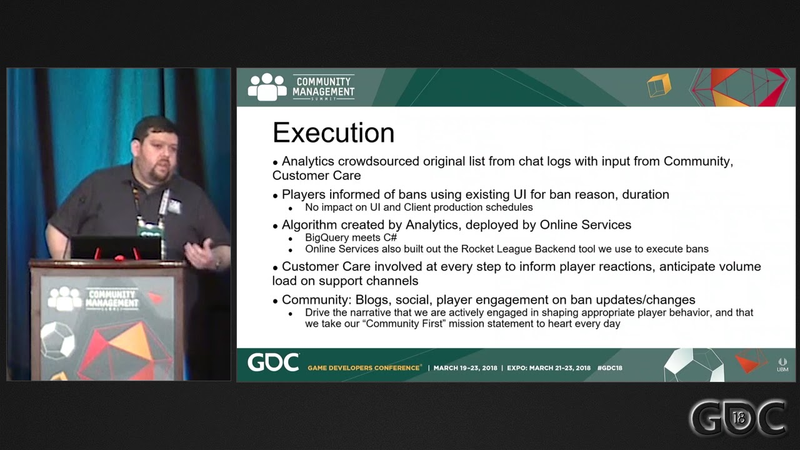
To combat rising toxicity within Rocket League, Psyonix implemented an automated, data-driven moderation framework designed to enforce community standards through tiered, escalating penalties.
- Psyonix implemented an automated language ban system for Rocket League that uses a data-driven 'gram' threshold, where players are escalated through a penalty ladder starting at 24 hours up to two weeks for repeated offenses.
- The system relies on active player reports rather than proactive chat scanning, allowing for context-dependent moderation that avoids penalizing friends who use informal language within private parties.
- To encourage behavior modification, the system includes a de-escalation mechanic where players who maintain good conduct for 30 days see their strike count reduced, preventing long-term accumulation of penalties for one-off incidents.
Tools-Based Rigging in Bungie's Destiny
Bungie’s approach to character rigging for the Destiny franchise centers on a modular, Python-based architecture designed to overcome the limitations of traditional, static animation pipelines.
- Bungie developed a modular rigging system for Destiny using Python and Pymel in Autodesk Maya, utilizing object-oriented programming to manage thousands of animation files efficiently.
- The rigging architecture relies on 'rig components'—independent, reusable Python classes that can be added or removed from a character's rig dynamically without breaking existing animation data.
- To maintain agility during engine development, the team implemented a 'rig template' system that assembles these modular components into complete control rigs for characters, vehicles, and props.