1 free read left. Create a free account for unlimited reading + AI research.
Create free accountArticle G|A|M|E – The Italian Journal of Game Studies
1 free read left. Create a free account for unlimited reading + AI research.
Create free accountArticleG|A|M|E – The Italian Journal of Game Studies
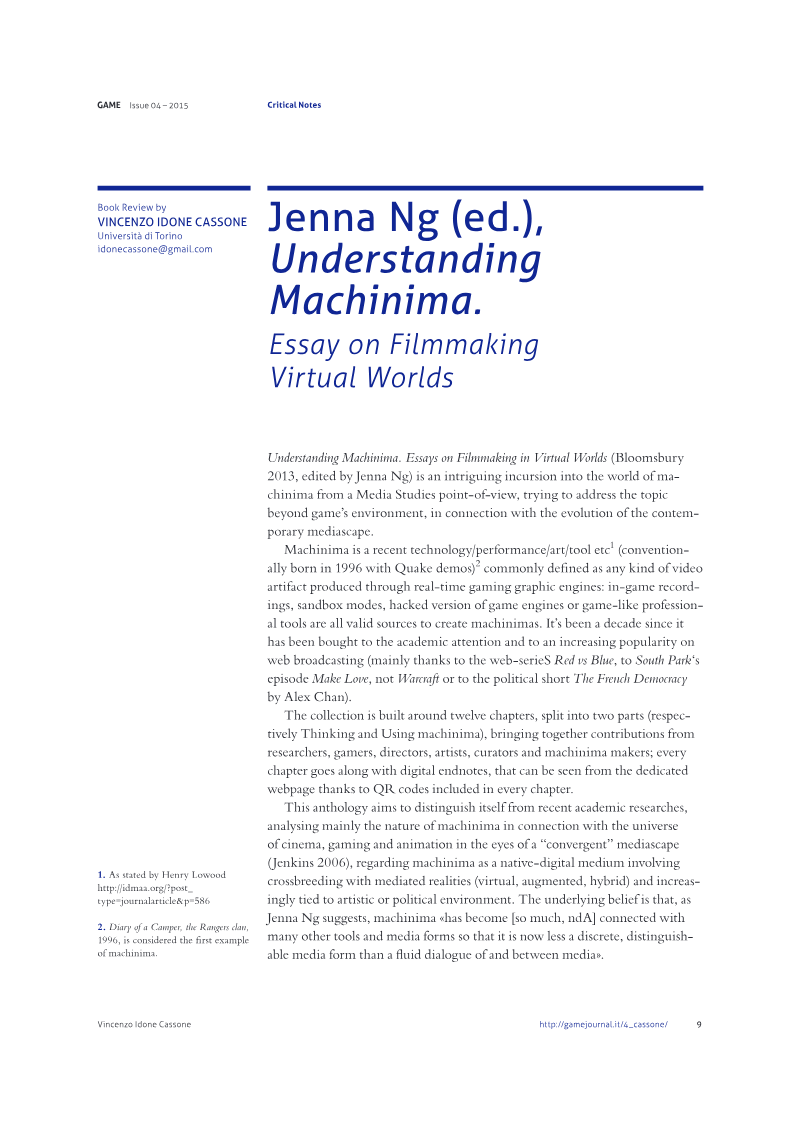
Understanding Machinima, edited by Jenna Ng and published by Bloomsbury, gathers twelve chapters on video made with real-time game graphics engines.
This review examines Understanding Machinima: Essays on Filmmaking in Virtual Worlds, an anthology edited by Jenna Ng and published by Bloomsbury in 2013, which approaches machinima, video produced through real-time game graphics engines, from a Media Studies perspective. The collection's twelve chapters, divided into "Thinking" and "Using" machinima, bring together contributions from researchers, gamers, directors, artists, curators, and machinima makers. The reviewer characterizes the volume as an attempt to move beyond game-centered analysis and situate machinima within a convergent contemporary mediascape, treating it as a native digital medium shaped by cinema, gaming, animation, and fandom.
The review identifies several recurring themes across the essays. The first is machinima's hybrid nature, which resists easy categorization and raises the question of whether it should be defined by its distinctions from other media or accepted as a fully hybrid form. Related debates concern whether machinima should develop an independent visual language or accept a "minor" position within established media, and whether it is moving toward cinematic conventions or a distinctive "gamish" aesthetic. The reviewer also notes arguments that machinima functions as a form of digital puppetry and as a capture-based technique for documenting persistent virtual worlds.
The review highlights expanding applications beyond gaming, including digital art, political activism, live performance, and game culture jamming, as well as pedagogical uses in which learning to make machinima develops digital literacies. It also raises ethical concerns about filming avatars and about players unwillingly becoming participants in in-game interventions. The reviewer concludes that the book is well written and engaging, though best suited to readers already familiar with media theory, and sees it as a starting point for further research on machinima's relationship to digital animation, game art, cinema, and activism.
G|A|M|E – The Italian Journal of Game Studies · 2026
G|A|M|E – The Italian Journal of Game Studies · 2026
G|A|M|E – The Italian Journal of Game Studies · 2026
G|A|M|E – The Italian Journal of Game Studies · 2026
G|A|M|E – The Italian Journal of Game Studies · 2026
G|A|M|E – The Italian Journal of Game Studies · 2026
G|A|M|E – The Italian Journal of Game Studies · 2026
G|A|M|E – The Italian Journal of Game Studies · 2026
G|A|M|E – The Italian Journal of Game Studies · 2026
G|A|M|E – The Italian Journal of Game Studies · 2026
G|A|M|E – The Italian Journal of Game Studies · 2026
G|A|M|E – The Italian Journal of Game Studies · 2026













Comments