1 free read left. Create a free account for unlimited reading + AI research.
Create free accountWhitepaper G|A|M|E – The Italian Journal of Game Studies
1 free read left. Create a free account for unlimited reading + AI research.
Create free accountWhitepaperG|A|M|E – The Italian Journal of Game Studies
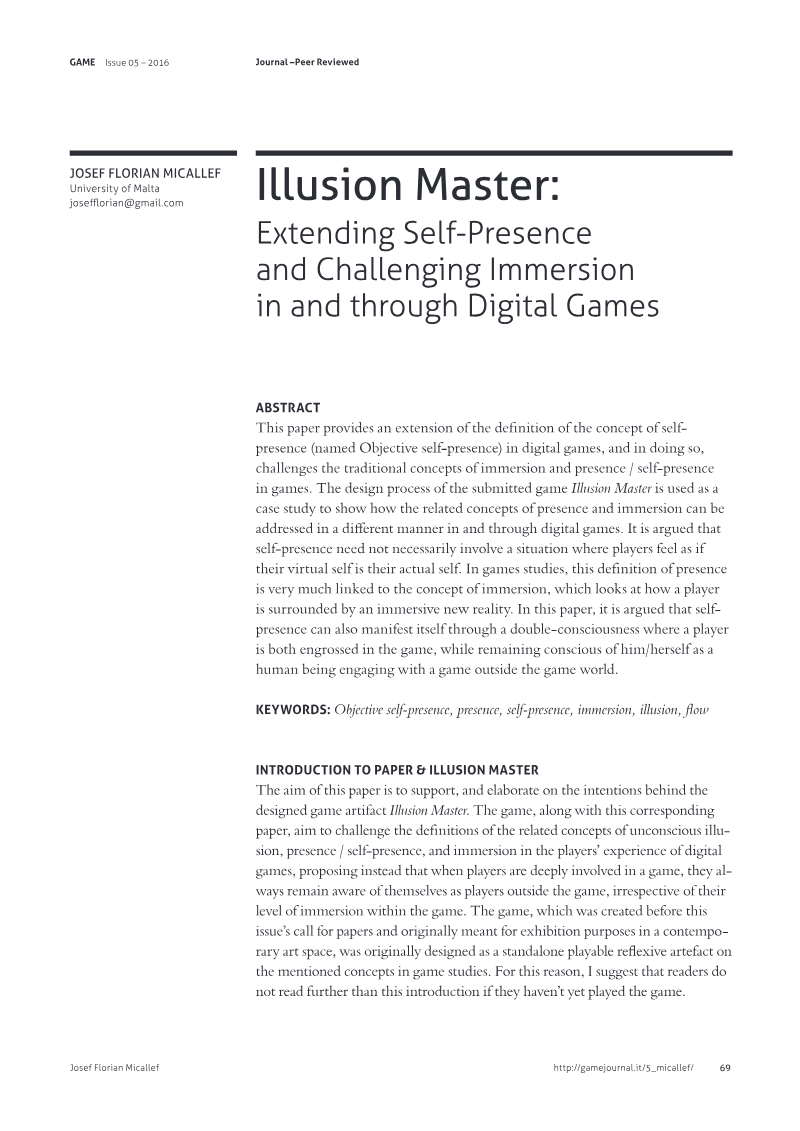
Micallef argues that players do not lose awareness of themselves as players once absorbed in a virtual world. Existing presence and immersion theories underplay this reflective dimension.
Micallef's paper, "Illusion Master: Extending Self-Presence and Challenging Immersion in and through Digital Games," argues that players of digital games do not lose awareness of themselves as players once absorbed in a virtual world, and that existing theories of presence and immersion underplay this reflective dimension. To account for it, the author proposes "objective self-presence," a state in which players remain absorbed in the game while becoming reflectively conscious of their own involvement with the technology. The argument positions this concept against traditional accounts that assume total transport into the game world, including Salen and Zimmerman's critique of the "immersive fallacy" and Vella's subjective and objective player-figure model. The paper also surveys overlapping and sometimes ambiguous concepts across the presence, immersion, flow, and illusion literatures, drawing on work by Lombard and Ditton, Biocca, Murray, Csikszentmihályi, and Grau.
The theoretical claims are tested through the design of Illusion Master, a short, retro-styled casual platformer built around a three-button control scheme, nostalgic aesthetics, positive fictions, and flow-based difficulty. Its immersive features are deliberately dismantled late in play, when the player must recognize that they hold the power of the illusion and must stop playing in order to win. The author presents this as a direct intervention into conventional conceptions of immersion rather than a stylistic device. The game's feedback systems include sound cues, a five-point levelling structure, and a progress bar, while difficulty is adjusted through ghost speed tied to performance, with two colour-coded ghosts added after early prototypes proved too easy.
The paper's evidence base is primarily qualitative. Observations from prototype play inform the design adjustments, and the final boss encounter, in which the player must cease shooting to succeed, is interpreted as the moment the player becomes objectively self-present. No quantitative playtesting data is reported, which limits the empirical strength of the conclusions, though the work offers a clear conceptual extension of self-presence theory and a concrete design case for challenging assumptions about immersion in digital games.
G|A|M|E – The Italian Journal of Game Studies · 2026
G|A|M|E – The Italian Journal of Game Studies · 2026
G|A|M|E – The Italian Journal of Game Studies · 2026
G|A|M|E – The Italian Journal of Game Studies · 2026
G|A|M|E – The Italian Journal of Game Studies · 2026
G|A|M|E – The Italian Journal of Game Studies · 2026
G|A|M|E – The Italian Journal of Game Studies · 2026
G|A|M|E – The Italian Journal of Game Studies · 2026
G|A|M|E – The Italian Journal of Game Studies · 2026
G|A|M|E – The Italian Journal of Game Studies · 2026
G|A|M|E – The Italian Journal of Game Studies · 2026
G|A|M|E – The Italian Journal of Game Studies · 2026
European Conference on Games Based Learning (ECGBL) · 2026
DiGRA · 2026
DiGRA · 2025