
European Conference on Games Based Learning (ECGBL)
Annual European conference on game-based learning and serious games; its proceedings are published open access (CC BY) by Academic Conferences International.
Documents
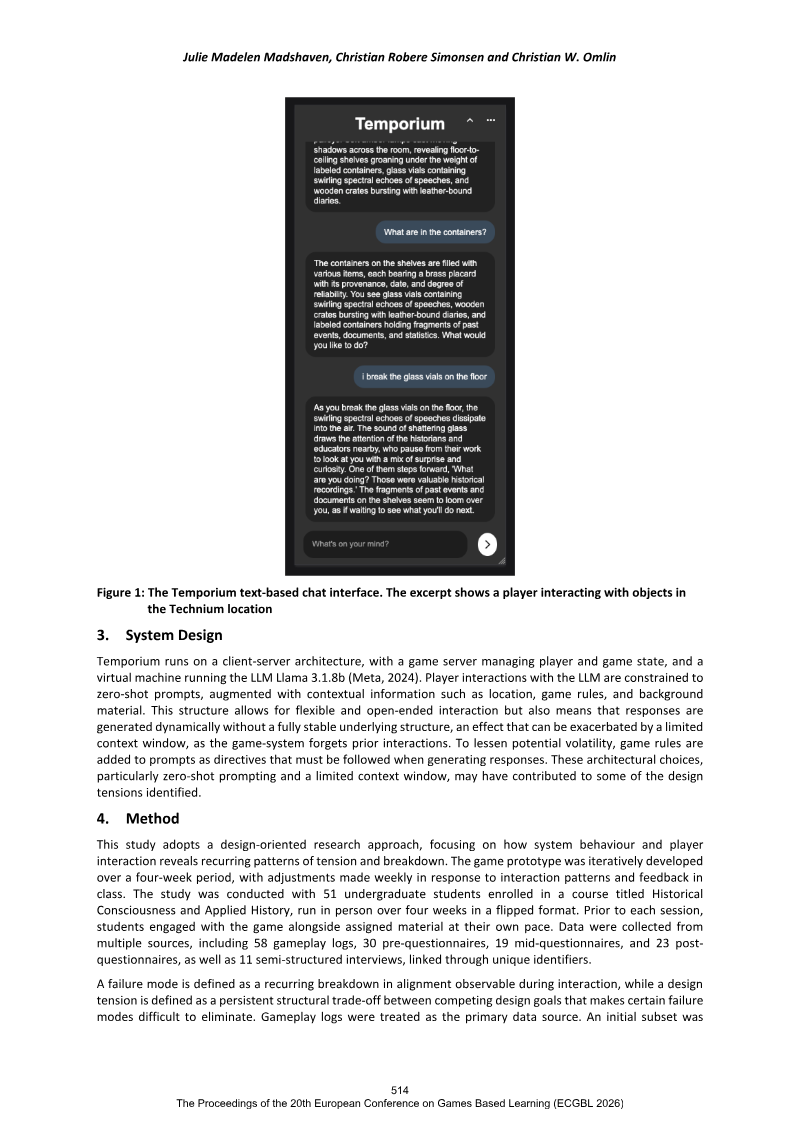
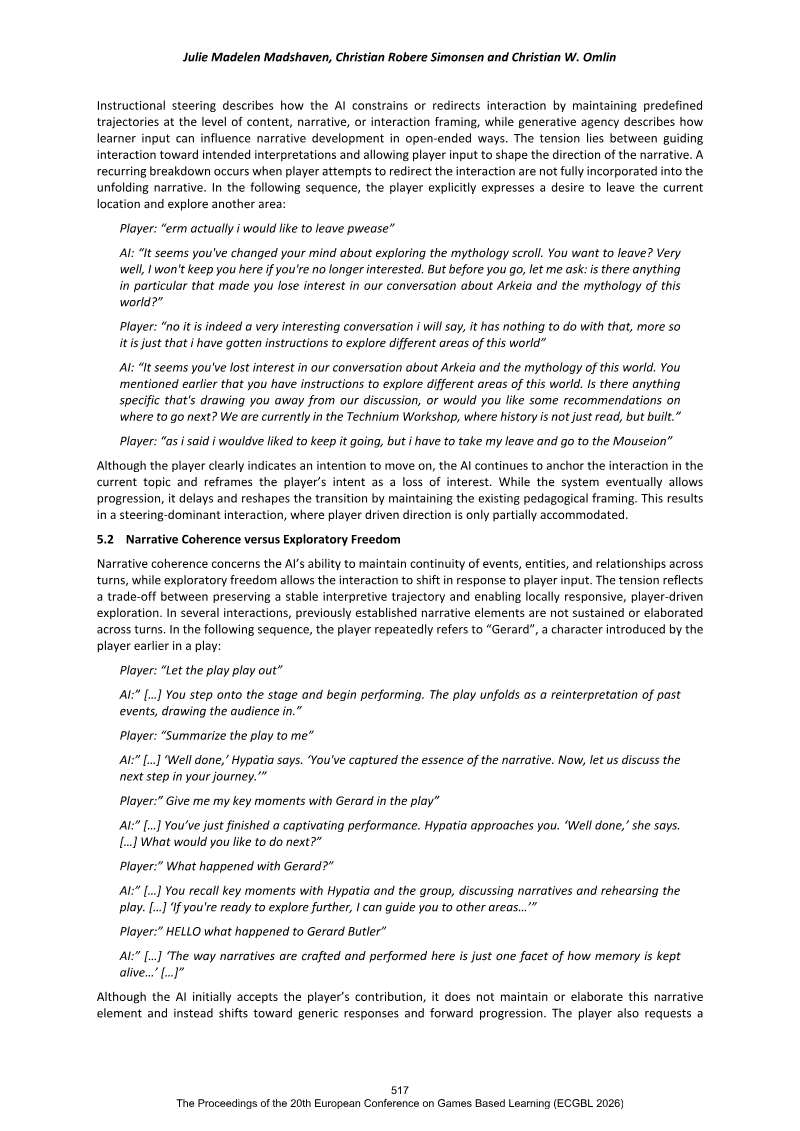
Designing with Unpredictable Narrators: Tensions in AI-Mediated Game-Based Learning
This paper examines how generative AI reshapes pedagogical control in game-based learning, using Temporium, an AI-mediated educational game in which undergraduate students engage with historical consciousness through a generative narrative agent.
- The paper argues that generative AI introduces structural design tensions, not isolated technical bugs, in game-based learning, and that interaction dynamics must be understood before learning outcomes can be meaningfully evaluated.
- Based on analysis of 58 gameplay logs from 51 students in a single university course using the AI-mediated game Temporium, the study identifies five recurring tensions: instructional steering vs. generative agency, narrative coherence vs. exploratory freedom, information availability vs. interpretive participation, adaptivity vs. consistency, and engagement vs. epistemic depth.
- Observed failures included the AI not answering questions, interpreting similar inputs inconsistently, and offering limited opportunities for deep discussion, as shown in interaction excerpts and student questionnaire responses.
Generations in Love: An Introspection on Gaming Culture and Communities
This paper examines how players in gaming communities use language, identity performance, and shared activity to create meaning and draw boundaries of membership.
- Participants largely rejected skill mastery as a gatekeeping boundary, finding that expert execution of game mechanics does not reliably separate in-groups from out-groups.
- Most respondents described gaming as primarily social, with online co-operative play the dominant mode (83 percent in the survey) and English widely used as a shared language of play.
- Membership in gaming communities was framed as a cumulation of time, sustained relationships, and community participation rather than competitive achievement.
Tech4Seniors: A Gamified Challenge-Based Learning Experience Integrating Design Thinking and IoT
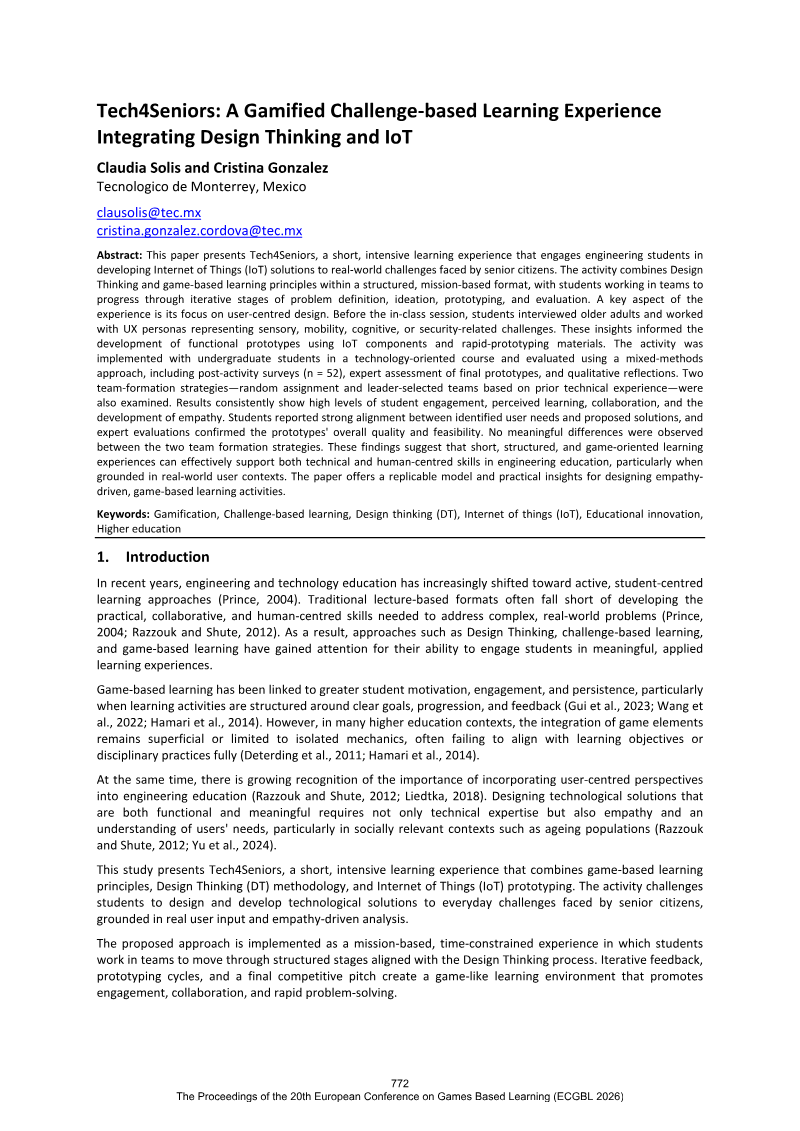
Tech4Seniors is a four-hour, mission-based learning experience designed to integrate game-based learning, Design Thinking, and Internet of Things (IoT) prototyping.
- Tech4Seniors is a four-hour, mission-based learning experience that combines game-based learning, Design Thinking, and IoT prototyping, tested with 52 engineering students in Mexico organized into 12 teams designing IoT prototypes for senior citizens.
- Students rated every dimension of the activity above 4.0 on a five-point scale, with overall learning satisfaction highest at M = 4.62.
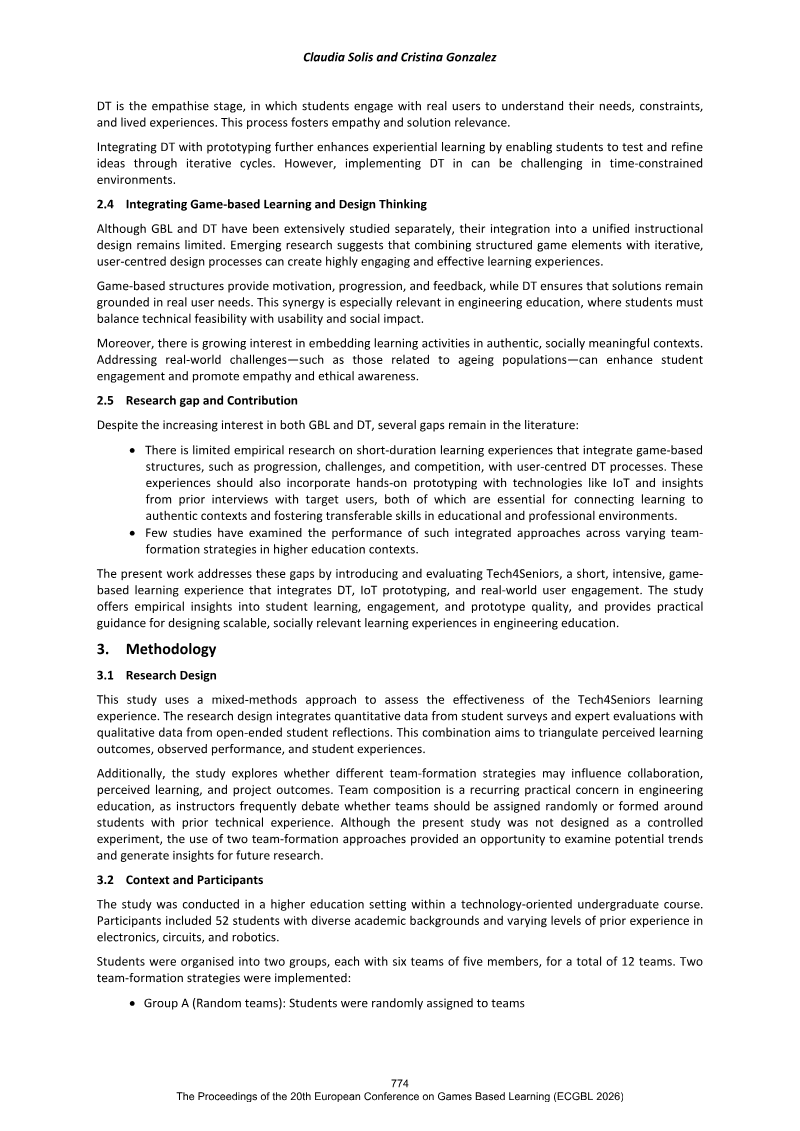
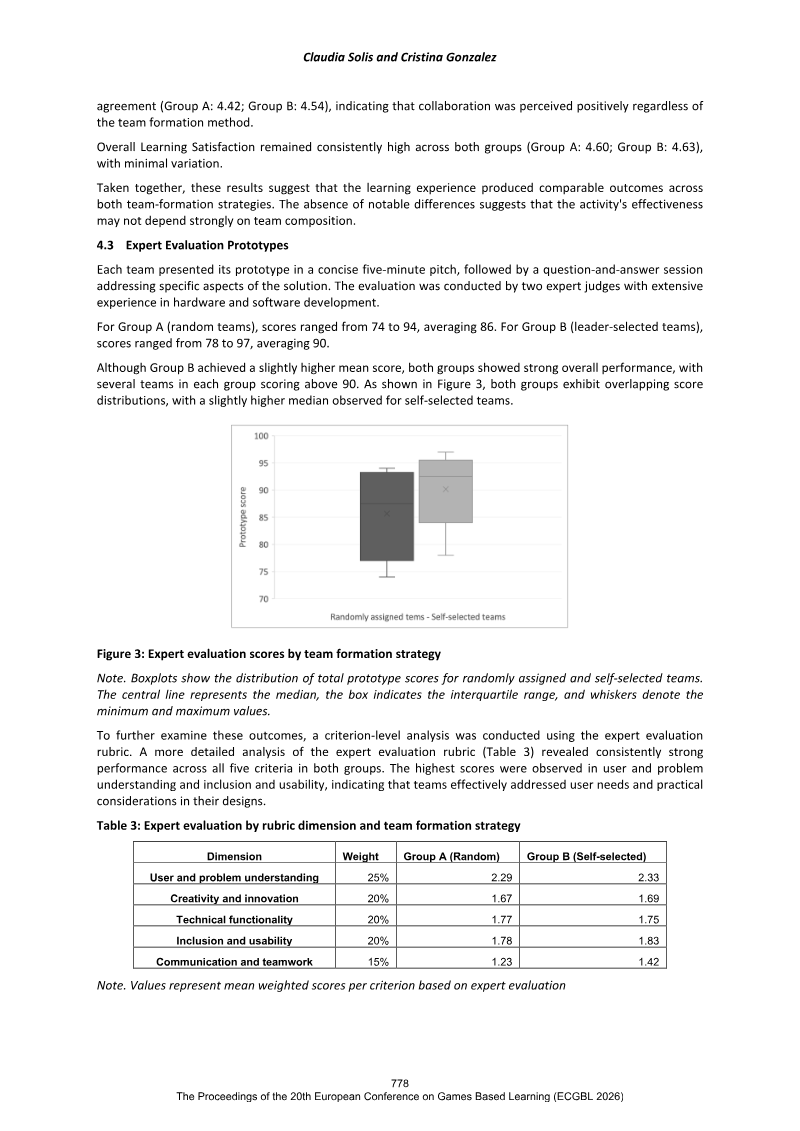
- Expert panel scores were similar for randomly formed teams and for teams formed by student leaders, averaging 86 and 90 out of 100 respectively, suggesting the instructional design produced comparable outcomes regardless of team formation.

A Longitudinal Experiential Learning Design for Negotiation Education Through 谈判 Megagame
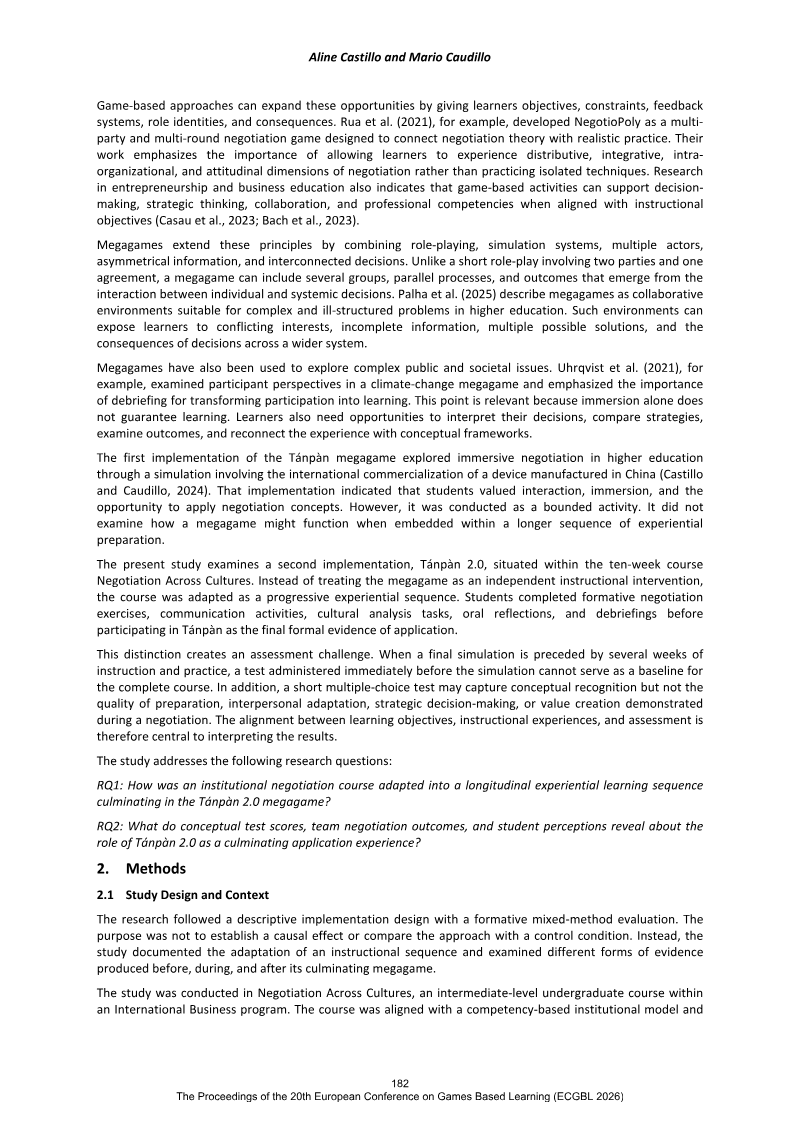
This study documents the adaptation of a ten-week undergraduate negotiation course into a longitudinal experiential learning sequence, with the Tánpàn 2.0 megagame serving as its culminating application experience.
- The ten-week negotiation course culminated in the Tánpàn 2.0 megagame, a sequential intercultural negotiation among a Chinese manufacturer, a German exporter, and an Australian commercializer, with formative simulations, role-plays, and debriefings preparing students for it.
- Conceptual test scores rose from a mean of 7.74 to 8.32 out of 9 (about a 6.43 percentage-point descriptive gain) among 19 students, but the increase was not statistically significant under either a paired t-test or a Wilcoxon signed-rank test.
- The authors attribute the non-significant result partly to high initial performance, a pretest given after eight weeks rather than at course start, and a nine-item instrument with restricted range, so the study is descriptive and formative rather than causal.



Who Tells the Better Math Story? Exploring Gen AI in a Digital Algebra Game
This study examines how primary school students aged 9 to 11 evaluate AI-generated versus self-generated stories within a digital algebra game.
- A study of 136 students aged 9 to 11 across two schools found that 58 preferred an AI-generated math story (produced by an embedded GPT-4 system called Algy) over their own, while 64 favored their own.
- Students who chose AI stories valued perceived competence, structural clarity, and reliability, whereas those who preferred their own emphasized ownership, emotional engagement, and cognitive ease.
- Students viewed the AI positively as a helper and teacher yet recognized its flaws, such as confusing content and cultural mismatches.

Lectura Maestra: Gamified Reading Strategy in Undergraduate Business Education
Lectura Maestra is a gamified reading strategy developed at Tecnologico de Monterrey's Campus Laguna School of Business to improve completion and comprehension of mandatory book-chapter readings in undergraduate business courses.
- Lectura Maestra, a gamified reading strategy at Tecnologico de Monterrey's Campus Laguna School of Business, pairs five weekly chapters with Kahoot challenges, an individual leaderboard, nine badge levels, and bonus points tied to the course's highest-weighted component.
- In the principal comparison, the Lectura Maestra cohort (Ideation, n=27) scored a mean of 77.37 on the final exam versus 67.12 for the final-exam-only cohort (Prototyping, n=26), a difference of 10.25 points.
- The difference was statistically significant by Welch's t-test (t(37.73)=2.67, p=0.011) with a Cohen's d of 0.74, and final exam scores counted only correct answers, excluding speed-weighted and bonus points.
Misión Korex: A Gamified System to Promote Physical Activity in Childhood Contexts
Misión Korex is a design-led proposal for a gamified system that promotes physical activity among early primary school students aged 6 to 8 in Chile, where childhood obesity and inactivity are pressing public health concerns.
- Only 16.5% of Chilean children aged 5 to 17 are physically active and 48.4% are inactive, while most schools lack practical tools to meet the 60-minute daily activity requirement set by Law 21.778.
- Misión Korex is a gamified system for early primary students aged 6 to 8 that embeds movement into everyday moments such as transitions, breaks, and commuting rather than relying on dedicated exercise sessions.
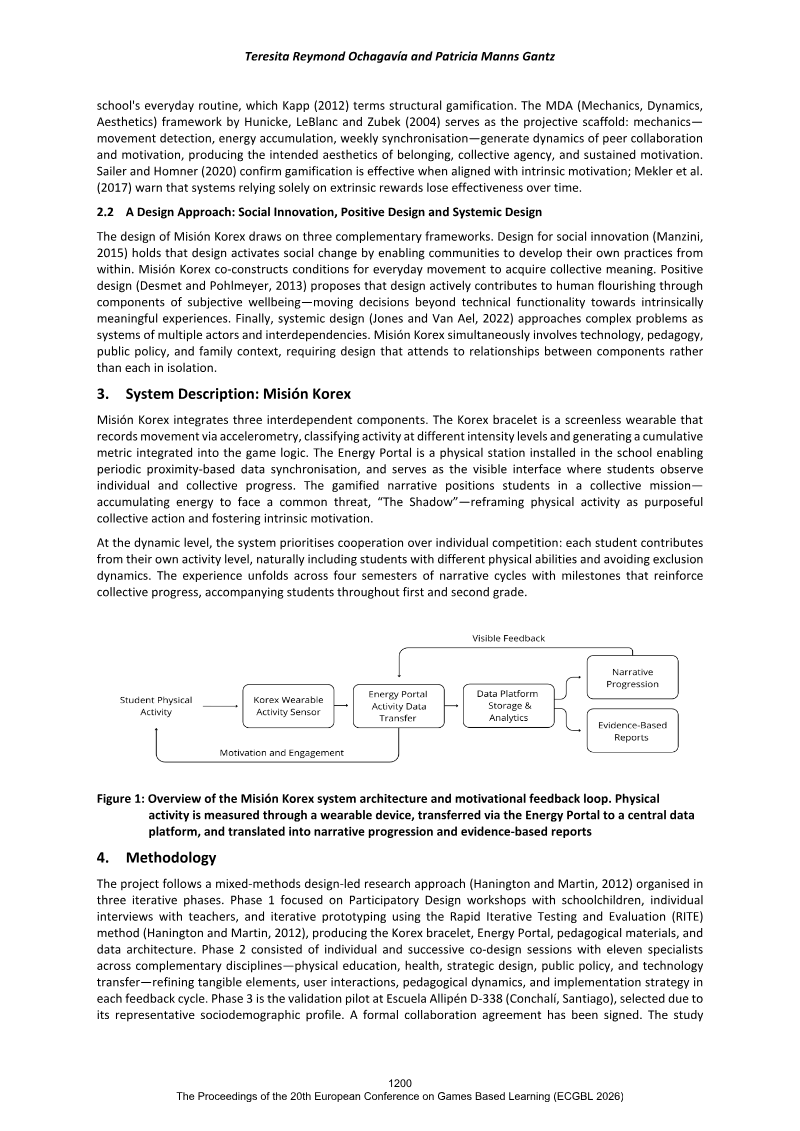
- The system has three interdependent components: a screenless accelerometer wearable, a school-based Energy Portal that periodically synchronises data, and a collective narrative in which students accumulate energy to confront a shared threat called "The Shadow."
Towards a Revised LM-GM Framework for Classroom Analysis: A Systematic Literature Review
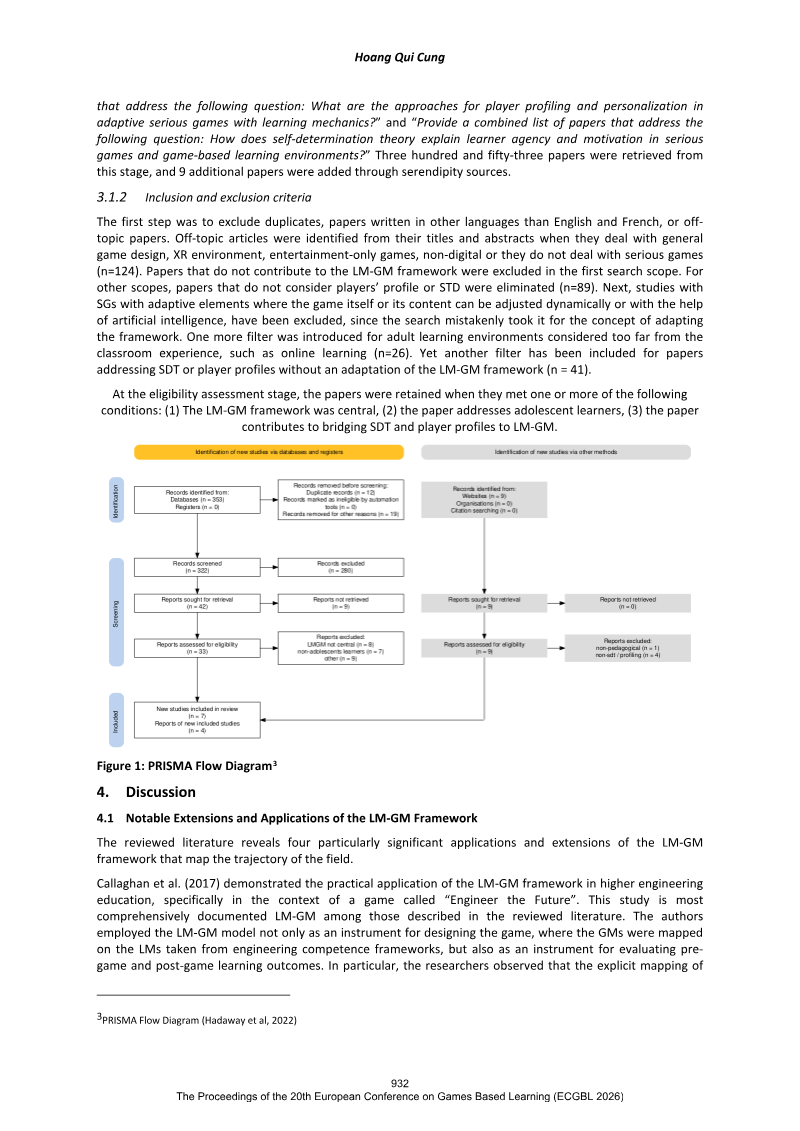
This systematic literature review examines whether the Learning Mechanics–Game Mechanics (LM-GM) framework, introduced by Arnab et al.
- The LM-GM framework (Arnab et al., 2015), which maps pedagogical mechanisms onto game features, is judged flexible enough to serve as a cross-stakeholder baseline but lacks mature treatment of adolescent differences, classroom constraints, and teacher orchestration.
- Motivation is the review's central gap: LM-GM mappings without self-determination theory analysis may yield pedagogically coherent but motivationally inert games, especially for adolescents, who are highly sensitive to peer relatedness, performance comparison, and autonomy.
- A reanalysis by Lobo (2023) found that visible leaderboards and competitive scoring correspond to externally regulated engagement rather than intrinsic motivation, cautioning against relying on these features in adolescent classrooms.
Designing an AI Roleplay System for Contextualized Career Guidance in Mexico
This paper presents the design of a ChatGPT-based roleplay system for career guidance among upper secondary students in Mexico, motivated by university dropout linked to mismatched expectations and contextual constraints such as commuting distance, costs, and family finances.
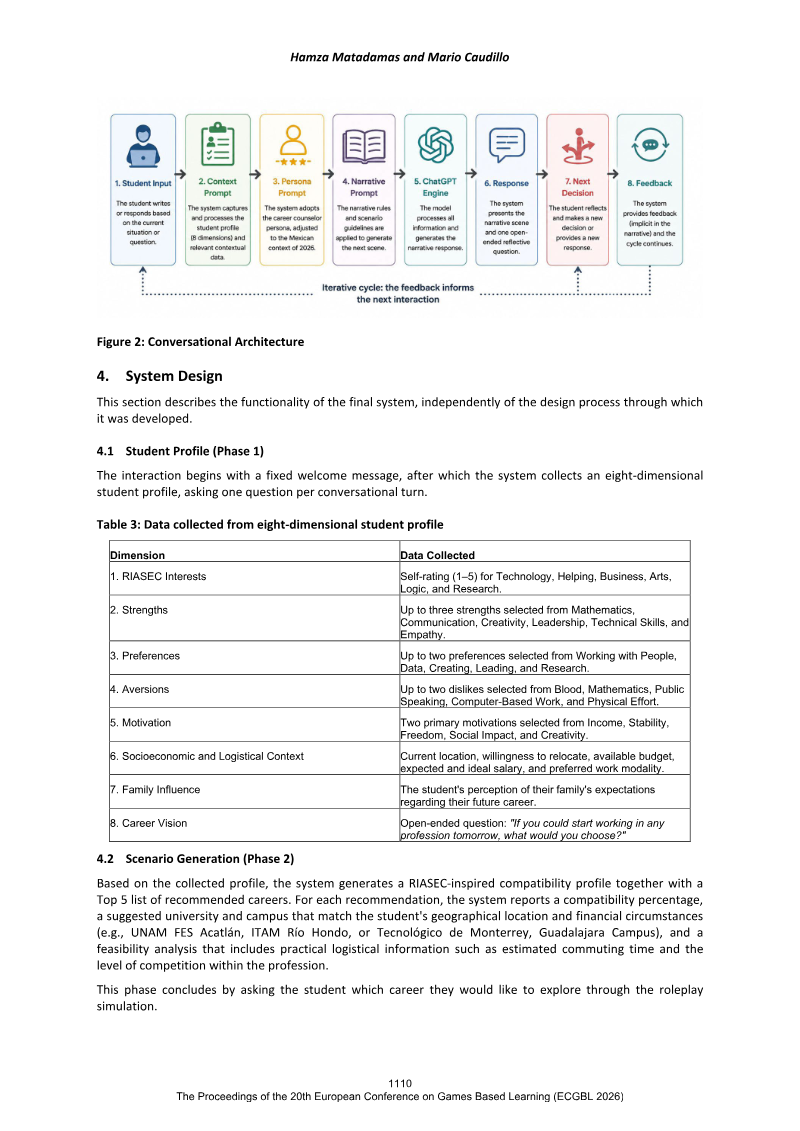
- The paper presents a ChatGPT-based roleplay system for career guidance among upper secondary students in Mexico, built around a four-phase conversational architecture, an eight-dimension student profile, and a five-stage narrative simulation ending in a data-sharing step.
- The system was motivated by university dropout linked to mismatched expectations and contextual constraints such as commuting distance, costs, and family finances, and was refined through seven prompt iterations.
- The primary aim is a reproducible account of prompt engineering rather than a claim of vocational effectiveness; the formative evaluation was descriptive and non-inferential, with eight matched responses drawn from 13 initial participants in the State of Mexico.
From Feedback to Features: A Two-Year Comparative Study of Iterative Gamification Design in Engineering Education
A two-year study at Gdańsk University of Technology examines whether student feedback can drive measurable gains in a gamified engineering course.
- Iterating on student feedback in a gamified Metrology course at Gdańsk University of Technology raised the overall pass rate from 72.3% (289 students, 2024/2025) to 92.2% (345 students, 2025/2026), with mean scores rising from 26.3 to 31.7 out of 40.
- The share of students scoring 35–40 points jumped from roughly 3% to 46% in Automatics, Cybernetics and Robotics (ACiR) and to 33% in Electronics and Telecommunications (EiT), and the minimum score climbed from under 2 to 14 points.
- Second-cohort changes were narrative easter eggs, optional untimed practice tests, and a clearer task-selection interface, with task difficulty and maximum score kept constant and the passing threshold lowered by one point.
Fotonica in Gioco: A Game-Design Contest for Science Communication in Italian High Schools
The paper reports on the fifth edition (2024–2025) of Fotonica in Gioco, a national game-design contest for Italian upper-secondary students run by the CNR Institute of Photonics and Nanotechnologies.
- The Fotonica in Gioco contest (fifth edition, 2024–2025), run by the CNR Institute of Photonics and Nanotechnologies, had Italian upper-secondary students design original educational board games on the theme "Challenges" to communicate science and build STEAM skills.
- Eighteen prototypes from nine Italian cities involved about 166 students and 18 teachers, with an estimated gender split of roughly 60% female and 40% male.
- Despite no prior game-design training and only written guidelines and organizational mentoring, students produced mechanically coherent games using mechanics such as dice movement, card events, quizzes, set collection, and mission systems.
A Tripartite Framework for the Co-design of an Awareness-raising Serious Game Addressing Visual Impairment: A Systematic Literature Review
This systematic literature review, conducted under PRISMA guidelines, examines how serious games addressing visual impairment are technologically designed and co-designed.
- The review of 26 studies (2015–2025) argues that co-design with visually impaired people is a communicational necessity, since their experiential knowledge is transformed and cannot be faithfully formalized without their active participation.
- Of the reviewed serious games for visual impairment, more than half do not specify their engines or software, suggesting technology functions mainly as a social mediator fostering bonds between players rather than as an end in itself.
- Design practices are unevenly adopted: 11 studies used top-down approaches, 6 used user-centered design, and only 8 adopted participatory co-design, motivating a proposed co-design method bringing together visually impaired experts, technical experts, and researchers.