1 free read left. Create a free account for unlimited reading + AI research.
Create free accountArticle European Conference on Games Based Learning (ECGBL)
1 free read left. Create a free account for unlimited reading + AI research.
Create free accountArticleEuropean Conference on Games Based Learning (ECGBL)
The study followed 634 students across three degree programmes at Gdańsk University of Technology over two years.
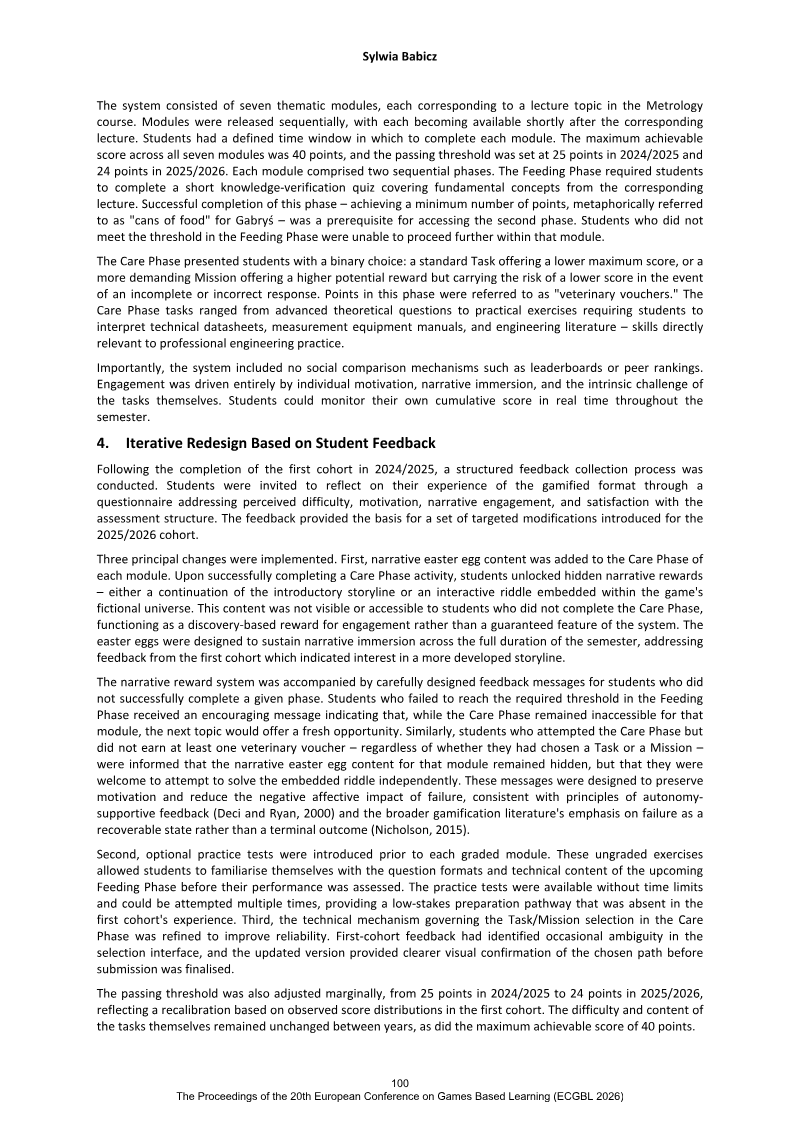
A two-year study at Gdańsk University of Technology examines whether student feedback can drive measurable gains in a gamified engineering course. The work follows 634 students across three degree programmes (Electronics and Telecommunications, Automatics, Cybernetics and Robotics, and Biomedical Engineering) enrolled in a Metrology lecture course. In the first cohort (2024/2025, 289 students), a gamified system replaced a single end-of-course test with seven topic-based modules, each combining a knowledge-check phase with an optional higher-risk, higher-reward task. After collecting student feedback, the course designers introduced narrative easter eggs, optional untimed practice tests, and a clearer task-selection interface for the second cohort (2025/2026, 345 students), while keeping task difficulty and maximum score unchanged and lowering the passing threshold by one point.
Outcomes improved across all three programmes. The overall pass rate rose from 72.3% to 92.2%, mean scores increased from 26.3 to 31.7 out of 40, and the minimum score climbed from under 2 points to 14. Score distributions shifted sharply upward, with 46% of ACiR students and 33% of EiT students reaching the 35-40 point range in the second year, compared with roughly 3% in the first. Chi-square and Mann-Whitney tests were significant for each programme, with large effect sizes for score distributions (r ranging from 0.434 to 0.555). Data came from Moodle system logs rather than self-reports.
The study is quasi-experimental, without random assignment or a control group, and all design changes were introduced simultaneously, so the individual contribution of each change and the influence of cohort differences cannot be isolated. The authors identify practice tests as the most likely driver of the gains in lower-performing students, while narrative content and interface refinements may have sustained engagement. The work argues that systematically acting on student feedback is a low-cost, replicable approach within existing learning management systems, and calls for controlled experiments and student-reported motivation data in future research.



European Conference on Games Based Learning (ECGBL) · 2026



European Conference on Games Based Learning (ECGBL) · 2026



European Conference on Games Based Learning (ECGBL) · 2026



European Conference on Games Based Learning (ECGBL) · 2026



European Conference on Games Based Learning (ECGBL) · 2026



European Conference on Games Based Learning (ECGBL) · 2026



European Conference on Games Based Learning (ECGBL) · 2026



European Conference on Games Based Learning (ECGBL) · 2026



European Conference on Games Based Learning (ECGBL) · 2026



European Conference on Games Based Learning (ECGBL) · 2026



European Conference on Games Based Learning (ECGBL) · 2026



European Conference on Games Based Learning (ECGBL) · 2026
European Conference on Games Based Learning (ECGBL) · 2026