1 free read left. Create a free account for unlimited reading + AI research.
Create free accountWhitepaper European Conference on Games Based Learning (ECGBL)
1 free read left. Create a free account for unlimited reading + AI research.
Create free accountWhitepaperEuropean Conference on Games Based Learning (ECGBL)
The course culminated in Tánpàn 2.0, a sequential intercultural negotiation among three parties. Simulations, role-plays and debriefings prepared students for it.
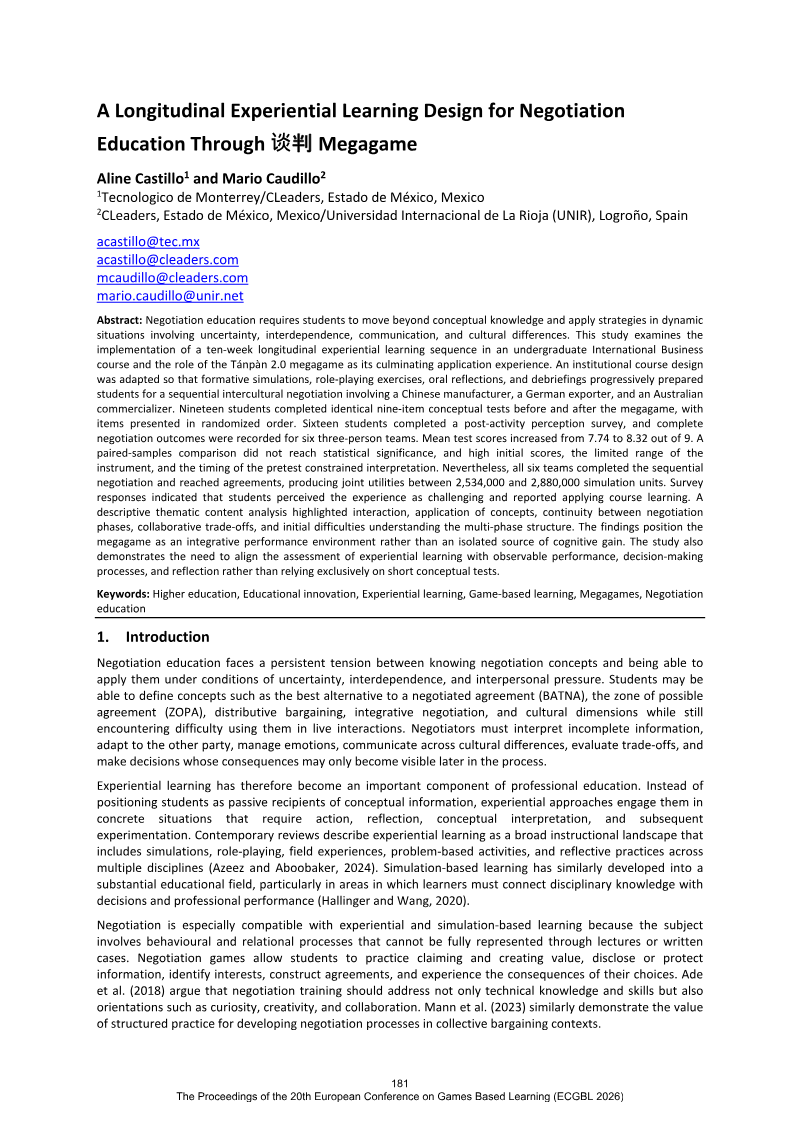
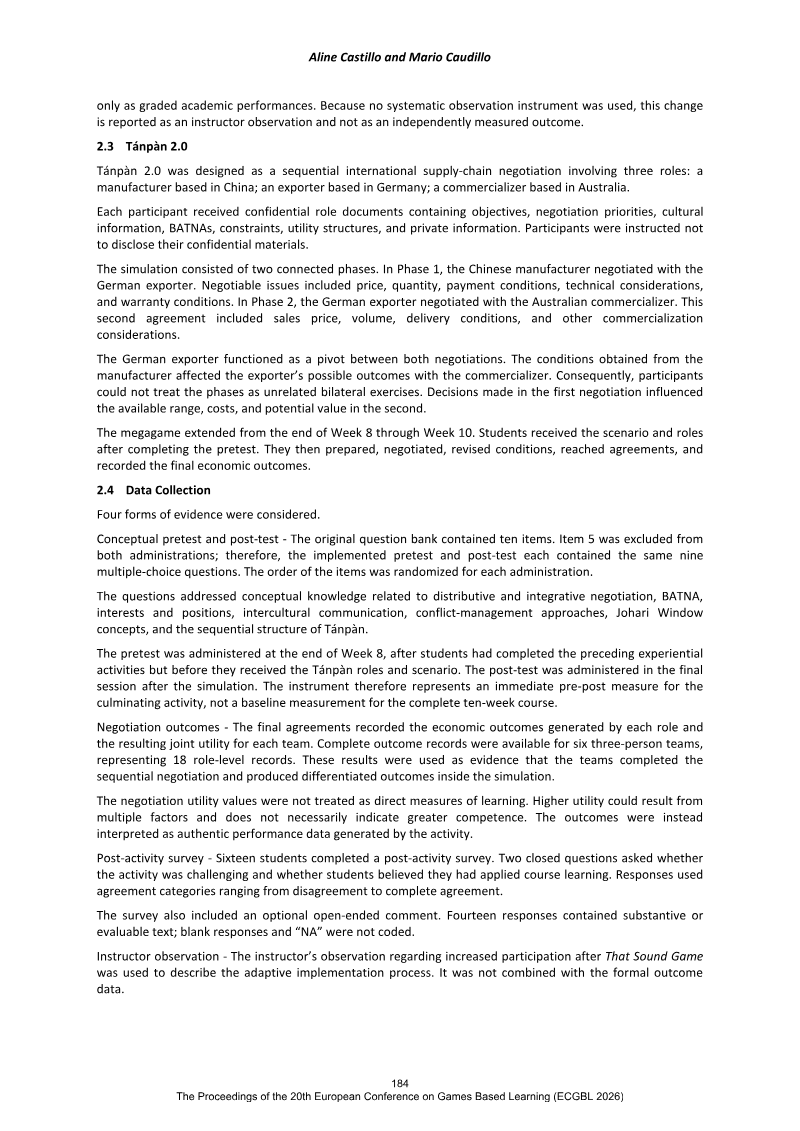
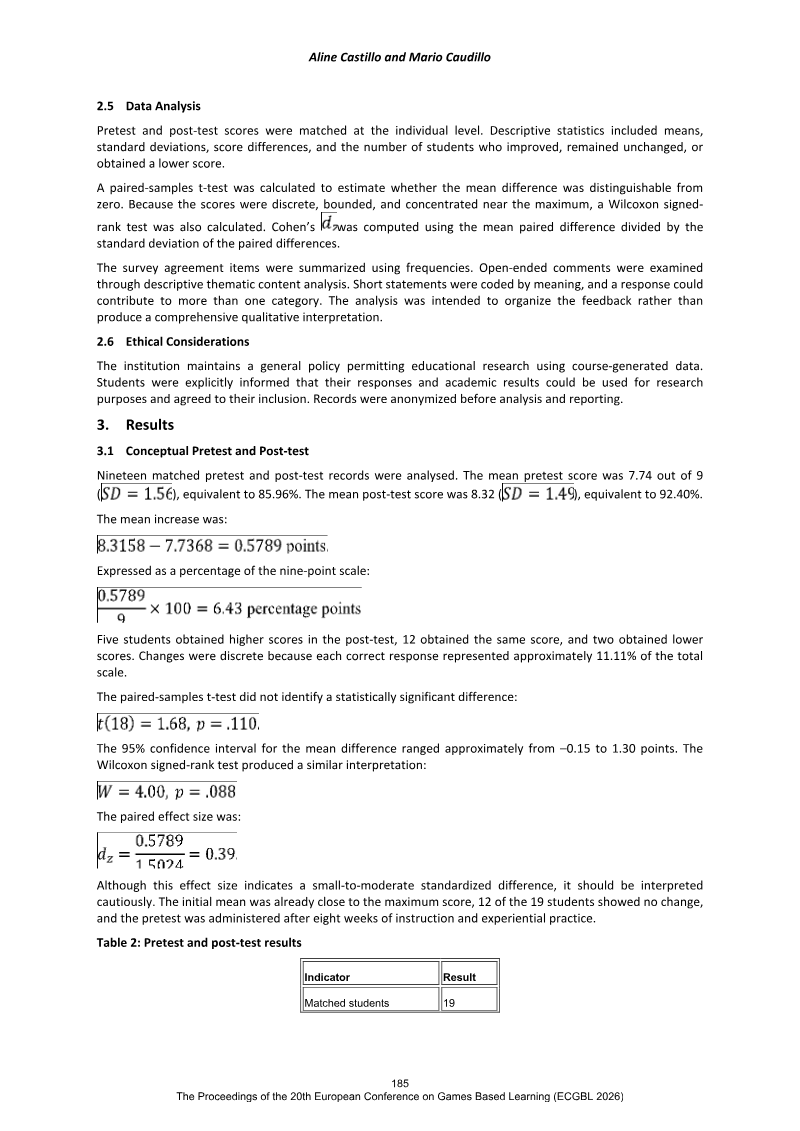
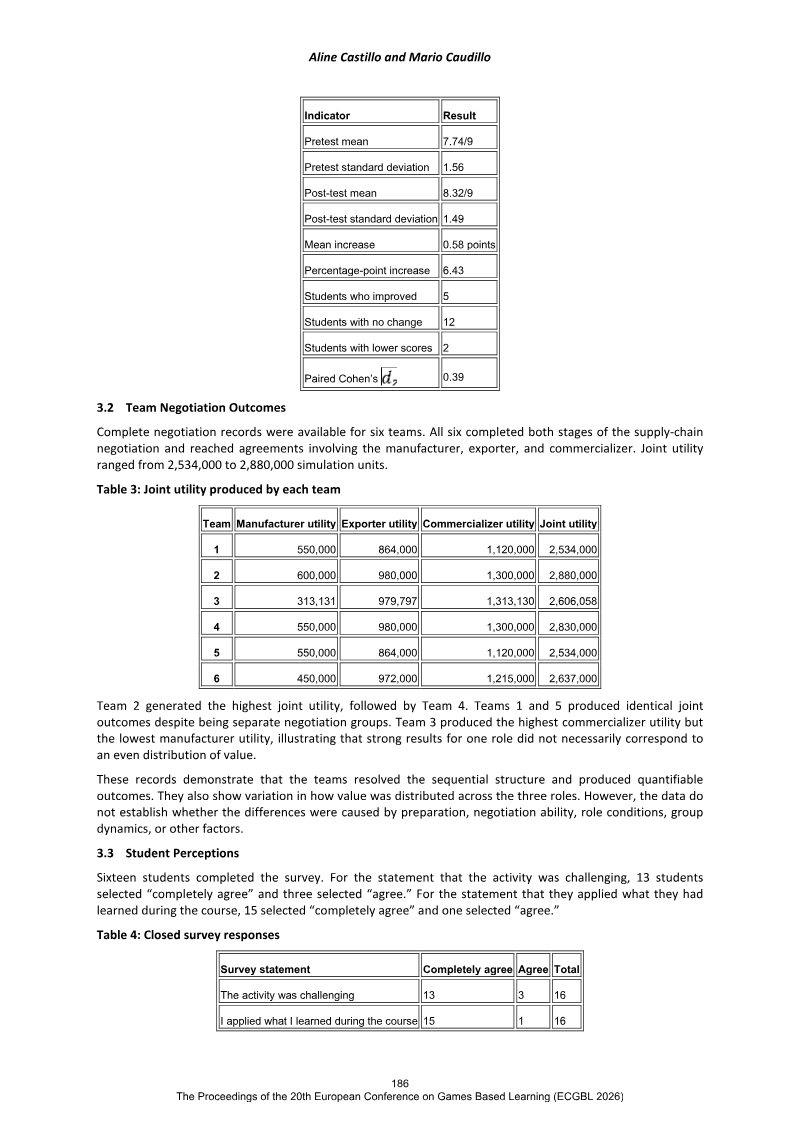
This study documents the adaptation of a ten-week undergraduate negotiation course into a longitudinal experiential learning sequence, with the Tánpàn 2.0 megagame serving as its culminating application experience. Formative simulations, role-plays, oral reflections, and debriefings were organized to prepare students for a sequential intercultural negotiation among a Chinese manufacturer, a German exporter, and an Australian commercializer. The research is descriptive and formative rather than causal, drawing on nineteen students' matched conceptual pretests and post-tests, complete outcome records for six three-person teams, and a sixteen-student post-activity survey.
Conceptual test scores rose from a mean of 7.74 to 8.32 out of 9, a descriptive gain of about 6.43 percentage points, but the increase did not reach statistical significance under either a paired-samples t-test or a Wilcoxon signed-rank test. The authors attribute this partly to high initial performance, a pretest administered after eight weeks of instruction rather than at course start, and a nine-item instrument with a restricted range. All six teams completed both negotiation stages and reached agreements, with joint utilities between 2,534,000 and 2,880,000 simulation units, showing that outcomes varied in both total value and its distribution across roles, though utility is not treated as a direct measure of learning.
Survey responses were uniformly positive: all sixteen respondents agreed the activity was challenging and that they applied course learning. Open-ended comments, coded descriptively, referred to interaction, application of concepts, continuity between negotiation phases, collaborative trade-offs, and initial confusion about the two-phase structure. An instructor observation that a low-stakes playful activity increased subsequent participation is reported as anecdotal rather than measured.
The authors conclude that Tánpàn functions best as an integrative performance environment rather than an isolated intervention assessable through a short knowledge test. They recommend combining conceptual measures with competency-based observation, structured reflection, a true course-start baseline, and delayed evidence of transfer, while acknowledging limitations including the small single-course sample, lack of a comparison group, and unvalidated outcome measures.
European Conference on Games Based Learning (ECGBL) · 2026



European Conference on Games Based Learning (ECGBL) · 2026
European Conference on Games Based Learning (ECGBL) · 2026



European Conference on Games Based Learning (ECGBL) · 2026



European Conference on Games Based Learning (ECGBL) · 2026



European Conference on Games Based Learning (ECGBL) · 2026



European Conference on Games Based Learning (ECGBL) · 2026



European Conference on Games Based Learning (ECGBL) · 2026



European Conference on Games Based Learning (ECGBL) · 2026



European Conference on Games Based Learning (ECGBL) · 2026



European Conference on Games Based Learning (ECGBL) · 2026



European Conference on Games Based Learning (ECGBL) · 2026
European Conference on Games Based Learning (ECGBL) · 2026