
European Conference on Games Based Learning (ECGBL)
Annual European conference on game-based learning and serious games; its proceedings are published open access (CC BY) by Academic Conferences International.
Documents
CSCape: A Video-Based Escape Room Framework (Not Only) for Computer Science
CSCape is an open-source software framework, presented by Johannes Schildgen of Regensburg University of Applied Sciences, for building interactive, video-based escape-room learning experiences.
- CSCape is an open-source framework from Regensburg University of Applied Sciences for building video-based escape-room learning experiences, aimed primarily at computer science education but applicable across academic disciplines.
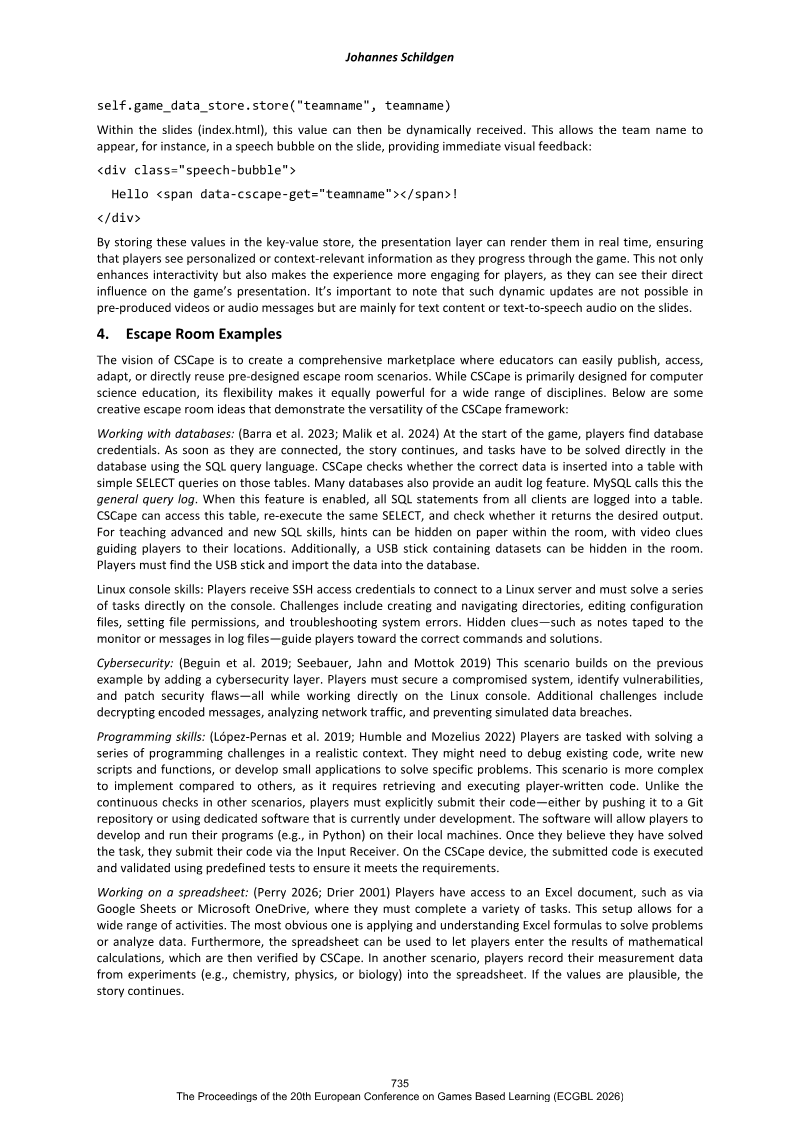
- It runs on low-cost hardware such as a Raspberry Pi connected to a projector or TV, showing a black screen until a task is solved and then playing a story video.
- Educators supply videos or slides and write Python check functions that verify task completion, for example by querying a database, inspecting a network configuration, or validating Google Form or spreadsheet entries.
Gender Differences in Italian Teachers' Readiness and Attitudes Towards Game Integration in the Classroom
A survey of 2,623 Italian teachers, predominantly secondary-level and concentrated in Southern Italy, examines how teachers' readiness and attitudes toward integrating games into classroom instruction vary by gender.
- Teachers' game-related knowledge, pedagogical intention, and readiness are strongly intercorrelated and most closely tied to personal gaming habits, game experience, and intention to use games, while teaching experience and school grade show only weak associations.
- Teachers feel most confident in game content knowledge (M = 3.00) and least confident in game pedagogical knowledge (M = 2.14), even though their pedagogical intention is high (M = 2.89) and their personal gaming experience is limited (M = 2.30).
- Among 2,623 surveyed Italian teachers (81.9% female, mean age 44.7, concentrated in Southern Italy), 56% use games occasionally in teaching and only 22.4% use them regularly.
Gamification for Learning Java Programming: Design and Implementation of Java Realm
This study presents the design and development of JavaRealm, a web-based gamified learning application for teaching Java programming to undergraduate IT students at a South African university.
- JavaRealm is a web-based gamified Java learning application designed for undergraduate IT students at a South African university, built via design science research to address high attrition and disengagement in introductory programming.
- The paper stops at the design validation phase: summative evaluation of learning outcomes and competency gains has not yet been conducted, so effectiveness remains unproven.
- Design validation involved 20 questionnaire respondents and six focus-group participants, all purposively sampled and mostly third-year or postgraduate students; respondents strongly favoured immediate feedback (95% agreement, M = 4.80, SD = 0.52).

Playful Serious Gaming for Change Management
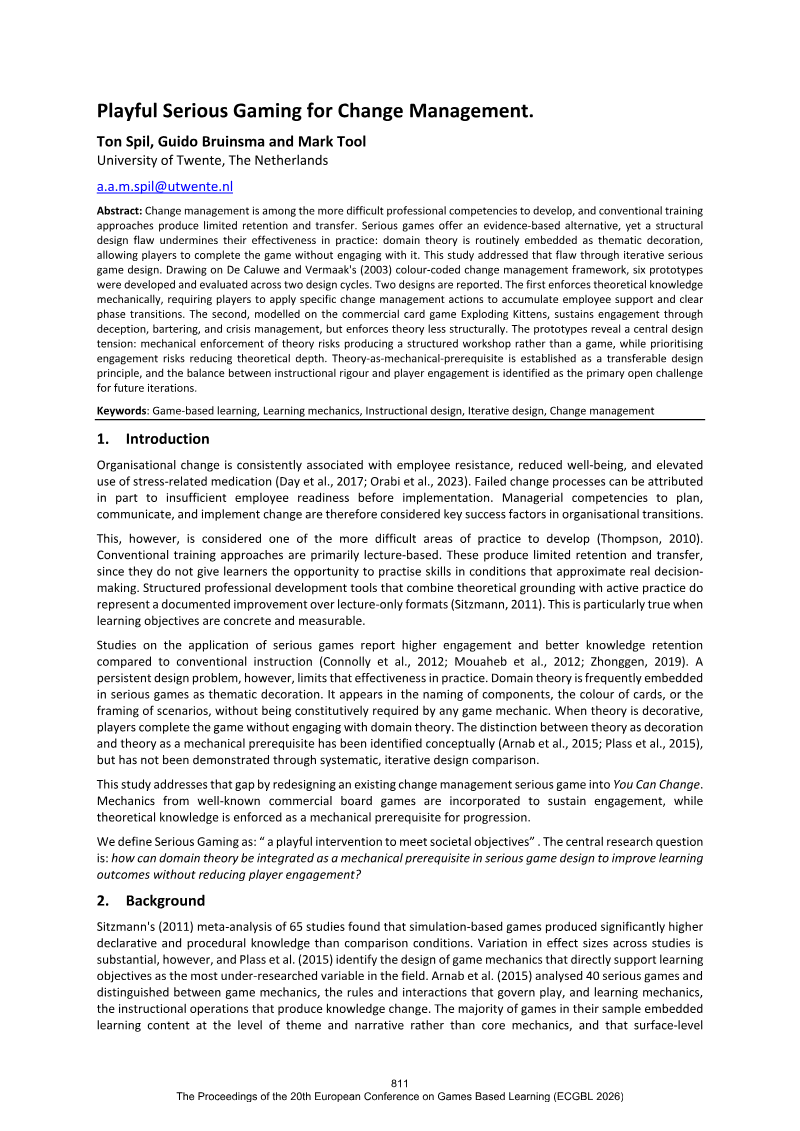
This study investigates how serious games for change management training can embed domain theory as a mechanical prerequisite for progression rather than as thematic decoration, a design flaw the authors argue undermines learning outcomes.
- Serious games for change management often embed domain theory as thematic decoration rather than as a mechanical prerequisite for progression, a design flaw the authors argue undermines learning outcomes.
- The core finding is a tension between instructional rigour and player engagement: mechanically enforcing theory produces an experience closer to a facilitated workshop than a game, while engagement-focused mechanics let players succeed through social manipulation without conceptual understanding.
- No single mechanic examined resolves both rigour and engagement; the authors propose theory-as-mechanical-prerequisite as a transferable design principle and suggest hybrid designs that enforce knowledge at bottleneck moments while allowing freer play between them.



MERIG: Design of a Multidimensional Evaluation Rubric for Informatics Games
This work-in-progress paper introduces MERIG, a multidimensional evaluation rubric for informatics games aimed at primary education.
- MERIG is a conceptual prototype of a multidimensional evaluation rubric for primary-school informatics games, argued to be needed because many existing learning games lack both pedagogical rigor and inclusive design, which can deepen gender disparities in STEM participation.
- The rubric is organized into three dimensions: gender-sensitive inclusive design (representation, stereotypes, accessibility), pedagogical efficacy (learning objectives, observable evidence of competence, empirical support), and ludo didactics (feedback, intrinsic motivation, scaffolding, learner agency).
- Each criterion is rated on a five-point Likert scale intended to capture gradations in quality.

AI-Supported Conditional Progression in Gamified Higher Education: Learning, Motivation and Cognitive Sustainability
This experimental study compares three learning conditions among 142 university students in a Neuropsychology course in Southern Italy: individual non-gamified study, traditional gamification on a learning platform, and gamification with AI-supported conditional progression, in which levels, time limits, attempt caps and…
- Students in the conditional progression condition completed far fewer required lessons than those in traditional gamification (2.59 vs. 3.79 of four; p < .001; d = 1.79), suggesting that progression constraints created operational friction.
- Immediate learning, measured by correct answers and total Kahoot! score, did not differ significantly across individual non-gamified study, traditional gamification, and AI-supported conditional progression (p = .922 and p = .943).
- Overall perceived workload (NASA-TLX) was statistically equivalent across the three conditions (p = .454), but conditional progression shifted students' attention from content difficulty toward managing rules and time limits.
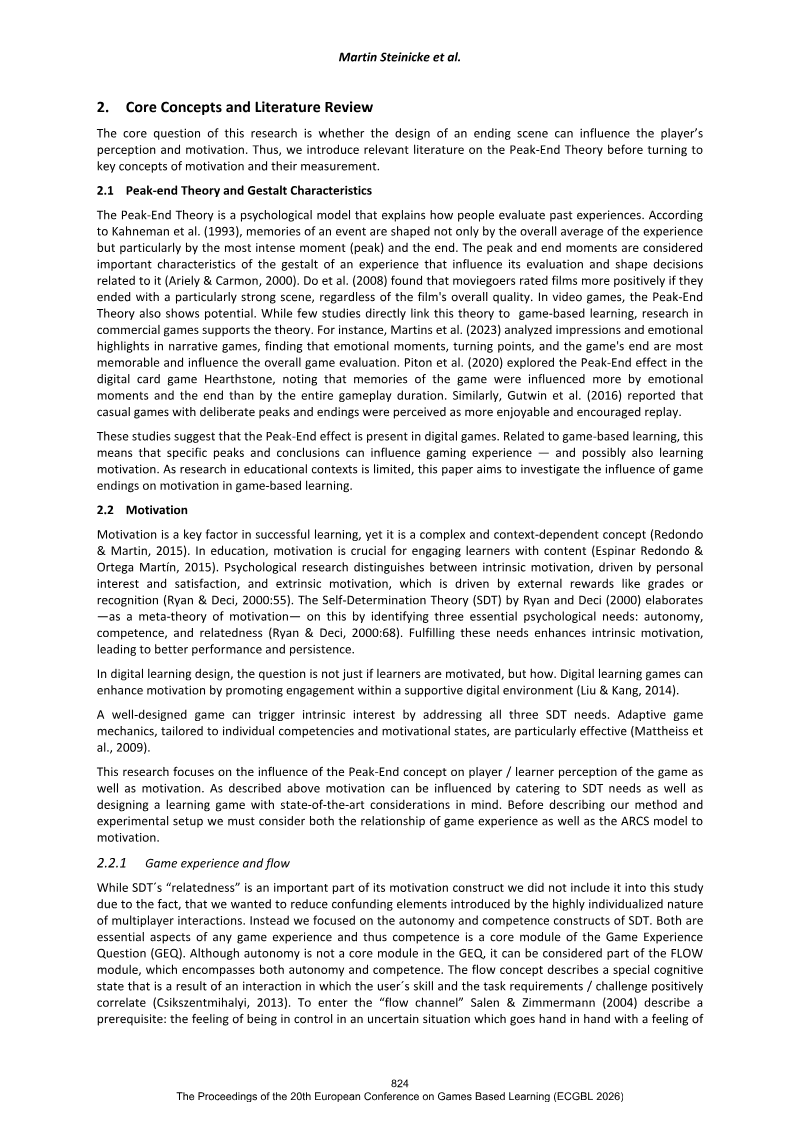
The Means of an End: Applying the Peak-End Theory to Game-Based Learning Design
This study examines whether the ending of a game-based learning experience can shape learner motivation and game experience, applying the Peak-End Theory from psychology to serious game design.
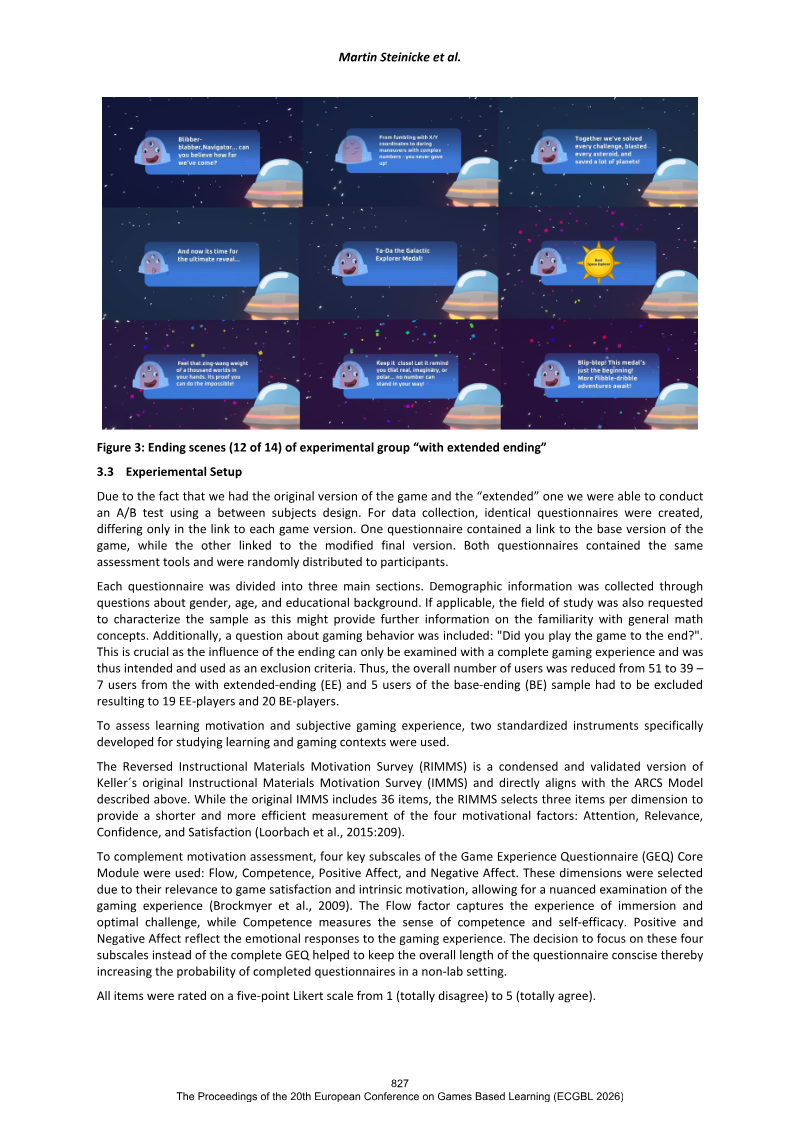
- A study of a complex-numbers learning game found that changing only the ending—an abrupt two-sentence close versus a farewell with a medal reveal, confetti, and a character sign-off—significantly raised learner motivation and game experience scores.
- The extended-ending group (n=19) outscored the base-ending group (n=20) on all four ARCS motivation dimensions (Attention, Relevance, Confidence, Satisfaction), with significance at the 0.05 level by Mann-Whitney U tests.
- All four measured Game Experience Questionnaire subscales favored the extended ending, reaching significance at the 0.01 level, with effect sizes ranging from medium to large.

Rapid Academic Levelling Through Artificial Intelligence Role Play Escape Room
This paper presents an exploratory demonstration of a single-session, GPT-based AI escape room designed to level up probability and statistics prerequisites for second-semester engineering students.
- The paper is an exploratory demonstration of a single-session, GPT-based AI escape room for levelling up probability and statistics prerequisites for second-semester engineering students, and explicitly does not claim to establish learning effectiveness.
- Fifteen engineering students completed a 35-minute AI escape room with anonymous pre- and post-tests; attempt rate rose from 40.0% to 68.6%, correct responses across all items rose from 19.3% to 55.7%, and accuracy among attempted items rose from 48.3% to 81.3%.
- The design has no control group, individual records could not be matched between administrations, the post-test had one fewer record than the pre-test, and no delayed assessment was conducted, so the changes cannot be causally attributed to the escape room or the AI component.
Building Bridges: A Collaborative Pipeline for Educational Game Creation
This paper presents a collaborative participatory design pipeline for building classroom-feasible educational games, demonstrated through DIETER (Digital Educational Escape Room), a modular escape room of short, tablet-ready STEM mini-games for upper secondary education.
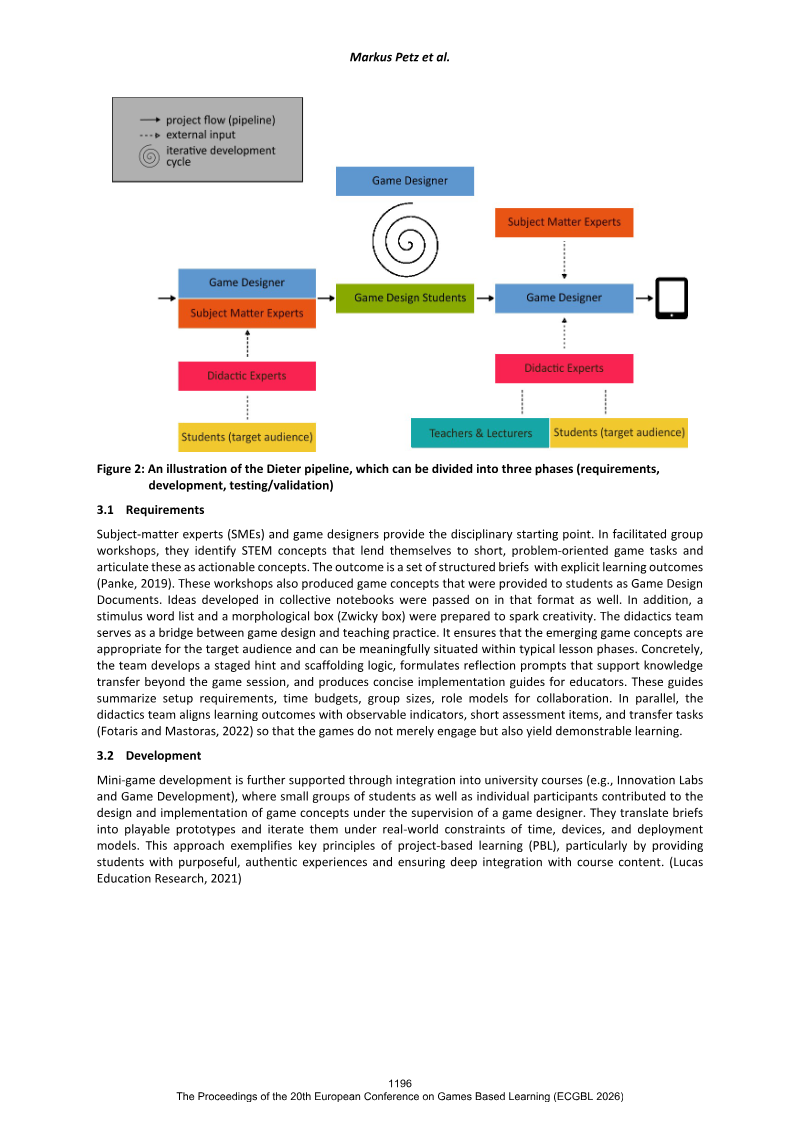
- DIETER (Digital Educational Escape Room) is a modular set of short, tablet-ready STEM mini-games for upper secondary education, built through a collaborative participatory pipeline linking subject experts, game design students, didactic specialists, students, and teachers across sprint-based cycles with review gates.
- An exploratory survey of Austrian upper secondary students (mostly sixth and eighth graders, 61% female and 36% male) rated smartphones most favorably for gaming (mean 2.10 on a 1-5 scale), followed by laptops (2.58), tablets (3.73), and interactive whiteboards (4.56, strongly disliked).
- Because of these results and broad household tablet access (87% of 12-19-year-olds in a German media study), the team prioritized touch-first, low-threshold tablet interaction for classroom use.
Gamifying Place-Making in Architectural Design Studio: A Workshop Model Based on Place, Territoriality and Appropriation
This study presents a gamified architectural design workshop intended to help students translate the theoretical concepts of place, territoriality, and appropriation into concrete design decisions.
- The workshop uses a process-oriented, mission-based structure of sequential, time-limited, progressively disclosed tasks to operationalize place-making theory in architectural design, deliberately avoiding points or badges as engagement mechanics.
- Fourteen fourth-year students in a single course progressed from constructing imaginary users, to designing individual 25 square-metre spaces tailored to those users, to combining them into four collective compositions.
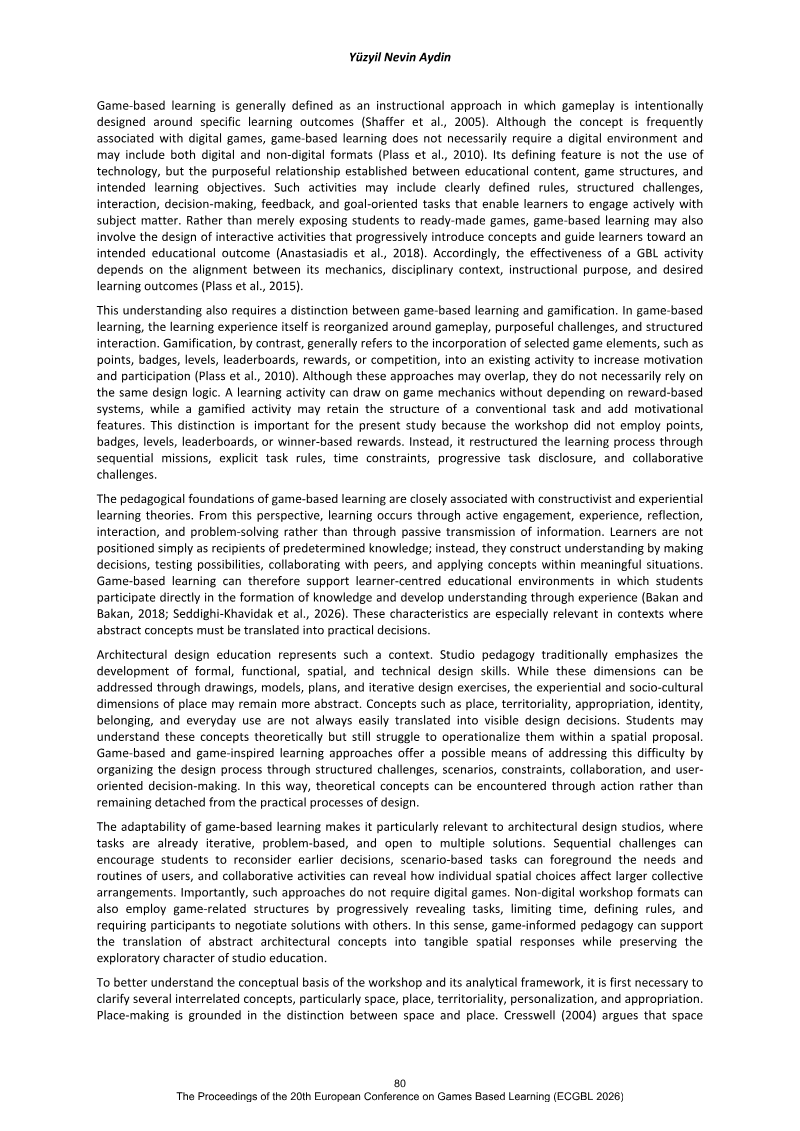
- User profiles acted as generators of spatial programmes, with students incorporating sensory, emotional, and symbolic considerations into their designs.



A Scalable, Modular Architecture Enabling Digital Teacher-Defined Mobile Escape Rooms
This work-in-progress paper introduces DIETER (DIgital EducaTional Escape Room), a modular framework that lets teachers build customized mobile escape room experiences from reusable digital mini-games and external, non-digital learning activities.
- DIETER is a modular framework that lets teachers assemble customized mobile escape room experiences from reusable Unity-based digital mini-games and external non-digital learning activities, shifting scenario configuration from developers to educators.
- The architecture has four components: a mobile master application for teachers and students, a repository server, a desktop tool for packaging and uploading mini-games with metadata, and an expandable game library, with each mini-game exposing a predefined interface for launch and completion signals.
- The current prototype supports browsing, downloading, and sequencing mini-games, with example titles covering Cartesian graphing, number-system conversion, and an introduction to genetic algorithms; external activities are incorporated through code validation within the app.
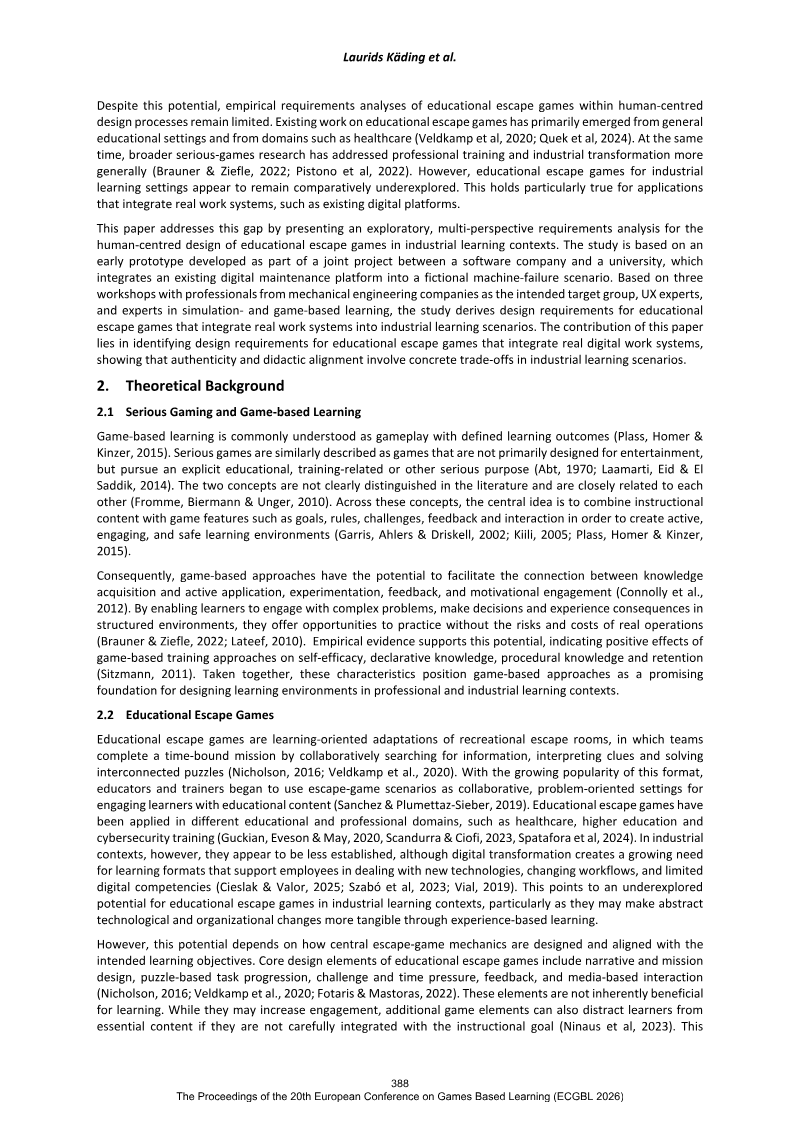
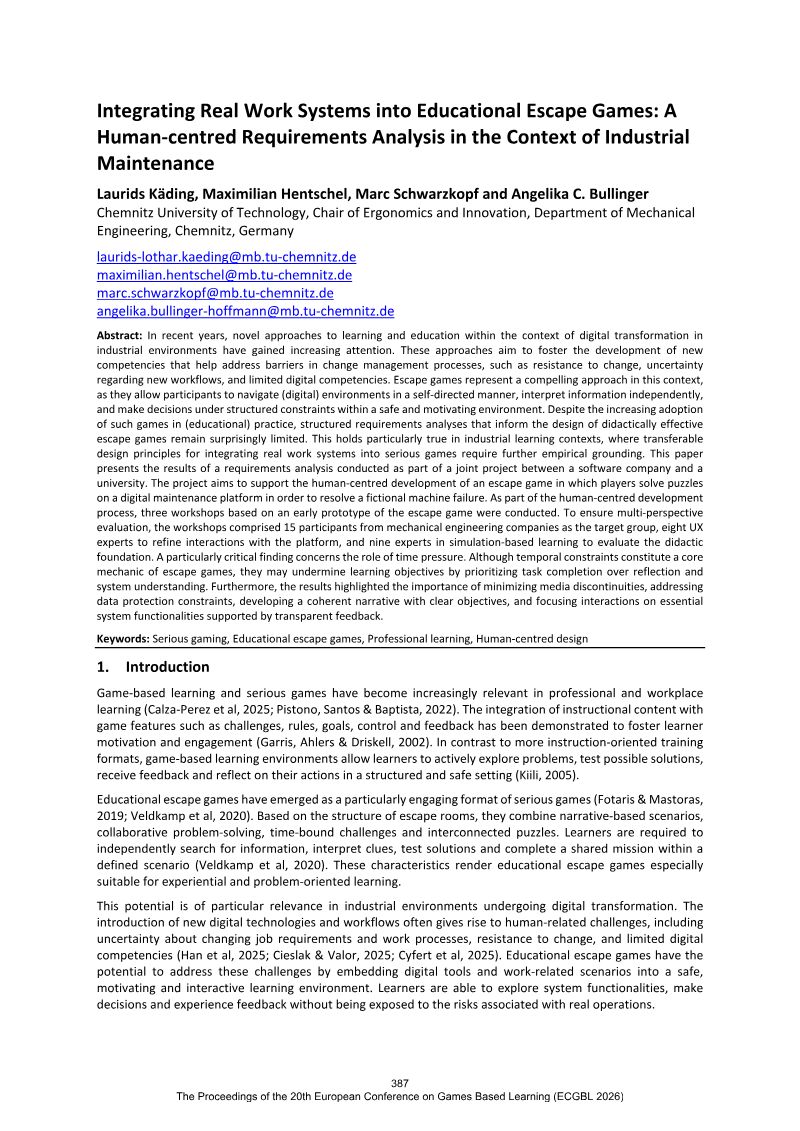
Integrating Real Work Systems into Educational Escape Games: A Human-Centred Requirements Analysis in the Context of Industrial Maintenance
This study examines how an educational escape game that embeds a real digital maintenance platform within a fictional machine-failure scenario can be designed for industrial learning.
- Embedding a real digital maintenance platform in an educational escape game was received positively by the 32 participants (15 target-group professionals, 8 UX experts, and 9 simulation and game-based learning experts) who evaluated an early prototype across three workshops.
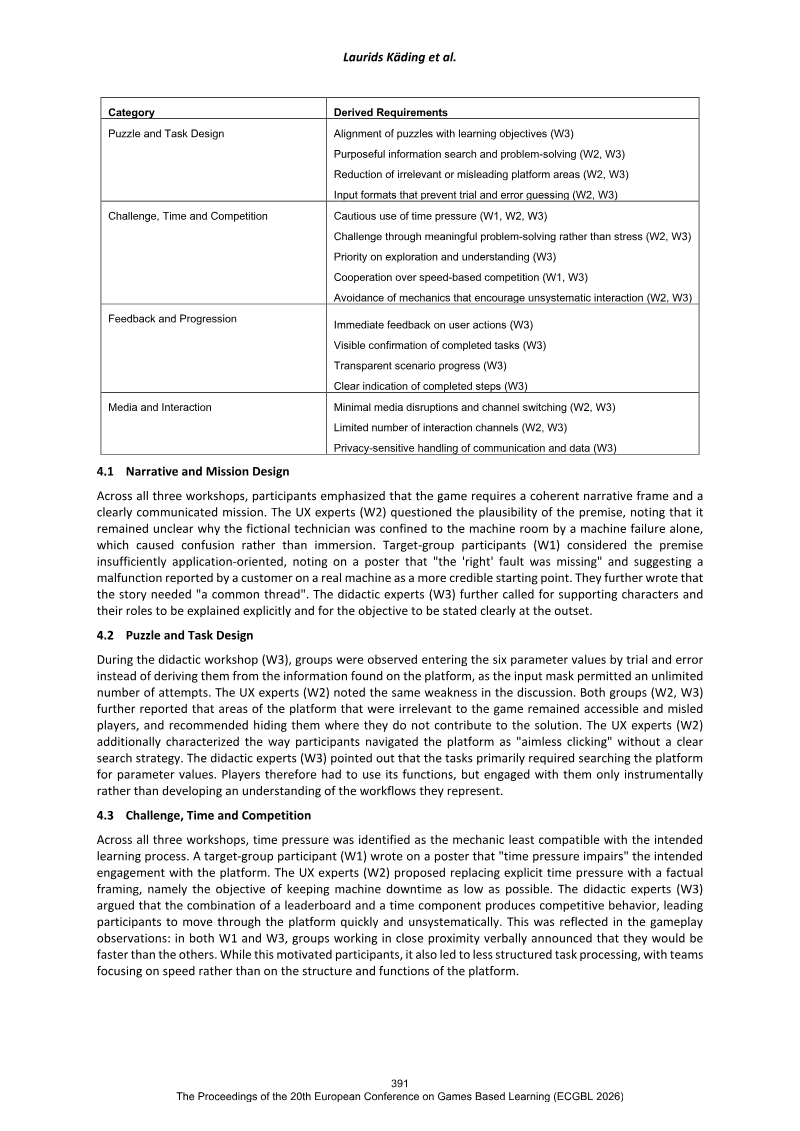
- Operational authenticity and game mechanics are in persistent tension: time pressure, competitive elements, unlimited trial-and-error input, and too many media channels were seen as obstacles to learning even though they boost engagement.
- Designers must deliberately decide which features of real work to reproduce faithfully and which to simplify or abstract in order to preserve educational value.