
European Conference on Games Based Learning (ECGBL)
Annual European conference on game-based learning and serious games; its proceedings are published open access (CC BY) by Academic Conferences International.
Documents
Sandwich Robot for Computational Thinking: Reflections From Testing With High School Pupils
This study examines "Sandwich Robot," a casual, Blockly-based puzzle game designed to build algorithmic thinking among beginner programmers, and reports on a second testing iteration with 45 pupils across three classes at a Danish technical high school, roughly second and third year students.
- The study tested a second iteration of "Sandwich Robot," a Blockly-based puzzle game for building algorithmic thinking, with 45 pupils across three classes at a Danish technical high school (roughly second and third year students).
- Data came from complementary sources: ethnographic drawings and field notes, automatically logged gameplay metrics (attempts, click density, solution length), and co-design sketches analyzed in NVivo.
- Pupils found the game engaging and challenging, with many replaying levels to earn three-star scores.
From Research to Prototypes: Developing a Digital Game to Foster Fraction Equivalence
The document presents the conceptual design of a digital game prototype intended to teach fraction equivalence by linking part-whole and magnitude representations of fractions.
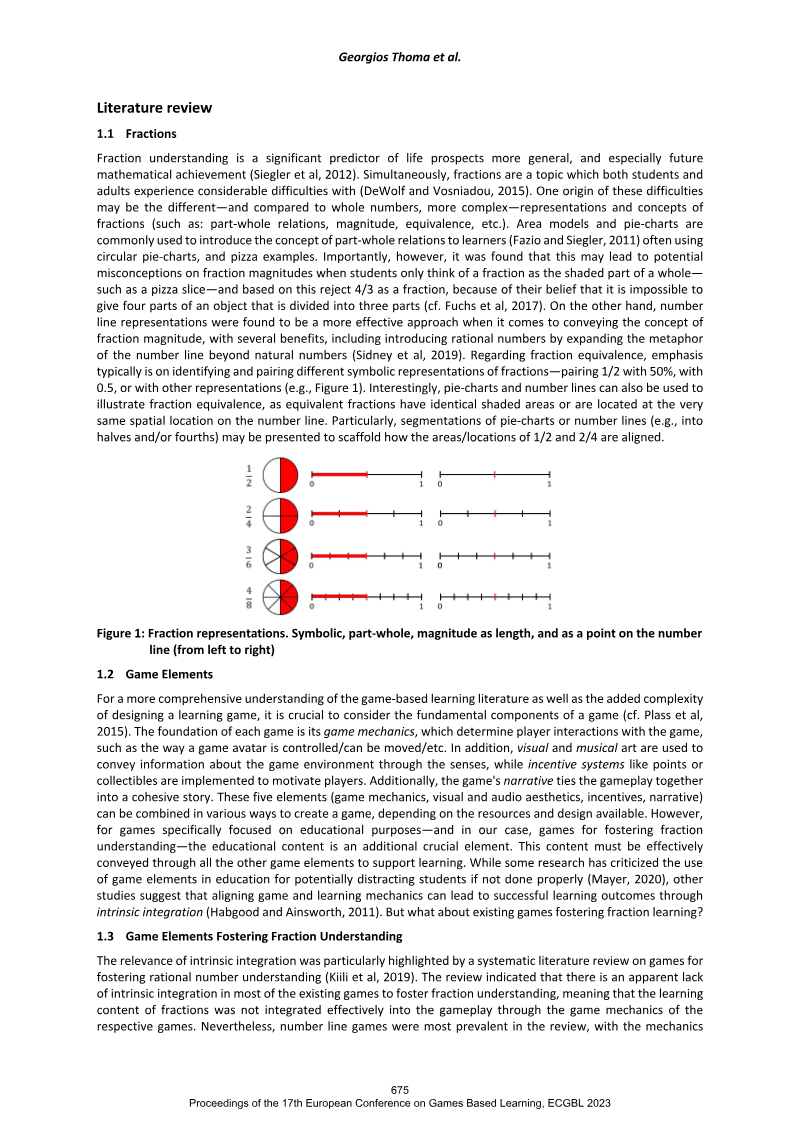
- The paper proposes a digital game prototype for teaching fraction equivalence that links part-whole and magnitude representations, arguing that existing fraction games rely on symbol-matching tasks not intrinsically tied to core fraction concepts.
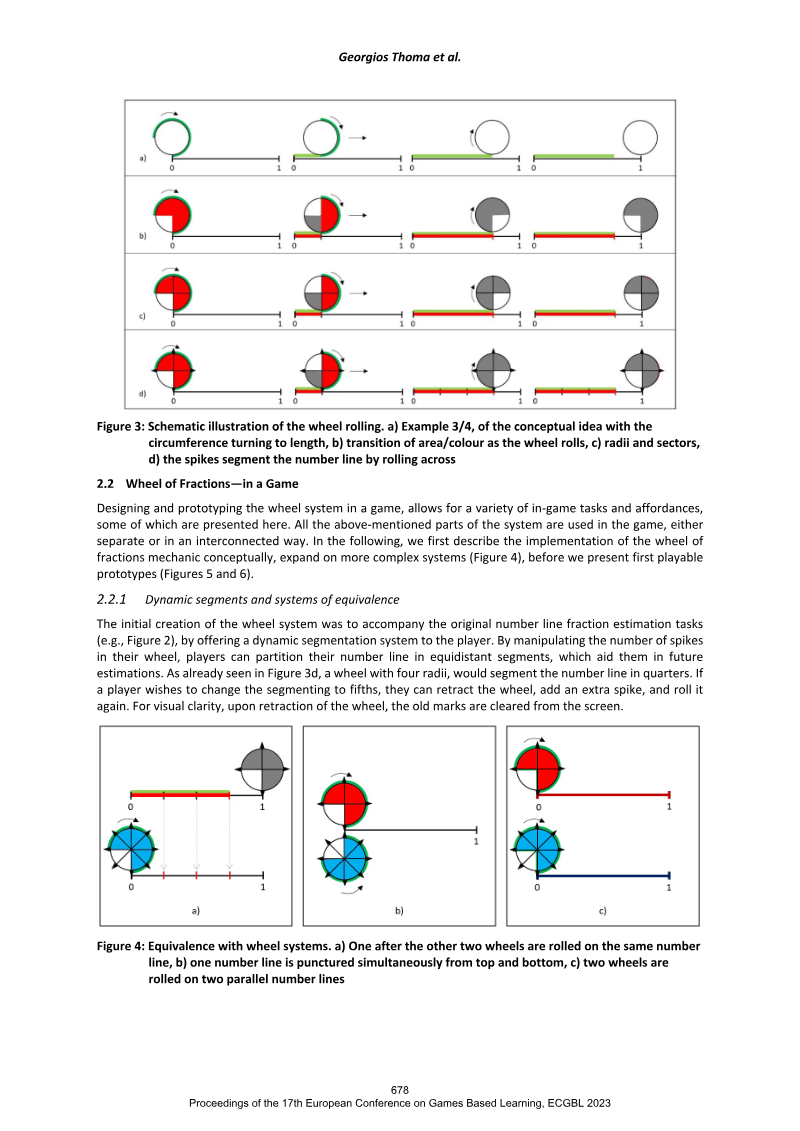
- Its central 'wheel of fractions' mechanic rolls a spiked wheel, whose circumference matches a number line's length, along the line to puncture it into equal segments, so equivalence emerges from play geometry (e.g., two and four spikes meeting at 1/2 and 2/4).
- Design features include dynamic segmentation, colour-coded punctures, and parallel number lines that connect pie-chart and number-line representations of fractions.
Requirements and Learning Modules for Implementing a Hologram Table in University Lectures
This paper examines the use of a hologram table in university lectures, with a focus on mining engineering education.
- The paper argues a hologram table can help students grasp complex spatial concepts that are hard to convey with 2D images, and unlike head-mounted AR/VR it lets users see one another, leaves the field of view unrestricted, and does not cause motion sickness.
- The evidence base is a qualitative requirements analysis from two design thinking workshops (8 participants: 4 teachers and 4 students; then 11 participants including the student representative board), supplemented by the Daling Decision Making Matrix applied to six mining engineering courses at bachelor's and master's levels.
- Students want more innovative, diverse, and practical teaching methods, greater collaboration, and mid-semester assessment, while teachers want modern visualization media and adequate technical support.
Applying Design Research for Cross-Disciplinary Collaboration: Experiences From a Gamification Process
This study examines how Design Science Research (DSR), operationalised through a five-phase framework adapted from Peffers et al.
- Design Science Research's iterative five-phase framework, adapted from Peffers et al. (2014), is proposed to structure knowledge exchange among a cross-disciplinary team of four researchers building a gamified energy-community tool.
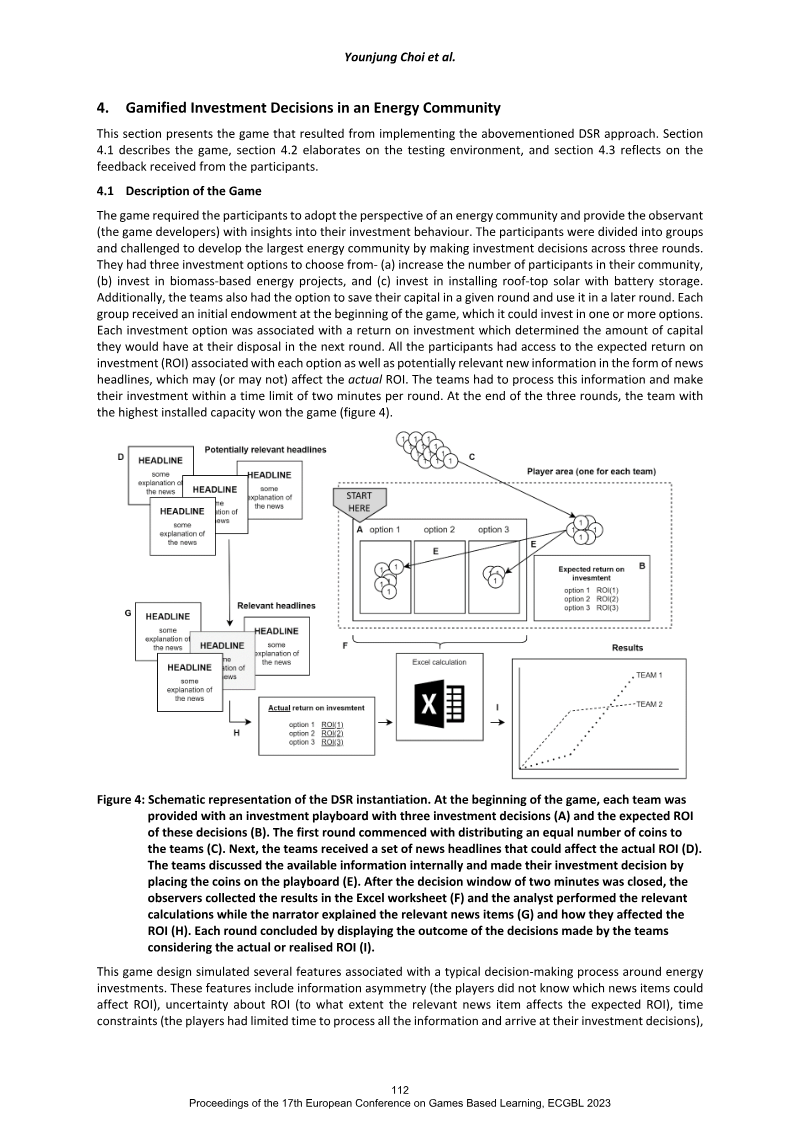
- The gamified artefact asked teams to allocate capital across three options over three rounds (expanding participation, biomass projects, and rooftop solar with storage), with news headlines introducing uncertainty that affected actual returns.
- Two instantiations with players of similar profiles, one informal session and one followed by a 16-question post-game survey, both confirmed stakeholder learning about energy communities.
Design and Development of a Gamified Tutorial for iVR Serious Games
This paper presents the design and development of a gamified tutorial for immersive virtual reality (iVR) serious games, aimed at teaching players how to use iVR controls and interactions while sustaining enjoyment and engagement.
- The paper presents a gamified tutorial for immersive VR (iVR) serious games that teaches iVR controls and interactions while sustaining enjoyment, aiming to reduce the novelty effect and frustration of unfamiliar VR environments.
- The tutorial draws on Gamified Learning Theory, Flow Theory, Mayer's Cognitive Theory of Multimedia Learning, and established video game tutorial design guidelines as its theoretical foundation.
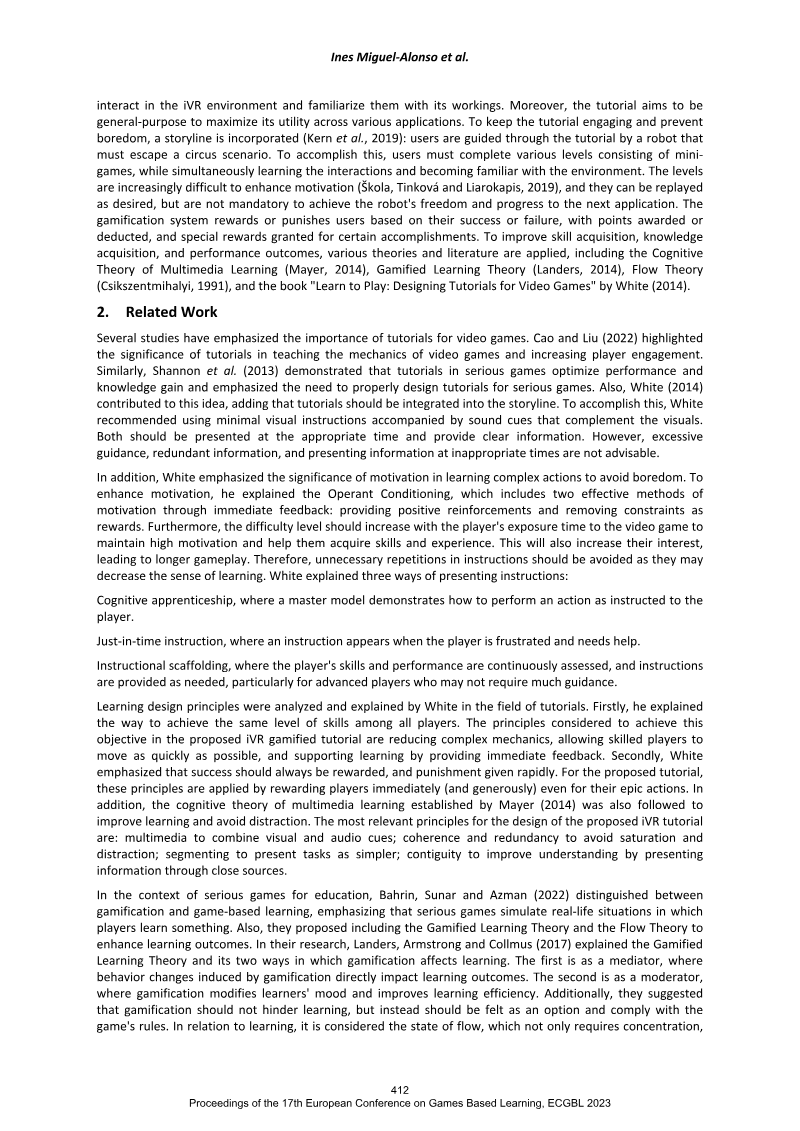
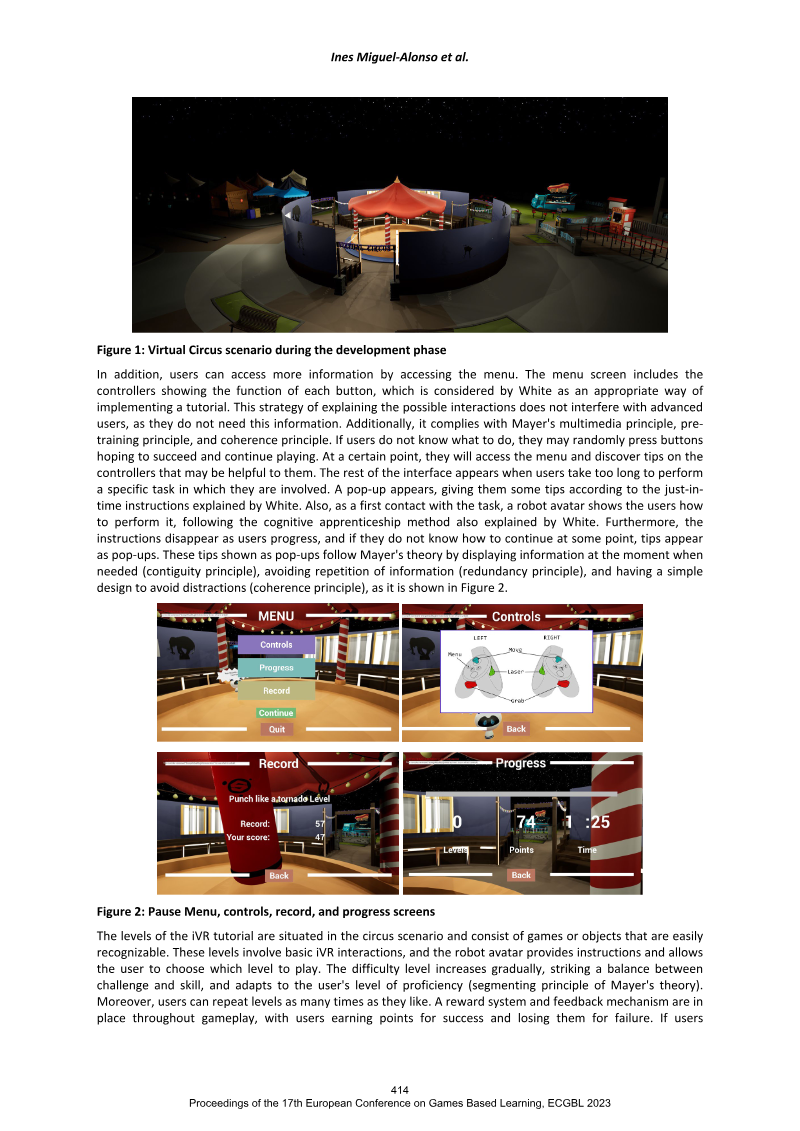
- The tutorial is a sequence of progressively harder mini-games in a circus scenario, featuring a robot avatar giving just-in-time tips, optional narrative framing, and a points-based reward and penalty system, and is designed to be general-purpose and usable standalone or before other serious games.
Science4Exitschool: Escape Games for Chemistry Classes
This paper introduces Science4ExitSCHOOL, a doctoral project from the University of Education Weingarten in Germany that develops, tests, and evaluates educational escape games for chemistry instruction from grade 7 onward.
- Science4ExitSCHOOL is a doctoral project from the University of Education Weingarten in Germany that develops and evaluates escape games for chemistry instruction from grade 7 onward, motivated by declining interest in chemistry and physics and weakening scientific competences.
- The paper defines six core elements of educational escape games: narrative, game-flow, puzzles, equipment, learning, and debriefing.
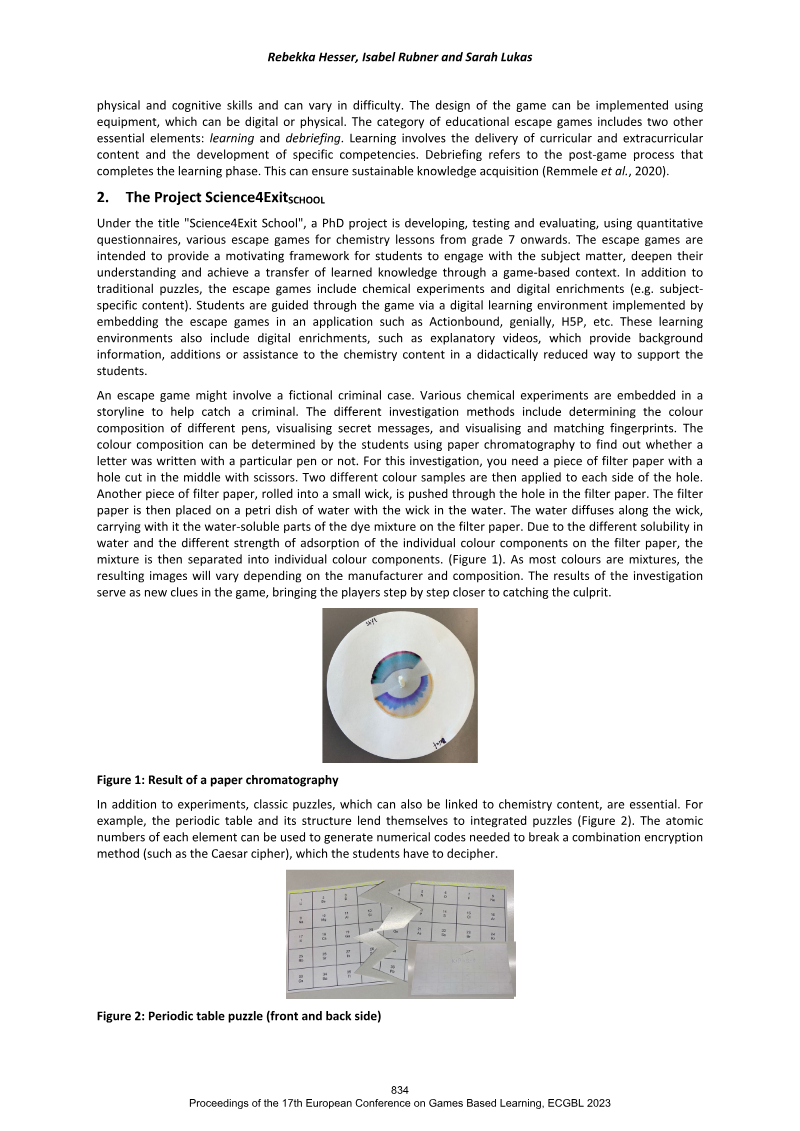
- Because laboratory safety rules out locking students in a lab, the project adapts escape games into classroom-based, virtual, or imaginative formats that combine traditional puzzles with chemistry experiments and digital tools such as Actionbound, genially, and H5P.
The Race to Nuclear Supremacy: Classroom Games as Motivation for Student Learning
A study conducted at a private Mexican university examined whether low-cost, magnetic-sphere classroom games could boost student motivation and comprehension during a multidisciplinary Physics and History session on nuclear fission, the atomic bomb, and E=mc².
- A small, non-randomized study at one private Mexican university used low-cost magnetic-sphere kits to model an atomic nucleus during a combined Physics and History session on fission, the atomic bomb, and E=mc².
- Survey responses were strongly positive in both groups: 18 of 19 students in the game group and 19 of 21 in the comparison group gave favorable answers on average, with 62.2% of all participants fully agreeing the activity helped their understanding.
- The authors conclude that inexpensive game-based activities can motivate students in combined physics and history lessons, addressing concerns about weak STEM motivation and limited resources in Mexico and Latin America.
Making Legislative Process Understandable: Survey of Parliaments' Serious Games of European Countries
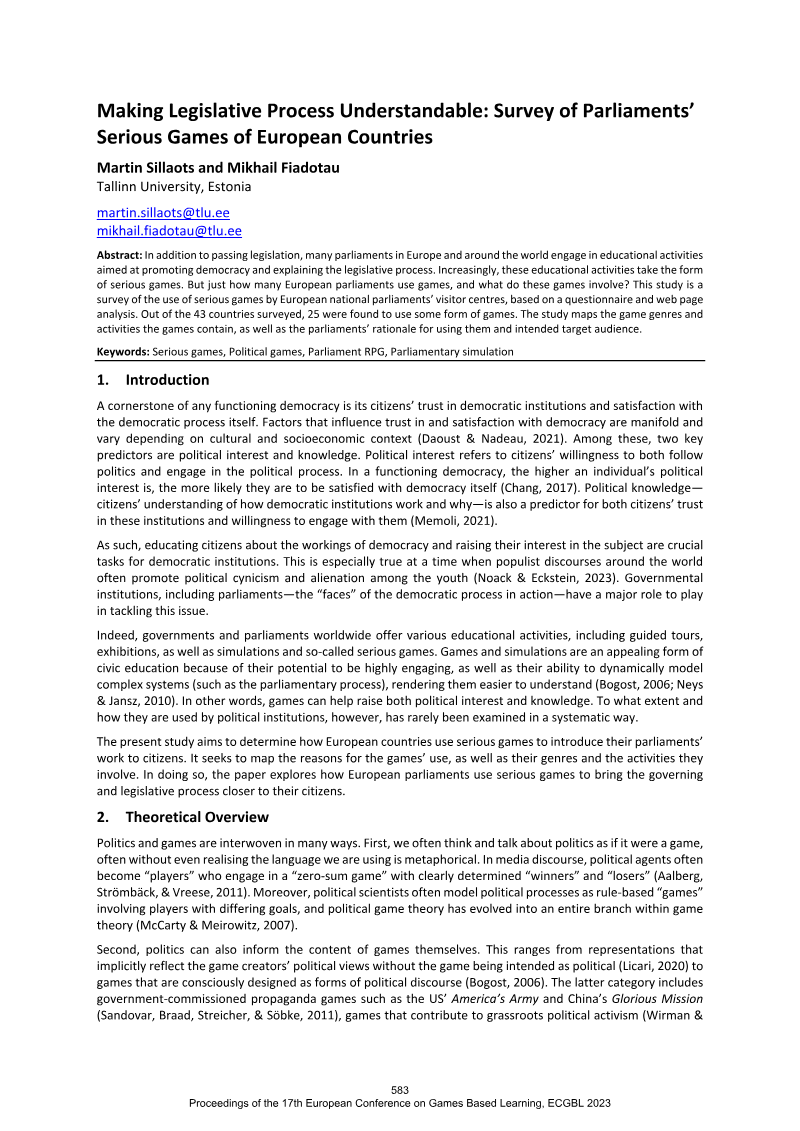
A survey of European national parliaments examines how legislatures use serious games, meaning games designed for purposes beyond entertainment, to explain parliamentary work and build civic knowledge.
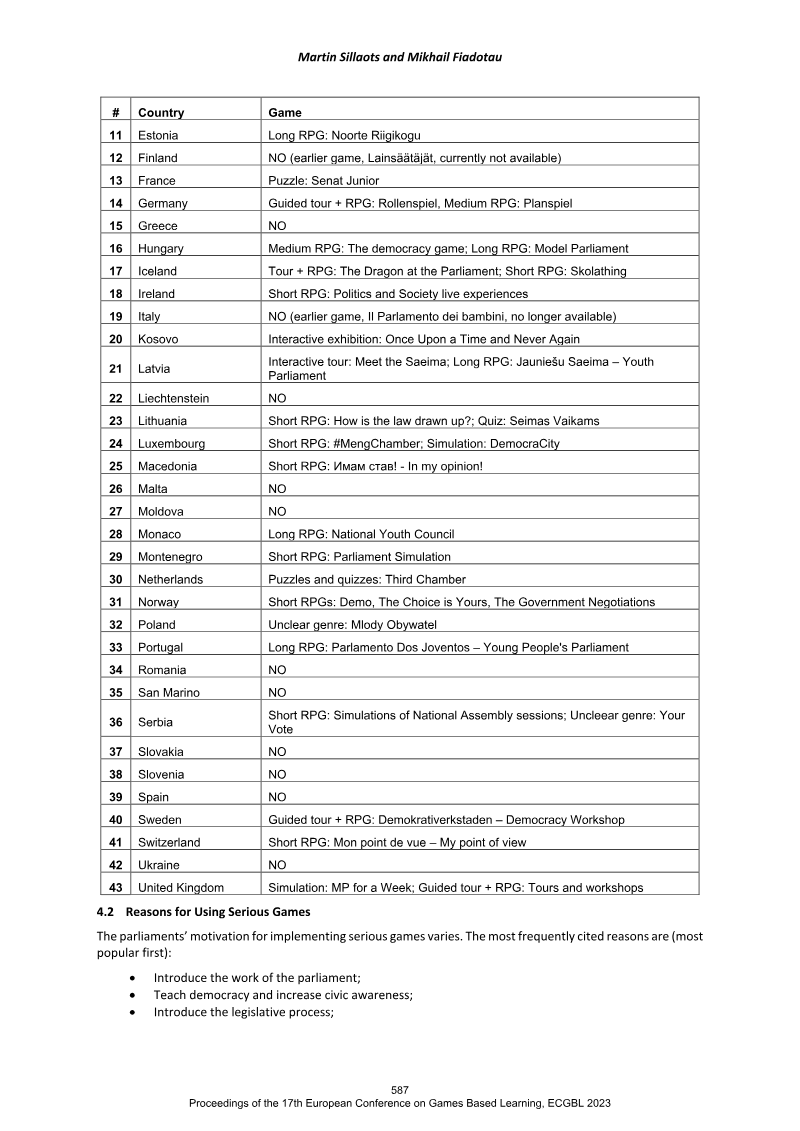
- Of 43 surveyed European national parliaments, 25 (58.1%) use serious games to explain parliamentary work and build civic knowledge, with 40 distinct game titles catalogued.
- Role-playing simulations of parliamentary procedure dominate the landscape at 52.5% of identified games, and sessions of one to three hours are the most common format.
- Most parliamentary serious games are physical, on-site activities, though Lithuania, Norway, and the United Kingdom also offer online versions.
Enhancing Mathematical Reasoning in Primary School: The Strategic Board Game Othello
This design-based study examines how the strategic board game Othello can be used to build mathematical reasoning among primary school students.
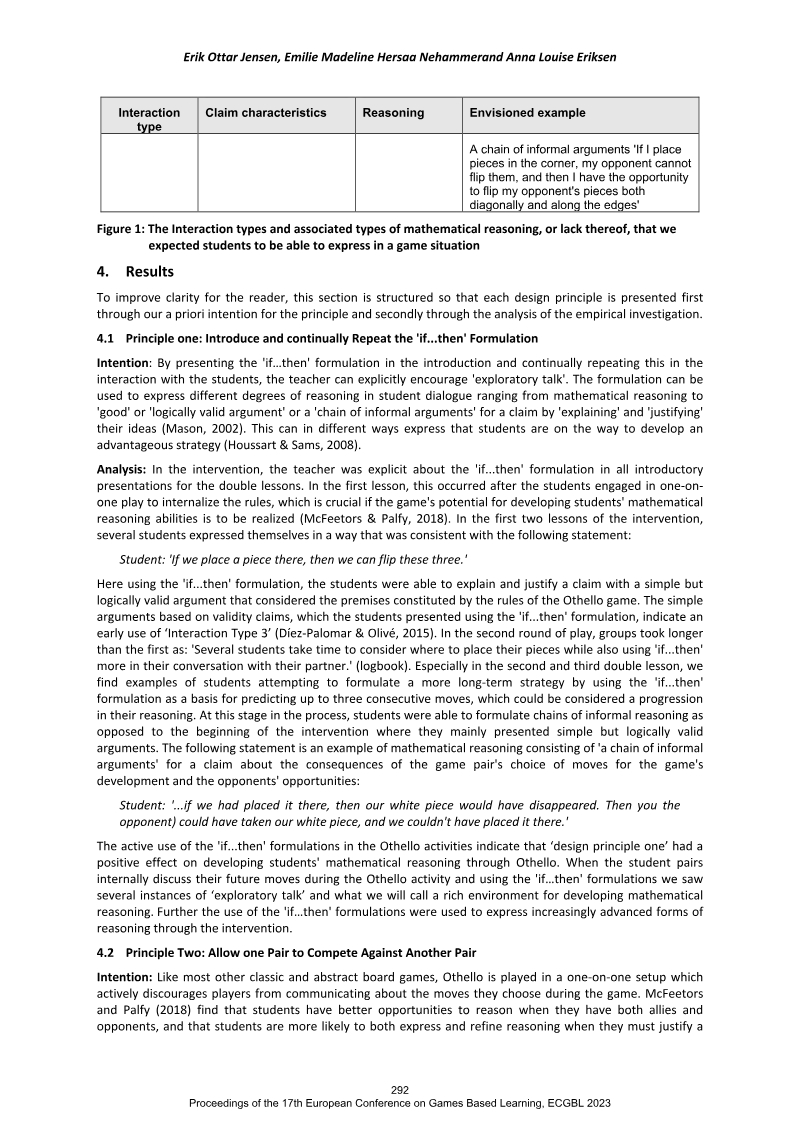
- The study proposes three design principles for building mathematical reasoning through Othello: using an "if...then" structure to organize arguments, pairing teams against each other so students must justify moves to teammates, and varying starting positions via worksheets to prompt forward-looking strategy.
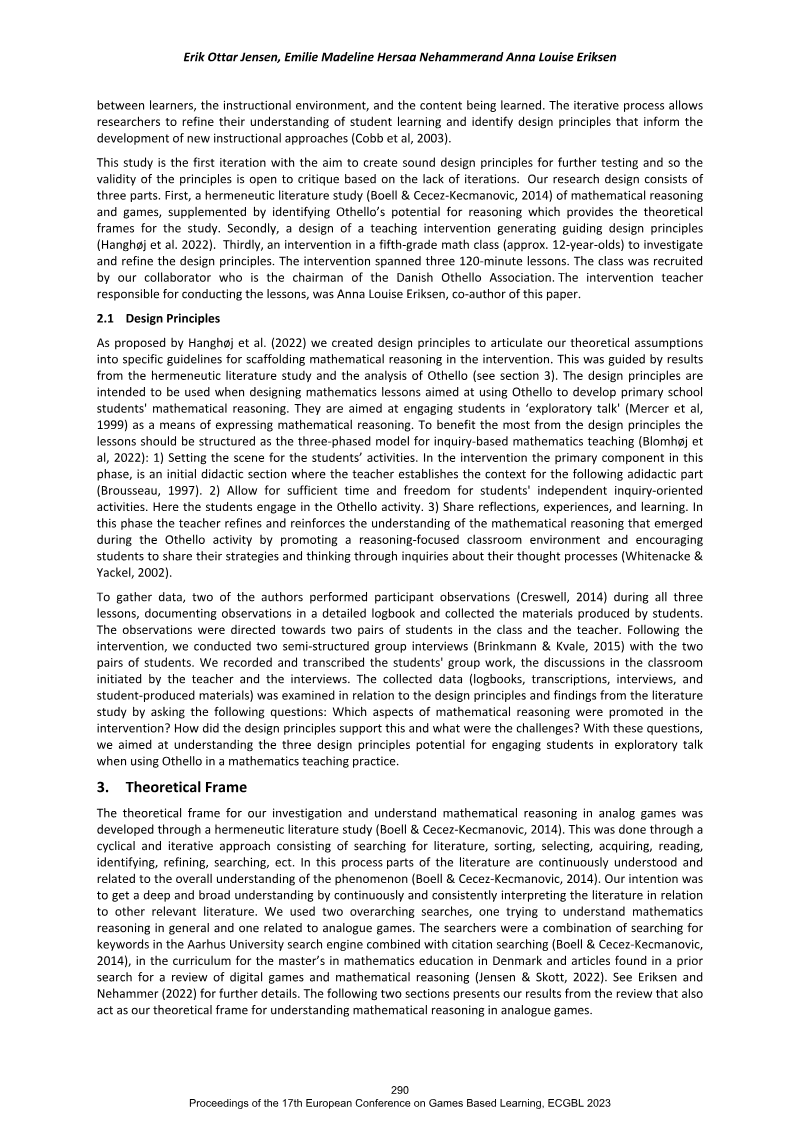
- The design was tested in a single fifth-grade class (about 12-year-olds) across three 120-minute lessons, with data drawn from observations of two student pairs and the teacher, student materials, transcribed recordings, and group interviews, so findings are exploratory rather than generalizable.
- Students progressed from simple, logically valid "if...then" arguments toward chains of informal reasoning over the three lessons.
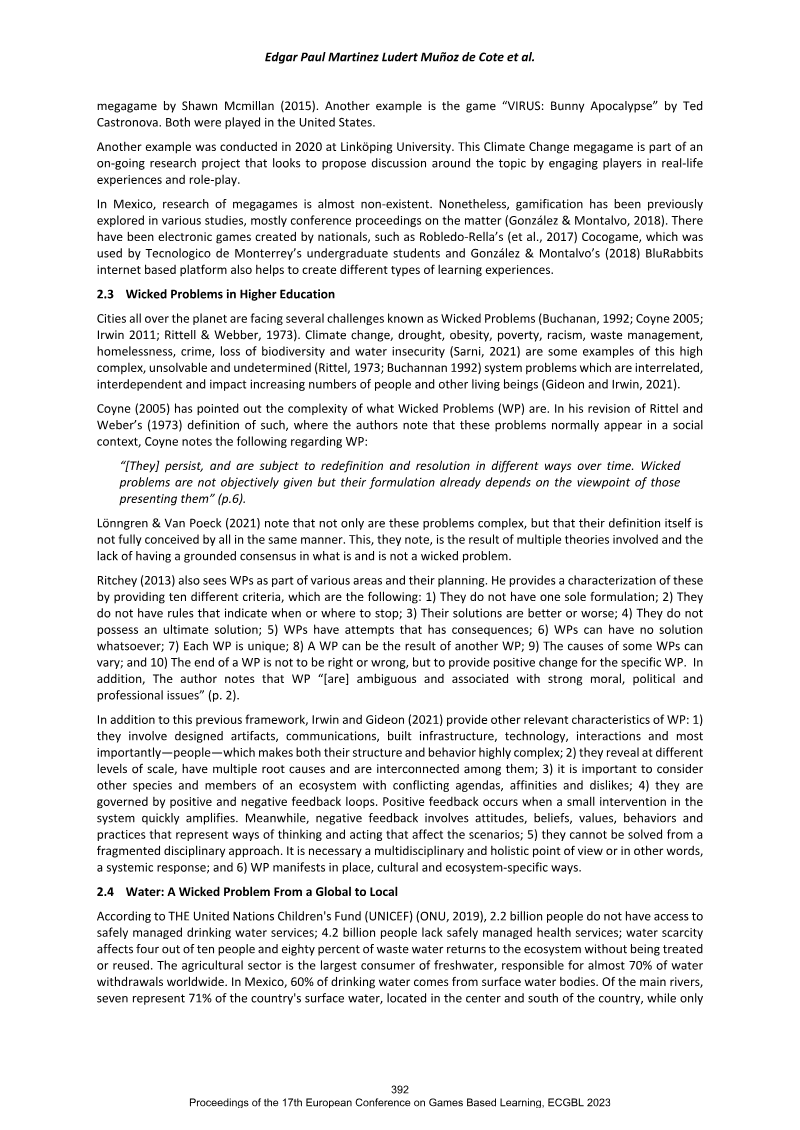
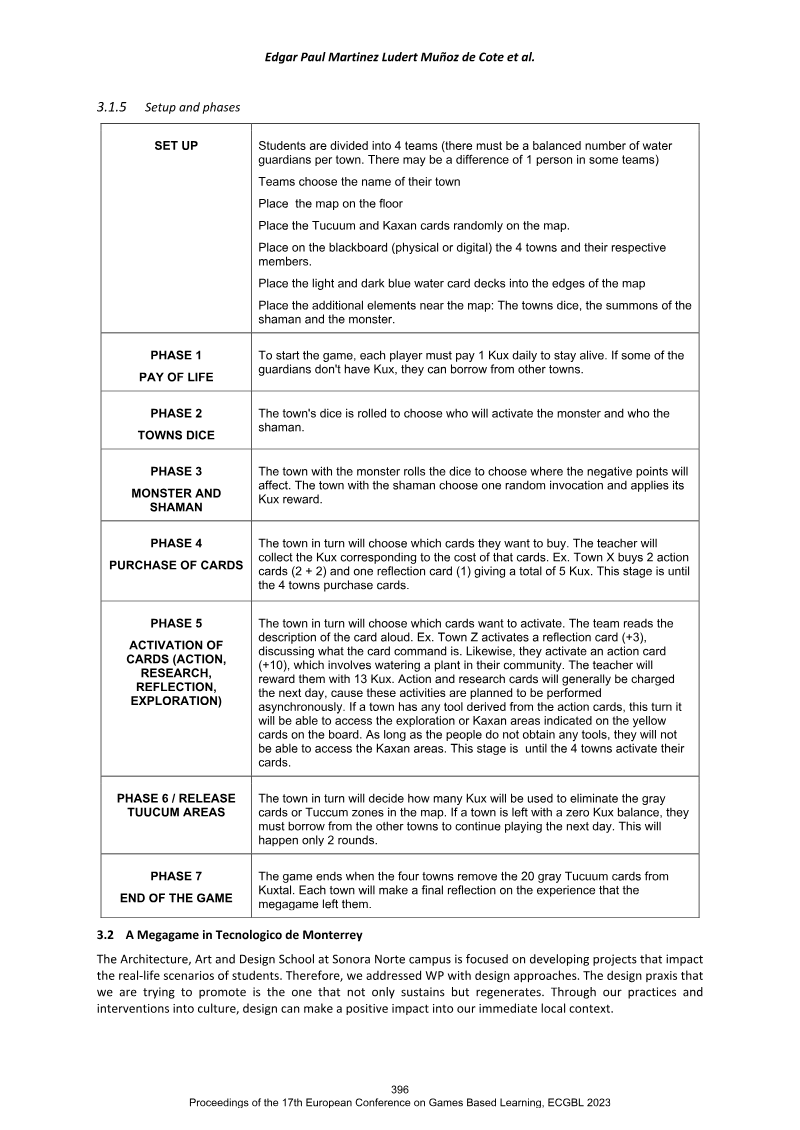
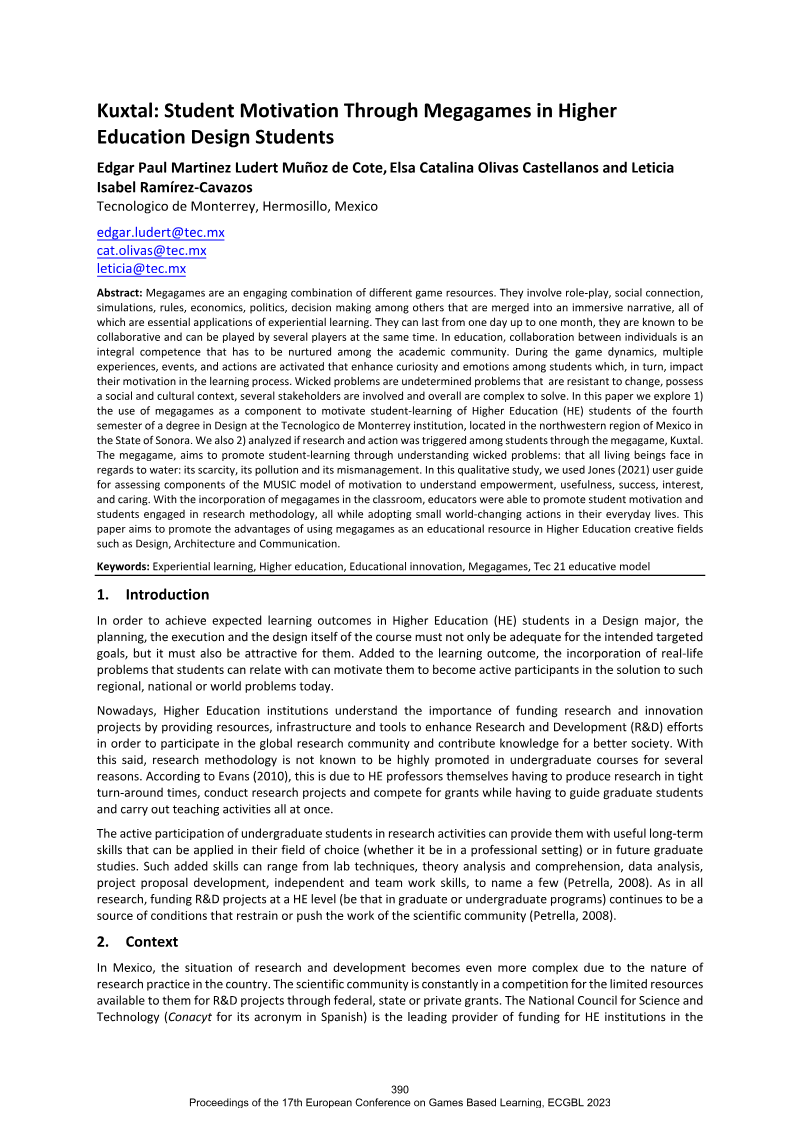
Kuxtal: Student Motivation Through Megagames in Higher Education Design Students
"Kuxtal" examines whether megagames, large-scale role-play simulations built around collaboration and resource management, can motivate Industrial Design students in Mexican higher education to engage with complex, real-world problems.
- Kuxtal is a megagame created by seven professors at Tecnológico de Monterrey that uses water scarcity, pollution, and mismanagement as its central challenges, designed around conditions in Hermosillo, where roughly 71% of water comes from underground aquifers.
- The study tests whether large-scale role-play megagames can boost motivation and research engagement among Industrial Design students, framed through the MUSIC model of academic motivation and a qualitative approach.
- In a week-long test with 24 Industrial Design students (mostly women), 17 strongly agreed they enjoyed the teaching methods and 18 strongly agreed the methods captured their attention.
Implementation of Game-Based Learning in a Tertiary General Education Course
This paper examines the implementation of game-based learning (GBL) through a modified version of the commercial strategy game Civilization in "In Dialogue with Nature," a general education seminar course at The Chinese University of Hong Kong.
- Modifying an existing commercial off-the-shelf game (the strategy game Civilization) rather than building one from scratch let the course team focus on pedagogical design, with two added historical scenarios (4000 BC and 1500 AD) to explore how political, economic, cultural, and geographical factors shape scientific development.
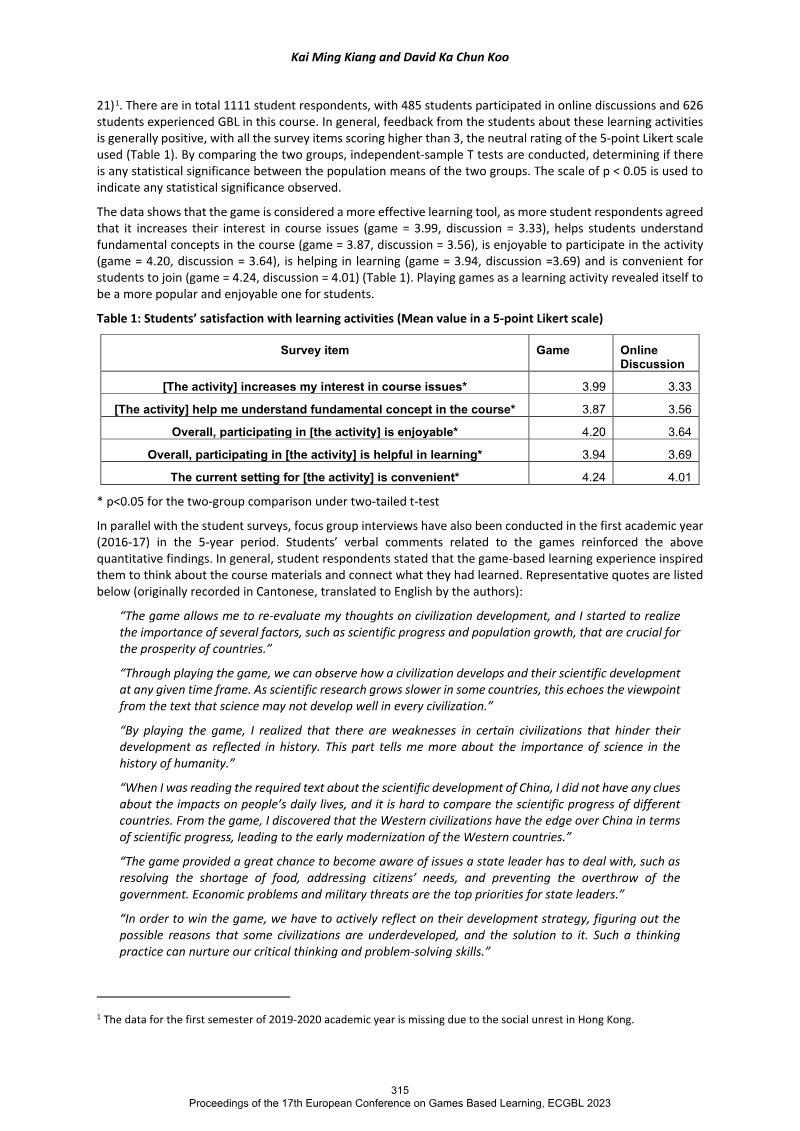
- Across five academic years (2016-17 to 2020-21) and 1,111 student respondents, the 626 game-based students rated the activity significantly higher than the 485 Blackboard discussion students on interest, conceptual understanding, enjoyment, helpfulness, and convenience (5-point Likert scale).
- Game-based students reported higher self-perceived attainment of course learning outcomes (6-point scale) and earned slightly higher course grades (3.236 versus 3.180 on a 4-point scale).
A Simulation Game for Anti-Money Laundering (AML) Using Unity
This paper presents a two-player Unity simulation game designed to teach anti-money laundering concepts, with particular attention to individuals who may be drawn into laundering schemes as money mules.
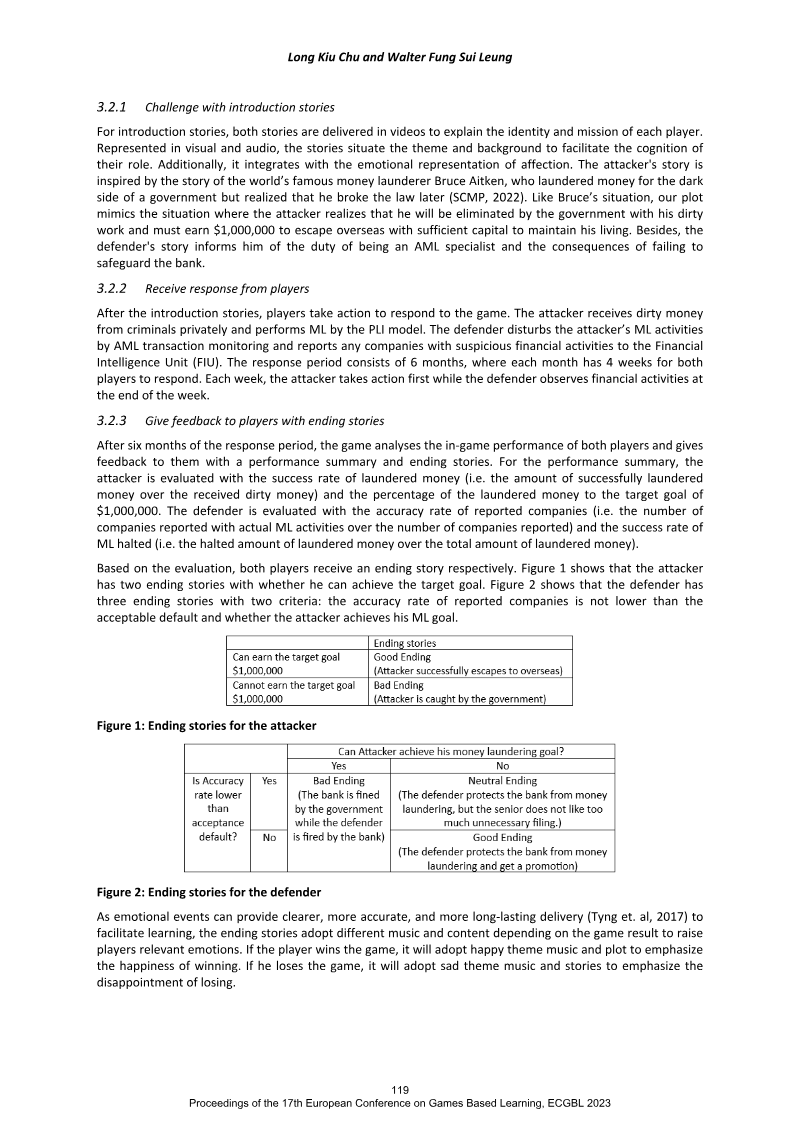
- The game is a two-player Unity simulation in which one player acts as a money launderer using shell companies and the placement-layering-integration model, while the other acts as an AML specialist, targeting individuals such as potential money mules whom existing corporate-focused AML games underserve.
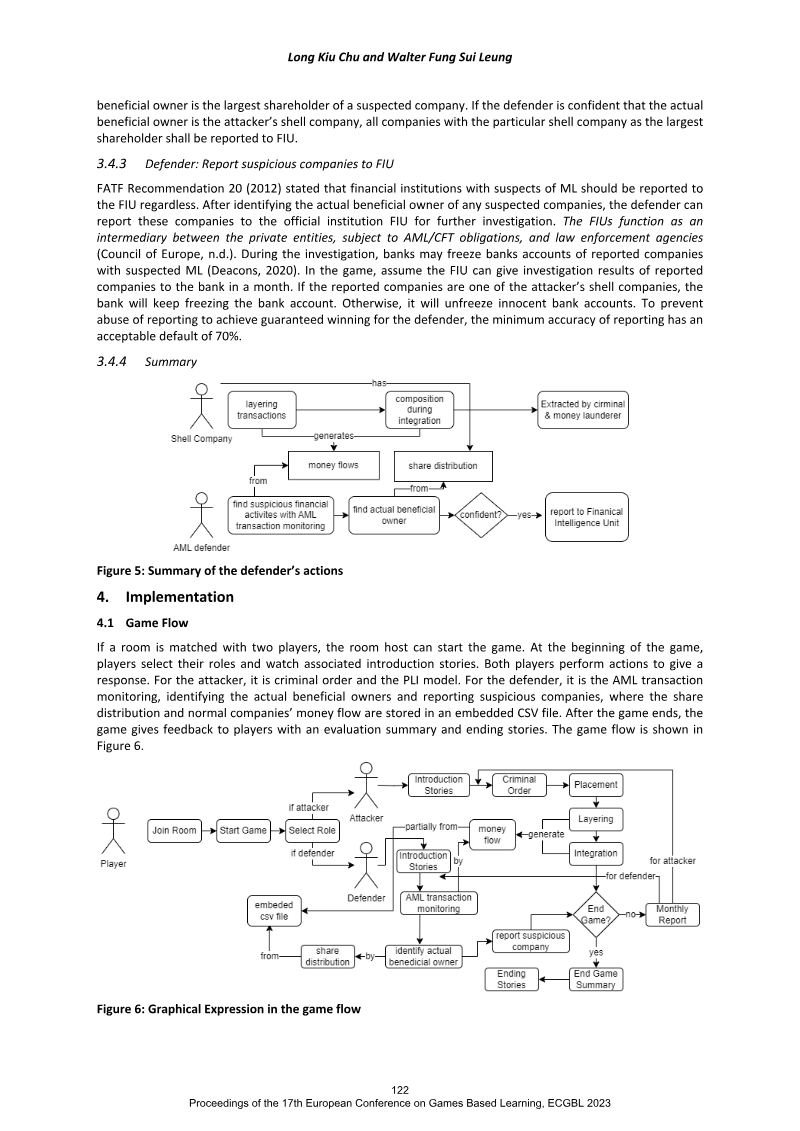
- The AML specialist role applies transaction monitoring, beneficial-ownership identification, and suspicious activity reporting aligned with FATF Recommendations 10 and 20.
- An evaluation with 50 students found post-survey awareness scores of money laundering and AML concepts exceeded pre-survey scores, supporting the authors' conclusion that the game is effective for basic education on ML/AML principles and enforcing institutions.