
ETC Press
ETC Press is an academic publisher run out of Carnegie Mellon University's Entertainment Technology Center. It publishes books, conference proceedings and edited volumes on game studies, game design, analog games and play.
Documents
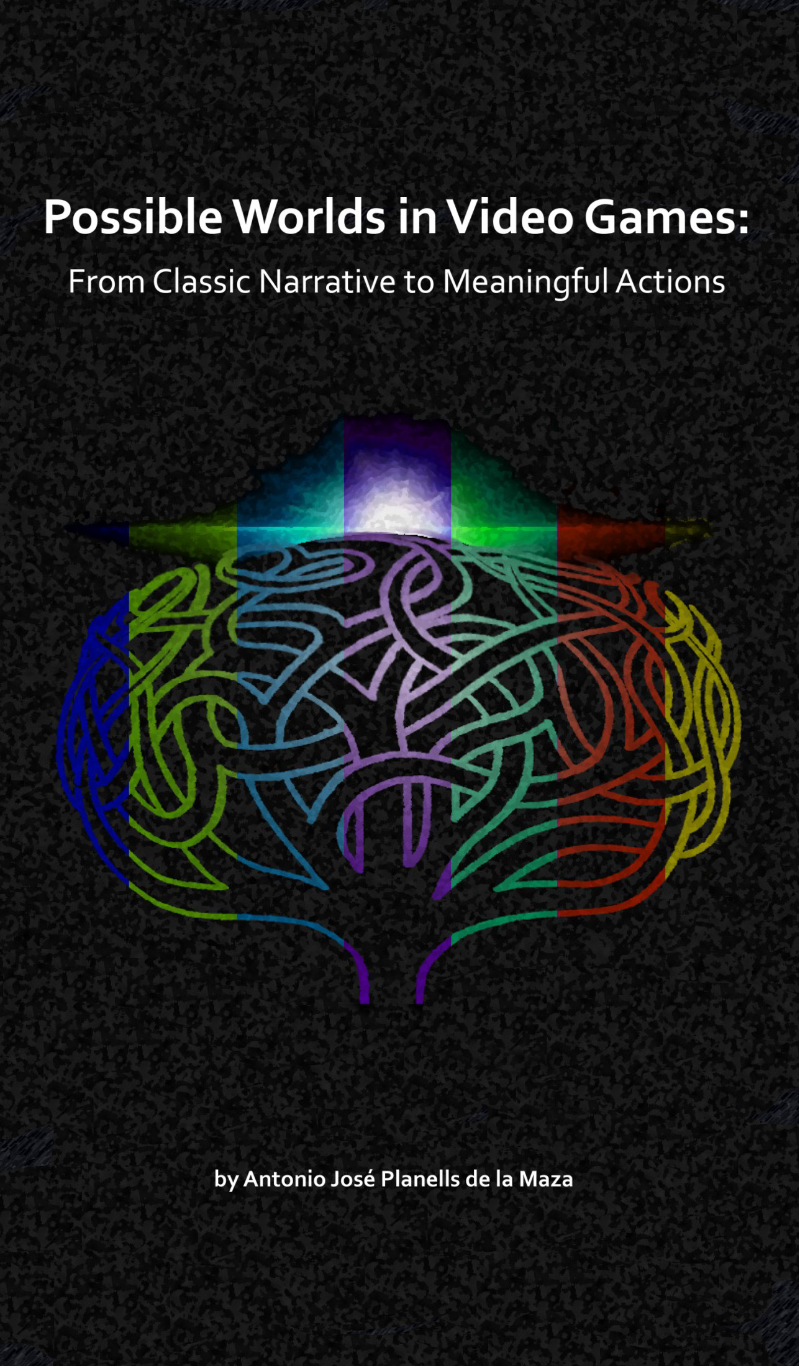
Possible Worlds in Video Games: From Classic Narrative to Meaningful Actions
Antonio José Planells de la Maza's book argues that video games, despite outperforming film and music in revenue, have been systematically neglected by academic study, and it proposes a theoretical framework for remedying this gap.
- Video games outperform film and music in revenue yet have been systematically neglected by academic study, a gap Planells de la Maza's book seeks to address with a new theoretical framework.
- The book conceptualizes video games as "ludofictional worlds" and analyzes them along three dimensions: a macrostructural static dimension (the game as a closed formal system of linked possible worlds), a microstructural dynamic dimension (evolving character identities and relationships), and a metaleptic dimension linking fictional worlds to the player.
- Its central conclusion is that video game worlds are structured around what can happen rather than what is, making the "possible" foundational to game design.

GLS Conference Proceedings 2017
The GLS 12 (2017) Conference Proceedings, published by ETC Press at Carnegie Mellon University and edited by Amanda Barany, Stefan Slater, and Constance Steinkuehler, gathers research, design work, and reflective commentary on game-based learning (GBL) and digital games for education.
- The GLS 12 (2017) proceedings, published by ETC Press at Carnegie Mellon University, mark the final year of the GLS conference series and gather research and design work on game-based learning across settings from U.S. classrooms to Nigeria, Taiwan, and Guatemala.
- A fifth-grade block-coding game study linked challenge-approach behaviors to posttest learning, while girls showed greater persistence without corresponding gains in test scores.
- RumbleBlocks research found that contrast-case designs produced out-of-game transfer that a standard version did not, suggesting in-game metrics like level success can overstate real learning.
Analog Game Studies: Volume 2
"Analog Game Studies: Volume 2" examines how board games, role-playing games, live action role-play, and other tabletop forms represent race, colonialism, gender, sexuality, disability, and everyday urban life, and how players and designers can reshape these representations.
- Analog games are not neutral: their settings, mechanics, and conventions encode social assumptions about race, colonialism, gender, and sexuality, from orientalist "historical exoticism" in Eurogames to heteronormative and patriarchal ideals in children's games such as Girl Talk.
- Queer representation in RPG source books shifted from villainization in the late 1980s toward matter-of-fact inclusion, a change driven largely by individual publishers rather than industry-wide norms.
- The author's "First Nations of Catan" remix reframes the game around indigenous occupancy, illustrating how designers can deliberately redesign representations in commercial board games.
Diversifying Barbie and Mortal Kombat: Intersectional Perspectives and Inclusive Designs in Gaming
Diversifying Barbie and Mortal Kombat (2017) argues that gender, race, sexuality, and class continue to shape who plays, designs, and is welcomed into video games, and that these inequities are structural rather than the product of individual choice.
- The volume argues that gender, race, sexuality, and class shape who plays, designs, and is welcomed into video games, and that these inequities are structural rather than the result of individual choice.
- Its central thesis is that broadening participation requires intersectional research examining how overlapping identities affect play and career opportunities, paired with inclusive design practices introduced early in development and supported by policy.
- Women held about 22% of U.S. game industry jobs as of 2015, while Black developers made up roughly 3% of the workforce compared with 13% of the U.S. population.
From Where Do Dungeons Come?
Aaron Trammell's essay argues that the emergence of the dungeon as a central fantasy trope in Dungeons & Dragons, particularly in the original 1974 manual The Underworld & Wilderness Adventures, is symbolically tied to Cold War anxieties about nuclear attack in America.
- Aaron Trammell argues that the dungeon's emergence as a central fantasy trope in Dungeons & Dragons, as seen in the original 1974 manual The Underworld & Wilderness Adventures, is symbolically tied to Cold War American anxieties about nuclear attack.
- The essay places the dungeon within a 1950s and 1960s revival of subterranean fiction, including works by C.S. Lewis and J.R.R. Tolkien, films such as The Mole People, and the "Hollow Earth" tradition, against which the game's underground focus appears distinctive.
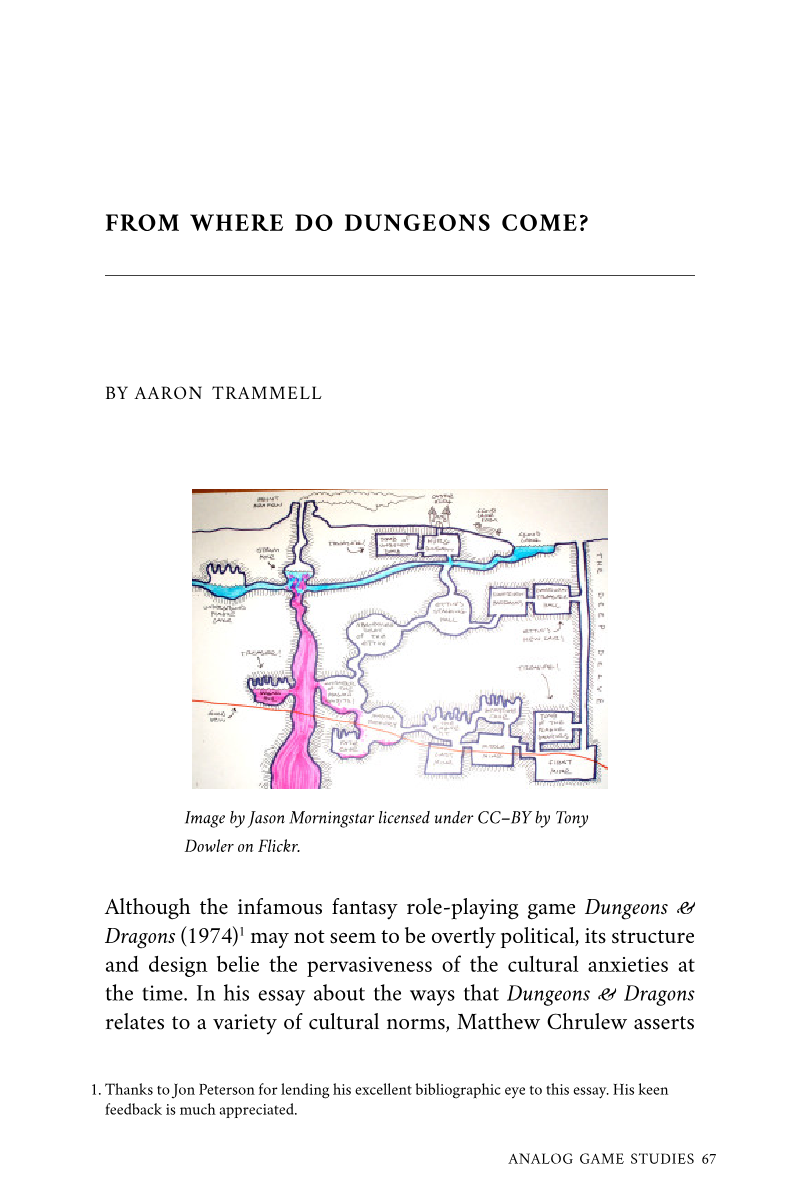
- Trammell observes that the game presented wilderness and underworld as equally dangerous, yet supplied players with maps, charts, and reference tables that offered a sense of control over unpredictable environments.
Orientalism and Abstraction in Eurogames
This essay argues that Eurogames, the German-influenced board game tradition emerging in the late twentieth century, contribute to Orientalist representations of the East through abstraction and the erasure of violence.
- The essay argues that Orientalist representations in Eurogames arise mainly from the formal properties of the medium (abstraction and systems design), not from explicit ideological intent, and it uses Edward Said's concept of Orientalism as its framework.
- Its central case study is Paolo Mori's Vasco da Gama (2009), which the author reads as framing fifteenth-century Portuguese maritime expansion in economic terms while omitting the violence and disruption of indigenous and Muslim trading networks.
- The Eurogame genre partly developed as a reaction against American games such as Monopoly and Clue, and under the influence of the Spiel des Jahres award and a German cultural aversion to militarism, designers shifted away from detailed wargaming toward games that minimize direct conflict and player elimination.
The Playing Card Platform
In "The Playing Card Platform," Nathan Altice argues that playing cards function as a platform whose physical form shapes game design in the way hardware shapes software.
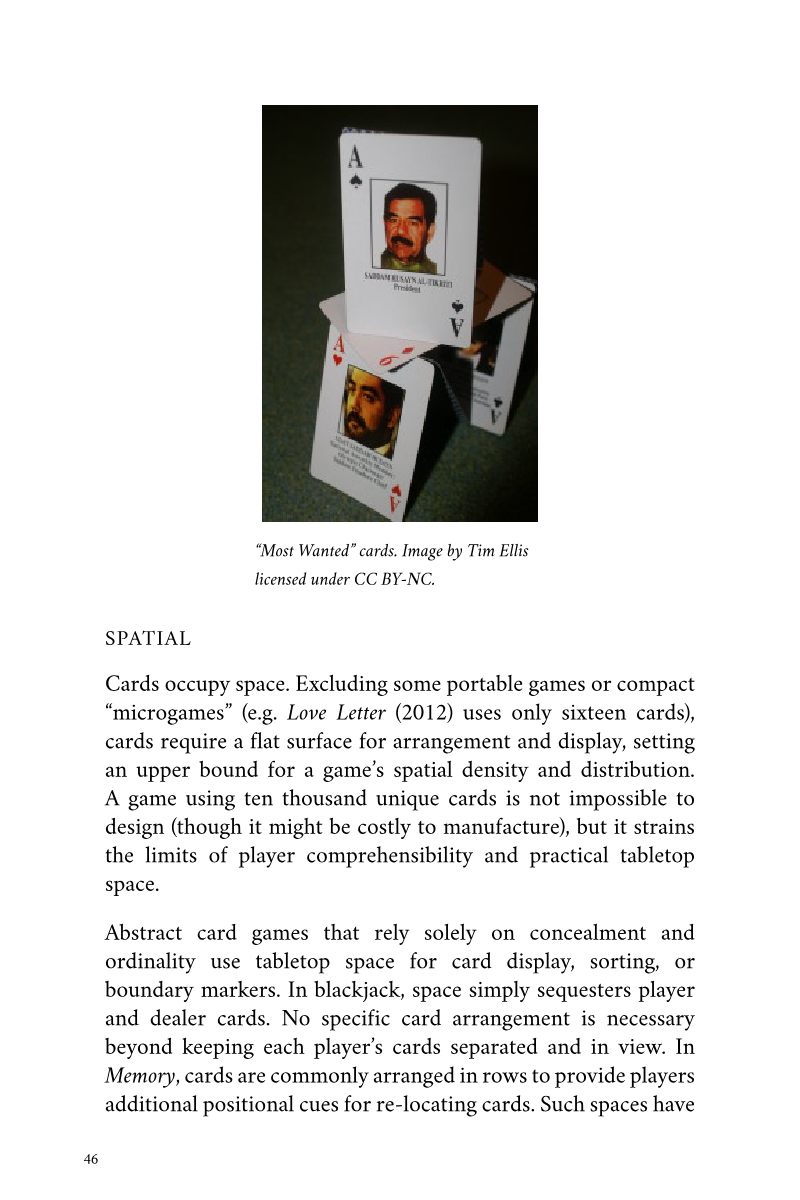
- Nathan Altice argues that playing cards act as a platform whose physical form shapes game design much as hardware shapes software, identifying five defining characteristics: planar, uniform, ordinal, spatial, and textural.
- The rectangular card's two concealable faces enable secrecy-based games like poker that board games cannot easily support, while uniformity underpins fair play and mass commercial reproduction.
- Magic: The Gathering extended the traditional deck's ordinal logic through colors, custom ranks, combinatorial complexity, and collectible scarcity, and its 1993 tapping mechanic, which repurposed a 90-degree rotation as a resource tracker, spawned numerous variants.
Misogyny and the Female Body in Dungeons & Dragons
Aaron Trammell's essay examines two 1976–1977 articles from The Dragon, TSR Hobbies' flagship Dungeons & Dragons magazine, to trace how misogynist and racist attitudes were embedded in early tabletop gaming culture.
- Trammell's essay analyzes two 1976–1977 articles from The Dragon, TSR Hobbies' flagship Dungeons & Dragons magazine, to show how misogynist and racist attitudes were built into early tabletop gaming culture.
- The author argues these attitudes persist because the hobby has prioritized accuracy of simulation over the ethics of what is being simulated.
- Len Lakofka's "Notes on Women & Magic" replaces women's charisma with a "beauty" statistic, unlocks seduction-based abilities, and gives female combat ability a disadvantage relative to men's default.
Strategies for Publishing Transformative Board Games
Will Emigh's essay examines how micro-publishing models are enabling board game designers to address critical social and political themes that mainstream publishers tend to avoid.
- Physical board games face steeper distribution barriers than digital games because production and shipping costs are largely avoided in digital publishing, which is the core obstacle for small designers.
- Micro-publishing strategies such as crowdfunding, print-on-demand services, print-and-play distribution, and conferences like IndieCade and No Quarter are reducing costs and expanding reach for independent board game designers.
- Mainstream board games often avoid difficult subjects through abstraction: Settlers of Catan omits native inhabitants entirely, and Archipelago reduces colonization to abstract mechanics with little cultural depth.
Fun in a Different Way: Rhythms of Engagement and Non-Immersive Play Agendas
Nick Mizer's essay argues that non-immersive play is a legitimate and valuable mode of tabletop role-playing rather than a design flaw or a failure of the gaming experience.
- Nick Mizer argues that non-immersive play is a legitimate, valuable mode of tabletop role-playing rather than a design flaw, and that many players enjoy shifting attention among play frames instead of sustained absorption in the fiction.
- Mizer builds on Erving Goffman's concept of frames and Gary Fine's three-frame model of role-playing (social, game, and fiction), proposing that movement between these frames can itself be a pleasurable object of play.
- Mizer critiques the scholarly and gaming preference for immersion, citing Daniel Mackay's argument that games lacking strong emotional identification with characters serve disciplinary functions, and offers Bertolt Brecht's epic theatre and Michael Saler's "disenchanted enchantment" as alternatives.