1 free read left. Create a free account for unlimited reading + AI research.
Create free accountArticle ETC Press
1 free read left. Create a free account for unlimited reading + AI research.
Create free accountArticleETC Press
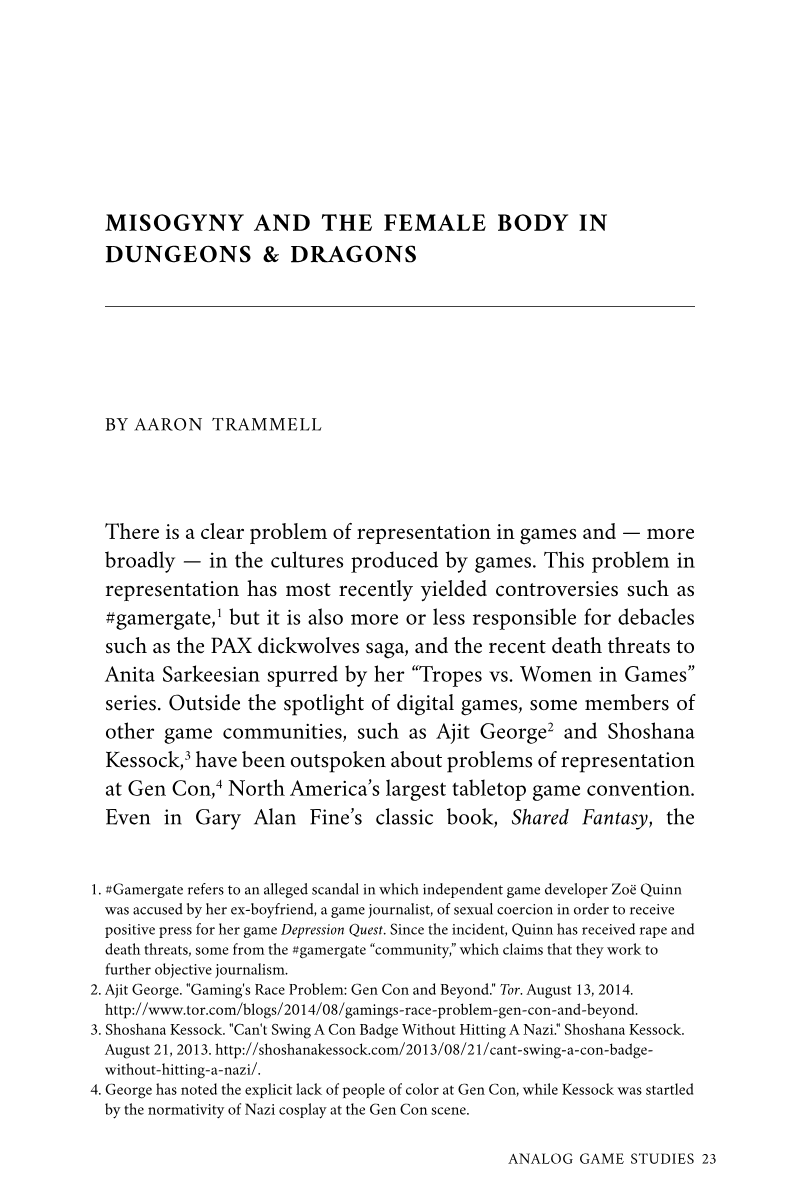
Aaron Trammell's essay examines two articles from The Dragon, TSR Hobbies' flagship Dungeons & Dragons magazine.
Aaron Trammell's essay examines two 1976–1977 articles from The Dragon, TSR Hobbies' flagship Dungeons & Dragons magazine, to trace how misogynist and racist attitudes were embedded in early tabletop gaming culture. The author argues that these attitudes persist because the hobby has historically prioritized the accuracy of simulation over the ethics of what is being simulated. The essay situates this analysis within broader controversies over representation in games, including Gamergate and recent critiques of diversity at Gen Con, and it notes that the articles were written by men for a male audience, with women being infrequent contributors to the magazine in its early years.
The primary texts are Len Lakofka's "Notes on Women & Magic" and P.M. Crabaugh's "Weights & Measures, Physical Appearance and Why Males are Stronger than Females." Lakofka's rules assign women a "beauty" statistic in place of charisma, unlock seduction-based abilities, and place female combat ability at a disadvantage relative to men's default. Crabaugh grants female characters bonuses to constitution and dexterity grounded in essentialist biological claims, and his skin-complexion table allocates most character options to Caucasian categories, justified by the racial composition of the sword-and-sorcery literature he drew upon. The author reads these systems through Foucault's concept of informatic power, arguing that they reify existing modes of control.
The analysis concludes that the hobby's reliance on authenticity as an alibi has carried racist and misogynist assumptions from historical reenactment into fantasy genres, where Robert E. Howard's influential work is also noted for white supremacist themes. The essay contends that little has changed in the nearly five decades since, and it calls on players, designers, and gamewrights to recognize these biases and deliberately revise the rules and representations they inherit.
Each row is a game or company this document names, each column a document, oldest first. A mark means that document names it. Select a row to see those documents.
ETC Press · 2023
ETC Press · 2022
ETC Press · 2022
ETC Press · 2021

ETC Press · 2021
ETC Press · 2021
ETC Press · 2020


ETC Press · 2020
ETC Press · 2020
ETC Press · 2020
ETC Press · 2020
ETC Press · 2020
European Conference on Games Based Learning (ECGBL) · 2026