
Eludamos: Journal for Computer Game Culture
Open-access peer-reviewed journal on computer game culture, published since 2007 (now via Septentrio Academic Publishing).
Documents

No B.S.: The Contemporary Practice of Game Education, Design, and Development
This document is an interview excerpt from the 2010 journal Eludamos, in which the authors speak with Quentin Rezin, a scripter and level designer at inXile Entertainment, about the paths into and realities of game development.
- Quentin Rezin, a scripter and level designer at inXile Entertainment, pursued a B.A. in Computer Science at the University of Arkansas because no game-specific degree was available, filling electives with arts, philosophy, and science to build a broad skill set.
- Rezin concludes that university training left him well prepared, but most universities offer little project-based or team-based experience, a gap typically filled on the job.
- At inXile, designers were frequently reassigned across writing, tutorials, and programming support, reflecting the flexibility a smaller studio needs since it cannot afford extensive specialization.
Evoking the Inexpressible: The Fine Art and Business of Games
This interview with game designer Brian J. Moriarty, conducted in early 2010 and published in Eludamos, explores the tension between games as commercial enterprise and as fine art.
- Brian J. Moriarty, a former Atari enthusiast and magazine writer, became an Infocom implementor and created titles including Wishbringer, Trinity, and Loom, giving him a view across the early, small-team era of games.
- Moriarty argues that game development is more uncertain than film because technology must often be invented during production, whereas film benefits from more predictable risk and budgeting.
- The games industry is described as a $40 billion business, and Moriarty contrasts today's large, schedule-driven studios with the small, self-taught teams and single-author production of the early industry.

"Stay Small and Keep It All": Making a Big Splash in Boutique Game Development
This interview with Michael Thornton Wyman, founder and CEO of Big Splash Games, explores the trade-offs and character of boutique game development compared with large publisher environments like Electronic Arts.
- Boutique studios gain creative freedom and room to take risks, but sacrifice the financial cushion and exposure that large publishers like Electronic Arts provide.
- Small studios depend on a uniformly highly capable team with little tolerance for weak performers, and mistakes carry much greater consequences for survival.
- Small-team user testing is typically informal and hands-on, often conducted in home settings with testers playing without guidance, unlike the more formalized testing at larger companies.

Development in Context
"Development in Context" is an introductory piece from the 2010 volume of Eludamos, a journal for computer game culture, written by Judd Ethan Ruggill and Ken S. McAllister.
- The paper argues that computer game scholars face a serious obstacle in the complexity and rapid change of the game industry, and that understanding a game's play and culture requires grasping how it was made.
- Production processes in games are often obscured by proprietary practices, intricate corporate structures, shifting consumer markets, and constant technological change.
- The authors propose engaging directly with game developers as a way to clarify these hidden production processes, drawing on interviews conducted over the previous year.
The Museology of Computer Games: An Interview with the Curator of the Computerspiele Museum, Andreas Lange, and Art Historian and Archivist Dr. Winfried Bergmeyer, Berlin
The Museology of Computer Games, an interview published in Eludamos Vol. 4, No. 1 (2010), examines how computer games are collected, displayed, and preserved, with Berlin's Computerspiele Museum as its focal case.
- Games are considered the most difficult digital form to archive because they must be preserved in a playable, interactive state rather than as static artifacts, and the EU-funded KEEP project (a three-million-euro initiative) recognises gamer-driven emulator development as a valuable preservation tool.
- The Computerspiele Museum in Berlin evolved from a youth-protection and educational initiative into what its curator describes as Europe's largest collection of entertainment software and hardware, yet it has no permanent collection and relies on donations and project-based acquisitions.
- Curator Andreas Lange argues the industry often lacks the staff and records needed to supply historical materials, while academic demand for legal access to games is growing.
Indoor Fireworks: The Pleasures of Digital Game Pyrotechnics
Niedenthal's 2010 Eludamos article argues that fireworks in digital games constitute a distinct "pleasure primitive," combining bodily tension and release with the emotional anticipation and fulfillment built into the three-stage structure of a firework shell: detonation, flight, and burst.
- Niedenthal's 2010 Eludamos article argues that fireworks in digital games form a distinct "pleasure primitive" that combines bodily tension and release with the three-stage structure of a firework shell: detonation, flight, and burst.
- Drawing on Caillois's concept of ilinx (voluptuous panic), the author contends that pyrotechnic effects disrupt the stability of the visual frame and the player's sense of bodily control, producing a controlled sensory overwhelm.
- The analysis is organized around simulation (fireworks simulators and 3D show-design tools), gameplay (RollerCoaster Tycoon 3, Fantavision, Boom Boom Rocket, Okami, Big Bang Mini), and narrative (Assassin's Creed II's Venetian carnival and Okami's pyrotechnist Tama).
Exploring the Creative Potential of Values Conscious Design: Students' Experiences with the Values at Play Curriculum
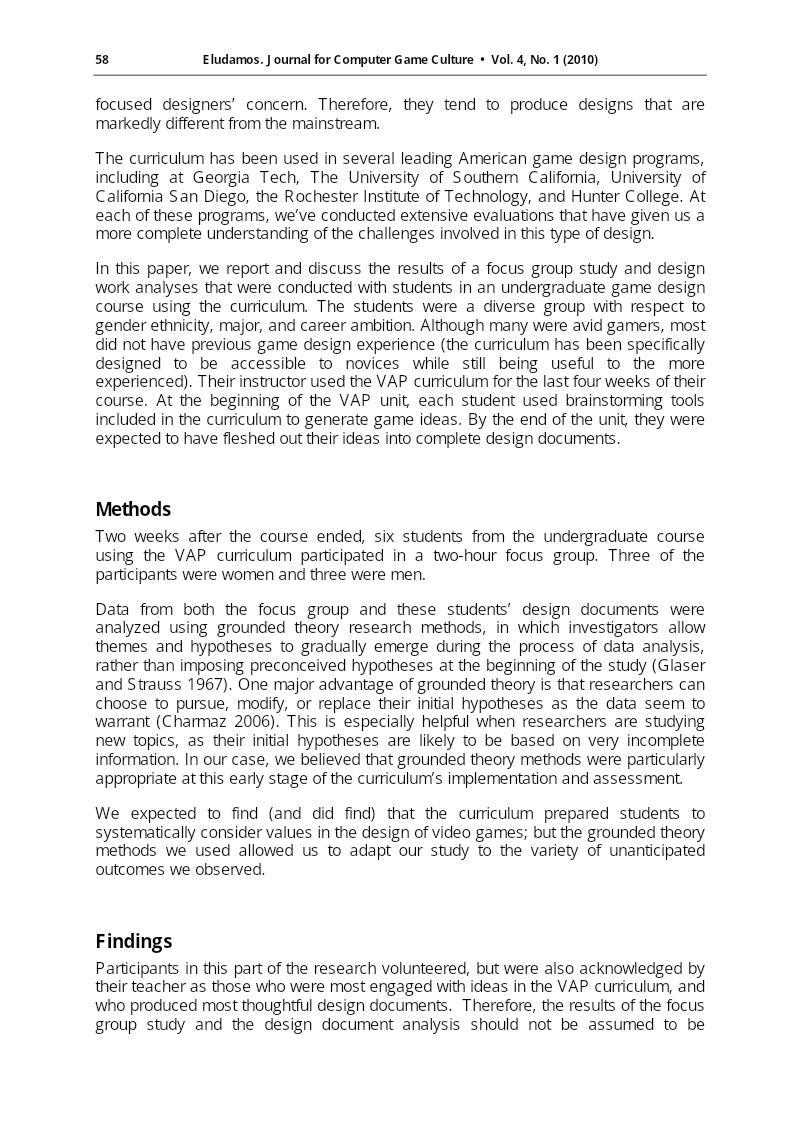
Belman and Flanagan's 2010 study examines how undergraduate game design students engaged with the Values at Play curriculum, a four-week program that teaches students to embed social and political values into game design.
- Students in the Values at Play curriculum, a four-week program teaching undergraduate game design students to embed social and political values in games, often embedded values unintentionally in game features, and struggled to make them explicit.
- The study's main tensions were reconciling values-conscious goals with the need for games to be fun, and resisting conventional genre clichés such as violent conflict.
- Students adopted three strategies: repurposing familiar mechanics, using unwinnable or unconventional win states borrowed from serious games, and inventing original mechanics to foster empathy, such as the language-barrier mechanic in Cabbies.
The Computer Game as a Somatic Experience
Nielsen's "The Computer Game as a Somatic Experience" argues that playing computer games is a lived unity of mind and body rather than a passive or purely physical activity, and that it is best examined from a phenomenological first-person perspective.
- Playing computer games is framed as a lived unity of mind and body, best examined through a phenomenological first-person perspective rather than as passive or purely physical activity.
- The player-game relation is described as a composite aesthetic experience whose value lies in the new reality it generates, not merely in formal game structures.
- Experiential features (first-person view, motion controls, force-feedback peripherals) immerse and decouple the body, while representational features (stereotyped bodies, third-person view) foreground cultural meanings of embodiment.
Why So Serious? On the Relation of Serious Games and Learning
Breuer and Bente's 2010 article examines the term "serious games," arguing that its definition is contested and inconsistently applied across research and industry.
- The term "serious games" is contested and inconsistently applied: the label does not reliably indicate an educational purpose or socially desirable effect, since some games labeled serious lack a learning goal and even extremist propaganda games could qualify under a loose definition.
- Breuer and Bente favor flexible, multi-dimensional descriptive tags (platform, subject, learning goals, audience, interaction mode) over fixed genre categories, arguing that commercial off-the-shelf games can also serve serious ends.
- Play and learning share core qualities, including challenge, interactivity, motivation, self-efficacy, and flow, which make games an attractive vehicle for education.

Postcolonial Playgrounds: Games as Postcolonial Cultures
Sybille Lammes argues in this article that historical strategy games such as Age of Empires, Civilization, and Rise of Nations can be understood as "postcolonial playgrounds," arenas where players engage with and reshape colonial legacies.
- Sybille Lammes frames historical strategy games such as Age of Empires, Civilization, and Rise of Nations as "postcolonial playgrounds" where players engage with and reshape the hybridized, unsettling legacies of colonialism rather than simply reproducing colonial power or speaking from the standpoint of colonized peoples.
- Only the third of three definitions of postcolonialism, which treats the "post" as signaling transformed and hybridized colonial legacies, is judged to fit these games; they neither celebrate the end of colonialism nor merely reproduce it.
- The games' mutable maps contrast with fixed, objective colonial-era maps: borders in Civilization shift as the player explores, and the Age of Empires mini-map grows as territory is discovered.

Ten Years Later: Towards the Careers of Long-Term Gamers in Austria
Götzenbrucker and Köhl's 2009 study, "Ten Years Later: Towards the Careers of Long-Term Gamers in Austria," revisits fifteen Austrian online gamers first interviewed in 1999 to examine how sustained gaming intersects with lifestyle, identity, and social networks.
- Most still-active long-term gamers in the study shifted from achievement-driven play toward socializing and less time-intensive games, driven mainly by life transitions such as employment and family commitments.
- Socializers were the largest group, comprising eight of the fifteen participants, and Bartle's player typology still applied a decade after the original 1999 interviews.
- Participants' social networks contracted by roughly 20 percent, from an average of 17.2 contacts in 1999 to 13.7 in 2009, though many online friendships proved durable.

Repelling the Invasion of the "Other": Post-Apocalyptic Alien Shooter Videogames Addressing Contemporary Cultural Attitudes
Ryan Lizardi's analysis examines post-apocalyptic alien invasion shooters, including Halo, Gears of War, Killzone, Resistance, and BioShock, as allegories for enduring American cultural attitudes.
- The study reads post-apocalyptic alien shooters such as Halo, Gears of War, Killzone, Resistance, and BioShock as allegories for enduring American cultural attitudes, using Xavier's historical allegory theory and Shohat and Stam's concept of ethnocentrism rather than reading them only through post-9/11 politics.
- The author argues the subgenre reflects a longer-standing American tendency to view the nation through its own cultural perspective and to cast outsiders as inferior 'Others' to be violently subdued.
- Partial evidence for the domestic framing is that these games sell substantially better in the United States than abroad, though the analysis relies mainly on close textual readings rather than quantitative sales data.