1 free read left. Create a free account for unlimited reading + AI research.
Create free accountArticle Eludamos: Journal for Computer Game Culture
1 free read left. Create a free account for unlimited reading + AI research.
Create free accountArticleEludamos: Journal for Computer Game Culture
The article argues that fireworks in digital games combine bodily tension and release. Their structure mirrors a firework shell.
Niedenthal's 2010 Eludamos article argues that fireworks in digital games constitute a distinct "pleasure primitive," combining bodily tension and release with the emotional anticipation and fulfillment built into the three-stage structure of a firework shell: detonation, flight, and burst. Drawing on Caillois's concept of ilinx, or voluptuous panic, the author contends that pyrotechnic effects disrupt the stability of the visual frame and the player's sense of bodily control, producing a controlled form of sensory overwhelm. The argument positions fireworks as sensory, historically pictorial, and fractal structures that mirror the broader trajectories of gameplay.
The analysis proceeds through three lenses. In simulation, the article examines fireworks simulators and three-dimensional show-design tools. In gameplay, it considers community-driven design in RollerCoaster Tycoon 3, timing and rhythm mechanics in Fantavision and Boom Boom Rocket, and the power and awe evoked by Okami and Big Bang Mini. In narrative, it explores Assassin's Creed II's Venetian carnival and the pyrotechnist character Tama in Okami. Across these lenses, the author concludes that fireworks function as emotional punctuation and as a framework for "ludic festivity," with Shimizu's principles of aesthetic contrast and Duncker's concept of "dynamical joy" helping to describe the intense sensory experience games can offer. Rhythm-based pyrotechnic games receive particular attention for how they fuse player timing with spectacle.
The article's most modest but telling claim is that the simplest use of fireworks, as celebratory light effects, acts as emotional punctuation that acknowledges player achievement. The scope is largely interpretive and drawn from a selection of titles released roughly between 2000 and 2009 across Wii, PS2, PS3, DS, and Mac platforms, with an emphasis on examples from Japanese and Western mainstream game design. The work rests on art history, game studies, and pyrotechnics literature rather than empirical measurement, so its contributions are conceptual and critical rather than quantitative.
Each row is a game or company this document names, each column a document, oldest first. A mark means that document names it. Select a row to see those documents.
Eludamos: Journal for Computer Game Culture · 2024
Eludamos: Journal for Computer Game Culture · 2024



European Conference on Games Based Learning (ECGBL) · 2026
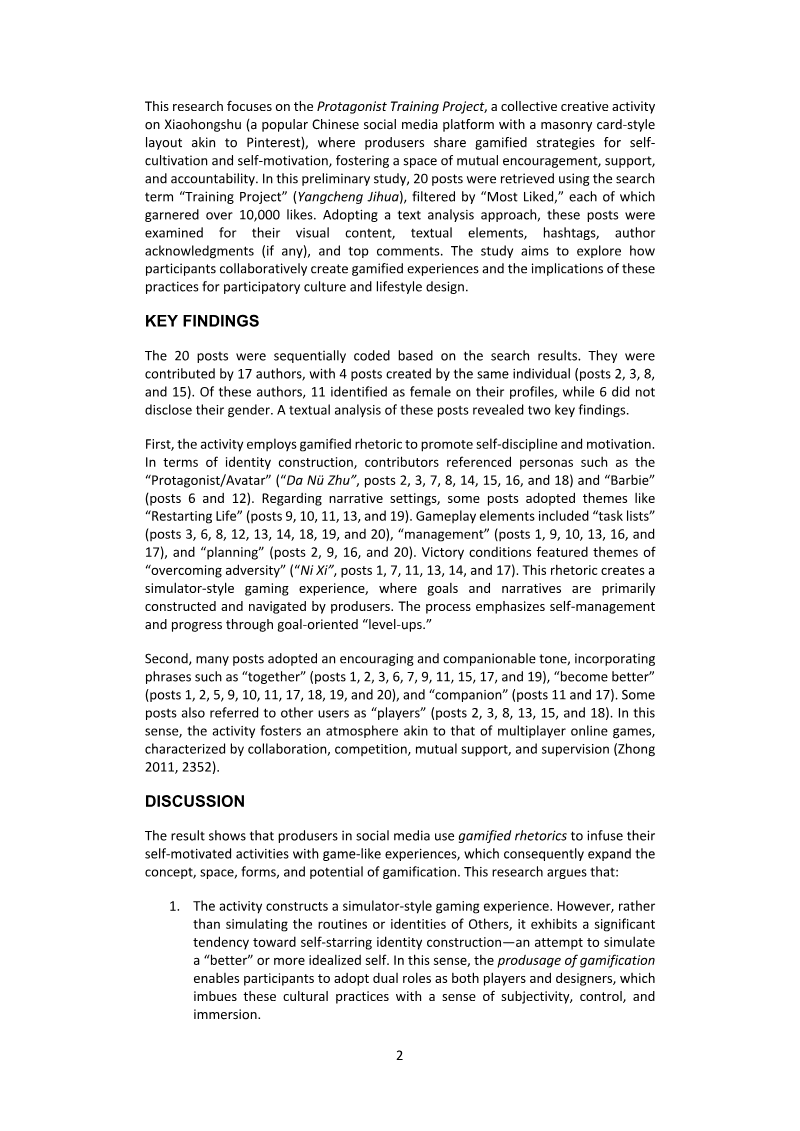
DiGRA · 2025

Eludamos: Journal for Computer Game Culture · 2024
Two & a Half Gamers · 2026