
DiGRA
The Digital Games Research Association: the international association of academics and professionals who study digital games. Its Digital Library holds the proceedings of the DiGRA conferences since 2002.
Documents
Girls Creating Games: Challenging Existing Assumptions about Game Content
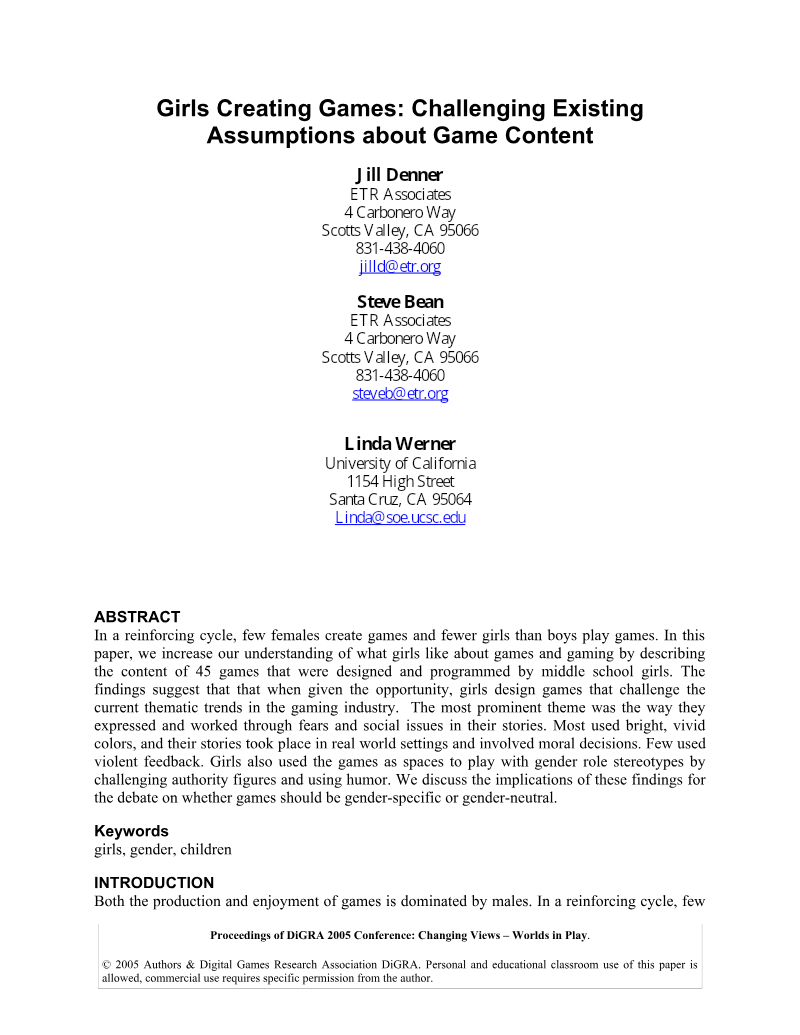
This paper examines the content of 45 games designed and programmed by middle school girls in California, aiming to deepen understanding of what girls find appealing in games and to inform the debate over whether games should be gender-specific or gender-neutral.
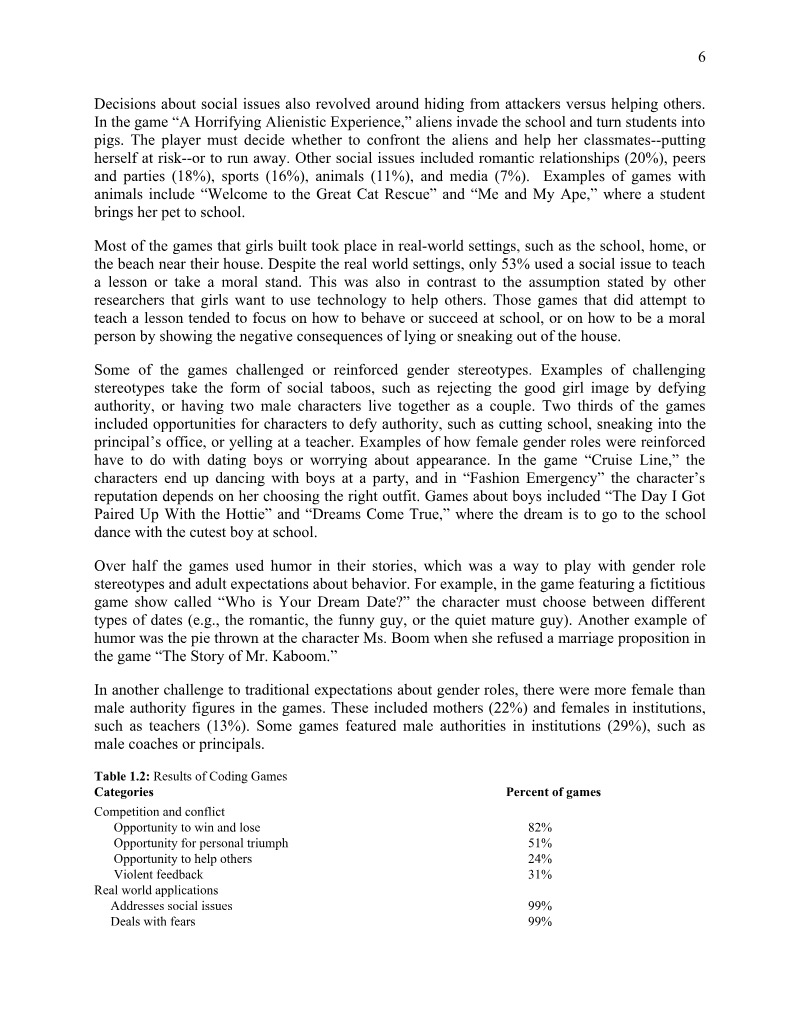
- Girls who were given the chance to design games produced content that departs from the commercial industry's dominant themes of competition, violence, and male-oriented fantasy, challenging assumptions about what girls want from games.
- Nearly all of the 45 games analyzed (99%) addressed social issues and fears, most often concerns about getting into trouble, the threat of violence, and relationship consequences.
- Real-world settings appeared in 71% of games and 53% used a prosocial lesson, while only 31% included violent feedback.
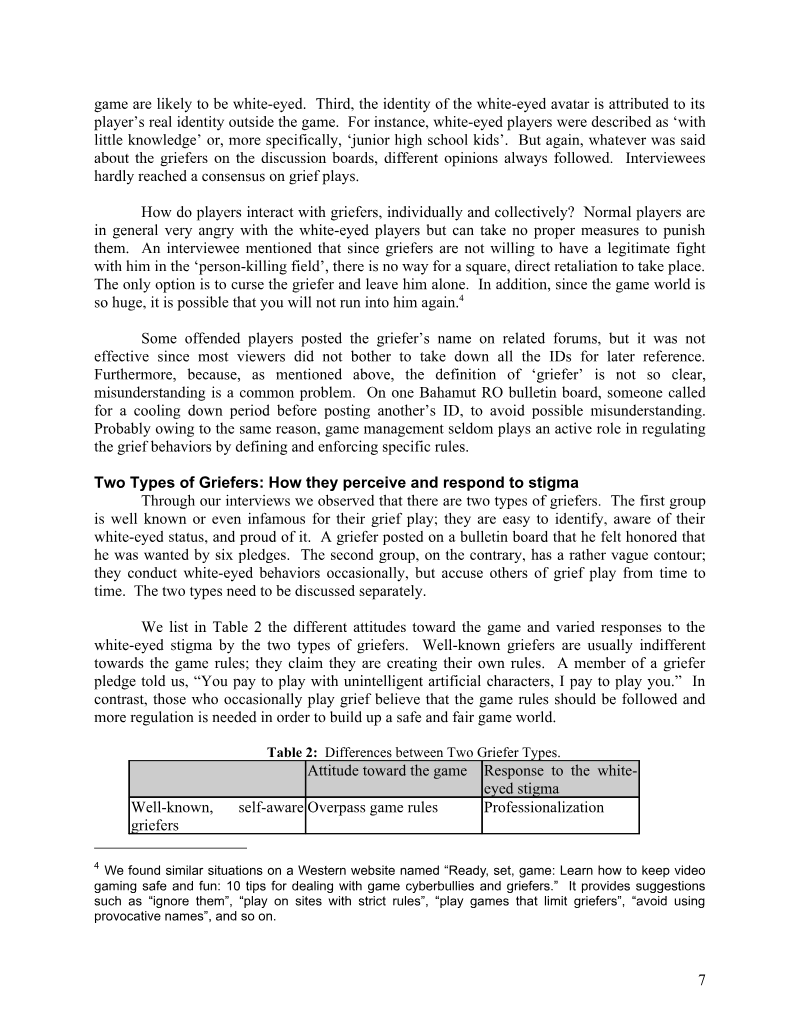
The White-Eyed Player Culture: Grief Play and Construction of Deviance in MMORPGs
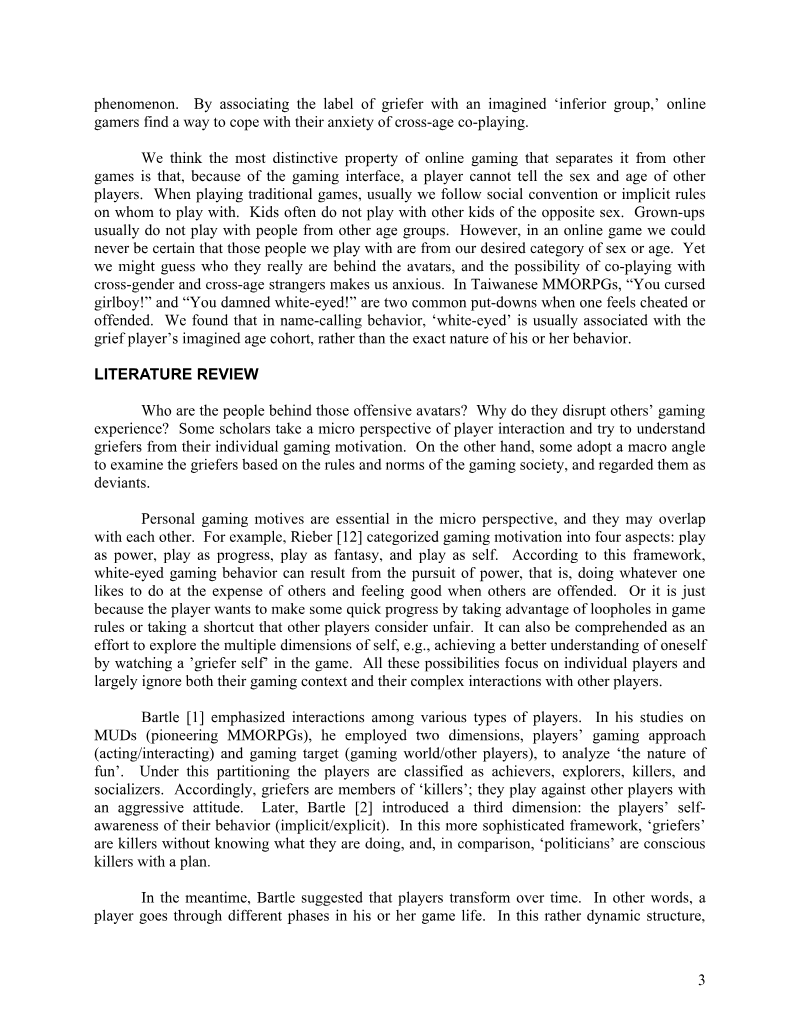
This study examines the "white-eyed" phenomenon in Taiwan's massively multiplayer online role-playing games (MMORPGs), where "griefers" are players who disrupt others' gameplay for enjoyment, and the concept carries fluid, ambiguous meanings.
- The 'white-eyed' phenomenon in Taiwan's MMORPGs is treated as a collective social process of deviance construction and 'othering,' not merely individual antisocial behavior, with the authors identifying an explicit, self-aware griefer group organized into pledges and an implicit majority who grief unknowingly and deflect the stigma onto others.
- The central explanatory claim is that the griefer stigma mainly expresses adult anxiety about cross-age co-playing, since online interfaces hide other players' age and sex, leading junior high school students to become the imagined griefers.
- The 'little white-eyed' label is interpreted as a contested claim over who legitimately owns online gaming, reflecting an effort to redefine the boundaries of legitimate play in a still-unnormalized virtual society.
Fictive Affinities in Final Fantasy XI: Complicit and Critical Play in Fantastic Nations
This paper is a critical analysis of Final Fantasy XI, a persistent-world massively multiplayer online role-playing game produced by Square-Enix in 2002, arguing that the game's fantasy setting engineers the player's complicity in the racial and national ideologies it depicts.
- The paper argues that Final Fantasy XI (Square-Enix, 2002) engineers player complicity in the racial and national ideologies it depicts, treating the game as a text and a site of playable procedure rather than received narration.
- The game's three playable nations, San D'Oria, Bastok, and Windurst, and the opposing Beastmen races are modeled on real-world histories of nationalism, colonialism, and ethnogenesis, including European Reconquista imagery, American industrial race relations, and Japanese debates over Yamatai and pan-Asianism.
- Mechanisms of complicity include initial conflict with Beastmen, the economic practice of 'farming' them, and the territorial Conquest system, which position players as participants in ongoing hostilities.
Narrative Structure in Trans-Reality Role-Playing Games: Integrating Story Construction from Live Action, Table Top and Computer-Based Role-Playing Games
This paper proposes a framework for Trans-Reality Role-Playing Games (TRRPGs), a form of role-playing that integrates the established modalities of table-top RPGs (TTRPGs), live-action RPGs (LARPs), and computer-based massively multiplayer online RPGs (MMORPGs) within a single, coherent, persistent game world.
- Trans-Reality Role-Playing Games (TRRPGs) propose integrating table-top, live-action, and computer-based MMORPG role-playing into one coherent, persistent game world so players across staging contexts experience a shared world.
- The authors argue each form offers distinct storytelling strengths: table-top RPGs rely on collaborative verbal improvisation, MMORPGs on fixed audiovisual performance primitives, and LARPs on embodied face-to-face performance that produces a multitext where each player holds a different story perspective.
- Achieving a shared experience requires a unified and persistent game space, consistent characters, objects, NPCs and mobs across all players, and shared rules and mechanics.
Her Own Boss: Gender and the Pursuit of Incompetent Play
This paper, presented at the DiGRA 2005 conference, examines how gender shapes girls' and women's relationships to computer and video games, with particular attention to identity, access, and playful engagement.
- The paper argues that computer game-based learning initiatives risk deepening girls' existing disadvantage in computing, since educational game design is often treated as technologically neutral and rarely incorporates girls' perspectives.
- Aggregate statistics showing women playing as much as men are misleading, partly because classification shifts that count women who play card or board games as "gamers" fold gender into homogeneous player data.
- When broken down by genre and time spent, men play action and role-playing games for roughly twice as long as women, indicating video game playing remains predominantly male territory.
Gendered Gaming Experience in Social Space: From Home to Internet Café
This study, presented at the DiGRA 2005 conference, examines how the social relations embedded in different gaming spaces shape online gamers' experiences, with particular attention to how gender structures those experiences.
- Online gaming is primarily a social activity, so access to both virtual and physical gaming spaces strongly shapes players' enjoyment.
- Girls face stricter regulation than boys at home and are discouraged from visiting Internet cafés, especially with friends, which widens gender disparities in public gaming.
- Internet cafés in Taipei are a stigmatized public space dominated by male customers, and this social stigma limits girls' access to them.
Interactive Digital Storytelling: Towards a Hybrid Conceptual Approach
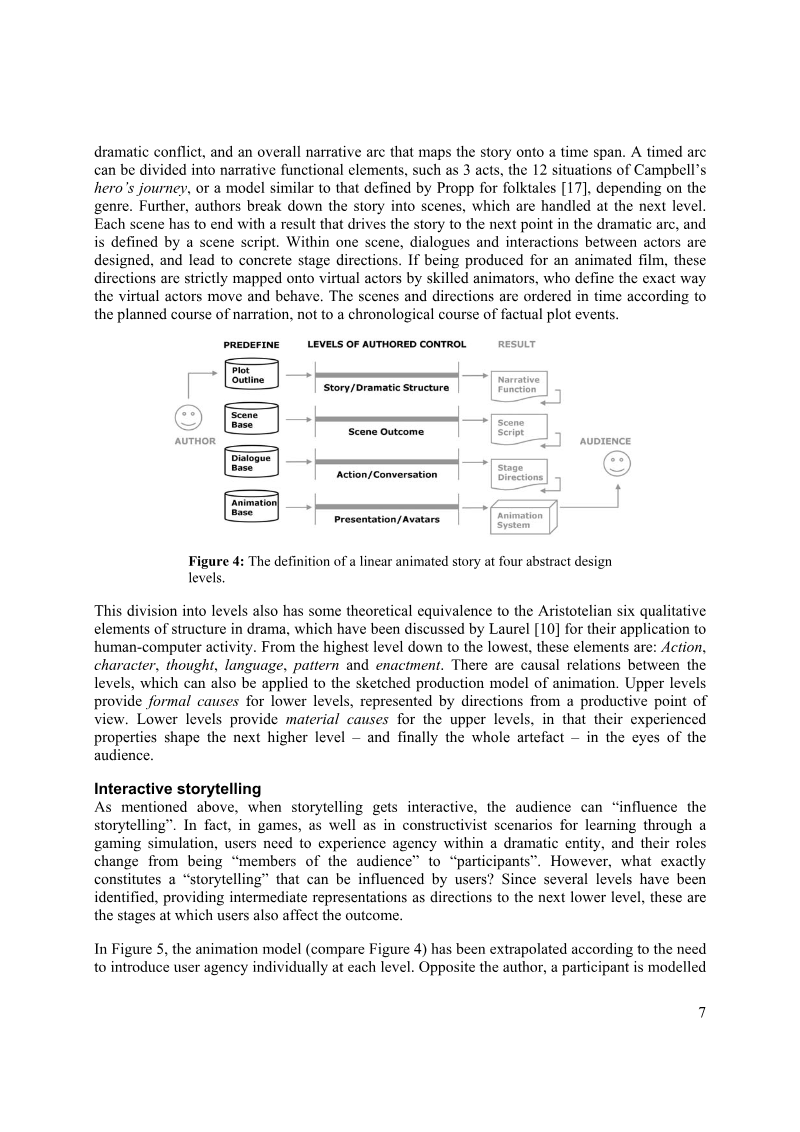
Interactive Digital Storytelling: Towards a Hybrid Conceptual Approach argues that interactive storytelling is best understood not as a single concept but as a hybrid of game design and cinematic narrative, shaped by influences from computer animation, human-computer interaction, game design, and artificial intelligence.
- Interactive storytelling is framed as a hybrid of game design and cinematic narrative, shaped by computer animation, human-computer interaction, game design, and artificial intelligence, rather than as a single concept.
- The central tension is between predefined story structure and user agency, and the quality of interactive storytelling depends on how, where, and to what degree user input shapes the narrative.
- The author argues this balance can only be refined through play-testing, not resolved in theory alone.
Push. Play: An Examination of the Gameplay Button
Griffin's essay "Push. Play" argues that the button, despite its enduring centrality to video game interaction, represents a significant limitation on the medium's expressive development.
- Griffin's essay "Push. Play," presented at DiGRA 2005, argues that the video game button, despite its near-universal use, limits the medium's expressive development.
- The author's central thesis is that the button reflects a cognition-centered design approach that disregards the body's abilities, and he recommends revising the button rather than replacing it to add tangible, embodied interaction while preserving simplicity.
- The button succeeds because it reduces friction between player intent and in-game action, letting players focus on the game world rather than the device, a point grounded in play theory such as the "magic circle" concept.
Role Theory: The Line Between Roles as Design and Socialization in EverQuest
This paper applies sociological role theory to the massively multiplayer online game EverQuest, examining how character classes are functionally designed into the game and then reshaped through player socialization and individual appropriation.
- Role theory is applied to EverQuest, arguing that character classes are first functionally designed, then refined by community norms, and finally individualized through each player's personality and style of play.
- The paper finds that the relationship between game structure and player socialization is reciprocal rather than simply oppositional, challenging the expectation that player interaction would deconstruct rigid structural roles.
- Using the cleric class as its main example, the paper shows that design prioritizes the stability of the class role over any individual player, so any competent cleric can fill the position in group play.
Game Styles, Innovation, and New Audiences: An Historical View
Costikyan's paper argues that games have always been organized into genres defined not by theme but by shared core mechanics, and that new genres, once discovered, drive a wave of imitation and, in turn, attract new audiences.
- Games are organized into genres defined by shared core mechanics rather than theme, and new genres, once discovered, spawn waves of imitation and attract new audiences.
- The largest commercial successes typically arise from genuinely new genres that discover new 'peaks' in gameplay space, rather than from refinements of existing ones, making such innovation the most valuable contribution a designer can make.
- Rising development costs have made publishers increasingly reluctant to take risks on experimental designs, which the author warns may threaten the games industry's long-term health.
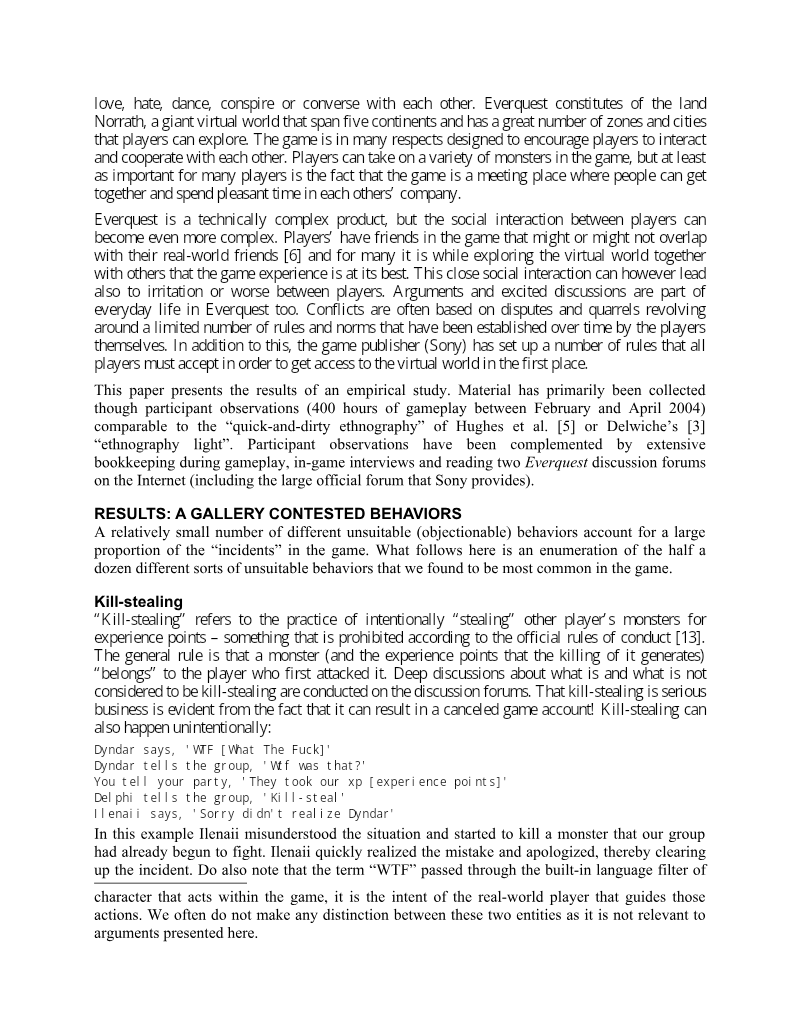
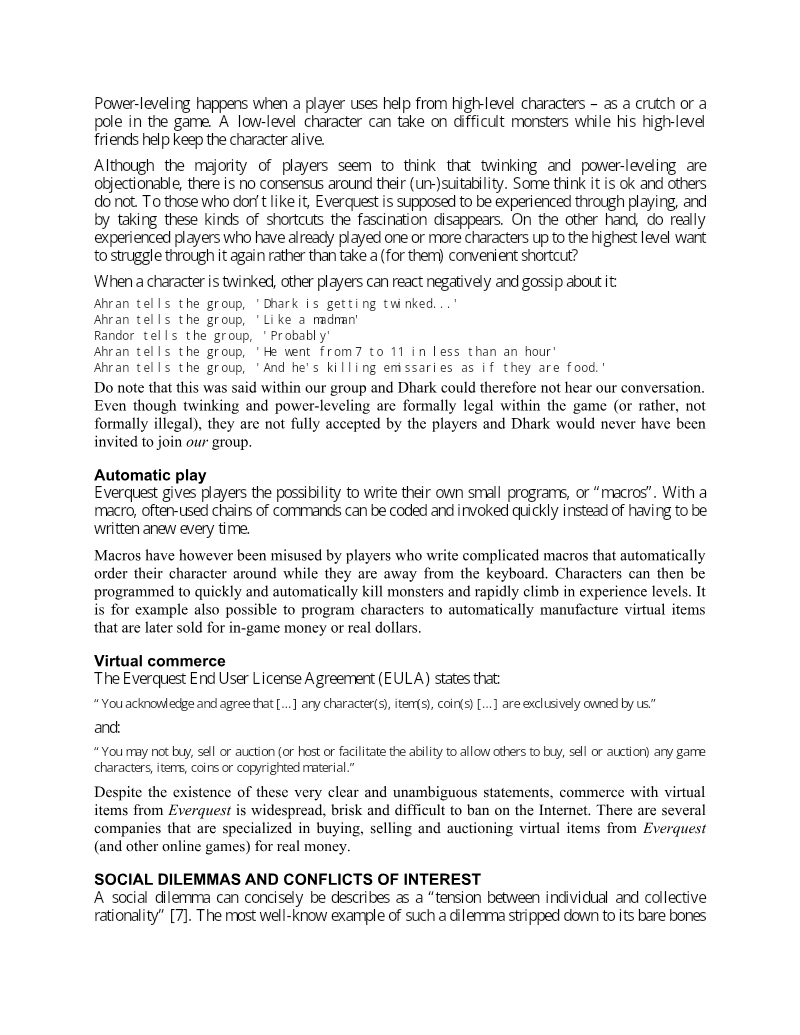
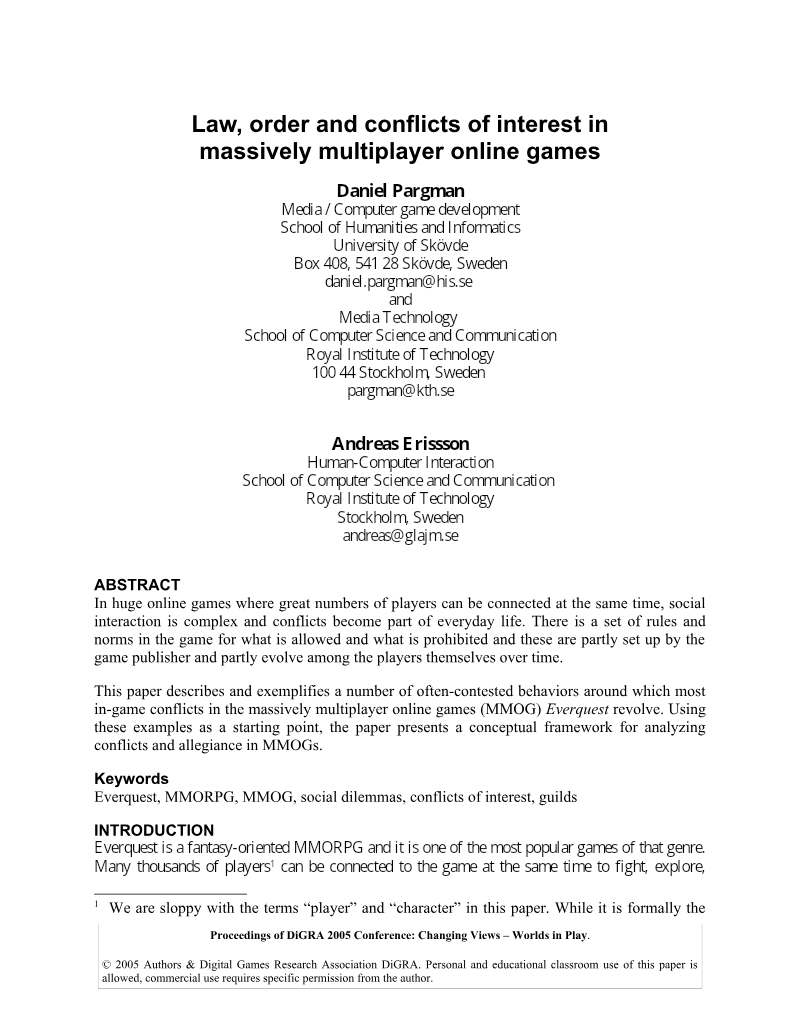
Law, Order and Conflicts of Interest in Massively Multiplayer Online Games
This paper examines how conflicts and social norms operate in massively multiplayer online games, using the fantasy MMORPG Everquest as its case.
- Rules in large online games like Everquest arise from two sources: the publisher's formal rules and the norms players develop among themselves over time.
- Based on roughly 400 hours of ethnographic gameplay (February–April 2004), supplemented by in-game interviews, event logging, and analysis of two Everquest forums including Sony's official forum, the authors identify recurring objectionable behaviors such as kill-stealing, train-pulling, camping, twinking, power-leveling, macro-driven automated play, and real-money item trading.
- Most objectionable behaviors are regulated through informal social sanctions rather than formal enforcement, and their effectiveness depends heavily on how susceptible each individual player is to social pressure.

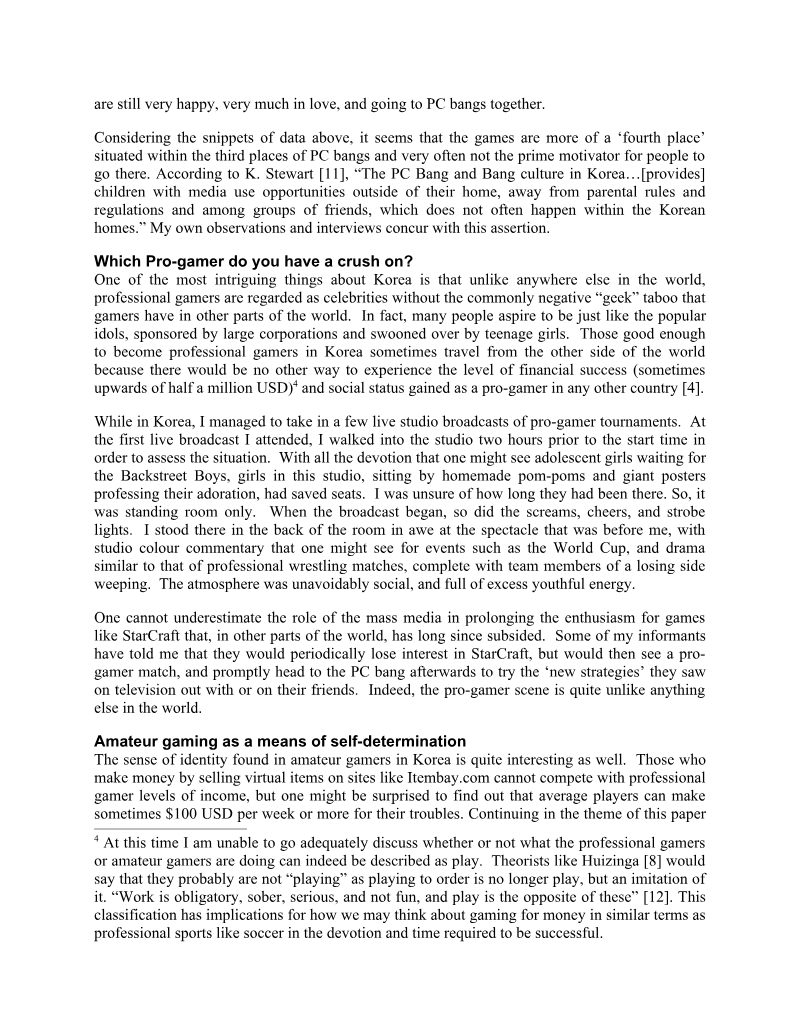
Understanding Korean Experiences of Online Game Hype, Identity, and the Menace of the "Wang-tta"
Florence Chee's 2005 study, based on four months of ethnographic fieldwork in Seoul during 2004, examines why Korea has earned a reputation for intensive online gaming and argues that this reputation is better explained by social, cultural, and infrastructural conditions than by a universal notion of biomedical addiction.
- Florence Chee's 2005 study, based on four months of 2004 ethnographic fieldwork in Seoul, argues that Korea's reputation for intensive online gaming is better explained by social, cultural, and infrastructural conditions than by a universal model of biomedical addiction.
- Korean PC game rooms ("PC bangs") are treated as third places for social connection and shelter, charging roughly one US dollar per hour, with about one venue per Seoul city block and round-the-clock operation.
- Many players, especially in PC bangs, are motivated more by social bonds than by the games themselves, with one couple's relationship developing through shared play.