
DiGRA
The Digital Games Research Association: the international association of academics and professionals who study digital games. Its Digital Library holds the proceedings of the DiGRA conferences since 2002.
Documents

Creating Multiplayer Ubiquitous Games Using an Adaptive Narration Model Based on a User's Model
The paper proposes an adaptive narration model for Multiplayer Ubiquitous Games (MUGs), games that blend real-world and virtual-world interaction.
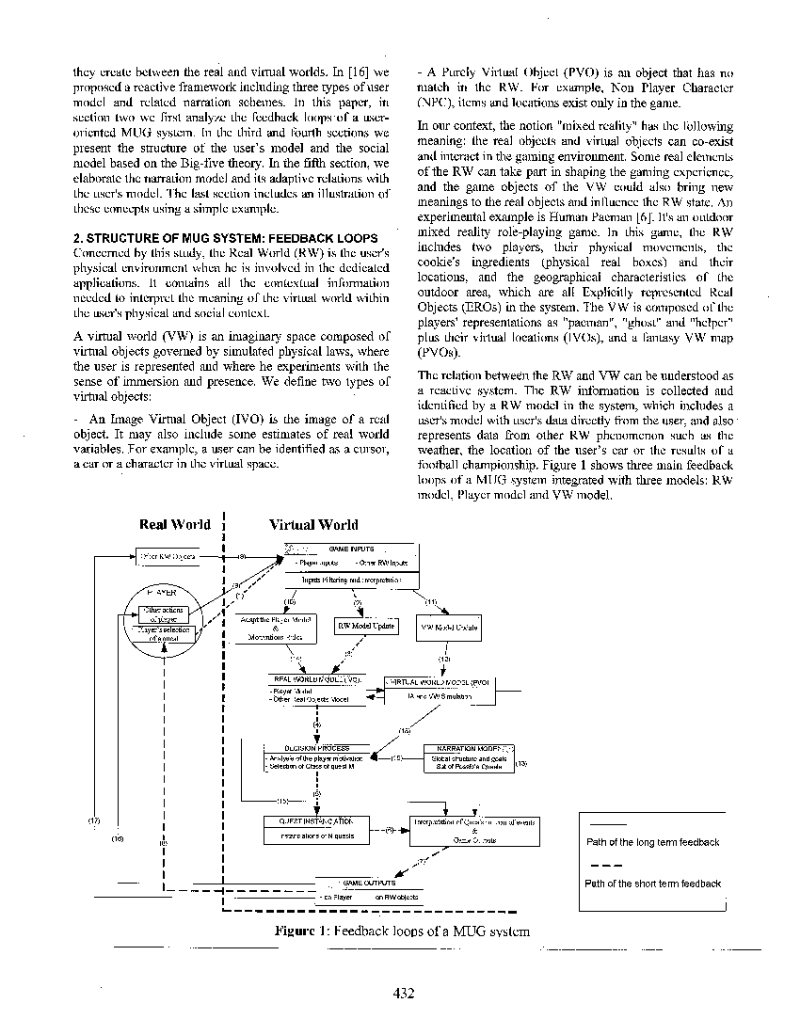
- The paper proposes an adaptive narration model for Multiplayer Ubiquitous Games (games blending real-world and virtual-world interaction) in which quests are tailored to each player's profile rather than drawn from the pre-scripted structures typical of MMORPGs.
- Player profiles are initialized using the Five-Factor Model of personality and Bartle's player types, and are treated as dynamic, updated via exponential smoothing with weighted vector equations as players make choices.
- Quests are sorted into four classes (Destruction, Exploration, Social Interaction, and Creation), with the class chosen according to the distance between the quest and the player's profile, then instantiated using location and social data.
Perceptions of Player in Game Design Literature
Olli Sotamaa's analysis examines how game design literature conceptualizes the player, a figure widely discussed yet rarely defined with precision.
- Olli Sotamaa's analysis of ten recent game design books finds no clear consensus on what a player is, and concludes that the field's understanding of players remains inarticulate and ambiguous.
- Many claims about players in game design literature rest on anecdote and personal experience rather than rigorous empirical research.
- Competing frameworks treat players differently: market-oriented models (Bateman and Boon's Myers-Briggs-based clusters, hardcore/casual splits) treat them as consumer segments, while play-style taxonomies such as Bartle's achiever, socializer, explorer, and killer types emerged from late-1980s and early-1990s MUD communities.
Revising Immersion: A Conceptual Model for the Analysis of Digital Game Involvement
Calleja's "Revising Immersion" argues that the vague, binary metaphor of immersion should be replaced by a more precise framework for analyzing how players engage with digital games.
- Calleja's paper argues that the vague, binary metaphor of immersion should be replaced by 'incorporation,' which better describes inhabiting a virtual environment, acting meaningfully within it, and remaining present to others.
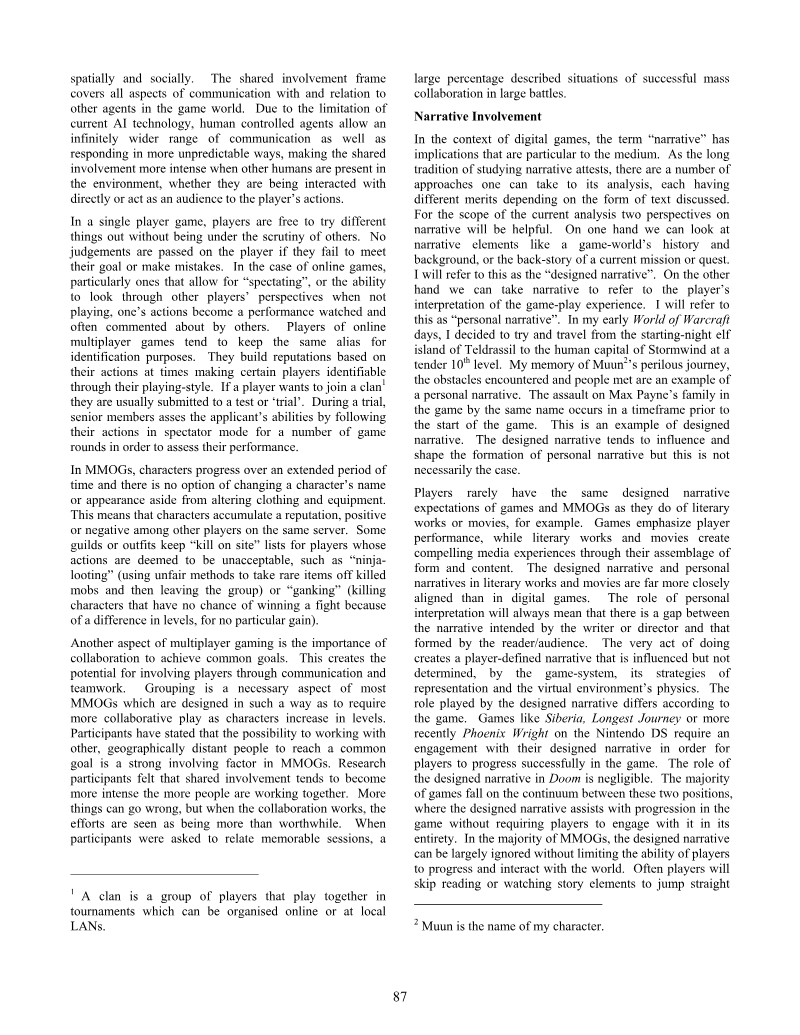
- The model analyzes digital game involvement through five frames (tactical, narrative, shared, performative, and spatial) and places its analytical focus on the micro-level momentary engagement rather than macro-level motivational phases.
- A key distinction is between designed narrative and personal narrative; the paper finds that in massively multiplayer online games most players largely disregard the designed storyline and instead construct personal narratives through play and collaboration.
Game Design on Item-Selling Based Payment Model in Korean Online Games
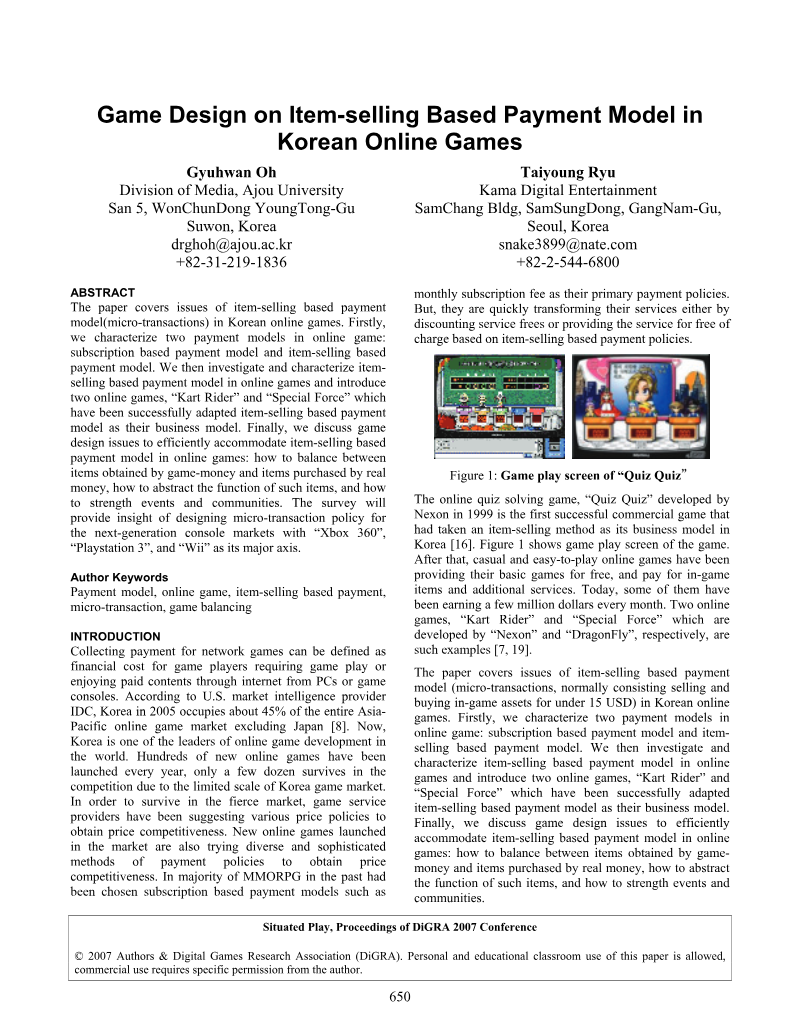
This paper examines the item-selling, or micro-transaction, payment model in Korean online games and the design choices it demands.
- Korea's MMORPG market moved away from the subscription model since 2006, as free-to-play competitors and price cuts eroded it, with item-selling offering a lower financial barrier and broader reach, especially to younger and female players.
- Kart Rider reportedly generated roughly KRW 3 billion in monthly revenue in Korea and reached 10 million subscribers within eight months of launch.
- Special Force earned about KRW 5 billion monthly with roughly 90,000 concurrent players and approximately KRW 20 billion in cumulative profit through January 2006.
Because Players Pay: The Business Model Influence on MMOG Design
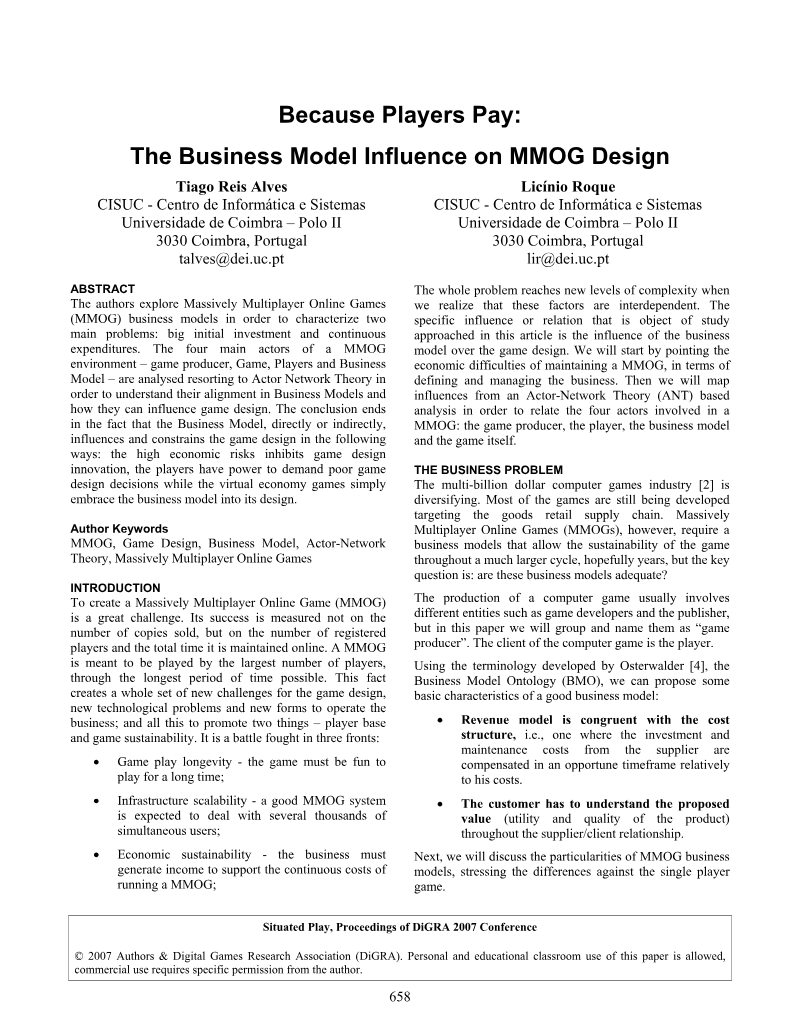
This paper examines how business models shape the design of Massively Multiplayer Online Games (MMOGs), arguing that the economic structure of a game directly or indirectly constrains its design choices.
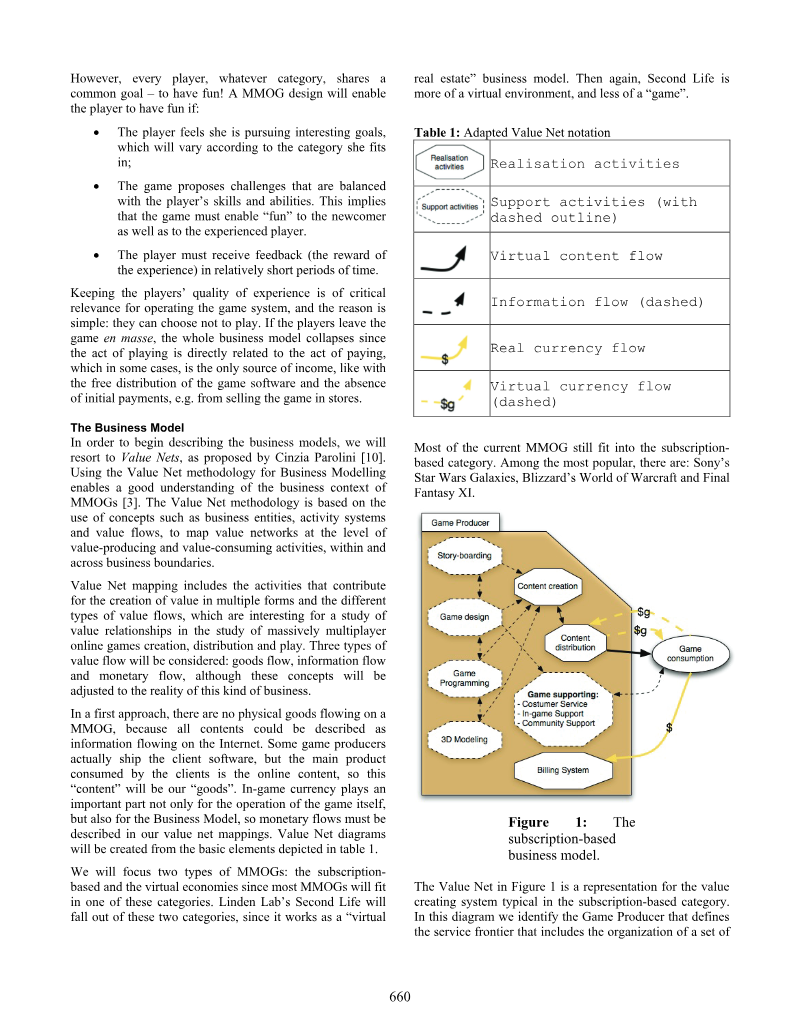
- In MMOGs, the business model is not a secondary concern because large upfront investment and continuous operating costs (server infrastructure, game masters, community support) make economic structure a fundamental design constraint.
- Financial risk pushes MMOG producers toward cloning proven successful titles, which limits innovation in the genre.
- Subscription-based MMOGs such as World of Warcraft and Star Wars Galaxies typically charge US$10 to US$15 per month, and their revenue depends on sustained player engagement, giving players considerable leverage over producers.
Situated Play and Mobile Gaming
"Situated Play and Mobile Gaming" examines how games played on mobile devices in everyday urban settings differ from abstract, screen-bound play.
- The magic circle of a mobile game is permeable and not fixed: players must actively create and maintain it, with the boundary between virtual and physical play shifting continually.
- Situated mobile play depends on three conditions: players sensing their physical presence in the game world, a meaningful feedback relation between actions and outcomes, and implicit physical social interaction.
- Players must continually balance three relations: to themselves (self-awareness), to objective conditions (instrumental action), and to other players (social interaction).
Situations of Play: Patterns of Spatial Use in Videogames
"Situations of Play: Patterns of Spatial Use in Videogames" argues that game environments are not merely backdrops but architectural and performative spaces that reproduce and formalize recurring patterns drawn from the real world.
- Game environments are defined by six recurring spatial patterns—challenge, contested, nodal, codified, creation, and backdrop—which dictate the range of permissible player actions.
- Game space is not merely a backdrop but a formalization of real-world spatial patterns that players internalize through repeated gameplay, potentially influencing how they perceive physical environments.
- The report categorizes play into three distinct types: screen-mediated, embedded, and pervasive, noting that modern titles increasingly blend these patterns into complex configurations.
Situating Gaming as a Sonic Experience: The Acoustic Ecology of First-Person Shooters
This study argues that sound in first-person shooters has been neglected within Game Studies, which has long treated games as primarily visual media.
- First-person shooter (FPS) sound functions as an 'acoustic ecology' where players are active participants who both generate the soundscape and have their behavior shaped by it.
- Sound in FPS games serves as a critical navigational and semantic tool, providing essential spatial and contextual information that directly influences player performance and immersion.
- The study introduces 'navigational listening' as a fourth mode of listening to complement Michel Chion’s existing framework, specifically addressing how players process audio to move through virtual environments.
The Quest in a Generated World
This paper presents a method for generating quests within procedurally generated three-dimensional game worlds, arguing that procedural content creation alone lacks the context necessary to make game spaces meaningful.
- Procedural world generation requires quest structures—defined by setting, space, challenge, and goal—to provide meaningful context and player direction.
- The Charbitat prototype, built on the Unreal Tournament 2004 engine, utilizes a graph-based analysis to integrate key-and-lock puzzles into infinite, procedurally generated 3D environments.
- World generation relies on an incremental construction method that scores candidate tile configurations using approximately twelve distinct design evaluators.
A Certain Level of Abstraction
Jesper Juul's paper "A Certain Level of Abstraction" examines how abstraction operates in video games, arguing that it is a central element of game design, a process players decode during play, and an optimization strategy developed over time.
- Abstraction is a central design element in games: there is no natural level of detail for any action, and the chosen level defines a game and its genre, as shown by Cooking Mama omitting actions like ordering take-out and contrasting with Diner Dash: Flo on the Go.
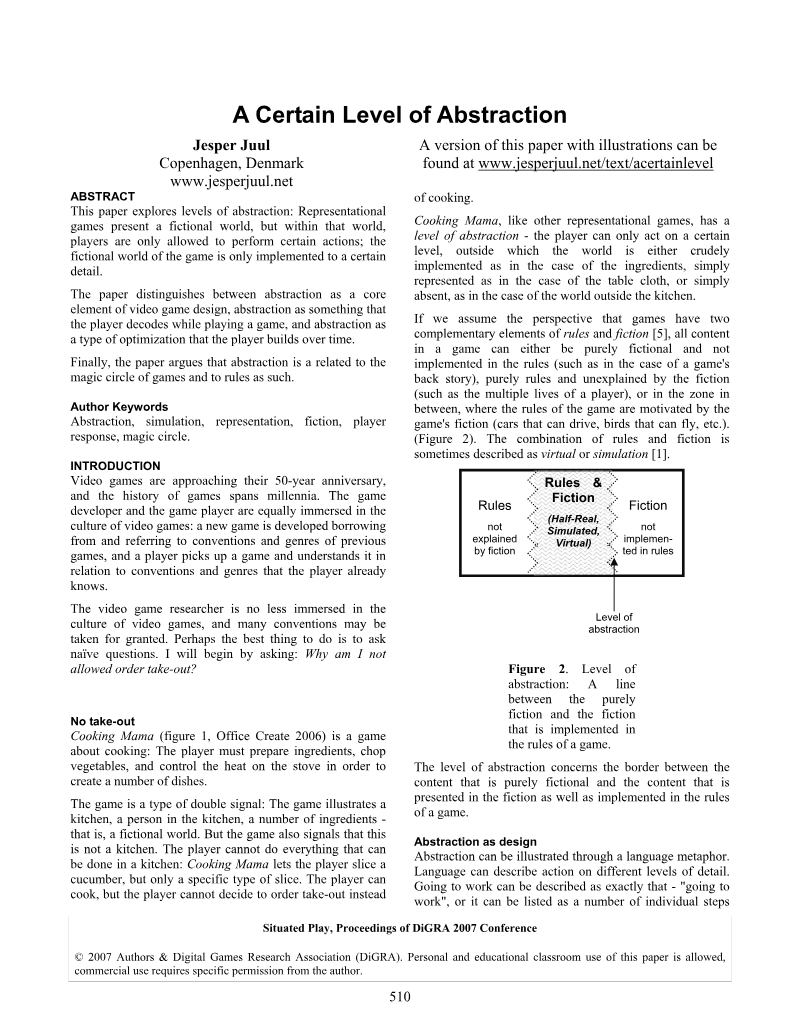
- Juul's framework places game content on a spectrum from purely fictional to purely rule-based, with the most interesting design territory where rules are motivated by the fiction.
- Experienced players recognize genres through learned conventions, while novices rely on the fiction to infer rules, illustrated with real-time strategy titles such as StarCraft and Age of Empires II.
Extending the Serious Game Boundary: Virtual Instructors in Mobile Mixed Reality Learning Games
This paper proposes that mobile augmented reality learning (MARL) games, in which learners wear see-through heads-up displays and interact with a 3D animated virtual instructor, can deliver personalized, context-aware education that is both engaging and pedagogically sound.
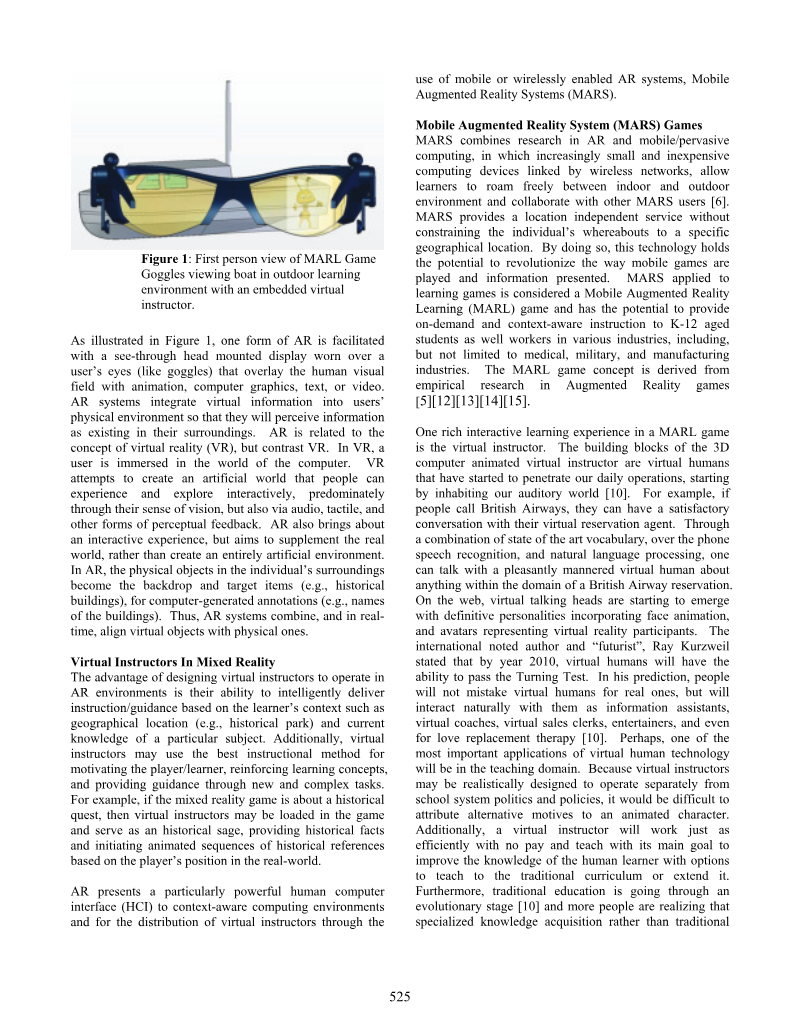
- The paper proposes mobile augmented reality learning (MARL) games in which learners wear see-through heads-up displays and interact with a 3D animated virtual instructor that adapts to learning style, emotion, and pedagogical technique, guiding real-world quests anytime, anywhere, and at the learner's own pace.
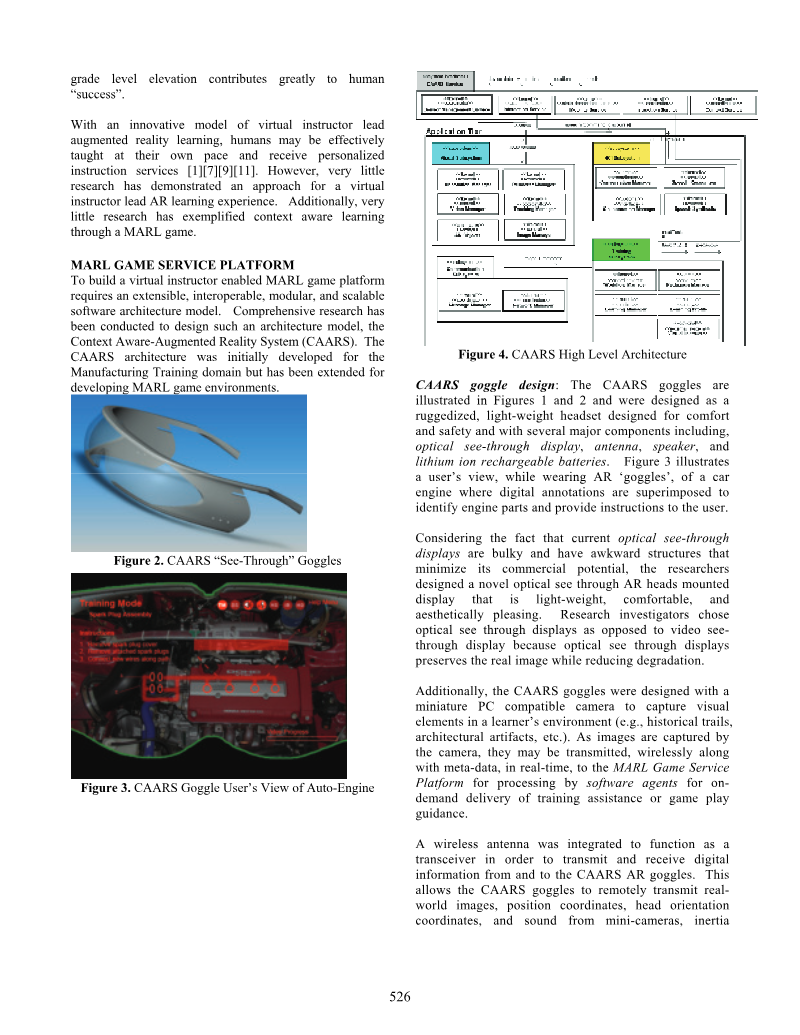
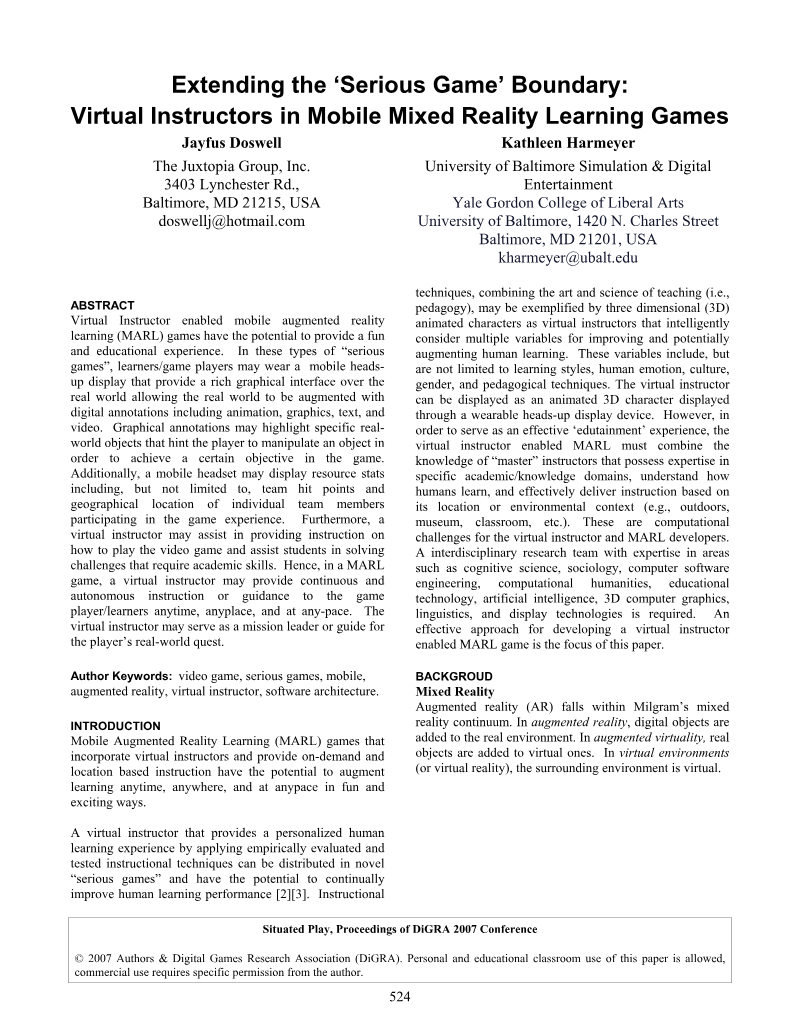
- Its central contribution is the Context-Aware Augmented Reality System (CAARS), originally developed for manufacturing training and extended to MARL, combining a lightweight optical see-through headset (camera, speaker, microphone, inertial sensors, roughly eight hours of battery life) with a service-oriented software architecture.
- The training subsystem uses software agents and pedagogical models, such as scaffolding that gives novices more step-by-step guidance than experienced learners, and generates virtual instructors from the PECA (Pedagogical Embodied Conversational Agent) product line architecture, which supports gesture, speech, and optional physiological biosensor input.
Recognizing New Literacies: Teachers and Students Negotiating the Creation of Video Games in School
This paper reports initial findings from the first year of a three-year ethnographic study examining how video game creation functions as a learning and literacy practice in secondary school classrooms.
- Video game creation is framed as a sophisticated learning and literacy practice that schools should recognize as valuable rather than dismiss as distraction, drawing on new literacies theory that treats digital and multimodal texts as part of literacy.
- The study is an exploratory, first-year qualitative ethnography at one large high school in Western Canada, with two technology teachers using Kid's Programming Language (Grades 11-12) and Game Maker (Grades 9-10), so its findings are not generalizable.
- Data came from several weeks of classroom observation, interviews with nine students and two teachers, and stimulated-recall sessions in which students explained their reasoning while watching recordings of their own work, analyzed in NVivo.