1 free read left. Create a free account for unlimited reading + AI research.
Create free accountArticle DiGRA
1 free read left. Create a free account for unlimited reading + AI research.
Create free accountArticleDiGRA
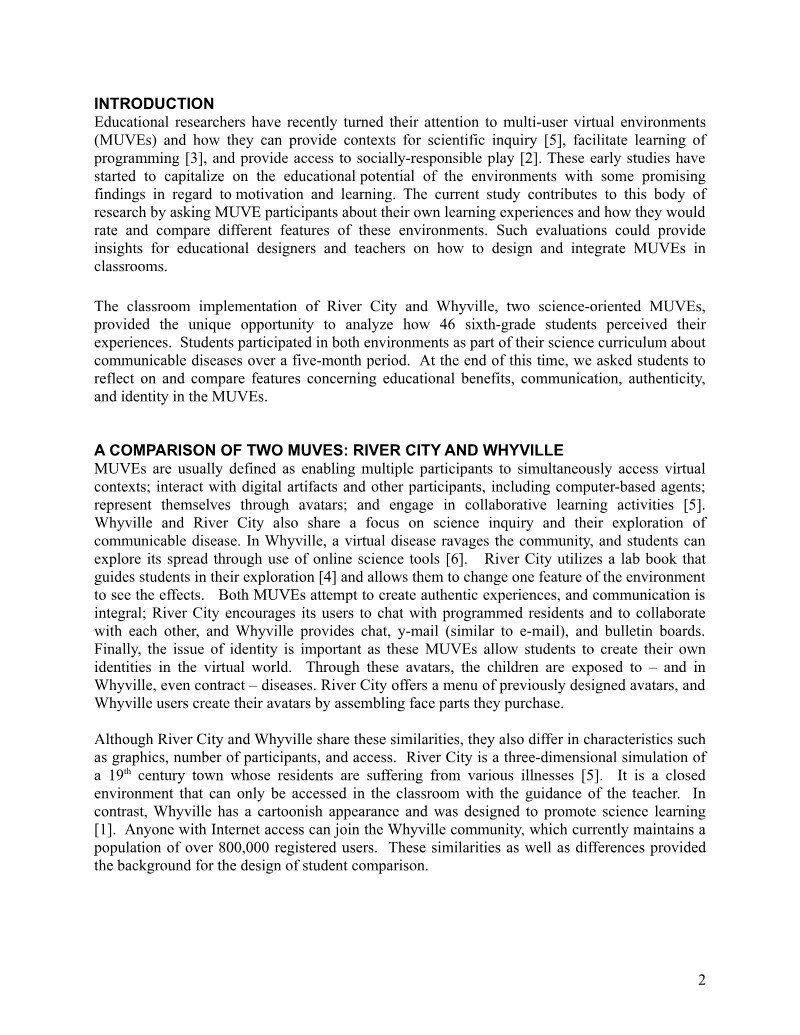
Students in Los Angeles used River City and Whyville during a communicable diseases curriculum spanning late 2003 and early 2004.
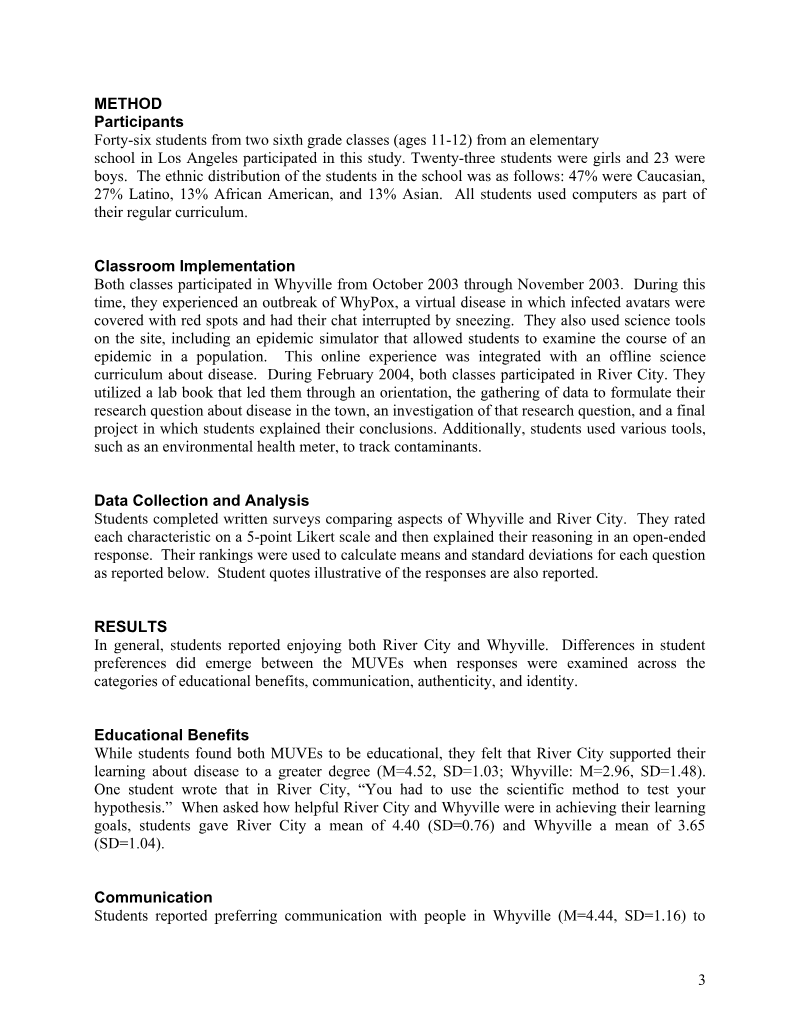
This study examines how 46 sixth-grade students in Los Angeles perceived two science-oriented multi-user virtual environments (MUVEs), River City and Whyville, after using both as part of a curriculum on communicable diseases spanning late 2003 and early 2004. Students rated and compared the environments across educational benefits, communication, authenticity, and identity, using five-point Likert scales followed by open-ended explanations. The research design is a classroom-based comparative evaluation with a balanced gender split and a racially diverse student population.
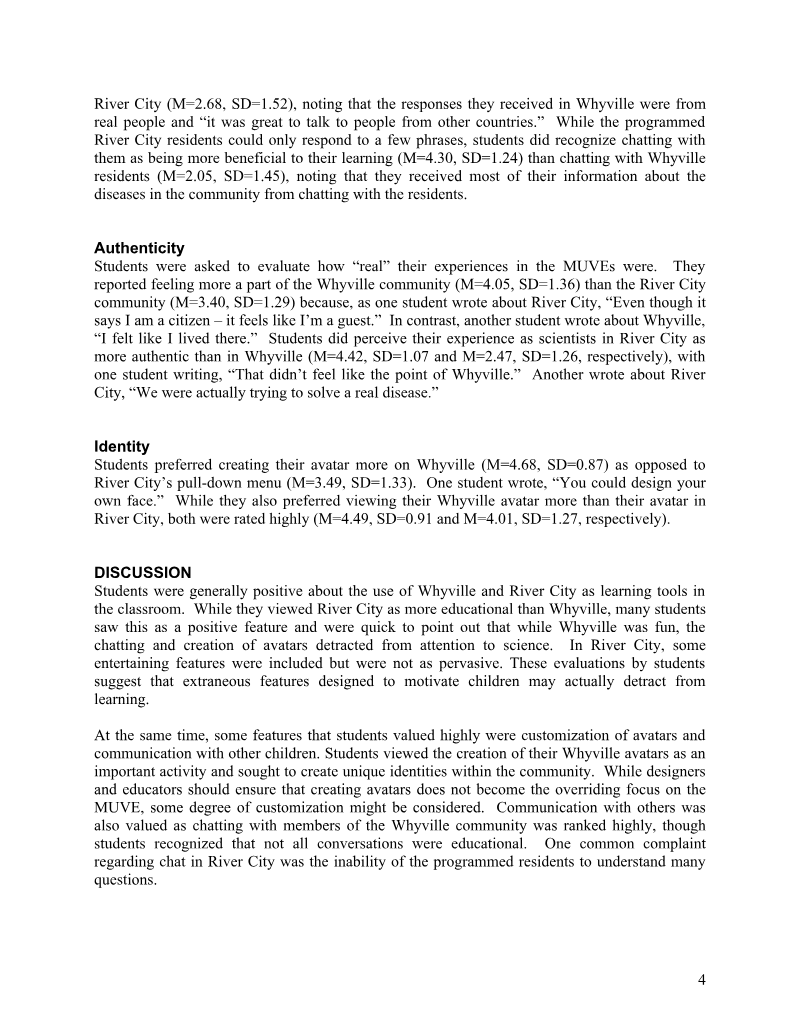
Students judged River City, a closed, three-dimensional simulation of a nineteenth-century town, to be more educational for learning about disease (M=4.52) than Whyville, a cartoonish, open-access community with over 800,000 registered users (M=2.96). Whyville, however, was preferred for communication with real peers (M=4.44 versus 2.68 for River City's programmed residents), though students acknowledged that chatting with River City residents was more beneficial to their learning. Students also felt a stronger sense of belonging in Whyville (M=4.05 versus 3.40 in River City), where they described feeling like residents rather than guests, while River City offered a more authentic sense of scientific inquiry (M=4.42 versus 2.47).
Customization was another point of divergence: students strongly preferred designing their own Whyville avatars from purchased face parts (M=4.68) over choosing from River City's pre-set menu (M=3.49), though both environments received high ratings for seeing one's avatar onscreen. The authors conclude that entertaining and social features valued by students may compete with science content, and that designers should balance educational purpose against the personal and social features children consider important.

DiGRA · 2026

DiGRA · 2026



DiGRA · 2026



DiGRA · 2026



DiGRA · 2026



DiGRA · 2026



DiGRA · 2026



DiGRA · 2026



DiGRA · 2026

DiGRA · 2026



DiGRA · 2026



DiGRA · 2026
Serious Games Society · 2025