1 free read left. Create a free account for unlimited reading + AI research.
Create free accountArticle DiGRA
1 free read left. Create a free account for unlimited reading + AI research.
Create free accountArticleDiGRA
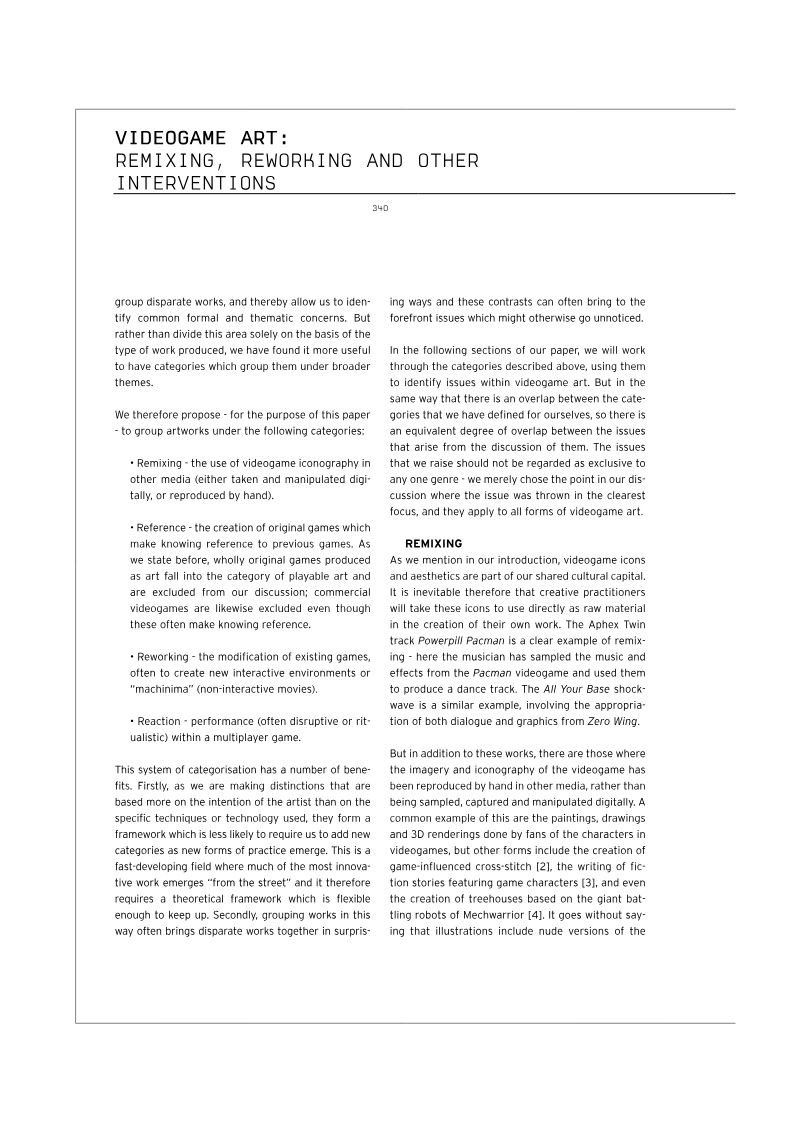
The paper observes that Pacman and Space Invaders remain widely recognized. It argues this makes them more flexible for artistic reinterpretation.
This paper examines videogame art, a form that knowingly draws on game culture and is distinguished from playable art and from commercial games, which it excludes from consideration. Its central argument is that this work can be understood through four categories of practice: remixing, reference, reworking, and reaction. The authors illustrate these with examples ranging from Aphex Twin's Powerpill Pacman and fan recreations of Space Invaders to projects such as Triggerhappy and Desert Rain, which reuse early game iconography to comment on broader cultural themes. A recurring observation is that early icons like Pacman and Space Invaders remain widely recognized and carry less "brand baggage" than newer franchise figures such as Mario, which makes them more flexible vehicles for artistic reinterpretation.
A substantial focus falls on reworking, the practice of altering games through patches, skins, maps, and mods. The authors show how these modifications span a spectrum from enhancing a game to subverting it for artistic ends. Works such as Blast Theory's Desert Rain, Adam Killer, Gameboy F_UK, and Brody Condon's Gunship Ready help map the tension between playable art, which retains interactivity, and non-interactive machinima, which does not. Across these examples, the authors find that videogame art typically depends on appropriation and détournement, the subversion of existing material. They conclude that the field needs clearer frameworks for understanding context, audience engagement, and the difference between genuine artistic intent and the fan modification that commercial games often encourage.
The study's final assessment is more cautious. While appropriation can be effective for critique, as in Jodi's work built on Quake, the author judges that much videogame art remains underdeveloped and risks functioning as a technical demonstration rather than a sustained artistic practice. Drawing a parallel with the history of cinema, the author argues that technological advances make more expressive work possible without guaranteeing it. The field's maturation, on this view, depends on wider exhibition opportunities and serious critical analysis, along with the cultivation of a more developed critical vocabulary and audience.
Each row is a game or company this document names, each column a document, oldest first. A mark means that document names it. Select a row to see those documents.

DiGRA · 2026

DiGRA · 2026



DiGRA · 2026



DiGRA · 2026



DiGRA · 2026



DiGRA · 2026



DiGRA · 2026



DiGRA · 2026



DiGRA · 2026

DiGRA · 2026



DiGRA · 2026



DiGRA · 2026
Replay. The Polish Journal of Game Studies · 2026